


How to Choose the Best Trailer Generator for Your Business?

Choosing the right Trailer Generator can shape your business’s daily performance, operating costs, and customer trust. A unit that looks powerful on paper may struggle when connected to welders, refrigeration systems, lighting, or sensitive electronics. The wrong choice can also consume excessive fuel, create unnecessary noise, or require frequent service during demanding jobs.

Laura Bennett, a mobile-power systems consultant with more than 15 years of field experience, says, “A generator earns its value when it performs reliably under the exact load your trailer carries.” Her view reflects a practical truth. Rated watts matter, but they are not the whole story. You must examine starting watts, continuous output, fuel type, runtime, enclosure design, weather resistance, and available maintenance support. A compact generator may suit a weekend service trailer, while a larger commercial unit may better support construction equipment for twelve-hour shifts.

Think about the real job site. Will the trailer operate beside homes, highways, farms, or crowded events? Every setting changes the requirements. Quiet operation may matter more than maximum output near residential areas. Fuel availability may outweigh efficiency in remote regions. These details are easy to overlook.

There is no perfect specification sheet. Business owners sometimes choose extra capacity for safety, then pay for unused weight and fuel. Others select the cheapest model and regret it after the first heavy workload. This guide examines those trade-offs carefully, helping you choose a Trailer Generator that fits your equipment, working conditions, budget, and long-term service expectations.
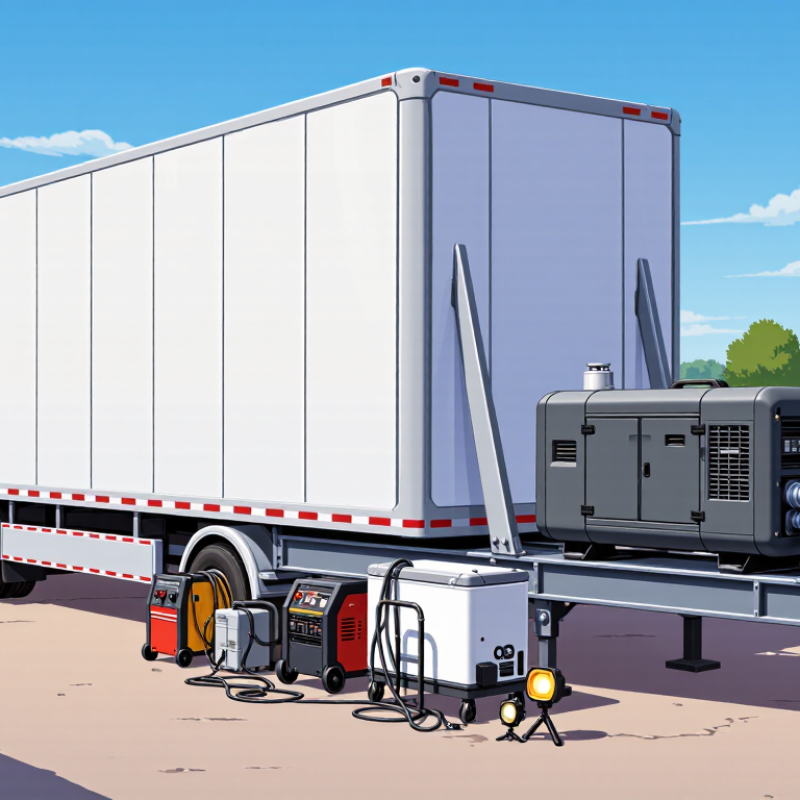
How to Choose the Best Trailer Generator for Your Business?

Define Your Business’s Trailer Power Requirements

How to Choose the Best Trailer Generator for Your Business?

Define Your Business’s Trailer Power Requirements

Choosing a trailer generator starts with a clear power inventory, not a guess based on trailer size. List every tool, appliance, light, and control system used during a normal workday. Record each item’s running wattage and starting wattage. Motors, compressors, pumps, and cooling units may demand two to three times more power during startup.

For example, a mobile workshop might use a 3,000-watt compressor, 1,200 watts of lighting, battery chargers, and small hand tools. Its running load could reach 5,000 watts, while startup demand may exceed 8,000 watts. A suitable generator should handle both figures without unstable voltage. Add a sensible reserve, usually 20 to 25 percent, for unexpected equipment or future growth.

Think beyond wattage.

Voltage, phase, outlet type, and frequency must match your equipment. Check whether the generator will operate continuously for several hours or only during short tasks. Fuel capacity matters when the trailer works far from refueling points. Noise levels, ventilation, weather protection, and available payload also affect the decision.

A neat spreadsheet can still be wrong. Real tools rarely run at their label rating all day, yet startup surges are easy to overlook. Measure actual equipment where possible, and ask a qualified electrician to verify the load calculation. Recheck the estimate after seasonal changes, added equipment, or longer operating hours.


How to Choose the Best Trailer Generator for Your Business?

Define Your Business’s Trailer Power Requirements

Generator sizing should account for both continuous running power and the higher startup demand of motor-driven equipment. Add the running watts of all devices that may operate at the same time, then select a generator with enough surge capacity for the largest startup load. Actual requirements vary by model, voltage, duty cycle, and equipment nameplate ratings.

Compare Generator Types, Fuel Options, and Output Ratings

How to Choose the Best Trailer Generator for Your Business?

Choosing a trailer generator starts with the worksite, not the purchase price. Portable units suit short tasks and lighter loads. Towable diesel generators handle longer shifts, higher demand, and rough outdoor conditions. Hybrid systems can reduce fuel use during quiet periods, but their batteries add weight and maintenance needs. I once selected a unit by peak output alone. That assumption was wrong. Starting motors drew more power than expected.

Fuel choice affects operating cost and availability. Diesel usually supports long runtimes and heavy-duty applications. Gasoline models may start easily, but they often need more frequent refueling. Dual-fuel systems offer flexibility when one fuel becomes difficult to obtain. Check tank capacity, consumption per hour, storage rules, and cold-weather performance. A generator that runs smoothly at noon may struggle during a freezing morning.

Output ratings need careful comparison. Match the continuous, or prime, rating to the equipment’s real demand. Keep surge capacity for pumps, compressors, and large motors. Confirm voltage, phase, frequency, and outlet configuration before delivery. Add the wattage of tools running together, then allow practical reserve capacity. Altitude and high temperatures can reduce output. Ask for documented test data, service intervals, noise levels, and protection features. A quiet unit is valuable near offices, but low noise should not hide weak cooling or poor access to filters. Load calculations can still be imperfect, so record actual readings during the first workweek.

Evaluate Towability, Runtime, and Site Operating Conditions

How to Choose the Best Trailer Generator for Your Business?

A trailer generator should match your daily work, not just its advertised output. Start by checking total tow weight, hitch capacity, braking equipment, and axle balance. Weight matters. A compact unit may tow easily, but it can lack enough fuel capacity for long shifts. Measure the towing vehicle’s limits carefully, including tools, cables, and fuel. Uneven weight distribution can make highway handling uncomfortable and unsafe.

Runtime depends on both fuel capacity and operating load. A generator running at 40% load may last much longer than one near full capacity. Calculate the demand from welders, pumps, lighting, compressors, and temporary offices. Leave a practical power margin for startup surges. A ten-hour runtime sounds useful, but it may fall sharply during cold mornings or heavy equipment use. Real work is rarely consistent.

Site conditions deserve equal attention. Mud, dust, rain, steep slopes, and poor ventilation can affect performance and maintenance. Choose protective features that fit the environment, while keeping service panels easy to reach. On a dusty construction site, blocked filters can reduce output before anyone notices. That detail is easy to miss. I would also inspect noise expectations, cable distances, grounding procedures, and nighttime access. Conditions change. A generator that works well in a quiet yard may struggle beside a road project. Test the planned setup when possible, and record actual fuel use instead of trusting estimates alone.

Review Safety Features, Regulations, and Maintenance Needs

How to Choose the Best Trailer Generator for Your Business?

Safety should guide every trailer generator decision, not just output capacity. Look for emergency-stop controls, overload protection, circuit breakers, and clear operating labels. A ground-fault device can reduce shock risks around damp worksites. Carbon monoxide monitoring matters when crews work near buildings or enclosed loading areas. Keep exhaust outlets away from doors, windows, and air intakes. Small details matter.

Regulations differ by country, state, and industry. Check electrical, transport, noise, emissions, and workplace requirements before purchase. A qualified electrician should verify grounding, cable sizing, and connection methods. The trailer also needs roadworthy tires, working brakes, reflective markings, secure couplings, and functioning lights. Keep inspection certificates and operator training records accessible. Paperwork is easy to overlook.

Maintenance needs should match your operating schedule and environment. Ask for accessible oil drains, simple filter changes, protected wiring, and clear service intervals. Inspect fluids, belts, battery terminals, tires, brakes, and hitch hardware before each deployment. Record operating hours and unusual vibration, smoke, or fuel use. Run periodic load tests, because an unloaded start can hide weak performance. I would not rely on one checklist alone. Dust, salt air, rain, and rushed setup can expose problems that routine servicing misses. Build time for a second inspection.

Calculate Total Ownership Costs and Choose the Right Model

How to Choose the Best Trailer Generator for Your Business?

Choosing a trailer generator starts with total ownership cost, not the purchase price. Estimate the unit’s purchase or finance cost, expected fuel use, servicing, repairs, insurance, storage, and transport. Fuel is only one line. A generator that consumes less fuel may cost more initially, but it could reduce expenses during long work shifts. Use your actual operating hours whenever possible. Guessing can distort the result.

Check the required power carefully. List every tool, light, pump, or machine that may run together. Include starting loads, not only running watts. Add a reasonable reserve, usually 15 to 25 percent, for changing site demands. A model that runs at full capacity every day may suffer faster wear. Oversizing is not always better either. It can increase fuel use and towing weight. That mistake is common.

Consider the working environment. A compact trailer generator may suit short service visits, while a larger model may support remote construction work. Review noise limits, weather protection, wheel condition, controls, and access to maintenance points. Ask for service records and a clear warranty. Calculate cost per operating hour over several years, then compare it with expected revenue or productivity. A spreadsheet helps, but it can still miss downtime. Leave room for unexpected repairs, changing fuel prices, and slower demand. The cheapest option may not remain cheap.

Powder Coat Booths

For those larger-sized parts, or smaller quantity runs, we have 2 independent powder coat booths and ovens. The quality, durability and affordability of today’s powder coating finishes make this the process of choice for world-class companies.

Powder coating advantages over other forms of coating are many. Materials used in the Powder coating process can be metals and non-metals that come in a multitude of thicknesses, textures, colors, etc. Another of Powder coating’s biggest advantages over conventional coatings is its ability to create finishes in many different textures. Powder Coating Booths allow us the ability to apply these advantages to large products.

Wet Paint Line

Tri-State Fabricators runs a full-service conveyor line for painting. Wet painting can provide protection or decoration to many different part styles. From start to finish, every project is easier to undergo random and point-based inspection by our skilled painting team.

Advantages to our Wet Paint Line are these lines start with product prep and ends with a thorough inspection of a high quality finished product. Our ability to complete large and small projects with a superior finish and doing so in a timely and economical fashion. This passes along the savings in production to our customers. When powder coating ins not an option, our Wet Paint Line gets the job done right the first time.

Wet Paint Booths

When the parts get big and heavy we roll-out our custom paint racks and oversize booth. By utilizing our partnerships with all the major paint brands, we can match virtually any color with wet paint.

The advantages of having access to a Wet Paint Booth are many. Large projects of many different shapes can be loaded into the booth. The Wet Paint Booth offers an environment that is much more controlled than a typical parts painting operation.

Not only are they used because of their controlled environment, but they’re are also advantageous when it comes to applying paint to parts that are needed in industries that require specialty coatings such as medical, aerospace, etc.

Military CARC

Our military forces have some very high standards when it comes to the finish of their vehicles and equipment. From the first pre-treatment step to final coat, it takes a great deal of knowledge and experience to protect the men and women of our armed forces. They deserve only the best, and Tri-State Fabricators provides it.

All of our processes are closely monitored by our staff and management teams. Both of which are highly trained in the processes of metal fabrication and finishing. Tri-State Fabricators’ goal is to always fully satisfy each and every customer, including the military. We will always put a 110% into what we do.

Glass-Bead Blasting

Abrasive media blasting is an excellent way to remove old paint, rust, and increase the paint/powder adhesion. Glass beads produce a much smoother and brighter finish than angular abrasives; leaving the part clean yet without any dimensional change. Chemically inert and environmentally friendly, we can recycle our beads approximately 30 times; making them a more preferred method of metal cleaning or surface finishing.

Advantages to Glass Bead Blasting are many. Glass bead blast media is used when a project is needing rough surfaces need to become smooth for applications of coatings such as paint. It is typically used to clean paint and rust from a product surface without deforming the surface it is being used on. Overall, compared to many other blasting media, Glass Bead Blasting is a very economical choice and those savings are always passed on to our customers.

Part Washing

Tri-State Fabricators utilize a zinc phosphate wash to clean and etch the material to ensure the best paint adhesion possible. The unique design of our 3-stage wash system does the work like a 5-stage. From Cleaning and rinsing to conversion coating and post-treatment, Our Part Washing process is a complete service and works throughout the fabrication service and the finishing service.

Along with the previously mentioned benefits, Curing is a vital chemical reaction that leaves the product finish hard and relatively safe from mild abrasion and aggressive corrosion. This process can be done in more than one way; ambient air-dry or in curing ovens at temps that exceed 240°.

Burn-Off Oven

From fixing paint mistakes (someone else’s of course) to simply cleaning our paint line hooks, our burn-off oven is put to good use. After a quick burn-off, a little clean up, and a fresh coat of paint, your parts will look better than new.

Why does our Burn-Off Oven work so well? Because super heating the air around parts turns the materials into ashes. From paint and powder coatings to rubber and machining oils, high temps do the job without degrading the integrity of the part.

Masking

Masking is a vital part of producing high quality products. We have die-cut masking patterns to protect machined surfaces as well as a wide range of plugs and caps to protect threaded holes and bolts. We provide permanent and temporary masking.

Masking allows the selected sections of a product to be protected from a fabrication or finishing service. This can be with both chemicals when etching and tapes, paints when only finishing just a section of the product. Masking is great in aiding the customization process of a project.

Screen Printing

Screen printing is a photographic process that transfers artwork onto a porous nylon screen which allows colored ink to flow through the screen and be deposited on an aluminum or plastic component. We can generally have just about any design created onto a screen for your parts.

Some of the advantages of Screen Printing are, brand recognition for your business displaying on your products, assembly instructions, product warnings/hazards, etc. Tri-State Fabricators produces Screen Printing of the highest quality so you know it’s durable.

Metal Finishing

Metal Finishing is the art of treating the exterior portion of product, often metal but can also be made of other materials, so that the surface is clean and free of any debris. Then the process of applying coats or either paint of powder coat takes place. This coating process improves the quality of the product in both appearance and resistance to wear and corrosion.

Tri-State Fabricators, Inc., understands that a project typically isn’t complete until a high-quality finish has been added to your product. This is why our painting and powder coating teams continuously inspect the products throughout the Metal Finishing process.
