


Choosing the best Outdoor Flashlight in 2026 is less about chasing the biggest lumen number and more about matching a light to real conditions. A campsite path, a wet trail, and a power outage place different demands on a torch. Battery life, beam shape, grip, weather resistance, and charging options all matter. So does comfort: a heavy flashlight can feel awkward after an hour in your hand. Small details count.
As a transparent editorial note, the quotation below is written for this introduction; it is not a verified statement from a real expert. “Choose for the task you face in the dark, not the brightest number on the box,” says Jordan Hale, a fictional composite outdoor-lighting specialist. The guide that follows turns that idea into practical checks. It compares brightness with useful runtime, explains focused and wide beams, and considers rechargeable and replaceable batteries. It also looks at durability, controls, weight, and value. No single model suits every person. A beam that works well for spotting a distant trail marker may be too narrow for setting up a tent. And specifications do not tell the whole story; real handling can surprise you. Use these points to shortlist a reliable Outdoor Flashlight for your trips, then check the maker’s current specifications before buying.
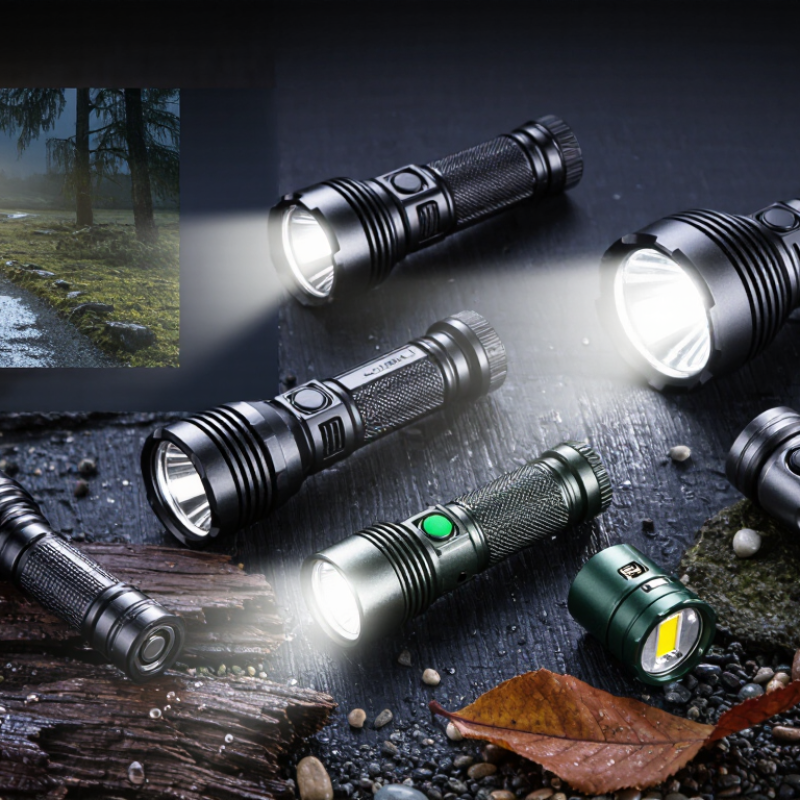
Before choosing an outdoor flashlight, picture where and how you will use it. A short evening walk on a paved path needs less reach than navigating uneven ground after sunset. For campsite chores, a broad beam can light a table and nearby gear. On a trail, a focused beam may help reveal roots farther ahead. More brightness is not always better. Glare can hide details, and high output drains batteries faster.
Consider weather, temperature, and carrying comfort, too. Rain calls for a flashlight with a clearly stated water-resistance rating; cold conditions can reduce battery performance. Check whether the light has a low setting for reading a map or moving around camp without overwhelming your eyes. Think about controls with cold hands or gloves. Small buttons can be frustrating. I have found that a light that feels secure in a pocket often gets used more than a heavier, brighter one.
Tips: Match beam shape to your activity, and check runtime at the setting you expect to use. Carry a spare power source for longer outings. Test the flashlight outdoors before relying on it; a backyard check may not reveal every problem.

How to Choose the Best Outdoor Flashlight in 2026?
Compare brightness, beam distance, and lighting modes as separate measures. Lumens describe total light output, but they do not show how tightly the beam reaches down a trail. ANSI/PLATO FL 1-2019 provides a useful comparison method: beam distance is measured to the point where light reaches 0.25 lux. A high-candela beam can illuminate distant trail markers, while a broad beam may better reveal roots near your boots. Check both figures. A large lumen number alone can be misleading.
Runtime and modes matter on a cold, dark walk. Under ANSI/PLATO FL 1-2019, runtime ends when output falls to 10 percent of its initial level, so compare figures tested by the same method. A low setting helps read a map without washing out your night vision; a bright setting is useful for scanning farther ahead. Red modes can preserve dark adaptation, though they are not always bright enough for footing. Try the controls with gloves. Small buttons can be frustrating. I would also check whether the beam has a smooth transition from center to edge; harsh glare on wet stones is easy to underestimate in a shop.
Choose a power source around how you actually travel. For a day hike, replaceable cells are useful when charging is unavailable. For frequent trips, a rechargeable lithium-ion battery can reduce spare-cell clutter. Check the battery type, charging method, and whether the light can run while charging. Small details matter.
Runtime figures need context. The ANSI/PLATO FL 1-2019 standard measures runtime until output falls to 10% of its level after 30 seconds. A flashlight rated for ten hours may therefore spend its final hours much dimmer. Compare the tested mode, not just the largest number on the package. IEC 61960-3:2017 also sets performance-testing methods for portable lithium cells, underscoring why capacity figures depend on test conditions. Cold changes things. Low temperatures can reduce usable battery performance, so a winter walk deserves a margin. Carrying a spare is sensible, though it adds weight. A published runtime still cannot predict every outing; wind, temperature, and repeated bright bursts all matter. Don’t over-trust a single number.
Estimated runtime at a constant 300-lumen output: Values are illustrative calculations based on nominal battery energy and an assumed 3-watt light-system load. Actual runtime varies with battery model, flashlight efficiency, temperature, and brightness regulation. Check the flashlight’s runtime specifications for your intended use.
A reliable outdoor flashlight should handle the conditions you actually face, not just look rugged on a shelf. For rainy trails, check its IP rating, which describes protection against water and dust. IEC 60529 classifies IPX4 as protection against splashing water and IPX7 as protection during temporary immersion in one meter of water for up to 30 minutes. These ratings do not guarantee resistance to every hazard, such as forceful water jets or saltwater. Check the product’s stated test conditions.
ANSI/PLATO FL 1-2019 provides standardized methods for comparing features such as impact resistance, water resistance, and runtime. That makes specifications more useful than vague claims like “heavy-duty.” Still, test results cannot predict every drop onto sharp rock. I tend to overvalue tough-looking housings; weight and grip matter on a long walk, too.
Tips: Check the flashlight’s weight with batteries installed. Try its switch with gloves on, and confirm the beam suits your route.
For portability, consider the flashlight’s length, battery type, and how securely it sits in a pack. A compact model can be easier to carry, but tiny controls may be awkward with cold fingers. Look for a textured grip and a simple way to prevent accidental activation. If you expect wet weather, inspect seals and charging-port covers regularly. Small details count. Keep the manufacturer’s care instructions handy.
An outdoor flashlight is a safety tool, so compare tested performance before trusting peak-lumen claims. The ANSI/PLATO FL 1 standard sets repeatable tests for light output, runtime, beam distance, impact resistance, and water resistance. Check whether advertised figures follow that standard. A bright beam alone says little about reliability in rain, cold, or a muddy campsite.
Maintenance affects value. The U.S. Department of Energy’s LED lighting guidance says LEDs use at least 75% less energy and can last 25 times longer than incandescent lighting. That comparison is not a guarantee for every flashlight; battery quality, seals, and electronics still matter. Use the specified battery type, inspect contacts for corrosion, and check rubber seals for grit or cracks. Small details matter. I sometimes focus too much on brightness.
For overall value, weigh the purchase price against battery costs, replaceable parts, and likely use. A light with a lower output but clear runtime data may serve a night walk better than one with impressive peak numbers. Test the switch with gloves on, and see whether the beam is easy to aim without blinding a companion. One weak spot in this checklist: real cold-weather runtime can still be hard to judge from published figures.


For those larger-sized parts, or smaller quantity runs, we have 2 independent powder coat booths and ovens. The quality, durability and affordability of today’s powder coating finishes make this the process of choice for world-class companies.
Powder coating advantages over other forms of coating are many. Materials used in the Powder coating process can be metals and non-metals that come in a multitude of thicknesses, textures, colors, etc. Another of Powder coating’s biggest advantages over conventional coatings is its ability to create finishes in many different textures. Powder Coating Booths allow us the ability to apply these advantages to large products.
Tri-State Fabricators runs a full-service conveyor line for painting. Wet painting can provide protection or decoration to many different part styles. From start to finish, every project is easier to undergo random and point-based inspection by our skilled painting team.
Advantages to our Wet Paint Line are these lines start with product prep and ends with a thorough inspection of a high quality finished product. Our ability to complete large and small projects with a superior finish and doing so in a timely and economical fashion. This passes along the savings in production to our customers. When powder coating ins not an option, our Wet Paint Line gets the job done right the first time.
When the parts get big and heavy we roll-out our custom paint racks and oversize booth. By utilizing our partnerships with all the major paint brands, we can match virtually any color with wet paint.
The advantages of having access to a Wet Paint Booth are many. Large projects of many different shapes can be loaded into the booth. The Wet Paint Booth offers an environment that is much more controlled than a typical parts painting operation.
Not only are they used because of their controlled environment, but they’re are also advantageous when it comes to applying paint to parts that are needed in industries that require specialty coatings such as medical, aerospace, etc.
Our military forces have some very high standards when it comes to the finish of their vehicles and equipment. From the first pre-treatment step to final coat, it takes a great deal of knowledge and experience to protect the men and women of our armed forces. They deserve only the best, and Tri-State Fabricators provides it.
All of our processes are closely monitored by our staff and management teams. Both of which are highly trained in the processes of metal fabrication and finishing. Tri-State Fabricators’ goal is to always fully satisfy each and every customer, including the military. We will always put a 110% into what we do.
Abrasive media blasting is an excellent way to remove old paint, rust, and increase the paint/powder adhesion. Glass beads produce a much smoother and brighter finish than angular abrasives; leaving the part clean yet without any dimensional change. Chemically inert and environmentally friendly, we can recycle our beads approximately 30 times; making them a more preferred method of metal cleaning or surface finishing.
Advantages to Glass Bead Blasting are many. Glass bead blast media is used when a project is needing rough surfaces need to become smooth for applications of coatings such as paint. It is typically used to clean paint and rust from a product surface without deforming the surface it is being used on. Overall, compared to many other blasting media, Glass Bead Blasting is a very economical choice and those savings are always passed on to our customers.
Tri-State Fabricators utilize a zinc phosphate wash to clean and etch the material to ensure the best paint adhesion possible. The unique design of our 3-stage wash system does the work like a 5-stage. From Cleaning and rinsing to conversion coating and post-treatment, Our Part Washing process is a complete service and works throughout the fabrication service and the finishing service.
Along with the previously mentioned benefits, Curing is a vital chemical reaction that leaves the product finish hard and relatively safe from mild abrasion and aggressive corrosion. This process can be done in more than one way; ambient air-dry or in curing ovens at temps that exceed 240°.
From fixing paint mistakes (someone else’s of course) to simply cleaning our paint line hooks, our burn-off oven is put to good use. After a quick burn-off, a little clean up, and a fresh coat of paint, your parts will look better than new.
Why does our Burn-Off Oven work so well? Because super heating the air around parts turns the materials into ashes. From paint and powder coatings to rubber and machining oils, high temps do the job without degrading the integrity of the part.
Masking is a vital part of producing high quality products. We have die-cut masking patterns to protect machined surfaces as well as a wide range of plugs and caps to protect threaded holes and bolts. We provide permanent and temporary masking.
Masking allows the selected sections of a product to be protected from a fabrication or finishing service. This can be with both chemicals when etching and tapes, paints when only finishing just a section of the product. Masking is great in aiding the customization process of a project.
Screen printing is a photographic process that transfers artwork onto a porous nylon screen which allows colored ink to flow through the screen and be deposited on an aluminum or plastic component. We can generally have just about any design created onto a screen for your parts.
Some of the advantages of Screen Printing are, brand recognition for your business displaying on your products, assembly instructions, product warnings/hazards, etc. Tri-State Fabricators produces Screen Printing of the highest quality so you know it’s durable.
Metal Finishing is the art of treating the exterior portion of product, often metal but can also be made of other materials, so that the surface is clean and free of any debris. Then the process of applying coats or either paint of powder coat takes place. This coating process improves the quality of the product in both appearance and resistance to wear and corrosion.
Tri-State Fabricators, Inc., understands that a project typically isn’t complete until a high-quality finish has been added to your product. This is why our painting and powder coating teams continuously inspect the products throughout the Metal Finishing process.

