


Choosing the right Jewelry Equipment is a business decision, not simply a shopping task. A jeweler’s bench may need a reliable polishing motor, precise scales, and safe, consistent lighting. A production workshop may depend more on casting capacity, ventilation, and equipment that can handle repeat orders. The details matter. A machine that saves minutes on one piece may create extra work across a full day.
The scale of the market makes these choices increasingly relevant. Grand View Research estimated the global jewelry market at USD 353.26 billion in 2023 and projected a 4.7% compound annual growth rate from 2024 to 2030. That figure describes jewelry sales, not equipment spending, but it signals a large and evolving field. Demand alone, however, cannot tell a business which tools to buy. Product mix, material, output volume, staff skills, and after-sales support all shape the right choice.
Start with the work you actually do. List the processes that slow production, note the tools requiring frequent repair, and compare machine specifications with your daily workload. Ask suppliers about training, spare parts, warranties, and maintenance requirements. Then check those promises against written documentation. Be cautious with impressive capacity claims. They may not reflect real workshop conditions. And a bigger machine is not always better. Some businesses buy for imagined growth, then leave costly features unused. A modest setup may be wiser, though underbuying can limit quality and throughput. The best choice is rarely obvious; it deserves a careful review before purchase.
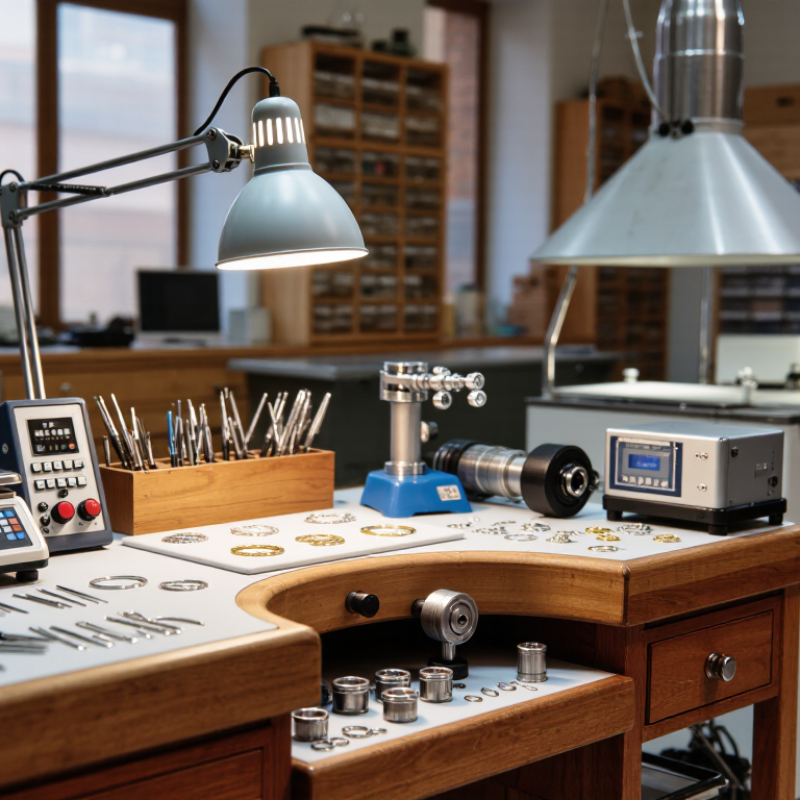
Define your jewelry business needs before comparing equipment. A repair studio needs reliable soldering, polishing, and stone-setting tools. A small production workshop may need casting capacity, rolling mills, and repeatable measurement. Be specific. Record your main materials, product types, weekly order volume, and current bottlenecks. A bench crowded with unused tools is a costly mistake.
Set measurable production goals, such as pieces completed per week, acceptable defect rates, or turnaround time. The World Gold Council’s Gold Demand Trends: Full Year 2023 reported global gold jewelry demand of 2,093 tonnes, up 3% year over year. That figure does not predict your sales, but it shows why material choice and product mix deserve careful planning. If your orders are mostly delicate rings, precision and consistent finishing may matter more than high-volume casting capacity.
Map each production step, from forming metal to final polishing, and note where delays or rework occur. Then choose equipment that addresses those specific gaps. A laser welder may help with localized repairs, while a dependable polishing system could improve finishing consistency. Check workspace, power supply, training needs, maintenance, and service access before committing. I would not buy for an imagined future workload alone; plans change, and that assumption can be expensive. Start with capacity you can use now, while leaving room to expand.
| Business need or goal | Typical production profile | Equipment to consider | Selection priorities | Planning notes |
|---|---|---|---|---|
| Starting a small handmade jewelry studio | One-off or short-run pieces; output varies with design complexity and available work hours. | Bench pin and workbench, jeweler’s saw, files, pliers, mandrels, basic soldering setup, polishing motor, and a reliable scale. | Versatility, safe operation, serviceability, and room to add tools as demand grows. | Prioritize essential hand tools and appropriate ventilation and eye protection before buying specialized machinery. |
| Producing custom or made-to-order pieces | Low-volume work with frequent changes in size, materials, and design details. | Precision measuring tools, flexible bench tools, soldering equipment, a setting toolkit, and optional CAD software with a compatible 3D printer or casting partner. | Accuracy, quick changeovers, repeatable sizing, and compatibility with the materials and stone settings used. | Compare the cost of in-house printing and casting with outsourcing; the best option depends on order volume and workflow. |
| Making consistent small-batch collections | Repeated designs produced in batches, with a need for consistent dimensions and finish. | Rolling mill, flex-shaft tool, polishing and finishing equipment, Casting Equipment if justified, and suitable molds or production fixtures. | Repeatability, production time per piece, batch capacity, and ease of maintaining the equipment. | Track labor time, scrap, and rework by design to identify which process is worth upgrading first. |
| Expanding into higher-volume production | Regular batches or multiple production stages, often requiring predictable throughput and documented quality checks. | Production-grade casting or forming equipment, polishing systems, dust collection, workholding fixtures, and inspection tools. | Throughput, uptime, operator training, maintenance support, workspace requirements, and process safety. | Confirm electrical, ventilation, water, and installation requirements; compare total operating costs, not just purchase price. |
| Offering engraving or detailed personalization | Small customized jobs that may involve different shapes, materials, and artwork files. | Engraving tools or a suitable laser system, secure workholding, design software, and material-specific test pieces. | Marking quality, supported materials, file workflow, ventilation, guarding, and operator training. | Verify that the chosen process is appropriate for each material and finish; follow equipment safety guidance. |
| Repairing and resizing jewelry | Variable jobs with a focus on careful handling, accurate sizing, and controlled heat or finishing. | Soldering setup, ring mandrels, sizing tools, pliers, polishing equipment, magnification, and a suitable ultrasonic cleaner where appropriate. | Fine control, safe handling of set stones, accessibility for inspection, and easy cleanup between jobs. | Check material and gemstone care requirements before using heat, chemicals, ultrasonic cleaning, or abrasive finishing. |
Planning tip: Estimate weekly demand, production time per piece, budget, workspace, and required quality level before comparing equipment. Capacity depends on design complexity, operator skill, and workflow.

Choose equipment by following the piece from first sketch to final inspection. For design work, a reliable computer, jewelry CAD software, and a calibrated monitor help turn dimensions into workable models. A digital caliper catches small measurement errors before they become costly. Fit matters.
For bench work, match tools to the methods your team actually uses. A jeweler’s saw, files, pliers, and a flexible-shaft tool cover many hand-fabrication tasks. Soldering calls for a stable torch, heat-resistant bench surface, and effective local ventilation. If you cast in-house, assess the full setup: investment mixer, burnout kiln, casting machine, and space for safe handling. Buying only the machine can leave a production bottleneck. Keep it simple.
Finishing needs its own plan. A polishing motor with suitable wheels, dust extraction, and task lighting can improve consistency and reduce airborne particles. Add an ultrasonic cleaner only if your materials and process allow it. For inspection, use a loupe or microscope, accurate scales, and proper measuring tools. Check service access, staff training, and maintenance costs before purchasing. A powerful machine may look efficient on paper, yet sit idle when only a few orders need it. I would review the workflow after a month; early estimates are often imperfect.
Choose jewelry equipment by the work it must repeat, not by its headline speed. Check the working area, power, accuracy, cycle time, and tool-change steps against your actual designs. Measure a typical ring, pendant, and largest planned piece before selecting a machine. Then request a sample run using your materials and workflow. Small details matter. The World Gold Council’s Gold Demand Trends reports put global gold-jewelry demand at 2,093 tonnes in 2023 and 1,877 tonnes in 2024. These figures do not predict one workshop’s orders, but they underline why flexible capacity can be safer than buying for a peak that may not last.
Compatibility goes beyond a power socket. Confirm electrical supply, ventilation, dust extraction, software file formats, fixture sizes, and whether your benches can support vibration. Check that the equipment handles your metals and production methods without adding repeated manual steps. Ask for a timed demonstration, including setup and cleanup, not just the cutting or forming cycle. A polished sample can mislead; one piece rarely reveals delays across a full shift. Also compare maintenance intervals, replacement tooling, and operator training requirements. A machine that fits the budget but disrupts existing workflows may cost more in lost production.
How to Choose the Best Jewelry Equipment for Your Business?
Evaluate Costs, Safety Standards, and Maintenance Needs
A low purchase price can hide the real cost of owning jewelry equipment. Compare installation, training, energy use, consumables, and likely repair expenses before deciding. Small costs add up. Ask suppliers for written estimates and clear warranty terms. Also consider downtime: a machine that sits idle during repairs can delay orders and affect cash flow. A spreadsheet helps, but it may not capture the pressure of a missed delivery.
Safety deserves a close inspection, not a quick checkbox. Look for stable guards, clear operating instructions, accessible emergency stops, and suitable dust or fume controls where the process requires them. Confirm that electrical and workplace requirements match your location, and review the equipment’s documentation. Requirements vary, so a certificate alone may not answer every question. Not always. Avoid assuming a compact machine is automatically safe for a small workshop.
Maintenance needs should fit your staff’s skills and schedule. Check how often filters, belts, or other wear parts need attention, and whether replacement parts are readily available. Ask how routine servicing is performed and what training is provided. Keep a simple log of cleaning, adjustments, and faults; patterns can reveal trouble before a breakdown. I would also leave room in the budget for unexpected service. Even careful planning misses something.
A reliable supplier should explain machine tolerances, maintenance intervals, spare-part lead times, and warranty exclusions in writing. Ask for a sample engraving or casting test using your own material. Check the finish under magnification, not just in a sales video. Small details matter.
Plan for changing demand, not just today’s order book. The World Gold Council’s Gold Demand Trends reports recorded 2,093 tonnes of global gold jewellery demand in 2023, then 1,877 tonnes in 2024. That shift is a reminder to avoid buying every machine at maximum capacity. Choose equipment with adjustable settings or modular add-ons, and confirm that upgrades will fit later models. A compact polishing station may be enough now. Leave room for extraction, safe storage, and another workbench. Growth gets cramped fast.
Compare total ownership costs, including installation, training, tooling, and downtime—not only the sticker price. Request references from workshops with similar production volumes, then ask how quickly repairs were handled. A supplier’s promise is not a maintenance plan. I would also keep a simple record of breakdowns and consumable use; it can expose a weak assumption before the next purchase. This part is easy to overlook.


For those larger-sized parts, or smaller quantity runs, we have 2 independent powder coat booths and ovens. The quality, durability and affordability of today’s powder coating finishes make this the process of choice for world-class companies.
Powder coating advantages over other forms of coating are many. Materials used in the Powder coating process can be metals and non-metals that come in a multitude of thicknesses, textures, colors, etc. Another of Powder coating’s biggest advantages over conventional coatings is its ability to create finishes in many different textures. Powder Coating Booths allow us the ability to apply these advantages to large products.
Tri-State Fabricators runs a full-service conveyor line for painting. Wet painting can provide protection or decoration to many different part styles. From start to finish, every project is easier to undergo random and point-based inspection by our skilled painting team.
Advantages to our Wet Paint Line are these lines start with product prep and ends with a thorough inspection of a high quality finished product. Our ability to complete large and small projects with a superior finish and doing so in a timely and economical fashion. This passes along the savings in production to our customers. When powder coating ins not an option, our Wet Paint Line gets the job done right the first time.
When the parts get big and heavy we roll-out our custom paint racks and oversize booth. By utilizing our partnerships with all the major paint brands, we can match virtually any color with wet paint.
The advantages of having access to a Wet Paint Booth are many. Large projects of many different shapes can be loaded into the booth. The Wet Paint Booth offers an environment that is much more controlled than a typical parts painting operation.
Not only are they used because of their controlled environment, but they’re are also advantageous when it comes to applying paint to parts that are needed in industries that require specialty coatings such as medical, aerospace, etc.
Our military forces have some very high standards when it comes to the finish of their vehicles and equipment. From the first pre-treatment step to final coat, it takes a great deal of knowledge and experience to protect the men and women of our armed forces. They deserve only the best, and Tri-State Fabricators provides it.
All of our processes are closely monitored by our staff and management teams. Both of which are highly trained in the processes of metal fabrication and finishing. Tri-State Fabricators’ goal is to always fully satisfy each and every customer, including the military. We will always put a 110% into what we do.
Abrasive media blasting is an excellent way to remove old paint, rust, and increase the paint/powder adhesion. Glass beads produce a much smoother and brighter finish than angular abrasives; leaving the part clean yet without any dimensional change. Chemically inert and environmentally friendly, we can recycle our beads approximately 30 times; making them a more preferred method of metal cleaning or surface finishing.
Advantages to Glass Bead Blasting are many. Glass bead blast media is used when a project is needing rough surfaces need to become smooth for applications of coatings such as paint. It is typically used to clean paint and rust from a product surface without deforming the surface it is being used on. Overall, compared to many other blasting media, Glass Bead Blasting is a very economical choice and those savings are always passed on to our customers.
Tri-State Fabricators utilize a zinc phosphate wash to clean and etch the material to ensure the best paint adhesion possible. The unique design of our 3-stage wash system does the work like a 5-stage. From Cleaning and rinsing to conversion coating and post-treatment, Our Part Washing process is a complete service and works throughout the fabrication service and the finishing service.
Along with the previously mentioned benefits, Curing is a vital chemical reaction that leaves the product finish hard and relatively safe from mild abrasion and aggressive corrosion. This process can be done in more than one way; ambient air-dry or in curing ovens at temps that exceed 240°.
From fixing paint mistakes (someone else’s of course) to simply cleaning our paint line hooks, our burn-off oven is put to good use. After a quick burn-off, a little clean up, and a fresh coat of paint, your parts will look better than new.
Why does our Burn-Off Oven work so well? Because super heating the air around parts turns the materials into ashes. From paint and powder coatings to rubber and machining oils, high temps do the job without degrading the integrity of the part.
Masking is a vital part of producing high quality products. We have die-cut masking patterns to protect machined surfaces as well as a wide range of plugs and caps to protect threaded holes and bolts. We provide permanent and temporary masking.
Masking allows the selected sections of a product to be protected from a fabrication or finishing service. This can be with both chemicals when etching and tapes, paints when only finishing just a section of the product. Masking is great in aiding the customization process of a project.
Screen printing is a photographic process that transfers artwork onto a porous nylon screen which allows colored ink to flow through the screen and be deposited on an aluminum or plastic component. We can generally have just about any design created onto a screen for your parts.
Some of the advantages of Screen Printing are, brand recognition for your business displaying on your products, assembly instructions, product warnings/hazards, etc. Tri-State Fabricators produces Screen Printing of the highest quality so you know it’s durable.
Metal Finishing is the art of treating the exterior portion of product, often metal but can also be made of other materials, so that the surface is clean and free of any debris. Then the process of applying coats or either paint of powder coat takes place. This coating process improves the quality of the product in both appearance and resistance to wear and corrosion.
Tri-State Fabricators, Inc., understands that a project typically isn’t complete until a high-quality finish has been added to your product. This is why our painting and powder coating teams continuously inspect the products throughout the Metal Finishing process.

