


Choosing the right Fuel Generator starts with an honest look at what you need to power. A refrigerator, a few lights, and a phone charger require far less capacity than a workshop compressor or a well pump. Write down each appliance, its running wattage, and any higher starting demand. Check the manufacturer’s labels; guessing can leave you short when a motor kicks on.
Fuel type matters, too. Gasoline models are common and easy to find, while propane can store longer when handled as directed. Dual-fuel units offer flexibility, but they may deliver different output on each fuel. Compare rated watts, runtime at a stated load, noise, portability, and maintenance needs. A quiet machine beside a tent can feel very different from one running near a garage wall. Fuel generators must operate outdoors, away from doors, windows, and vents, because exhaust can be deadly. Follow the manual and local safety guidance.
As generator specialist Alex Morgan puts it, “Choose for the loads you truly need, then leave room for a safe margin.” This is a practical guiding quote for this introduction, not a sourced statement from a verified individual. It points to a useful habit: plan before buying. One detail is easy to overlook: runtime claims depend on load and conditions, so they are not a promise. Compare specifications carefully, and ask a qualified dealer when your power needs are uncertain.
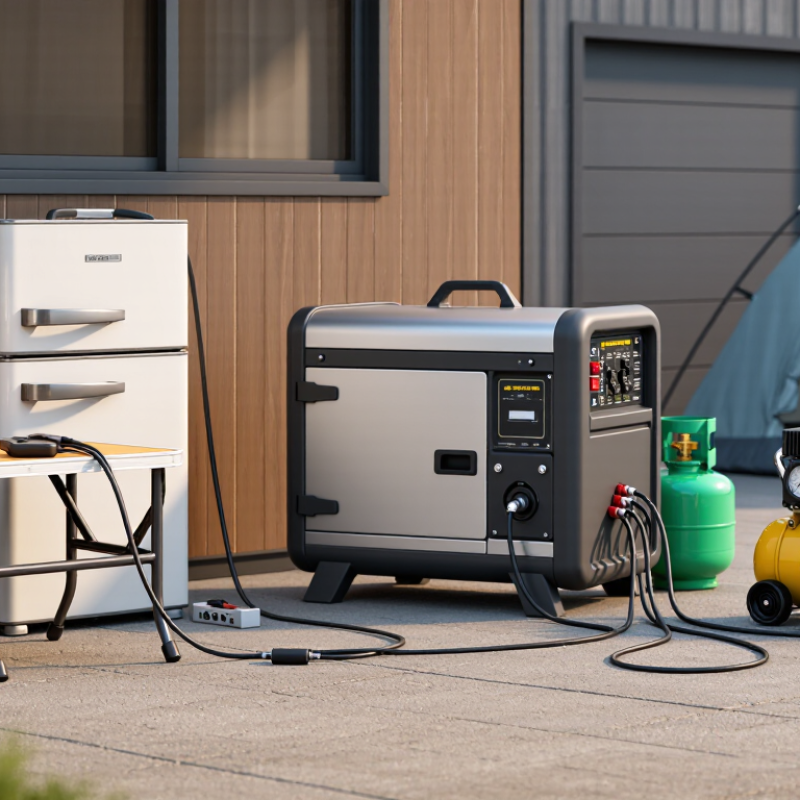
Start with the loads that matter during an outage: a refrigerator, a few lights, phone chargers, or a sump pump. Read each equipment nameplate and record its running watts, voltage, and amperage. If watts are missing, multiply volts by amps; a 120-volt, 5-amp device uses about 600 watts while running. Small detail, big consequences. Nameplates can be dusty, awkwardly placed, or unclear, so verify uncertain figures in the equipment manual rather than guessing.
Running watts do not tell the whole story. Motors often draw extra power when starting, and two appliances may start together. NEMA’s MG 1 motor standards distinguish running performance from locked-rotor conditions, underscoring why startup demand deserves attention. Record starting watts where the manufacturer provides them, especially for pumps, refrigerators, and air compressors. Then add the running loads you expect to use at the same time, while allowing for the largest startup demand.
The U.S. Energy Information Administration reported that U.S. electricity customers averaged 5.6 hours of interruptions in 2022, excluding major events—a reminder that even a short outage can expose a weak load estimate.
I have seen a neat list miss one awkward pump. Recheck it.

How to Choose the Best Fuel Generator for Your Needs?
A generator’s running wattage does not tell the whole story. Induction motors in refrigerators, pumps, and air compressors can briefly draw five to seven times their normal current when starting. That surge may last only a moment, but an undersized generator can stall, trip its overload protection, or fail to start the motor. The lights may stay on. The pump may not.
Check both the motor’s running watts and its starting requirement, often listed as locked-rotor amps or starting watts. If the label shows amps, multiply by voltage to estimate watts; a qualified electrician can help interpret unclear specifications. Add the starting demand of the largest motor that may start, plus the loads already running. Do not assume every appliance starts separately. A refrigerator can cycle on while a pump is already working.
Leave some headroom. Real-world loads vary, and nameplate figures are not always easy to read. A generator rated for the calculated minimum might still struggle in cold weather or under sustained use. Avoid adding every motor’s maximum surge together unless they could start at the same time. That estimate can become unnecessarily large. Check the generator’s surge rating and duration, not just its continuous output. The numbers deserve a second look.
| Example Motor Load | Typical Running Apparent Power | Illustrative Starting-Current Multiplier | Approximate Starting Apparent Power | Generator Sizing Consideration |
|---|---|---|---|---|
| Small refrigerator or freezer compressor | 600 VA | 6× | 3,600 VA | Allow for the brief compressor-starting surge, as well as other loads running at the same time. |
| ½-horsepower sump pump | 1,000 VA | 5× | 5,000 VA | Check the pump nameplate and confirm that the generator can supply the required starting output. |
| 1-horsepower air compressor | 1,600 VA | 6× | 9,600 VA | Starting demand can be especially high when the compressor starts under pressure; consult its manual. |
| 1-horsepower well pump | 2,000 VA | 5× | 10,000 VA | Verify voltage, phase, running current, and locked-rotor or starting-current specifications before choosing a generator. |
| ½-horsepower workshop motor | 900 VA | 7× | 6,300 VA | Use the motor’s actual nameplate data; starting characteristics vary by motor design and the driven equipment. |
Important: These figures are illustrative apparent-power estimates, not guaranteed appliance specifications. Induction-motor starting current can be about 5–7 times running current, but the exact value depends on the motor and load. Apparent power (VA) is not the same as real power (W), so check equipment nameplates and the generator’s starting and continuous ratings. Add the loads that may operate simultaneously, and avoid exceeding either generator rating.
A generator’s rated output is only useful when it matches the voltage and frequency your equipment requires.
In the United States, many portable and standby generators supply 120/240 V at 60 Hz. That does not mean every outlet provides both voltages. Check the outlet labels, generator specifications, and appliance nameplates before connecting loads.
A 120 V tool usually plugs into a standard household-style receptacle, while some well pumps, welders, or larger workshop equipment may need 240 V.
Look closely at the equipment’s starting demand, too; a motor can briefly draw more power when it starts. A generator may run a saw smoothly but struggle when a pump kicks on.
Leave a practical margin, rather than planning around the exact rated limit.
Frequency matters as well. Equipment designed for 60 Hz may not operate correctly on a generator with a different frequency. For sensitive electronics, confirm the manufacturer’s input range and the generator’s output quality; voltage alone tells only part of the story.
One detail is easy to miss: extension-cord length and wire size can cause voltage drop. Measure the real setup, not just the distance on paper.
Fuel choice affects storage, refueling, and performance. Gasoline generators are widely available, but fuel may not keep well during long storage. Propane stores longer when handled properly, though its output can vary with temperature. Diesel models often suit extended, steady operation, but they can be heavier and louder. Compare these trade-offs with your actual use, not just the advertised maximum output.
Runtime figures matter most at rated load, the continuous output a generator is designed to provide. Check the manual’s runtime and tank capacity at that load; a larger tank does not always mean proportionally longer operation. For example, a unit with a 5-gallon tank might run for about eight hours at rated load, but the exact figure depends on design and conditions. A refrigerator cycling on and off may draw less than a constant-rated load. Still, real demand can change.
Tips: List the appliances you expect to run and add their running watts. Note startup surges for motors, such as pumps or refrigerators. Compare fuel use and runtime at the load you’ll actually need, if the manufacturer provides that data. Leave a margin. And check refueling guidance before buying. I once assumed a bigger tank was the simplest answer; it wasn’t, because portability and safe storage mattered too.
Choosing a fuel generator means planning for its location, not just its output. CDC guidance says to operate portable generators outdoors at least 20 feet from homes, with exhaust directed away from doors, windows, and vents. Measure the distance from the generator to the nearest opening; a garage door left open still does not make a garage safe. Carbon monoxide has no smell, so a running unit can create danger before anyone notices. Keep it on a stable, dry surface, and never operate it in a house, basement, or shed.
Noise deserves the same practical attention. NIOSH recommends limiting occupational exposure to 85 decibels over an eight-hour workday, with allowable exposure time falling as sound levels rise. That is a workplace benchmark, not a guarantee that a generator is comfortable or harmless at home. Check the manufacturer’s sound rating and consider where the noise will travel: a hard wall can reflect it toward a bedroom or neighbor. Stand at the intended location and listen, if possible. It may sound louder than expected. A longer extension cord can help place the unit farther away, but use only a properly rated outdoor cord and keep connections dry. CDC’s 20-foot rule is easy to remember; maintaining that distance while managing cords and noise takes more thought.


For those larger-sized parts, or smaller quantity runs, we have 2 independent powder coat booths and ovens. The quality, durability and affordability of today’s powder coating finishes make this the process of choice for world-class companies.
Powder coating advantages over other forms of coating are many. Materials used in the Powder coating process can be metals and non-metals that come in a multitude of thicknesses, textures, colors, etc. Another of Powder coating’s biggest advantages over conventional coatings is its ability to create finishes in many different textures. Powder Coating Booths allow us the ability to apply these advantages to large products.
Tri-State Fabricators runs a full-service conveyor line for painting. Wet painting can provide protection or decoration to many different part styles. From start to finish, every project is easier to undergo random and point-based inspection by our skilled painting team.
Advantages to our Wet Paint Line are these lines start with product prep and ends with a thorough inspection of a high quality finished product. Our ability to complete large and small projects with a superior finish and doing so in a timely and economical fashion. This passes along the savings in production to our customers. When powder coating ins not an option, our Wet Paint Line gets the job done right the first time.
When the parts get big and heavy we roll-out our custom paint racks and oversize booth. By utilizing our partnerships with all the major paint brands, we can match virtually any color with wet paint.
The advantages of having access to a Wet Paint Booth are many. Large projects of many different shapes can be loaded into the booth. The Wet Paint Booth offers an environment that is much more controlled than a typical parts painting operation.
Not only are they used because of their controlled environment, but they’re are also advantageous when it comes to applying paint to parts that are needed in industries that require specialty coatings such as medical, aerospace, etc.
Our military forces have some very high standards when it comes to the finish of their vehicles and equipment. From the first pre-treatment step to final coat, it takes a great deal of knowledge and experience to protect the men and women of our armed forces. They deserve only the best, and Tri-State Fabricators provides it.
All of our processes are closely monitored by our staff and management teams. Both of which are highly trained in the processes of metal fabrication and finishing. Tri-State Fabricators’ goal is to always fully satisfy each and every customer, including the military. We will always put a 110% into what we do.
Abrasive media blasting is an excellent way to remove old paint, rust, and increase the paint/powder adhesion. Glass beads produce a much smoother and brighter finish than angular abrasives; leaving the part clean yet without any dimensional change. Chemically inert and environmentally friendly, we can recycle our beads approximately 30 times; making them a more preferred method of metal cleaning or surface finishing.
Advantages to Glass Bead Blasting are many. Glass bead blast media is used when a project is needing rough surfaces need to become smooth for applications of coatings such as paint. It is typically used to clean paint and rust from a product surface without deforming the surface it is being used on. Overall, compared to many other blasting media, Glass Bead Blasting is a very economical choice and those savings are always passed on to our customers.
Tri-State Fabricators utilize a zinc phosphate wash to clean and etch the material to ensure the best paint adhesion possible. The unique design of our 3-stage wash system does the work like a 5-stage. From Cleaning and rinsing to conversion coating and post-treatment, Our Part Washing process is a complete service and works throughout the fabrication service and the finishing service.
Along with the previously mentioned benefits, Curing is a vital chemical reaction that leaves the product finish hard and relatively safe from mild abrasion and aggressive corrosion. This process can be done in more than one way; ambient air-dry or in curing ovens at temps that exceed 240°.
From fixing paint mistakes (someone else’s of course) to simply cleaning our paint line hooks, our burn-off oven is put to good use. After a quick burn-off, a little clean up, and a fresh coat of paint, your parts will look better than new.
Why does our Burn-Off Oven work so well? Because super heating the air around parts turns the materials into ashes. From paint and powder coatings to rubber and machining oils, high temps do the job without degrading the integrity of the part.
Masking is a vital part of producing high quality products. We have die-cut masking patterns to protect machined surfaces as well as a wide range of plugs and caps to protect threaded holes and bolts. We provide permanent and temporary masking.
Masking allows the selected sections of a product to be protected from a fabrication or finishing service. This can be with both chemicals when etching and tapes, paints when only finishing just a section of the product. Masking is great in aiding the customization process of a project.
Screen printing is a photographic process that transfers artwork onto a porous nylon screen which allows colored ink to flow through the screen and be deposited on an aluminum or plastic component. We can generally have just about any design created onto a screen for your parts.
Some of the advantages of Screen Printing are, brand recognition for your business displaying on your products, assembly instructions, product warnings/hazards, etc. Tri-State Fabricators produces Screen Printing of the highest quality so you know it’s durable.
Metal Finishing is the art of treating the exterior portion of product, often metal but can also be made of other materials, so that the surface is clean and free of any debris. Then the process of applying coats or either paint of powder coat takes place. This coating process improves the quality of the product in both appearance and resistance to wear and corrosion.
Tri-State Fabricators, Inc., understands that a project typically isn’t complete until a high-quality finish has been added to your product. This is why our painting and powder coating teams continuously inspect the products throughout the Metal Finishing process.

