Choosing the right Cnc Devices can shape your production costs, delivery times, and product quality for years. The best machine is not automatically the fastest or most expensive. It is the one that fits your actual jobs, materials, tolerances, and operator skills. CNC educator Mike Lynch, founder of CNC Concepts, is known for emphasizing practical machining knowledge. A useful buyer’s principle is: “Choose for the work you run every week, not the features that look impressive in a brochure.” Treat that as a guide, not a substitute for checking a machine’s specifications and support.
Start with the parts you make now. Note their dimensions, materials, required accuracy, and monthly volume. A small shop producing aluminum brackets may need a reliable three-axis mill, while a turning operation may benefit more from a CNC lathe with suitable tooling. Picture a real setup: stock clamped securely, tools changed, chips cleared, and finished parts measured. These details reveal costs that a catalog rarely shows. They also expose a common mistake: buying extra capacity before confirming that customers will use it.
Compare usable work envelope, spindle power, control interface, tooling compatibility, maintenance access, training, and local service. Ask suppliers for a demonstration using a part similar to yours. Request clear details about installation, warranty coverage, and expected delivery. Then compare the full cost, including tooling, software, fixtures, and operator training. A spreadsheet helps. It will not make the decision for you. Review the numbers with machinists and production staff; they may notice workflow problems that a purchasing checklist misses. The final choice should support current work while leaving sensible room for growth.
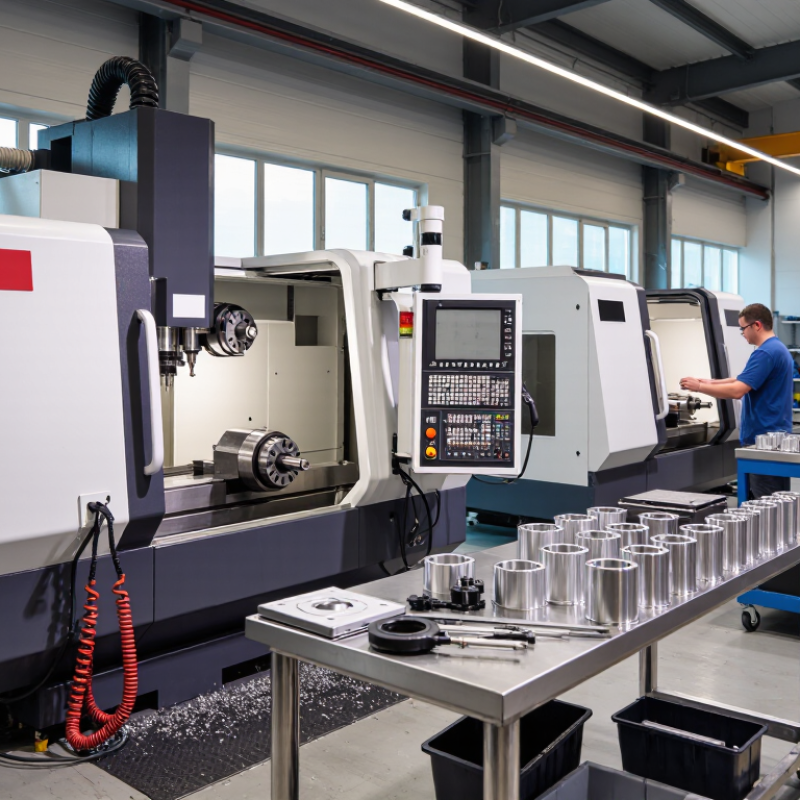
Before comparing CNC devices, define what your business actually makes. List the materials, part dimensions, tolerances, and surface finishes your jobs require. A shop cutting small aluminum brackets has different needs from one machining large steel components. Estimate monthly demand, peak workloads, and the number of product changes each week. Be specific. “More capacity” is not a useful target by itself.
Production goals should include usable output, not just advertised speed. Record current cycle times, setup delays, scrap, and machine downtime. Then identify the main bottleneck. A faster machine may not help if operators spend hours changing fixtures or waiting for inspection. Check whether the device supports your required operations, tooling, and workpiece size. Consider floor space, power, operator training, and routine maintenance. These details can alter the real cost. I have seen capacity estimates look convincing on paper, then fall short during frequent changeovers. Your own test parts provide better evidence than assumptions.
Tips: Bring representative parts and drawings to a machine evaluation. Ask for measured cycle times, including setup. Check tolerances across repeated runs, not just one successful cut. Leave room for maintenance and future work, but avoid paying for capacity you cannot use. A modest plan can be wiser.
Choosing a CNC machine starts with the shape of your work, not the machine’s headline speed. A three-axis milling machine suits flat parts, pockets, and drilled features in metal or plastic. If parts need angled faces or curved contours, four- or five-axis motion can reduce repeated setups. That matters when alignment errors become costly. More axes also mean higher programming and training demands.
For long, round components such as shafts, a CNC lathe is usually the natural fit. It rotates the workpiece while a cutting tool shapes its diameter and ends. Wood shops and sign makers may benefit more from a CNC router, which handles sheet goods across a broad table. Check the spindle, work area, dust collection, and tool-change needs against your actual jobs. A large table is not automatically useful.
For sheet metal, a CNC plasma cutter offers fast profiling, while waterjet cutting avoids heat at the cut edge and can handle varied materials. These processes differ in finish, operating costs, and secondary work, so compare sample cuts before committing. Keep a month of job records: material, dimensions, tolerances, and batch size. Then ask which machine completes most jobs with the fewest setups. It is easy to overbuy. Production mixes rarely stay exactly as forecast.
Choosing a CNC device starts with the parts you actually make, not the largest numbers on a specification sheet. Measure your typical workpiece and leave room for clamps, tools, and safe movement. A 600-millimeter table may sound generous, yet a tall fixture can reduce usable clearance. Check spindle power and cutting force against your materials and expected production pace. Bigger is not always better.
Precision needs a practical definition. Compare stated positioning accuracy and repeatability, then ask how those figures were measured. They may not predict results in a warm workshop after hours of operation. For a small aluminum component, a tolerance of 0.05 millimeters might be sufficient; a tighter fit may require more capable equipment and careful calibration. Inspect sample cuts if possible. Real evidence helps.
Compatibility can quietly add cost. Confirm that the machine accepts your intended file formats, tooling, workholding, and existing inspection methods. Check power supply, floor space, extraction needs, and operator training before purchase. These details are easy to overlook. I would also question optimistic cycle-time estimates: setup and tool changes take time, even on a capable machine. Compare the full workflow, not just the cutting speed.
A CNC purchase price is only the first line of the ownership budget. Add tooling, installation, software, energy, maintenance, training, and planned downtime. The U.S. Energy Information Administration reported an average industrial electricity price of 8.45 cents per kilowatt-hour in 2023. Your local rate may differ, but machine hours and idle time still affect the bill. Ask suppliers for measured power use under realistic cutting conditions, not just a peak rating. Small details matter.
Support costs deserve equal scrutiny. The U.S. Bureau of Labor Statistics reported a May 2023 median annual wage of $63,510 for industrial machinery mechanics and related workers. That is a useful U.S. labor benchmark, not a full service-cost estimate; benefits, overtime, and scarce CNC skills can raise the real figure. Compare warranty coverage, response times, remote diagnostics, spare-part availability, and technician travel charges. Ask how quickly critical components can arrive. A low-cost machine can become expensive when a spindle waits for service. No spreadsheet captures every surprise. Build a five-year estimate, then test it against a realistic week of production, including setup changes and one likely repair.
Choosing a CNC machine by purchase price alone can hide its real cost. Match its work envelope, spindle power, tool capacity, and accuracy to the parts you actually produce. A machine that cuts aluminum quickly may struggle with long steel runs or tight tolerances. Ask suppliers to demonstrate your material, tooling, and target cycle time. Measure repeatability across several parts, not just one polished sample.
Long-term value depends on uptime, service access, energy use, and operator training. Deloitte’s 2024 Smart Manufacturing Survey reports that 86% of surveyed manufacturing executives expect smart manufacturing solutions to drive competitiveness within five years. That supports evaluating controls and data connectivity, but features only pay off when your team can use them. Include maintenance and downtime in a five-year cost estimate. It may still miss surprises; real production is messy.
Tips: Request a test cut using your own drawing. Check service response times, spare-part availability, and the cost of common wear items. Compare the expected cost per finished part—not just the machine’s advertised speed.



For those larger-sized parts, or smaller quantity runs, we have 2 independent powder coat booths and ovens. The quality, durability and affordability of today’s powder coating finishes make this the process of choice for world-class companies.
Powder coating advantages over other forms of coating are many. Materials used in the Powder coating process can be metals and non-metals that come in a multitude of thicknesses, textures, colors, etc. Another of Powder coating’s biggest advantages over conventional coatings is its ability to create finishes in many different textures. Powder Coating Booths allow us the ability to apply these advantages to large products.
Tri-State Fabricators runs a full-service conveyor line for painting. Wet painting can provide protection or decoration to many different part styles. From start to finish, every project is easier to undergo random and point-based inspection by our skilled painting team.
Advantages to our Wet Paint Line are these lines start with product prep and ends with a thorough inspection of a high quality finished product. Our ability to complete large and small projects with a superior finish and doing so in a timely and economical fashion. This passes along the savings in production to our customers. When powder coating ins not an option, our Wet Paint Line gets the job done right the first time.
When the parts get big and heavy we roll-out our custom paint racks and oversize booth. By utilizing our partnerships with all the major paint brands, we can match virtually any color with wet paint.
The advantages of having access to a Wet Paint Booth are many. Large projects of many different shapes can be loaded into the booth. The Wet Paint Booth offers an environment that is much more controlled than a typical parts painting operation.
Not only are they used because of their controlled environment, but they’re are also advantageous when it comes to applying paint to parts that are needed in industries that require specialty coatings such as medical, aerospace, etc.
Our military forces have some very high standards when it comes to the finish of their vehicles and equipment. From the first pre-treatment step to final coat, it takes a great deal of knowledge and experience to protect the men and women of our armed forces. They deserve only the best, and Tri-State Fabricators provides it.
All of our processes are closely monitored by our staff and management teams. Both of which are highly trained in the processes of metal fabrication and finishing. Tri-State Fabricators’ goal is to always fully satisfy each and every customer, including the military. We will always put a 110% into what we do.
Abrasive media blasting is an excellent way to remove old paint, rust, and increase the paint/powder adhesion. Glass beads produce a much smoother and brighter finish than angular abrasives; leaving the part clean yet without any dimensional change. Chemically inert and environmentally friendly, we can recycle our beads approximately 30 times; making them a more preferred method of metal cleaning or surface finishing.
Advantages to Glass Bead Blasting are many. Glass bead blast media is used when a project is needing rough surfaces need to become smooth for applications of coatings such as paint. It is typically used to clean paint and rust from a product surface without deforming the surface it is being used on. Overall, compared to many other blasting media, Glass Bead Blasting is a very economical choice and those savings are always passed on to our customers.
Tri-State Fabricators utilize a zinc phosphate wash to clean and etch the material to ensure the best paint adhesion possible. The unique design of our 3-stage wash system does the work like a 5-stage. From Cleaning and rinsing to conversion coating and post-treatment, Our Part Washing process is a complete service and works throughout the fabrication service and the finishing service.
Along with the previously mentioned benefits, Curing is a vital chemical reaction that leaves the product finish hard and relatively safe from mild abrasion and aggressive corrosion. This process can be done in more than one way; ambient air-dry or in curing ovens at temps that exceed 240°.
From fixing paint mistakes (someone else’s of course) to simply cleaning our paint line hooks, our burn-off oven is put to good use. After a quick burn-off, a little clean up, and a fresh coat of paint, your parts will look better than new.
Why does our Burn-Off Oven work so well? Because super heating the air around parts turns the materials into ashes. From paint and powder coatings to rubber and machining oils, high temps do the job without degrading the integrity of the part.
Masking is a vital part of producing high quality products. We have die-cut masking patterns to protect machined surfaces as well as a wide range of plugs and caps to protect threaded holes and bolts. We provide permanent and temporary masking.
Masking allows the selected sections of a product to be protected from a fabrication or finishing service. This can be with both chemicals when etching and tapes, paints when only finishing just a section of the product. Masking is great in aiding the customization process of a project.
Screen printing is a photographic process that transfers artwork onto a porous nylon screen which allows colored ink to flow through the screen and be deposited on an aluminum or plastic component. We can generally have just about any design created onto a screen for your parts.
Some of the advantages of Screen Printing are, brand recognition for your business displaying on your products, assembly instructions, product warnings/hazards, etc. Tri-State Fabricators produces Screen Printing of the highest quality so you know it’s durable.
Metal Finishing is the art of treating the exterior portion of product, often metal but can also be made of other materials, so that the surface is clean and free of any debris. Then the process of applying coats or either paint of powder coat takes place. This coating process improves the quality of the product in both appearance and resistance to wear and corrosion.
Tri-State Fabricators, Inc., understands that a project typically isn’t complete until a high-quality finish has been added to your product. This is why our painting and powder coating teams continuously inspect the products throughout the Metal Finishing process.


