


How to Choose GRP Gutter Making Machinery in 2026?

Choosing the right GRP gutter making machinery in 2026 requires more than comparing prices and advertised production speeds. GRP gutters, made from glass-reinforced polyester, demand stable forming, accurate resin control, and dependable curing. A machine may look impressive in a showroom, yet perform poorly with your actual reinforcement materials or gutter profiles.

This guide examines the practical factors behind a reliable purchase. It considers output capacity, mould design, resin distribution, heating systems, trimming accuracy, and operator safety. It also reviews maintenance access, spare-part availability, energy use, and supplier support. These details directly influence production consistency and long-term operating costs. Grp Gutters Machinery should match your product range, factory layout, workforce skills, and expected market demand.

A careful evaluation should include sample production, not only brochures. Request test runs using your chosen resin, glass fibre, and profile dimensions. Inspect the finished gutter for surface smoothness, wall thickness, alignment, and resistance to deformation. Ask for documented quality procedures and realistic delivery terms. Experienced suppliers should explain limitations clearly, including cleaning intervals and mould replacement needs.

No machine is perfect.

A spreadsheet alone can mislead. High speed may reduce quality when curing control is weak. Low purchase cost may create expensive downtime later. Buyers should compare verified performance, service records, training, and lifecycle value. This article provides a practical framework for selecting machinery with greater confidence, while recognizing that every factory has different technical and commercial priorities.
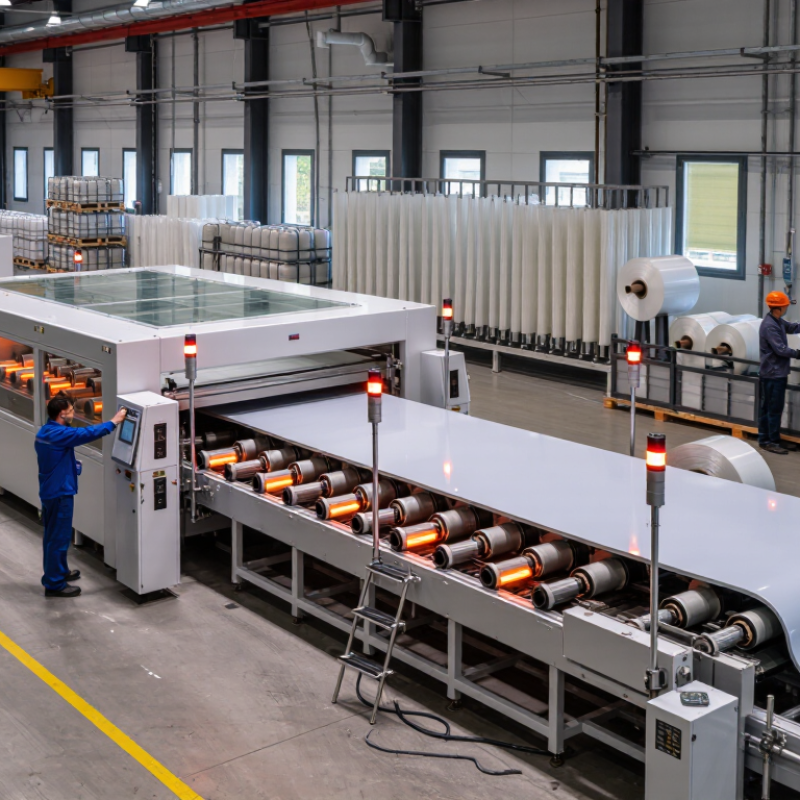
How to Choose GRP Gutter Making Machinery in 2026?

Define Gutter Profiles, Resin Systems, and EN 1433 Load Classes

Choosing GRP gutter making machinery in 2026 starts with the finished profile, not the machine catalogue. Define the channel width, depth, wall thickness, outlet shape, and grating seat. A narrow pedestrian channel needs different tooling from a deep road-drainage profile. Measure the moulded section carefully. Small dimensional errors can cause poor joints and uneven water flow.

Resin selection affects strength, curing speed, surface quality, and machine settings. Polyester resin suits many general applications and supports economical production. Vinyl ester can provide better chemical and moisture resistance. Epoxy may deliver excellent bonding, but it often costs more and needs careful curing control.

Check the reinforcement design, resin viscosity, heating method, and pull speed together. EN 1433 load classes must guide the tooling and testing plan. A15 is intended for pedestrian areas, while B125 suits many parking and light-traffic zones. Heavier classes, including C250 and D400, require stronger assemblies and verified testing. Do not choose a class from appearance alone. Site conditions can be less predictable.

Tips: Ask machinery suppliers for trial samples using your actual resin and glass reinforcement. Inspect profile tolerance, curing consistency, trimming quality, and production speed. Request test records linked to EN 1433 requirements. Keep room for adjustments. My own preference is to start with a flexible pilot tool, although this can slow early production. That compromise is easy to overlook. Also check cleaning access, operator safety, spare parts, and data logging before signing specifications.


Match Pultrusion Capacity to 2026 Demand and kg/h Output Targets

How to Choose GRP Gutter Making Machinery in 2026?

Matching pultrusion capacity to demand is more important than choosing the fastest line. Estimate monthly sales, working days, and planned operating hours. Then convert the forecast into a realistic kg/h target. A line rated at 120 kg/h may produce less during profile changes, die cleaning, and startup waste.

For example, a plant expecting 38 tonnes monthly, with 22 working days and two eight-hour shifts, needs about 108 kg/h at full utilization. That figure leaves little room for downtime. I would normally add a practical capacity margin of 15 to 25 percent. However, the margin should reflect actual orders, not optimistic forecasts. Too much capacity increases energy, labor, and maintenance costs.

Check whether the machine can maintain stable pulling speed and resin impregnation at your target output. Gutter dimensions, glass content, resin viscosity, and curing length directly affect throughput. Ask for trial data using your intended reinforcement and resin system. Inspect the finished profile for straightness, surface pinholes, dimensional variation, and clean cut edges.

Do not judge output from a short demonstration. A two-hour test can hide heat buildup and adjustment problems. Review longer production records when possible. Also examine changeover time between gutter sizes. I have seen impressive hourly figures become disappointing after frequent tooling changes.

A slightly slower line may deliver more sellable kilograms each month. That is the number worth planning around.

Specify Dies, Pullers, and Cutters for ±1 mm Dimensional Accuracy

How to Choose GRP Gutter Making Machinery in 2026?

For ±1 mm dimensional accuracy, treat the die, puller, and cutter as one production system. The die controls the gutter’s profile, wall thickness, and drainage angle. Choose a rigid, polished die with stable heating and accurate alignment. Small die wear can create visible lips, uneven edges, or poor joints. Profile checks should use calibrated gauges, not visual judgment alone.

The puller must maintain steady traction without crushing the cured GRP. Servo control, adjustable gripping pressure, and synchronized speed help prevent stretching and profile distortion. Keep resin content, glass alignment, and curing temperature consistent. These factors can change dimensions before cutting. A flying cutter or guided abrasive saw should hold a clean, square cut. Measure both ends and the center of each piece. A perfect first setup is unlikely.

Tips: Test a short sample before full production. Check width, depth, flange angle, and cut length at room temperature. Record every adjustment. Recheck accuracy after several hours, because heat and die expansion may shift the result. Also inspect the puller pads regularly. Worn pads can slip quietly, and that mistake is easy to miss. When the tolerance is tight, slower production may be wiser than chasing output.

Verify GRP Quality Using ASTM D638, D790, and D2584 Test Data

How to Choose GRP Gutter Making Machinery in 2026?

Verify GRP Quality Using ASTM D638, D790, and D2584 Test Data

When choosing GRP gutter making machinery in 2026, treat laboratory data as a purchasing filter, not decoration. Request production samples, not only polished brochures. ASTM D638 test results show tensile strength, tensile modulus, and elongation. These values indicate how the gutter may resist pulling, handling, and installation stress. Ask for specimen conditioning, cure age, and test temperature. Missing details weaken the evidence.

ASTM D790 evaluates flexural performance, which matters when gutters carry water, snow, or uneven support loads. Compare flexural strength and modulus across samples from the beginning, middle, and end of a production run. Then examine ASTM D2584 ignition-loss data. This method helps estimate glass reinforcement content when resin and filler information is also available. It is not a complete formulation analysis. Be careful here.

A reliable machinery evaluation connects test data with process control. Check resin metering, fiber placement, mold temperature, pulling speed, and curing consistency. Ask whether operators can repeat the same profile without frequent manual correction. A small dimensional change can create poor joints at the site. I have found that one attractive test report can hide unstable production. No test plan is perfect. Recheck doubtful results through an independent laboratory, especially when D638 and D790 values vary widely between batches. Keep records of sample location, batch number, moisture exposure, and test date. This makes technical claims traceable and easier to challenge.

How to Choose GRP Gutter Making Machinery in 2026?

Verify GRP Quality Using ASTM D638, D790, and D2584 Test Data

The chart compares representative GRP screening values for three reinforcement levels. ASTM D638 measures tensile strength, ASTM D790 measures flexural strength, and ASTM D2584 estimates glass-fiber content through ignition loss. Higher glass content generally supports higher mechanical strength, but final performance also depends on resin type, fiber architecture, consolidation, curing, and test conditions. These values are engineering reference data rather than certified results for a specific manufacturer or machine.

Compare Energy Use, Scrap Rates, Maintenance, and Payback Periods

How to Choose GRP Gutter Making Machinery in 2026?

Energy use should be measured per finished metre, not only by motor size. The International Energy Agency’s Energy Efficiency 2023 report identifies industry as responsible for roughly 37% of global final energy demand. For GRP production, record heater, drive, extraction, and compressed-air consumption during a normal shift.

The U.S. Department of Energy reports that compressed-air leaks can waste 20–30% of compressor output. A small leak can become an expensive background noise.

Scrap rates often reveal more than brochure speed. Track start-up waste, trimming losses, dimensional rejects, and resin-contaminated material separately.

Industry sustainability reports from the American Composites Manufacturers Association stress process control and waste measurement, but they do not establish one universal GRP gutter scrap benchmark. That matters.

A quoted 2% rate may exclude unstable start-up production. Maintenance deserves the same honesty: inspect heating zones, pullers, cutting tools, sensors, and mould surfaces before comparing prices.

Calculate payback from usable output, energy cost, labour, scrap, and planned downtime. Include spare parts. The European Commission’s energy-efficiency guidance supports life-cycle costing rather than purchase-price comparisons.

A simple formula is useful: payback equals installed cost divided by annual verified savings.

But the spreadsheet can lie. Test production for several weeks before approving the final investment.

Powder Coat Booths

For those larger-sized parts, or smaller quantity runs, we have 2 independent powder coat booths and ovens. The quality, durability and affordability of today’s powder coating finishes make this the process of choice for world-class companies.

Powder coating advantages over other forms of coating are many. Materials used in the Powder coating process can be metals and non-metals that come in a multitude of thicknesses, textures, colors, etc. Another of Powder coating’s biggest advantages over conventional coatings is its ability to create finishes in many different textures. Powder Coating Booths allow us the ability to apply these advantages to large products.

Wet Paint Line

Tri-State Fabricators runs a full-service conveyor line for painting. Wet painting can provide protection or decoration to many different part styles. From start to finish, every project is easier to undergo random and point-based inspection by our skilled painting team.

Advantages to our Wet Paint Line are these lines start with product prep and ends with a thorough inspection of a high quality finished product. Our ability to complete large and small projects with a superior finish and doing so in a timely and economical fashion. This passes along the savings in production to our customers. When powder coating ins not an option, our Wet Paint Line gets the job done right the first time.

Wet Paint Booths

When the parts get big and heavy we roll-out our custom paint racks and oversize booth. By utilizing our partnerships with all the major paint brands, we can match virtually any color with wet paint.

The advantages of having access to a Wet Paint Booth are many. Large projects of many different shapes can be loaded into the booth. The Wet Paint Booth offers an environment that is much more controlled than a typical parts painting operation.

Not only are they used because of their controlled environment, but they’re are also advantageous when it comes to applying paint to parts that are needed in industries that require specialty coatings such as medical, aerospace, etc.

Military CARC

Our military forces have some very high standards when it comes to the finish of their vehicles and equipment. From the first pre-treatment step to final coat, it takes a great deal of knowledge and experience to protect the men and women of our armed forces. They deserve only the best, and Tri-State Fabricators provides it.

All of our processes are closely monitored by our staff and management teams. Both of which are highly trained in the processes of metal fabrication and finishing. Tri-State Fabricators’ goal is to always fully satisfy each and every customer, including the military. We will always put a 110% into what we do.

Glass-Bead Blasting

Abrasive media blasting is an excellent way to remove old paint, rust, and increase the paint/powder adhesion. Glass beads produce a much smoother and brighter finish than angular abrasives; leaving the part clean yet without any dimensional change. Chemically inert and environmentally friendly, we can recycle our beads approximately 30 times; making them a more preferred method of metal cleaning or surface finishing.

Advantages to Glass Bead Blasting are many. Glass bead blast media is used when a project is needing rough surfaces need to become smooth for applications of coatings such as paint. It is typically used to clean paint and rust from a product surface without deforming the surface it is being used on. Overall, compared to many other blasting media, Glass Bead Blasting is a very economical choice and those savings are always passed on to our customers.

Part Washing

Tri-State Fabricators utilize a zinc phosphate wash to clean and etch the material to ensure the best paint adhesion possible. The unique design of our 3-stage wash system does the work like a 5-stage. From Cleaning and rinsing to conversion coating and post-treatment, Our Part Washing process is a complete service and works throughout the fabrication service and the finishing service.

Along with the previously mentioned benefits, Curing is a vital chemical reaction that leaves the product finish hard and relatively safe from mild abrasion and aggressive corrosion. This process can be done in more than one way; ambient air-dry or in curing ovens at temps that exceed 240°.

Burn-Off Oven

From fixing paint mistakes (someone else’s of course) to simply cleaning our paint line hooks, our burn-off oven is put to good use. After a quick burn-off, a little clean up, and a fresh coat of paint, your parts will look better than new.

Why does our Burn-Off Oven work so well? Because super heating the air around parts turns the materials into ashes. From paint and powder coatings to rubber and machining oils, high temps do the job without degrading the integrity of the part.

Masking

Masking is a vital part of producing high quality products. We have die-cut masking patterns to protect machined surfaces as well as a wide range of plugs and caps to protect threaded holes and bolts. We provide permanent and temporary masking.

Masking allows the selected sections of a product to be protected from a fabrication or finishing service. This can be with both chemicals when etching and tapes, paints when only finishing just a section of the product. Masking is great in aiding the customization process of a project.

Screen Printing

Screen printing is a photographic process that transfers artwork onto a porous nylon screen which allows colored ink to flow through the screen and be deposited on an aluminum or plastic component. We can generally have just about any design created onto a screen for your parts.

Some of the advantages of Screen Printing are, brand recognition for your business displaying on your products, assembly instructions, product warnings/hazards, etc. Tri-State Fabricators produces Screen Printing of the highest quality so you know it’s durable.

Metal Finishing

Metal Finishing is the art of treating the exterior portion of product, often metal but can also be made of other materials, so that the surface is clean and free of any debris. Then the process of applying coats or either paint of powder coat takes place. This coating process improves the quality of the product in both appearance and resistance to wear and corrosion.

Tri-State Fabricators, Inc., understands that a project typically isn’t complete until a high-quality finish has been added to your product. This is why our painting and powder coating teams continuously inspect the products throughout the Metal Finishing process.
