


Choosing a Black Rectangular Hollow Section involves more than selecting a dark finish and a neat, straight profile. The right choice depends on how the section will be used, supported, cut, and joined. A frame in a sheltered workshop may need different specifications from an exposed gate or structural assembly. Start with the required outer dimensions and wall thickness. Then confirm the steel grade and section length against the project drawings.
Appearance can be misleading. “Black” may describe the surface supplied, so ask whether it is a mill finish, painted, or otherwise coated. Check product documentation for dimensions, tolerances, grade, and any applicable standards. These details matter when sections must align with plates, bolts, or adjoining members. Small differences show up quickly at a tight-fitting joint. They are easy to overlook.
Consider loads, span, restraint, and the finished environment before settling on a size. A qualified engineer should verify structural suitability; a catalogue table alone cannot account for every connection or support condition. For fabrication, check cutting requirements, weld access, and whether the surface needs preparation or extra protection. Ask the supplier for traceable documentation, especially when consistent quality matters. Compare delivered specifications, not just price per length. If a detail remains unclear, pause and confirm it. That may feel cautious, but replacing an unsuitable section later is rarely simple.
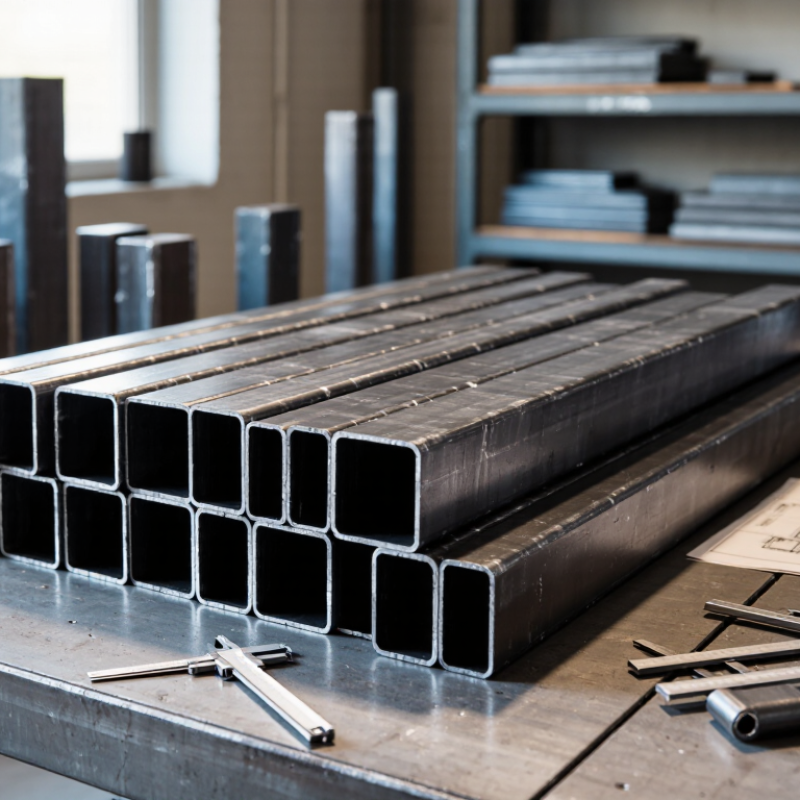
Black rectangular hollow section (RHS) is a welded steel tube with a rectangular cross-section and a dark, usually uncoated mill finish. Its flat faces are convenient for bolted connections, while the hollow centre keeps weight lower than a solid bar of similar outside dimensions. It is used for building frames, gates, equipment supports, trailers, and furniture. The finish is not automatically corrosion protection. Outdoors, moisture can collect at cut ends and welds.
RHS size is described by outside width, outside depth, and wall thickness. A 100 × 50 × 3 mm section, for example, has unequal sides and a nominal 3 mm wall. Check the product standard, steel grade, actual dimensions, and fabrication requirements before specifying it. The World Steel Association’s World Steel in Figures 2024 reports 1,892.2 million tonnes of crude steel production worldwide in 2023. That scale gives useful context, but it does not prove that a particular RHS size can carry a given load.
Match the section to its job. A deeper side can improve stiffness when oriented correctly, but joints and unsupported length also matter. Ask for mill test documentation and inspect the section for dents, twist, and uneven weld seams. For structural use, have loads and connections checked by a qualified engineer. I would not choose by appearance alone. A small mismatch in wall thickness can matter.

Choosing black rectangular hollow section starts with the load, span, and connection details—not appearance. Record the outside width and depth, then check whether the section fits the available space and supports the expected bending and compression. For example, a 100 × 50 mm section may fit a frame, but its capacity changes with wall thickness and orientation. Black typically describes the mill-finish surface, not the steel grade; confirm the finish and corrosion protection needed for the installation.
Wall thickness affects strength, weight, weld preparation, and cost. Avoid selecting the thickest option by default. Check design loads and local buckling with a qualified structural professional, using the applicable design code. ASTM A500/A500M lists minimum yield strengths of 315 MPa for rectangular Grade B tubing and 345 MPa for Grade C. These are material minimums, not allowable design stresses. One detail is easy to miss: actual dimensions and thickness tolerances can affect fit-up, so confirm the supplier’s specification before detailing connections.
Tips: State dimensions as width × depth × wall thickness, in millimetres or inches. Include length, grade, finish, and required tolerances on the order. Measure twice. If the section will be exposed outdoors, consider drainage and a suitable protective coating; paint alone may not protect cut ends or enclosed joints.
Compare section sizes and wall thicknesses against the estimated mass per metre shown. These values are calculated from nominal dimensions using a sharp-corner approximation, so actual product weights may differ because of corner radii and manufacturing tolerances. For EN 10219 hollow sections with wall thickness up to 16 mm, common minimum yield strengths are 235 MPa for S235JRH, 275 MPa for S275J0H, and 355 MPa for S355J2H. Confirm the required grade, dimensions, design loads, and applicable standard for your project.
How to Choose Black Rectangular Hollow Section?
Comparing Surface Finish, Coating, and Corrosion Protection
“Black” describes the steel’s appearance, not its corrosion resistance. Hot-rolled black RHS often retains mill scale, which can hide early rust and provide an unreliable base for paint. A black finish can look reassuring. It may not be. Check the surface for loose scale, oil, weld spatter, and damaged edges before specifying a coating.
The environment should guide protection. The 2016 NACE International IMPACT study estimated global corrosion costs at US$2.5 trillion annually, about 3.4% of global GDP. For coating selection, ISO 12944 classifies expected durability from low, under seven years, to very high, over 25 years. These are planning ranges, not warranties. A sheltered indoor frame and a coastal handrail need different systems.
For outdoor sections, compare a prepared steel surface with a compatible primer-and-topcoat system or hot-dip galvanizing. Ask for the preparation method, specified film thickness, and inspection records—not just a colour sample. On RHS, water can collect at cut ends, welds, and poorly drained cavities. Small detail, big consequence. Confirm venting and drainage before galvanizing, and repair coating damage after cutting or installation. One limitation remains: even a sound specification can fail if the site team skips surface preparation.
| Finish or protection option | Typical appearance | Typical coating thickness | Corrosion protection | Advantages | Limitations and suitable use |
|---|---|---|---|---|---|
| Black mill finish (uncoated) | Dark grey to black surface, often with mill scale; appearance and surface condition can vary. | No applied protective coating. | Low when exposed to moisture or weather. Mill scale is not a dependable long-term corrosion barrier. | Usually economical and readily available; can be prepared for a specified coating system. | Best for dry, indoor conditions or where a separate protection system will be applied. Clean and prepare the surface before painting; remove loose scale, rust, oil, and contaminants. |
| Shop-applied primer | Usually red, grey, or another primer color; not necessarily black. | Often approximately 20–75 μm dry film thickness (DFT), depending on the primer and specification. | Limited to moderate; intended mainly as temporary protection or as the base for a compatible paint system. | Can reduce flash rust during storage and handling and provide a base for later coating. | A primer alone may not provide durable outdoor protection. Confirm compatibility with the finishing coats, and check whether the primer must be removed from weld areas. |
| Zinc-rich primer with paint topcoats | Primer is commonly grey; the final color depends on the chosen topcoat. | A complete multi-coat system is commonly around 150–300 μm DFT; the specified build varies with exposure and product selection. | Moderate to high when correctly specified, applied to properly prepared steel, and maintained. | Provides a repairable barrier system; suitable for many fabricated structures and can be applied in a range of colors. | Performance depends on surface preparation, film thickness, application quality, and maintenance. Edges, welds, and damaged areas need particular attention. |
| Hot-dip galvanizing | Typically silver-grey; the surface may be bright, matte, or spangled. | Often approximately 45–85 μm or more, depending on steel thickness and the applicable specification. | High for many outdoor exposures because the zinc coating provides a barrier and sacrificial protection. | Coats accessible internal and external surfaces of properly vented hollow sections; generally offers durable protection with relatively low routine maintenance. | The section must be designed with suitable vent and drain openings for galvanizing. Welding or cutting after galvanizing damages the coating locally and requires repair. Appearance can vary. |
| Powder coating | Uniform colored finish; black is commonly available. | Often approximately 60–120 μm, depending on the powder and specification. | Moderate to high when pre-treatment, coverage, and curing are appropriate for the exposure. | Provides an even decorative finish and a tough surface; often used for finished products and components. | Requires controlled pre-treatment and curing facilities. Damage and cut edges can expose steel; field repairs may not match the original finish. Hollow-section interiors may not receive the same protection. |
| Duplex system: galvanizing plus paint | Painted color over a galvanized base; black topcoats are possible. | Combines the specified zinc coating with a paint system, often approximately 100–250 μm DFT of paint in addition to the zinc layer. | High when the paint system is compatible with the galvanized surface and applied and maintained correctly. | Adds color and a further barrier; may extend service life compared with either system alone in suitable conditions. | Requires correct preparation of the galvanized surface and compatible coatings. More steps and inspection are needed than for a single finish. |
Selection note: Thicknesses are indicative ranges, not guaranteed values. Specify protection based on the service environment, design life, fabrication sequence, and applicable project requirements. For painted systems, a defined surface-preparation grade and coating specification are essential; for galvanizing, confirm section venting and drainage before fabrication.
Start by identifying the standard required by the project, not just the section size. Standards can define dimensions, wall-thickness tolerances, steel grade, and testing requirements. Confirm which standard applies to your location and intended use. A tube labelled “black” usually describes its uncoated, dark mill-finish surface; it does not confirm its grade or structural capacity. Check the documentation.
Load requirements need real project details. Note the section’s span, support conditions, load direction, and connection method. A long beam may be limited by deflection before it reaches its strength limit. For example, a 100 × 50 mm section can behave differently when its wider face is turned vertically. Small details matter. Have a qualified engineer verify the selected size and wall thickness, especially where loads are uncertain. Do not guess from appearance.
Ask suppliers for the exact outside dimensions, nominal and minimum wall thickness, grade, applicable manufacturing standard, and available lengths. Request inspection documents or test certificates that match the supplied batch, along with clear tolerance information. Check whether the quoted weight is theoretical or measured; the difference can affect ordering and fabrication. Also confirm surface condition, packaging, and cut-length accuracy. A polished specification sheet helps, but it cannot replace batch traceability. I have seen small paperwork gaps create avoidable delays, so verify them before placing the order.
Selecting the right black rectangular hollow section starts with the fabrication and installation details. Check the specified outside dimensions, wall thickness, steel grade, and section length against your drawings. A tube that looks close can still cause trouble at a joint. Thin walls may distort during welding, while thicker sections add weight and can make handling harder. There is no universally perfect choice. Confirm whether “black” means an uncoated mill finish, and ask about surface condition before planning paint or other protection.
Tips: Allow for cutting and fit-up tolerances. Check that mitred ends meet cleanly, and leave practical access for welds, clamps, and fasteners. A quick trial assembly can reveal alignment problems before the full frame is made. Small gaps matter.
For installation, consider how the section will be lifted, positioned, and secured. Long pieces can flex during handling, even when the finished assembly is rigid. Protect cut edges and drilled holes if the project requires corrosion protection. Keep dimensions and material certificates with the job record, then compare the delivered section with the purchase specification. It is easy to focus on strength alone; in practice, finish, access, and a workable installation sequence deserve equal attention. For load-bearing designs, have a qualified professional verify the section and connections for the actual loads and support conditions.


For those larger-sized parts, or smaller quantity runs, we have 2 independent powder coat booths and ovens. The quality, durability and affordability of today’s powder coating finishes make this the process of choice for world-class companies.
Powder coating advantages over other forms of coating are many. Materials used in the Powder coating process can be metals and non-metals that come in a multitude of thicknesses, textures, colors, etc. Another of Powder coating’s biggest advantages over conventional coatings is its ability to create finishes in many different textures. Powder Coating Booths allow us the ability to apply these advantages to large products.
Tri-State Fabricators runs a full-service conveyor line for painting. Wet painting can provide protection or decoration to many different part styles. From start to finish, every project is easier to undergo random and point-based inspection by our skilled painting team.
Advantages to our Wet Paint Line are these lines start with product prep and ends with a thorough inspection of a high quality finished product. Our ability to complete large and small projects with a superior finish and doing so in a timely and economical fashion. This passes along the savings in production to our customers. When powder coating ins not an option, our Wet Paint Line gets the job done right the first time.
When the parts get big and heavy we roll-out our custom paint racks and oversize booth. By utilizing our partnerships with all the major paint brands, we can match virtually any color with wet paint.
The advantages of having access to a Wet Paint Booth are many. Large projects of many different shapes can be loaded into the booth. The Wet Paint Booth offers an environment that is much more controlled than a typical parts painting operation.
Not only are they used because of their controlled environment, but they’re are also advantageous when it comes to applying paint to parts that are needed in industries that require specialty coatings such as medical, aerospace, etc.
Our military forces have some very high standards when it comes to the finish of their vehicles and equipment. From the first pre-treatment step to final coat, it takes a great deal of knowledge and experience to protect the men and women of our armed forces. They deserve only the best, and Tri-State Fabricators provides it.
All of our processes are closely monitored by our staff and management teams. Both of which are highly trained in the processes of metal fabrication and finishing. Tri-State Fabricators’ goal is to always fully satisfy each and every customer, including the military. We will always put a 110% into what we do.
Abrasive media blasting is an excellent way to remove old paint, rust, and increase the paint/powder adhesion. Glass beads produce a much smoother and brighter finish than angular abrasives; leaving the part clean yet without any dimensional change. Chemically inert and environmentally friendly, we can recycle our beads approximately 30 times; making them a more preferred method of metal cleaning or surface finishing.
Advantages to Glass Bead Blasting are many. Glass bead blast media is used when a project is needing rough surfaces need to become smooth for applications of coatings such as paint. It is typically used to clean paint and rust from a product surface without deforming the surface it is being used on. Overall, compared to many other blasting media, Glass Bead Blasting is a very economical choice and those savings are always passed on to our customers.
Tri-State Fabricators utilize a zinc phosphate wash to clean and etch the material to ensure the best paint adhesion possible. The unique design of our 3-stage wash system does the work like a 5-stage. From Cleaning and rinsing to conversion coating and post-treatment, Our Part Washing process is a complete service and works throughout the fabrication service and the finishing service.
Along with the previously mentioned benefits, Curing is a vital chemical reaction that leaves the product finish hard and relatively safe from mild abrasion and aggressive corrosion. This process can be done in more than one way; ambient air-dry or in curing ovens at temps that exceed 240°.
From fixing paint mistakes (someone else’s of course) to simply cleaning our paint line hooks, our burn-off oven is put to good use. After a quick burn-off, a little clean up, and a fresh coat of paint, your parts will look better than new.
Why does our Burn-Off Oven work so well? Because super heating the air around parts turns the materials into ashes. From paint and powder coatings to rubber and machining oils, high temps do the job without degrading the integrity of the part.
Masking is a vital part of producing high quality products. We have die-cut masking patterns to protect machined surfaces as well as a wide range of plugs and caps to protect threaded holes and bolts. We provide permanent and temporary masking.
Masking allows the selected sections of a product to be protected from a fabrication or finishing service. This can be with both chemicals when etching and tapes, paints when only finishing just a section of the product. Masking is great in aiding the customization process of a project.
Screen printing is a photographic process that transfers artwork onto a porous nylon screen which allows colored ink to flow through the screen and be deposited on an aluminum or plastic component. We can generally have just about any design created onto a screen for your parts.
Some of the advantages of Screen Printing are, brand recognition for your business displaying on your products, assembly instructions, product warnings/hazards, etc. Tri-State Fabricators produces Screen Printing of the highest quality so you know it’s durable.
Metal Finishing is the art of treating the exterior portion of product, often metal but can also be made of other materials, so that the surface is clean and free of any debris. Then the process of applying coats or either paint of powder coat takes place. This coating process improves the quality of the product in both appearance and resistance to wear and corrosion.
Tri-State Fabricators, Inc., understands that a project typically isn’t complete until a high-quality finish has been added to your product. This is why our painting and powder coating teams continuously inspect the products throughout the Metal Finishing process.

