How to Choose an RF Power Amplifier for Your Needs

Choosing an RF Power Amplifier is not simply a matter of selecting the highest output rating. The right device must match your frequency band, signal bandwidth, required gain, and operating environment. Steve C. Cripps, author of RF Power Amplifiers for Wireless Communications, has explored these engineering trade-offs in depth. A concise paraphrase of his design perspective is: “Power amplifier design is a balance among efficiency, linearity, bandwidth, and practical limits.” Treat this as a paraphrase, not a verified verbatim quotation.

Start with the signal. A narrowband transmitter and a wideband communication system can demand very different amplifier behavior. Check output power at your actual frequency, not only the headline maximum. Then compare linearity specifications, such as EVM or adjacent-channel performance, when they matter to your modulation. Efficiency deserves close attention, too. Heat is real. A compact amplifier in a sealed enclosure may need more cooling than its datasheet suggests.

Also examine impedance, supply voltage, duty cycle, and protection features. Read the test conditions behind every specification; numbers without context can mislead. A device may look ideal on paper, yet perform poorly with your load, layout, or cooling arrangement. That is an easy mistake to make. This guide’s outline will help you compare key specifications, understand application needs, and avoid common selection pitfalls. Leave room for testing. Bench measurements may reveal assumptions worth revisiting.
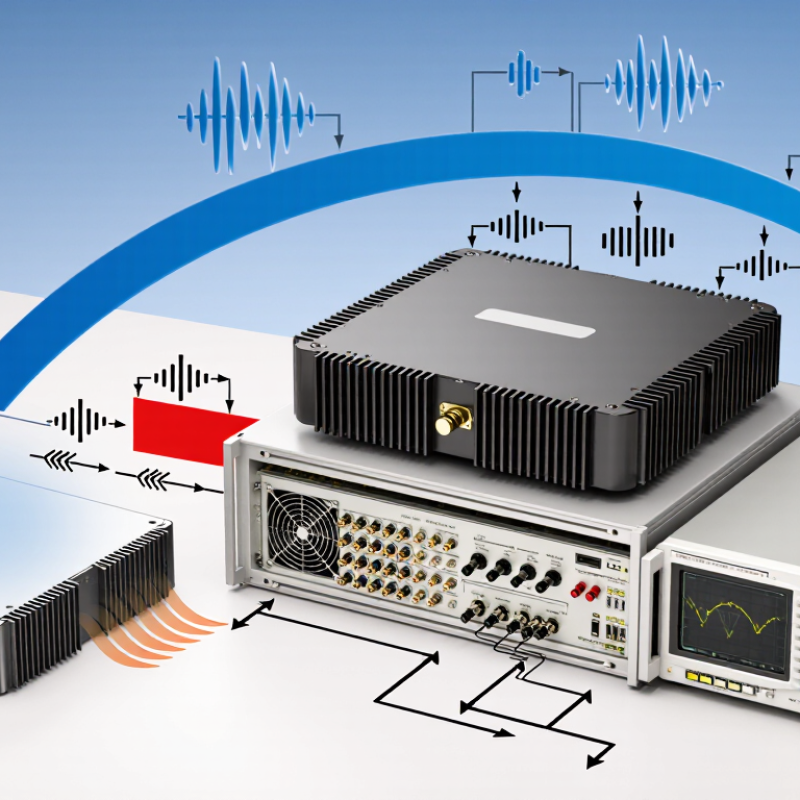
How to Choose an RF Power Amplifier for Your Needs

Define the Application and Its Operating Requirements

Define the real operating conditions before comparing RF power amplifiers. Note the frequency band, occupied bandwidth, modulation, target output power, and duty cycle. A short burst and a continuous carrier create very different thermal demands. Peak power is not enough. Also record the load impedance, available supply voltage, cooling method, and permitted distortion.

The application’s traffic profile matters. GSMA Intelligence’s Mobile Economy 2024 report estimated 1.6 billion 5G connections in 2023 and projected 5.5 billion by 2030. That growth makes bandwidth and linearity practical concerns, not just datasheet details. For a modulated signal, check adjacent-channel leakage and error-vector magnitude at the intended average power. A device that meets its peak rating may still distort when driven continuously. Thermal limits bite.

Make the test setup resemble the product. For example, a compact radio enclosure with limited airflow may run hotter than an open laboratory fixture. Specify ambient temperature, cable loss, antenna mismatch, and the required operating duration. Then leave margin for production variation and ageing. I have seen requirements written around a single bench measurement; that is convenient, but it can miss the warm enclosure and real load. Record what is known, and flag assumptions for validation.

Match Frequency Range, Bandwidth, and Output Power

How to Choose an RF Power Amplifier for Your Needs

Match Frequency Range, Bandwidth, and Output Power

Start with the signal’s actual frequency range, not just its center frequency. An amplifier must cover the lowest and highest operating frequencies while maintaining stable gain across the band. A narrow match can cause uneven output near the edges. Check the specified bandwidth under your intended load and modulation, too; a headline bandwidth alone may not reflect real performance.

Bandwidth affects how much signal the amplifier can carry without excessive distortion. 3GPP TS 38.104 specifies NR channel bandwidths up to 100 MHz in FR1 and 400 MHz in FR2, depending on band and configuration. For output power, compare the required average power with the amplifier’s linear output, not only its saturated rating. Leave headroom for signal peaks. A tidy specification sheet can still hide thermal limits or gain variation.

Tips: Check gain flatness, output at your target frequency, and heat dissipation during continuous operation. For a wideband signal, verify linearity at the required bandwidth and back-off. Then test with your real load. It may reveal something the calculations missed. Cite the applicable 3GPP TS 38.104 tables and the amplifier’s measurement conditions when comparing specifications.

Assess Linearity, Efficiency, and Signal Quality

A suitable RF power amplifier must preserve the signal, not merely produce a high output level. Linearity matters when transmitting complex modulation: distortion can blur constellation points and spill energy into nearby channels. For applicable NR base-station transmitter requirements, 3GPP TS 38.104 specifies a 3.5% RMS EVM limit for 256-QAM. Treat that figure as a defined test benchmark, not a universal pass mark for every system. Check the requirements for your own frequency band and configuration.

Efficiency should be measured at the output power and waveform you will actually use. A high peak-efficiency figure can look impressive, yet a signal’s peaks may require the amplifier to operate with back-off. Measure efficiency under that condition, and record average output power, temperature, and adjacent-channel leakage. The test setup matters. Cable loss or poor calibration can make a good amplifier look weak—or hide a real problem.

Signal quality also depends on bandwidth, matching, and thermal behavior. Compare EVM and spectral regrowth across the full operating range, not just at one convenient frequency. A small mismatch may raise heat and alter performance over time. Check again after the unit warms up. It is easy to overlook. For a field installation, repeat measurements with the intended cables and load; bench results alone can be incomplete.

Check Impedance, Connectivity, and Thermal Requirements

How to Choose an RF Power Amplifier for Your Needs
Check Impedance, Connectivity, and Thermal Requirements

Begin by checking the amplifier’s input and output impedance against the rest of your RF chain. Many systems use 50-ohm components, but confirm rather than assume. An impedance mismatch can increase reflected power and reduce the energy reaching the load. Small details matter. Check the operating frequency range, too; a suitable impedance rating does not guarantee performance across every frequency you need.

Next, inspect the connectors, cable types, and required control interfaces. Make sure connectors match your cables, and account for cable loss between the amplifier and antenna or test load. If remote monitoring or switching is important, verify that the amplifier supports the needed interfaces. A datasheet is useful, but it cannot show how awkward a connector will be in a crowded enclosure. Plan the physical layout before ordering.

Thermal requirements deserve equal attention. Compare the amplifier’s power output and duty cycle with its cooling needs, then allow room for airflow around vents and heat sinks. A unit that runs cool during a short bench test may heat up during continuous operation. Measure temperatures under realistic conditions and follow the manufacturer’s operating limits. I would leave extra thermal margin; estimates can be wrong, especially when nearby equipment restricts airflow.

Compare Reliability, Compliance, and Total Cost

How to Choose an RF Power Amplifier for Your Needs

A power rating alone tells you little about an amplifier’s long-term value. Check reliability under your actual duty cycle, operating temperature, and load conditions. A unit tested continuously on a bench may behave differently inside a warm, crowded enclosure. Ask for thermal and mismatch test data, not just a peak-output figure. Small details matter. Confirm that connectors, cooling, and protection features suit your setup. A fan that is difficult to replace can turn a minor fault into extended downtime.

Compliance deserves the same attention. Review applicable emissions, safety, and electromagnetic compatibility requirements for your destination and installation. Request current test reports and traceable documentation, then verify that they cover the exact model and configuration. Requirements can vary by market, so assumptions are risky. Total cost also extends beyond the purchase price: include power use, cooling, integration, spare parts, maintenance, and warranty support. Not always. A lower-cost amplifier may be the sensible choice for light, intermittent use; for continuous operation, service access and documented reliability may matter more. I would still leave room for uncertainty: published figures cannot fully predict performance in your enclosure. Compare the evidence with your real operating conditions before deciding.


Powder Coat Booths

For those larger-sized parts, or smaller quantity runs, we have 2 independent powder coat booths and ovens. The quality, durability and affordability of today’s powder coating finishes make this the process of choice for world-class companies.

Powder coating advantages over other forms of coating are many. Materials used in the Powder coating process can be metals and non-metals that come in a multitude of thicknesses, textures, colors, etc. Another of Powder coating’s biggest advantages over conventional coatings is its ability to create finishes in many different textures. Powder Coating Booths allow us the ability to apply these advantages to large products.

Wet Paint Line

Tri-State Fabricators runs a full-service conveyor line for painting. Wet painting can provide protection or decoration to many different part styles. From start to finish, every project is easier to undergo random and point-based inspection by our skilled painting team.

Advantages to our Wet Paint Line are these lines start with product prep and ends with a thorough inspection of a high quality finished product. Our ability to complete large and small projects with a superior finish and doing so in a timely and economical fashion. This passes along the savings in production to our customers. When powder coating ins not an option, our Wet Paint Line gets the job done right the first time.

Wet Paint Booths

When the parts get big and heavy we roll-out our custom paint racks and oversize booth. By utilizing our partnerships with all the major paint brands, we can match virtually any color with wet paint.

The advantages of having access to a Wet Paint Booth are many. Large projects of many different shapes can be loaded into the booth. The Wet Paint Booth offers an environment that is much more controlled than a typical parts painting operation.

Not only are they used because of their controlled environment, but they’re are also advantageous when it comes to applying paint to parts that are needed in industries that require specialty coatings such as medical, aerospace, etc.

Military CARC

Our military forces have some very high standards when it comes to the finish of their vehicles and equipment. From the first pre-treatment step to final coat, it takes a great deal of knowledge and experience to protect the men and women of our armed forces. They deserve only the best, and Tri-State Fabricators provides it.

All of our processes are closely monitored by our staff and management teams. Both of which are highly trained in the processes of metal fabrication and finishing. Tri-State Fabricators’ goal is to always fully satisfy each and every customer, including the military. We will always put a 110% into what we do.

Glass-Bead Blasting

Abrasive media blasting is an excellent way to remove old paint, rust, and increase the paint/powder adhesion. Glass beads produce a much smoother and brighter finish than angular abrasives; leaving the part clean yet without any dimensional change. Chemically inert and environmentally friendly, we can recycle our beads approximately 30 times; making them a more preferred method of metal cleaning or surface finishing.

Advantages to Glass Bead Blasting are many. Glass bead blast media is used when a project is needing rough surfaces need to become smooth for applications of coatings such as paint. It is typically used to clean paint and rust from a product surface without deforming the surface it is being used on. Overall, compared to many other blasting media, Glass Bead Blasting is a very economical choice and those savings are always passed on to our customers.

Part Washing

Tri-State Fabricators utilize a zinc phosphate wash to clean and etch the material to ensure the best paint adhesion possible. The unique design of our 3-stage wash system does the work like a 5-stage. From Cleaning and rinsing to conversion coating and post-treatment, Our Part Washing process is a complete service and works throughout the fabrication service and the finishing service.

Along with the previously mentioned benefits, Curing is a vital chemical reaction that leaves the product finish hard and relatively safe from mild abrasion and aggressive corrosion. This process can be done in more than one way; ambient air-dry or in curing ovens at temps that exceed 240°.

Burn-Off Oven

From fixing paint mistakes (someone else’s of course) to simply cleaning our paint line hooks, our burn-off oven is put to good use. After a quick burn-off, a little clean up, and a fresh coat of paint, your parts will look better than new.

Why does our Burn-Off Oven work so well? Because super heating the air around parts turns the materials into ashes. From paint and powder coatings to rubber and machining oils, high temps do the job without degrading the integrity of the part.

Masking

Masking is a vital part of producing high quality products. We have die-cut masking patterns to protect machined surfaces as well as a wide range of plugs and caps to protect threaded holes and bolts. We provide permanent and temporary masking.

Masking allows the selected sections of a product to be protected from a fabrication or finishing service. This can be with both chemicals when etching and tapes, paints when only finishing just a section of the product. Masking is great in aiding the customization process of a project.

Screen Printing

Screen printing is a photographic process that transfers artwork onto a porous nylon screen which allows colored ink to flow through the screen and be deposited on an aluminum or plastic component. We can generally have just about any design created onto a screen for your parts.

Some of the advantages of Screen Printing are, brand recognition for your business displaying on your products, assembly instructions, product warnings/hazards, etc. Tri-State Fabricators produces Screen Printing of the highest quality so you know it’s durable.

Metal Finishing

Metal Finishing is the art of treating the exterior portion of product, often metal but can also be made of other materials, so that the surface is clean and free of any debris. Then the process of applying coats or either paint of powder coat takes place. This coating process improves the quality of the product in both appearance and resistance to wear and corrosion.

Tri-State Fabricators, Inc., understands that a project typically isn’t complete until a high-quality finish has been added to your product. This is why our painting and powder coating teams continuously inspect the products throughout the Metal Finishing process.



