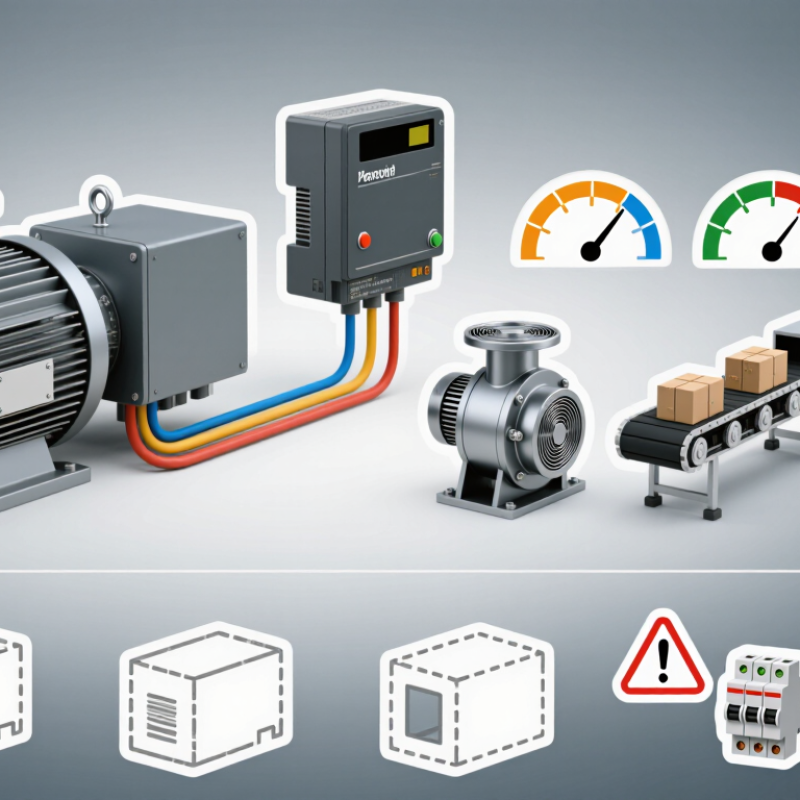
Choosing a Variable Frequency Converter in 2026 is not simply a matter of matching horsepower. The right unit must suit the motor, electrical supply, driven load, control method, and installation environment. A mismatch can cause nuisance trips, excessive heating, poor low-speed torque, or unexpected downtime. Small details matter.
Begin with the motor nameplate. Record its rated voltage, current, frequency, speed, and connection, then compare these values with the converter’s output ratings. Consider how the machine behaves, too. A centrifugal pump, a loaded conveyor, and a fan place different demands on acceleration, braking, and torque. Think about the operating cycle: frequent starts or long periods at low speed may affect sizing and cooling. Numbers can mislead.
This guide explains how to assess these requirements before comparing models. It also covers enclosure ratings, control interfaces, protective features, installation space, and support availability. In 2026, product ranges and software options may vary, so verify specifications in current manufacturer documentation rather than relying on a brochure summary. Check compatibility with existing motors and controls, and follow applicable electrical and safety requirements. A checklist helps, but it cannot replace a qualified review of the actual installation. That step may feel slow. It is often cheaper than discovering an overlooked limitation after commissioning.
A variable frequency converter changes the electrical supply delivered to an AC motor, allowing its speed to match the work required. For example, a ventilation fan may run slowly when a room needs little airflow, then accelerate as demand rises. Lower speed can reduce energy use in suitable applications, though actual savings depend on the system.
Inside the converter, a rectifier changes incoming AC power into DC power. A capacitor-based DC bus smooths that power before inverter switches create AC output at a controlled frequency.
That matters. Changing frequency changes the motor’s rotating magnetic field and, in turn, its operating speed. The converter also adjusts voltage to support motor performance across the speed range.
Many units provide gradual acceleration and deceleration, reducing sudden starts that can strain belts, couplings, or pipes. Not magic.
Setup still requires care. The motor’s voltage, current, power rating, and cooling method should be checked against the converter’s specifications. At very low speeds, a motor’s own fan may provide less cooling. Cable length, electrical noise, and load type can also affect operation. It is easy to focus only on the speed setting and overlook these details; the equipment manual and a qualified electrical professional can help confirm a suitable installation.
A sound variable frequency converter choice starts with the motor, not a catalog rating. Read the motor nameplate and record its voltage, phase, rated current, frequency, speed, and connection type. Current matters greatly; matching horsepower alone can leave too little capacity. For example, a pump may need steady speed control, while a loaded conveyor may demand high starting torque. Start at the motor.
Then examine how the machine operates. Note typical load, start frequency, daily run time, speed range, and whether it must stop quickly. Frequent starts or heavy loads can increase heating, so check the converter’s overload rating against the actual duty. Measure under load. Confirm the supply voltage and phase, and consider the installation: dust, moisture, heat, and limited airflow can shorten equipment life. Long motor cables may also require specific drive settings or added protection. These details are easy to overlook, especially when a machine runs well during a brief test. Compare measured conditions with the motor and converter documentation, and ask a qualified technician to review uncertain wiring or protection requirements before installation.
A converter’s current rating matters more than its headline power rating. Match its continuous output current to the motor nameplate, not just the motor’s kilowatt figure. Check supply voltage and phase as well; a single-phase input may require a different converter rating. Leave room for overloads. A loaded conveyor starting with material needs more starting torque than an unloaded fan. A quick check helps.
Compare overload capacity by both percentage and duration. For example, a rating of 150 percent for one minute is not equivalent to 150 percent for three seconds. Check whether the stated output applies at your switching frequency and ambient temperature. Heat reduces capacity. In a warm cabinet, derating may be necessary, even when the converter appears adequately sized on paper. That detail is easy to miss.
Features should fit the actual control task. Review speed range, low-speed torque, braking capability, and available inputs for sensors or emergency stops. Confirm communication options if the unit must exchange data with a control system. Also inspect enclosure protection, cooling clearances, and cable guidance in the installation manual. Those details affect reliability. I would still verify the proposed setup with a qualified technician; motor and load behavior can differ from estimates. A catalog comparison alone is imperfect.
Before choosing a variable frequency converter, compare its input supply with the site supply: voltage, phase, and frequency must align. Then check the motor nameplate for rated voltage, full-load current, power, and base frequency. Size the converter by motor current, not horsepower alone, especially when a pump starts under load or a fan runs continuously. Check overload ratings and the required speed range, too. Small mismatch, big trouble. Long motor cables, braking needs, or multiple motors may require extra components or a different setup. Confirm these details with the equipment manual or a qualified electrician; catalog figures may not reflect site conditions.
Installation needs space and care. Mount the unit on a solid, noncombustible surface, with clear airflow around its cooling vents. Keep it within its rated limits for dust, moisture, heat, and vibration. Use correctly sized conductors, protective grounding, and cable routing specified by the manufacturer. Where practical, separate motor leads from sensitive signal wiring. A qualified person should isolate power and verify that voltage is absent before wiring. After shutdown, wait the specified discharge period and confirm the DC bus is safe; stored energy may remain. Set motor parameters before operation, then test at low speed while watching current, noise, and temperature. That first test may reveal an assumption you missed.
2026 How to Choose a Variable Frequency Converter
For long-term operation, select a converter for the motor’s actual load, not just its rated power. Check the motor nameplate current and compare it with the converter’s continuous output-current rating. Pumps, fans, and conveyors can demand different overload capacity during startup or sudden load changes. Leave sensible headroom. Heat accumulates.
Ambient conditions matter over years of service. A converter installed in a warm, dusty cabinet may need derating or improved cooling. Check the specified temperature range, ventilation clearances, enclosure protection, and filter-cleaning requirements. Long motor cables can also increase electrical stress; follow the converter manual’s cable limits and consider suitable output filtering when the installation requires it. Small details become expensive later.
A selection sheet can look precise, yet real operating conditions are often less tidy. It is easy to over-focus on purchase price and overlook access for inspection or replacement. Before commissioning, verify wiring, protection settings, and cooling airflow against the manufacturer’s instructions. Record current, temperature, and fault history during normal operation. These measurements help identify gradual changes before they become unplanned downtime. Recheck them after major process changes, too.
| Selection Factor | What to Check | Practical Selection Guidance | Long-Term Operation Consideration |
|---|---|---|---|
| Motor nameplate and load current | Motor rated voltage, phase, frequency, and full-load current; actual load type and operating conditions. | Choose a converter whose continuous output-current rating meets or exceeds the motor’s rated current for the applicable duty. Use current ratings, not motor kW alone, when comparing models. | Allow for process conditions that can increase motor current, such as higher fluid density, mechanical wear, or sustained overload. |
| Load and duty classification | Whether the load is variable torque, such as many fans and centrifugal pumps, or constant torque, such as many conveyors and positive-displacement pumps. | Confirm that the converter has the required variable-torque or constant-torque rating. A model’s published power rating may differ by duty category. | For changing or heavy loads, use the more demanding applicable duty rating and verify it against the manufacturer’s load and overload curves. |
| Overload capability | Permitted overload current, overload duration, repetition interval, and starting or acceleration requirements. | Compare the converter’s overload rating with the machine’s worst-case starting and operating demand. Overload specifications vary by product and duty; do not assume a standard value. | Repeated overloads can cause thermal trips and shorten component life. Size the converter for normal operating conditions rather than relying on short-term overload capacity. |
| Supply voltage and input conditions | Available supply voltage, number of phases, frequency, voltage variation, and prospective fault current. | Match the converter’s input rating to the site supply and verify that its short-circuit rating is suitable for the installation’s available fault current. | Check the installation manual for permitted voltage tolerance, protective-device requirements, and any restrictions on supply systems or grounding arrangements. |
| Temperature and altitude | Maximum enclosure ambient temperature, installation altitude, ventilation, and heat from nearby equipment. | Use the converter’s specified rating at the actual site conditions. Many models require output-current derating above a stated ambient temperature or altitude; limits differ by model. | Keep cooling-air paths clear and account for cabinet temperature. High temperature and poor airflow can accelerate aging of electronic and capacitor components. |
| Enclosure and installation environment | Dust, moisture, washdown, corrosive substances, vibration, and indoor or outdoor location. | Select an enclosure protection rating appropriate to the exposure. An IP rating describes protection against access, solids, and water under specified test conditions; it does not by itself guarantee corrosion resistance. | Use suitable cabinet filtration, cooling, and corrosion protection where needed. Inspect seals and filters regularly, especially in dusty or humid environments. |
| Switching frequency and motor noise | Required acoustic performance, cable length, motor insulation, and the converter’s current rating at the selected switching frequency. | Choose the lowest switching frequency that meets the application’s noise requirements unless the equipment documentation supports a higher setting. Higher switching frequency can increase converter heating and may require derating. | Review motor temperature and converter thermal load after commissioning; do not change switching frequency without checking the applicable ratings. |
| Motor cable length and insulation | Cable length, cable type, motor insulation suitability, and the converter’s permitted motor-lead length. | Follow the converter instructions for maximum cable length. Long motor cables can increase reflected-wave voltage and electrical stress; an output reactor or dV/dt filter may be required. | Use correctly rated shielded or screened cable where required, and install grounding and cable terminations according to the equipment instructions and local electrical rules. |
| Braking and deceleration | Required stopping time, load inertia, overhauling loads, and frequency of deceleration cycles. | Check whether the converter can handle regenerative energy internally or needs a braking resistor, braking unit, or regenerative solution. Verify resistor ratings and duty cycle. | Provide adequate ventilation and clearance around braking components, which can become hot. Confirm protective measures for resistor overheating. |
| Harmonics and power quality | Supply-system impedance, number of converters, sensitive equipment, and applicable site or utility requirements. | Assess harmonic impact at the point of common coupling when required. Line reactors, DC-link chokes, or harmonic filters may be appropriate depending on the installation. | Evaluate the complete electrical system rather than selecting mitigation from converter size alone; verify compliance with applicable project and utility requirements. |
| Protection and safety functions | Overcurrent, motor thermal protection, ground-fault protection, safe torque off, and required emergency-stop architecture. | Confirm that built-in functions meet the application requirements and that any safety function has the required rating and is integrated into a validated safety system. | Test protective and safety functions during commissioning and at the intervals required by the risk assessment and applicable regulations. |
| Controls and communications | Local and remote control, analog or digital I/O, network protocol, feedback devices, and integration with the automation system. | Verify the needed I/O count, signal types, communication options, and control modes, including any encoder or closed-loop requirements. | Document parameter settings and network configuration. Confirm that replacement parts or compatible communication options can be obtained for the expected service life. |
| Maintenance and service access | Cooling-fan serviceability, filter access, diagnostics, spare-parts availability, and operating environment. | Prefer an installation that permits safe inspection and replacement of service parts without disturbing adjacent equipment. | Establish a maintenance plan based on the manufacturer’s instructions and site conditions. Keep suitable spare parts and record alarms, operating hours, and parameter changes. |

Note: Ratings, derating limits, cable-length limits, protection requirements, and maintenance intervals vary by converter model and installation. Confirm final selection against the applicable technical documentation, motor data, site conditions, and local electrical requirements.


For those larger-sized parts, or smaller quantity runs, we have 2 independent powder coat booths and ovens. The quality, durability and affordability of today’s powder coating finishes make this the process of choice for world-class companies.
Powder coating advantages over other forms of coating are many. Materials used in the Powder coating process can be metals and non-metals that come in a multitude of thicknesses, textures, colors, etc. Another of Powder coating’s biggest advantages over conventional coatings is its ability to create finishes in many different textures. Powder Coating Booths allow us the ability to apply these advantages to large products.
Tri-State Fabricators runs a full-service conveyor line for painting. Wet painting can provide protection or decoration to many different part styles. From start to finish, every project is easier to undergo random and point-based inspection by our skilled painting team.
Advantages to our Wet Paint Line are these lines start with product prep and ends with a thorough inspection of a high quality finished product. Our ability to complete large and small projects with a superior finish and doing so in a timely and economical fashion. This passes along the savings in production to our customers. When powder coating ins not an option, our Wet Paint Line gets the job done right the first time.
When the parts get big and heavy we roll-out our custom paint racks and oversize booth. By utilizing our partnerships with all the major paint brands, we can match virtually any color with wet paint.
The advantages of having access to a Wet Paint Booth are many. Large projects of many different shapes can be loaded into the booth. The Wet Paint Booth offers an environment that is much more controlled than a typical parts painting operation.
Not only are they used because of their controlled environment, but they’re are also advantageous when it comes to applying paint to parts that are needed in industries that require specialty coatings such as medical, aerospace, etc.
Our military forces have some very high standards when it comes to the finish of their vehicles and equipment. From the first pre-treatment step to final coat, it takes a great deal of knowledge and experience to protect the men and women of our armed forces. They deserve only the best, and Tri-State Fabricators provides it.
All of our processes are closely monitored by our staff and management teams. Both of which are highly trained in the processes of metal fabrication and finishing. Tri-State Fabricators’ goal is to always fully satisfy each and every customer, including the military. We will always put a 110% into what we do.
Abrasive media blasting is an excellent way to remove old paint, rust, and increase the paint/powder adhesion. Glass beads produce a much smoother and brighter finish than angular abrasives; leaving the part clean yet without any dimensional change. Chemically inert and environmentally friendly, we can recycle our beads approximately 30 times; making them a more preferred method of metal cleaning or surface finishing.
Advantages to Glass Bead Blasting are many. Glass bead blast media is used when a project is needing rough surfaces need to become smooth for applications of coatings such as paint. It is typically used to clean paint and rust from a product surface without deforming the surface it is being used on. Overall, compared to many other blasting media, Glass Bead Blasting is a very economical choice and those savings are always passed on to our customers.
Tri-State Fabricators utilize a zinc phosphate wash to clean and etch the material to ensure the best paint adhesion possible. The unique design of our 3-stage wash system does the work like a 5-stage. From Cleaning and rinsing to conversion coating and post-treatment, Our Part Washing process is a complete service and works throughout the fabrication service and the finishing service.
Along with the previously mentioned benefits, Curing is a vital chemical reaction that leaves the product finish hard and relatively safe from mild abrasion and aggressive corrosion. This process can be done in more than one way; ambient air-dry or in curing ovens at temps that exceed 240°.
From fixing paint mistakes (someone else’s of course) to simply cleaning our paint line hooks, our burn-off oven is put to good use. After a quick burn-off, a little clean up, and a fresh coat of paint, your parts will look better than new.
Why does our Burn-Off Oven work so well? Because super heating the air around parts turns the materials into ashes. From paint and powder coatings to rubber and machining oils, high temps do the job without degrading the integrity of the part.
Masking is a vital part of producing high quality products. We have die-cut masking patterns to protect machined surfaces as well as a wide range of plugs and caps to protect threaded holes and bolts. We provide permanent and temporary masking.
Masking allows the selected sections of a product to be protected from a fabrication or finishing service. This can be with both chemicals when etching and tapes, paints when only finishing just a section of the product. Masking is great in aiding the customization process of a project.
Screen printing is a photographic process that transfers artwork onto a porous nylon screen which allows colored ink to flow through the screen and be deposited on an aluminum or plastic component. We can generally have just about any design created onto a screen for your parts.
Some of the advantages of Screen Printing are, brand recognition for your business displaying on your products, assembly instructions, product warnings/hazards, etc. Tri-State Fabricators produces Screen Printing of the highest quality so you know it’s durable.
Metal Finishing is the art of treating the exterior portion of product, often metal but can also be made of other materials, so that the surface is clean and free of any debris. Then the process of applying coats or either paint of powder coat takes place. This coating process improves the quality of the product in both appearance and resistance to wear and corrosion.
Tri-State Fabricators, Inc., understands that a project typically isn’t complete until a high-quality finish has been added to your product. This is why our painting and powder coating teams continuously inspect the products throughout the Metal Finishing process.