


A rechargeable juicer battery usually lasts from several blending cycles to around 10–20 small blends per charge, but the real result depends on battery capacity, ingredient hardness, liquid level, motor load, and charging condition. Portable juicer battery life is best judged by tested cycles, while juicer charging time should be confirmed from the product manual rather than assumed from battery capacity alone.
Battery endurance is one of the most important buying questions for a cordless juicer, especially when the appliance is intended for offices, travel, outdoor use, or quick single-serve drinks. Available testing shows that performance varies widely: an independent portable-blender review from RTINGS reported that one tested model could run out after roughly three and a half minutes of blending, while other user and seller reports describe approximately 10–20 small blends per charge. These figures are not interchangeable specifications; they demonstrate why battery capacity, recipe conditions, and testing method matter.
The most useful general answer is that a small rechargeable juicer may deliver several single-serve blends per charge, while some models are reported to reach about 10–20 light-duty blends. A community answer on Quora gives a 10–20 blend range, and a product-focused battery guide reports a similar 15–20 blend range for selected 2,000–6,000 mAh models. These are reported results rather than a universal industry standard.
Battery life should therefore be expressed as completed blending cycles, not only as milliamp-hours. A higher mAh value can indicate greater stored electrical capacity, but it does not guarantee longer operation if the motor is more powerful, the blade is under greater load, or the battery management system limits discharge.
| Reported result | Blends or runtime | Source type | How to interpret it |
|---|---|---|---|
| Light portable blending | About 10–20 blends | Community report | Useful as an anecdotal range, not a guaranteed specification |
| Selected 2,000–6,000 mAh models | About 15–20 blends | Product-focused guide | Applies only to the models and recipes evaluated by that source |
| One independently tested portable model | About 3.5 minutes of blending | Independent review | Shows that continuous runtime can be much lower than cycle-based claims |
| One user report after charging | About 10–12 uses after 3 hours | User discussion | Experience varies with recipe, battery age, and charging method |
The practical conclusion is that a buyer should ask for both a rated battery capacity and a recipe-based cycle test. A supplier that states only “long battery life” has not provided enough information for a reliable comparison.
Ingredient resistance is usually the largest day-to-day influence on how many blends a cordless juicer completes. Soft berries, citrus segments, ripe banana, and cut melon place less mechanical resistance on the blade than ice, frozen fruit, fibrous vegetables, nuts, or very thick mixtures.
Liquid ratio also changes energy demand. A recipe with enough water, milk, or juice allows ingredients to circulate and reduces repeated blade stalls. A nearly dry cup may require several start attempts, manual shaking, or longer operating time, all of which reduce the number of usable cycles.
Motor and blade design affect consumption as much as battery capacity. A high-torque motor may process difficult ingredients more effectively, but it can draw more current during each cycle. A compact motor may use less energy per start but struggle with dense mixtures and require repeated operation.
Battery condition gradually changes the result. Capacity can decline with age, heat exposure, incomplete charging, long storage at an unsuitable charge level, or repeated operation under heavy load. Because internal battery construction and protection circuits differ by model, the product manual should take priority over generic charging advice.
Operating temperature and safety interlocks can also affect apparent endurance. Some rechargeable juicers stop when the cup is not correctly assembled, the motor is overloaded, or the battery temperature is outside its operating range. A pause caused by protection control is not necessarily a battery failure.
Juicer charging time depends on battery capacity, charger output, charging protocol, battery state, and the design of the charging circuit. A larger battery normally needs more energy to reach full charge, but charger power and charging limits determine how quickly that energy can be delivered.
Do not treat a charging light or a social-media demonstration as a universal charging specification. A TikTok result may describe a particular device reaching a full-charge indicator in about 30 minutes, while another user discussion describes roughly three hours of charging for a different product. These results are model-specific and should not be used to estimate every portable juicer.
| Specification to request | Numeric field to record | Why it matters | Verification method |
|---|---|---|---|
| Battery capacity | mAh or Wh | Indicates stored electrical energy | Product label, manual, or technical sheet |
| Charging input | V and A | Helps estimate charging capability and compatibility | Adapter label and product documentation |
| Full-charge time | Minutes or hours | Shows how long users wait between sessions | Manual and controlled test |
| Usable cycles | Number of blends per charge | Relates battery performance to real use | Same recipe, volume, and start procedure |
| Battery service information | Warranty period in months | Clarifies after-sales support | Warranty terms and supplier confirmation |
The most dependable test records the starting charge, recipe weight or volume, blending time per cycle, rest interval, and final completed cycle. Without those controls, two claims such as “15 blends” and “five minutes of runtime” may describe entirely different usage patterns.
Good preparation reduces motor load and can improve the number of usable cycles from each charge. Use this operating sequence:
Charging habits should follow the supplied instructions rather than internet folklore. Use the correct cable or adapter, keep the charging port dry, avoid charging a visibly damaged device, and unplug the unit when the manual advises that charging is complete. Do not open or modify a sealed battery pack unless qualified service personnel and the manufacturer specifically permit it.
Storage conditions matter when the juicer is used only occasionally. Keep the appliance clean and dry, protect it from excessive heat, and check the charge before travel. If the product will remain unused for an extended period, follow the manufacturer’s storage recommendation instead of leaving it continuously connected to a charger.
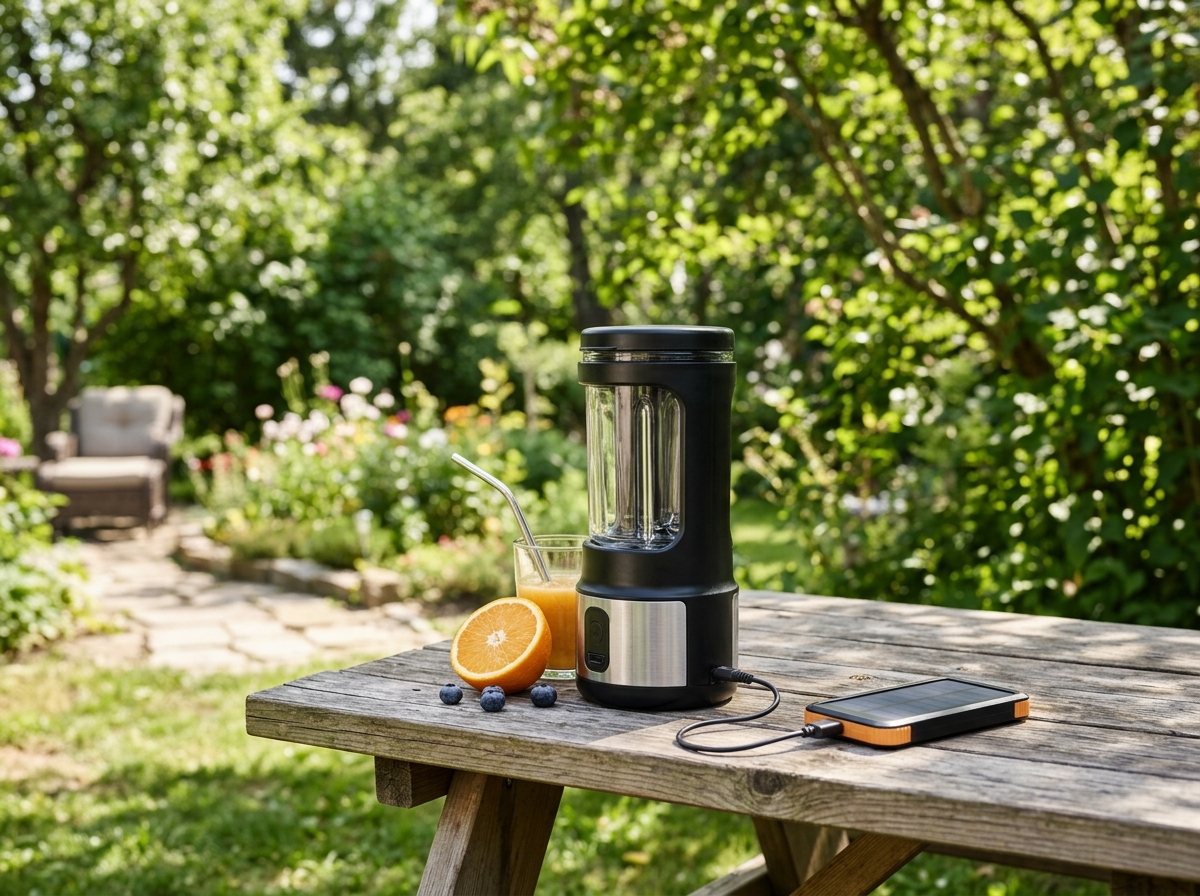
The right comparison focuses on workload rather than the largest battery number printed on a product page. A buyer who makes one soft-fruit drink at work has different requirements from a user who blends frozen fruit outdoors several times in one day.
For manufacturers and importers, battery performance should be translated into a clear product claim. “Up to 15 blends” is more useful when it identifies the recipe, liquid volume, ingredient condition, charge state, and test method. Claims should also distinguish laboratory or supplier testing from independent review and consumer experience.
A juicer that stops after one cycle does not automatically have a defective battery. The cause may be an overloaded blade, an incorrectly fitted cup, insufficient liquid, a low-temperature protection response, or a charger that is not delivering the expected input.
A slow charge can indicate a cable, adapter, port, or battery-management issue rather than normal battery aging. Inspect the connector for moisture or debris, use the specified charging equipment, and compare the indicator behavior with the manual. If the unit becomes unusually hot, swells, emits an odor, or shows physical damage, stop using it and contact the supplier.
A sharply reduced number of cycles after normal use is a reason to document the test before requesting support. Record the recipe, starting charge, charge duration, cycle count, ambient conditions, and any warning light. This evidence helps separate a battery-capacity issue from a high-load recipe or charging problem.
It may last for several blends, and reported small-blender results range from about 10–20 light-duty blends. Actual performance depends on the model, recipe, battery condition, and test method.
No. Higher capacity can provide more stored energy, but motor load, efficiency, blade design, protection settings, and charging conditions also determine usable performance.
There is no universal charging time. Some device-specific reports describe about 30 minutes, while another user report describes three hours. Follow the model’s manual and charger specification.
Only if the manufacturer expressly allows it. Ice and frozen ingredients create high mechanical load, so the user may need smaller pieces and additional liquid.
Common causes include thick recipes, frozen ingredients, repeated stalls, incomplete charging, battery aging, high temperature, or a charging cable and adapter problem.
Only when the manufacturer explicitly supports pass-through operation. Many cordless appliances disable the motor during charging for safety reasons.
Ask for battery capacity, charging input, full-charge time, tested cycles per charge, recipe conditions, safety documentation, warranty terms, replacement-part support, and market-specific compliance information.
Anzhi is a kitchen-appliance manufacturer established in 2021, with product coverage including air fryers, air fryer ovens, electric ovens, air purifiers, and portable juicers. The company supports OEM and mold customization, automated production, digital control, and overseas supply for trading companies and cross-border sellers. For rechargeable juicer sourcing, buyers can request a product specification review, sample testing plan, packaging discussion, and export-market support through the company’s official website.
Need a clearer battery specification for your next portable juicer project? Compare the intended recipe, charging requirement, target market, and cycle test conditions before requesting a quotation.


