Choosing a supplier for a Horizontal Ribbon Mixer takes more than comparing prices or catalog capacities. Buyers need to examine how each manufacturer handles material variability, batch size, cleaning access, and service support. A powder that flows freely into a mixer may behave differently after humidity rises or ingredients become cohesive. Small details matter: ribbon clearance, discharge-door design, weld finish, and access to wear parts can affect daily operation.
Industrial mixing authority Edward L. Paul’s work offers a useful principle: mixer selection should follow the process, not the other way around. This is a paraphrase of his broader work, not a verified direct quotation. It is a practical test for evaluating manufacturers. Ask how they validate mixing performance, what data supports their recommendations, and whether they can explain limitations—not just benefits. A polished brochure is not process evidence.
This guide compares leading Horizontal Ribbon Mixer manufacturers for global buyers, with attention to engineering capability, customization, quality controls, and after-sales support. It also considers the less visible realities: commissioning schedules, communication across time zones, and spare-parts availability. No supplier is ideal for every application. A careful shortlist should reflect your actual materials, plant constraints, and maintenance capacity. Start with those facts, then compare equipment.
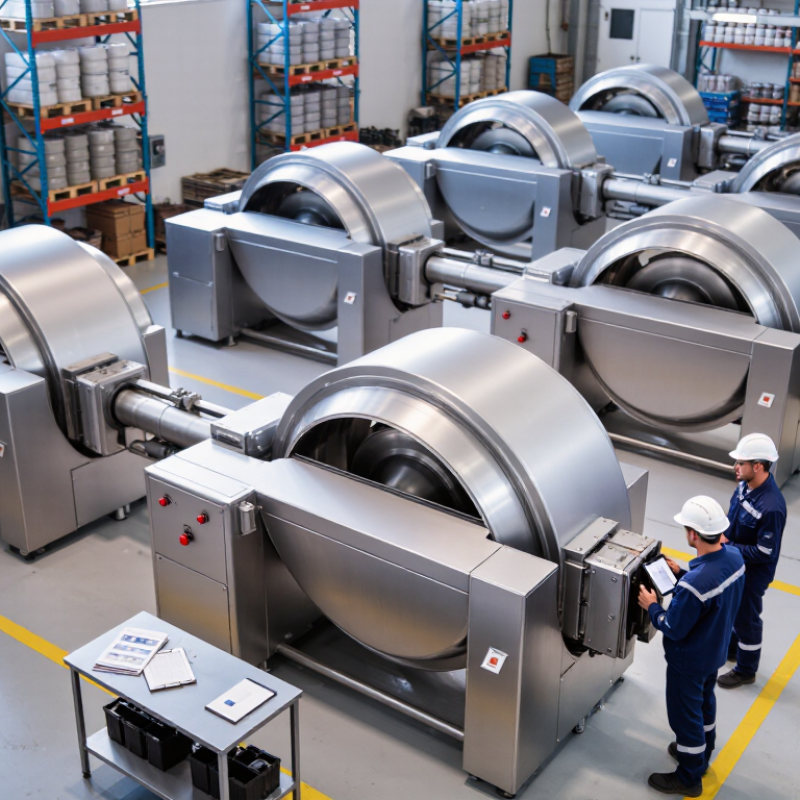
A horizontal ribbon mixer uses a U-shaped trough and a rotating shaft fitted with inner and outer helical blades. The blades move dry ingredients in opposing directions, creating repeated circulation across the vessel. This design suits powders and small granules, including flour blends, animal-feed ingredients, minerals, and selected chemical materials. It can also handle modest liquid additions, though sticky formulations may need a different mixer. The process looks simple. Control is not.
Applications often demand uniformity without damaging fragile particles. Operators therefore consider batch size, fill level, mixing time, discharge design, and cleanability—not just motor power.
The OECD-FAO Agricultural Outlook 2024–2033 projects global agricultural and fish production to grow 14% over the decade. That outlook is not a mixer-sales forecast, but it signals continued pressure on food and feed processing capacity.
Small details matter: a poorly positioned spray nozzle can leave damp pockets, while an unsuitable fill level can create uneven movement.
For global buyers, compare test results using the actual recipe, not only a supplier’s stated capacity. Ask how samples are taken and how uniformity is measured; results can shift with sampling method.
Published figures can mislead. A larger machine is not automatically better, and a short test may miss cleanout problems or product buildup around seals. Those trade-offs deserve another look before specifying equipment.
When evaluating horizontal ribbon mixer manufacturers, look beyond catalog capacity and polished photographs. Ask how the mixer handles your ingredients, target batch size, and required mixing time. Powder density, particle size, and moisture can change performance. Small details matter. Request a trial with a representative blend, and ask how uniformity is measured across samples taken from different points in the vessel.
Inspect the proposed design closely. Check ribbon clearances, shaft seals, discharge-gate access, and materials of construction. Ask for motor and gearbox specifications, expected maintenance intervals, and documented safety features. A reliable manufacturer should explain its assumptions and provide drawings that match the quotation. Request references from customers with comparable processes, while recognizing that one successful installation does not guarantee the same result for every blend. Even a carefully controlled test has limits if the sample differs from routine production. Service matters, too: clarify spare-part availability, installation support, and response times before ordering. Compare these answers in writing; vague promises are hard to assess later.
Suggested evaluation weights for comparing suppliers
Use these suggested weights as a buyer scorecard, then rate each supplier against the same criteria. The percentages are a planning framework, not measured market statistics or ratings of specific manufacturers.
Comparing horizontal ribbon mixer manufacturers starts with the process, not the catalog. A capable supplier asks about batch size, bulk density, flow behavior, and target blend time. These details influence trough dimensions, ribbon geometry, motor sizing, and working fill level. Ask how mixing performance is verified; a trial with representative material is more useful than a polished brochure. Small details matter. Inspect shaft seals, access doors, discharge gates, and wear surfaces. They affect cleaning time, maintenance access, and reliability during daily production.
Designs and customization options differ. Manufacturers may offer variable-speed drives, different discharge arrangements, product-contact materials, or tailored control panels. Request drawings and confirm which parts can be inspected or replaced without major disassembly. Check that the proposed mixer fits the available floor space and connects to existing feeding and packaging equipment. Customization can solve a real process constraint, but it may also add cost and complexity. More options are not always better. An access hatch that is too small, for example, can make routine inspection awkward. Compare clear specifications, test methods, and service documentation before choosing a supplier.
A horizontal ribbon mixer supplier should be assessed through verifiable evidence, not brochure claims. Request material certificates, weld inspection records, and a factory acceptance test using a representative batch. Watch the discharge gate and inspect product hold-up near the trough ends. Small details matter. The ISO Survey of Management System Standard Certifications reported 1,265,216 ISO 9001 certificates across 190 countries and economies in 2022. Certification can indicate a documented quality system, but it does not prove that a mixer suits a specific powder, batch size, or cleaning routine. Ask how the supplier validates blending uniformity and what acceptance criteria apply.
Compliance and service deserve equal scrutiny. Compare the proposed equipment’s materials, guarding, electrical documentation, and cleaning access with the requirements at the installation site. Ask for written spare-parts lead times, commissioning scope, and response arrangements across time zones. The World Bank’s Logistics Performance Index 2023 assessed 139 countries on factors including logistics services and timeliness; these conditions can affect equipment delivery and support. A supplier’s delivery estimate is not a service plan. Request references for comparable installations and clarify who handles troubleshooting after handover. One weak point remains: documentation may be complete while local technical support is thin. That gap is easy to overlook.

A horizontal ribbon mixer is not a stand-alone purchase. Buyers should compare usable working volume, batch size, product contact materials, discharge design, and cleanout access. Ask manufacturers for a written scope covering drawings, motor data, installation needs, commissioning, operator training, and spare-parts lead times. A factory acceptance test using representative material can reveal dead zones or discharge problems before shipment. It is not a perfect substitute for production trials.
Plan the installation around the actual room. Check door widths, floor loading, lifting access, electrical supply, and dust collection before approving the layout. The International Energy Agency’s 2011 report on electric motor-driven systems estimates that these systems use about 69% of industrial electricity. That makes motor sizing and operating duty worth checking, rather than accepting a default selection.
Small details count.
Long-term support needs evidence. Request recommended inspection intervals, wear-part lists, troubleshooting procedures, and response-time commitments in writing. The U.S. Department of Energy’s Operations & Maintenance Best Practices guide reports potential energy savings of 5% to 20% from effective maintenance programs, though actual results depend on the facility and equipment. Build a service plan around seals, bearings, ribbons, and gearbox checks.
One awkward question remains: who owns the first-year performance data? Agree on what will be recorded, such as batch time, motor load, and discharge residue.


For those larger-sized parts, or smaller quantity runs, we have 2 independent powder coat booths and ovens. The quality, durability and affordability of today’s powder coating finishes make this the process of choice for world-class companies.
Powder coating advantages over other forms of coating are many. Materials used in the Powder coating process can be metals and non-metals that come in a multitude of thicknesses, textures, colors, etc. Another of Powder coating’s biggest advantages over conventional coatings is its ability to create finishes in many different textures. Powder Coating Booths allow us the ability to apply these advantages to large products.
Tri-State Fabricators runs a full-service conveyor line for painting. Wet painting can provide protection or decoration to many different part styles. From start to finish, every project is easier to undergo random and point-based inspection by our skilled painting team.
Advantages to our Wet Paint Line are these lines start with product prep and ends with a thorough inspection of a high quality finished product. Our ability to complete large and small projects with a superior finish and doing so in a timely and economical fashion. This passes along the savings in production to our customers. When powder coating ins not an option, our Wet Paint Line gets the job done right the first time.
When the parts get big and heavy we roll-out our custom paint racks and oversize booth. By utilizing our partnerships with all the major paint brands, we can match virtually any color with wet paint.
The advantages of having access to a Wet Paint Booth are many. Large projects of many different shapes can be loaded into the booth. The Wet Paint Booth offers an environment that is much more controlled than a typical parts painting operation.
Not only are they used because of their controlled environment, but they’re are also advantageous when it comes to applying paint to parts that are needed in industries that require specialty coatings such as medical, aerospace, etc.
Our military forces have some very high standards when it comes to the finish of their vehicles and equipment. From the first pre-treatment step to final coat, it takes a great deal of knowledge and experience to protect the men and women of our armed forces. They deserve only the best, and Tri-State Fabricators provides it.
All of our processes are closely monitored by our staff and management teams. Both of which are highly trained in the processes of metal fabrication and finishing. Tri-State Fabricators’ goal is to always fully satisfy each and every customer, including the military. We will always put a 110% into what we do.
Abrasive media blasting is an excellent way to remove old paint, rust, and increase the paint/powder adhesion. Glass beads produce a much smoother and brighter finish than angular abrasives; leaving the part clean yet without any dimensional change. Chemically inert and environmentally friendly, we can recycle our beads approximately 30 times; making them a more preferred method of metal cleaning or surface finishing.
Advantages to Glass Bead Blasting are many. Glass bead blast media is used when a project is needing rough surfaces need to become smooth for applications of coatings such as paint. It is typically used to clean paint and rust from a product surface without deforming the surface it is being used on. Overall, compared to many other blasting media, Glass Bead Blasting is a very economical choice and those savings are always passed on to our customers.
Tri-State Fabricators utilize a zinc phosphate wash to clean and etch the material to ensure the best paint adhesion possible. The unique design of our 3-stage wash system does the work like a 5-stage. From Cleaning and rinsing to conversion coating and post-treatment, Our Part Washing process is a complete service and works throughout the fabrication service and the finishing service.
Along with the previously mentioned benefits, Curing is a vital chemical reaction that leaves the product finish hard and relatively safe from mild abrasion and aggressive corrosion. This process can be done in more than one way; ambient air-dry or in curing ovens at temps that exceed 240°.
From fixing paint mistakes (someone else’s of course) to simply cleaning our paint line hooks, our burn-off oven is put to good use. After a quick burn-off, a little clean up, and a fresh coat of paint, your parts will look better than new.
Why does our Burn-Off Oven work so well? Because super heating the air around parts turns the materials into ashes. From paint and powder coatings to rubber and machining oils, high temps do the job without degrading the integrity of the part.
Masking is a vital part of producing high quality products. We have die-cut masking patterns to protect machined surfaces as well as a wide range of plugs and caps to protect threaded holes and bolts. We provide permanent and temporary masking.
Masking allows the selected sections of a product to be protected from a fabrication or finishing service. This can be with both chemicals when etching and tapes, paints when only finishing just a section of the product. Masking is great in aiding the customization process of a project.
Screen printing is a photographic process that transfers artwork onto a porous nylon screen which allows colored ink to flow through the screen and be deposited on an aluminum or plastic component. We can generally have just about any design created onto a screen for your parts.
Some of the advantages of Screen Printing are, brand recognition for your business displaying on your products, assembly instructions, product warnings/hazards, etc. Tri-State Fabricators produces Screen Printing of the highest quality so you know it’s durable.
Metal Finishing is the art of treating the exterior portion of product, often metal but can also be made of other materials, so that the surface is clean and free of any debris. Then the process of applying coats or either paint of powder coat takes place. This coating process improves the quality of the product in both appearance and resistance to wear and corrosion.
Tri-State Fabricators, Inc., understands that a project typically isn’t complete until a high-quality finish has been added to your product. This is why our painting and powder coating teams continuously inspect the products throughout the Metal Finishing process.




