How to Source Metal Balusters Globally in 2026?
Global sourcing for Metal Balusters in 2026 demands more than comparing factory prices. Buyers must examine design quality, material grades, production capacity, and documented testing. A polished catalog can hide thin tubing, uneven welds, or coatings that fail beside the sea.
Architectural metals consultant Paul McAlister advises, “A baluster is small, but its safety, finish, and fit reveal the supplier’s entire discipline.” His point remains practical. A reliable supplier should provide alloy details, dimensional drawings, sample sections, coating specifications, and recent quality records. Ask for photographs from production, not only showroom images. Request a physical sample before approving a container order.
Regional conditions also matter. Stainless steel may suit humid coastal projects better than ordinary mild steel. Powder coating can perform well, but pretreatment and film thickness deserve close attention. Packaging requires equal care. Separators, corner protection, and moisture control can prevent scratched finishes after a long ocean journey.
A responsible sourcing plan should compare factories across several measures. Price is only one measure. Review minimum order quantities, tooling fees, lead times, inspection access, replacement policies, and communication speed. Confirm shipping terms clearly. Verify local building requirements with qualified professionals before production.
The process is rarely perfect. A promising supplier may miss a tolerance. A cheaper quote may become expensive after rework. Even experienced buyers can overlook small details, such as thread compatibility or carton strength. Careful records, independent inspections, and staged approvals reduce those risks. In 2026, successful Metal Balusters sourcing will depend on evidence, patience, and a willingness to question attractive assumptions.
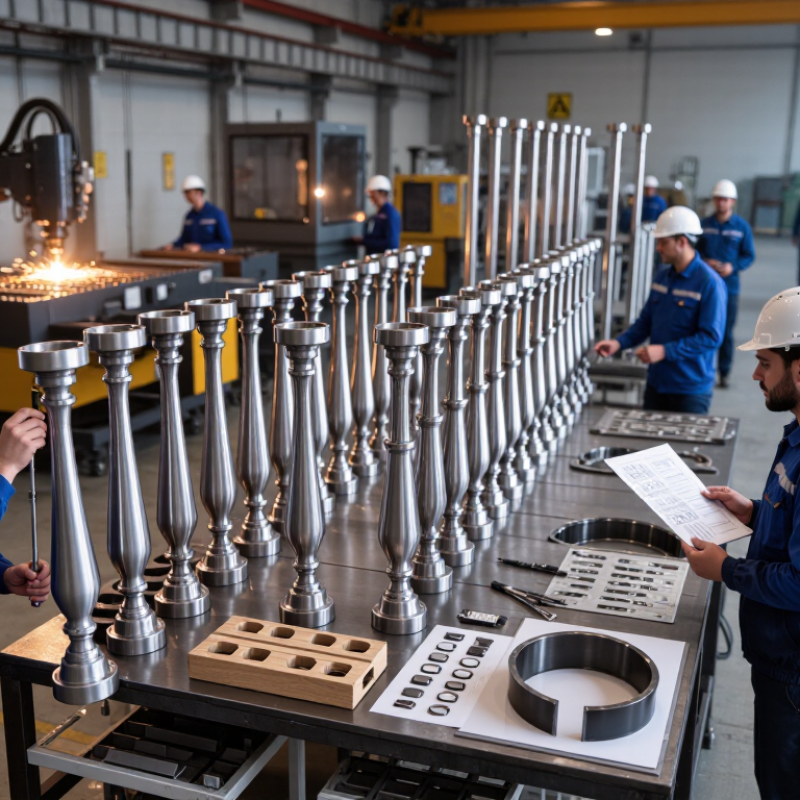
Define Baluster Requirements: 42-Inch Guards, 4-Inch Openings, and 200-Lb Loads
How to Source Metal Balusters Globally in 2026?
Before requesting quotes, convert the design into a measurable baluster schedule. Specify a 42-inch finished guard height, measured from the walking surface to the top rail. State the maximum clear opening as 4 inches. Include spaces near posts, floors, and decorative transitions. These figures are design targets, not universal law. Confirm local building requirements with a qualified professional before production.
Treat the 200-pound load as a test requirement, not a vague promise. Ask whether it means a concentrated load, horizontal rail load, or another project-specific condition. Require drawings showing tube thickness, alloy or steel grade, weld details, anchor types, and allowable tolerances. A sample baluster should face dimensional checks, finish inspection, and load testing before bulk approval. Small variations can change the opening measurement.
Global sourcing adds practical risks. Shipping moisture may damage unfinished metal, while packaging can bend slender sections. Request corrosion protection details and photographs of packed goods. Factory records, test reports, and batch identification improve traceability. Do not rely on polished samples alone. A supplier may meet the sample and miss the production tolerance. That possibility deserves written controls.
Leave room for review. A 4-inch gauge check is useful, but it cannot replace engineering judgment. Confirm site measurements after flooring, paint, and rail installation. The final guard may not match the early drawing. That is inconvenient, yet common. Clear specifications make corrections cheaper before containers leave the factory.
Select Materials: 304/316 Stainless Steel, 6063-T5 Aluminum, or Galvanized Steel
Global metal baluster sourcing in 2026 starts with choosing the right material for the project environment. 304 stainless steel suits indoor stairs and covered areas, offering clean appearance and dependable corrosion resistance. 316 stainless steel is safer for coastal air, pool zones, and frequent moisture. Its higher cost can prevent premature staining and replacement.
6063-T5 aluminum is lightweight, easy to handle, and practical for projects where installation speed matters. However, it can dent more easily than steel. Galvanized steel provides strong structural value for exterior applications, especially when budgets are tight. Inspect the zinc coating carefully. Thin or damaged areas may become early corrosion points.
Tips: Request samples before placing a large order. Compare wall thickness, surface finish, weld quality, and packaging protection. Ask suppliers for mill certificates, coating records, dimensional tolerances, and salt-spray test details. Confirm the actual alloy, not just the product description. Small differences matter.
A trial shipment can reveal problems that photos hide. Check threaded inserts, cut edges, and protective film after transport. In my experience, packaging damage causes more frustration than expected. Still, test results do not predict every installation condition. A 316 sample may perform poorly if fabrication leaves contamination on its surface. Aluminum may look perfect, then show marks during handling. Review the first batch with the installer, and record every defect before scaling the order.
Screen Global Suppliers Using ISO 9001, EN 1090-1, and AWS D1.1 Credentials
When sourcing metal balusters globally in 2026, credentials should guide your first screening, not replace technical judgment. ISO 9001 shows that a supplier controls documented processes, inspections, corrective actions, and customer feedback. Ask for the current certificate, issuing body, scope, and expiration date. A certificate covering unrelated products may offer little protection.
For structural baluster systems, review EN 1090-1 evidence carefully. Check whether the supplier’s execution class, factory production control, and material traceability match your project requirements. Request mill certificates, welding procedure records, dimensional reports, and coating test results. AWS D1.1 credentials can strengthen confidence in welded steel fabrication, especially when weld appearance, penetration, and inspection records matter. Still, paperwork is not proof by itself. I have seen neat certificates paired with inconsistent hole spacing and incomplete weld logs.
Compare certificates with the actual factory address and production scope. Ask for a recent sample, not only photographs. Verify welders’ qualifications, inspection methods, and batch identification. Check whether stainless steel, carbon steel, or aluminum changes the applicable standard. Keep written records of every clarification.
Tips: Compare certificates with the actual factory address and production scope. Ask for a recent sample, not only photographs. Verify welders’ qualifications, inspection methods, and batch identification. Check whether stainless steel, carbon steel, or aluminum changes the applicable standard. Keep written records of every clarification.
A practical audit should follow one baluster from raw material receipt to packing. Measure tube thickness, joint alignment, surface finish, and protective packaging. Ask how rejected parts are isolated. Some suppliers answer well but document poorly. That weakness deserves attention, even when the price looks attractive. Standards help reduce risk, but careful sampling and repeat inspections remain necessary.
Verify Samples for Weld Quality, Coating Thickness, Tolerances, and Salt-Spray Life
Global metal baluster sourcing in 2026 depends on evidence, not attractive photographs. A supplier sample should represent production material, welders, finishing line, and packing method. Request drawings with alloy, tube wall, joint design, and critical dimensions. Then inspect several pieces, not one. One perfect sample proves very little.
For weld quality, examine bead continuity, penetration, alignment, and visible undercut. Cut one sacrificial joint when the project allows it. This can expose porosity hidden beneath grinding. Record photographs under consistent light. Measure coating thickness on flat surfaces and weld zones with a calibrated gauge. Check multiple points on each part. Thin corners often fail first. Confirm adhesion after curing, because a thick coating can still bond poorly.
Tolerances need a fixture, not a casual ruler check. Verify post height, hole spacing, base plate flatness, and handrail fit against approved drawings. Ask for control plans and inspection records dated by batch. For corrosion resistance, define the salt-spray method, hours, specimen preparation, and failure criteria before testing. Independent laboratory reports are stronger than unverified claims. Still, salt spray does not perfectly predict outdoor life. Weather, drainage, scratches, and coastal pollution matter. I would also review rejected samples honestly. They reveal process weaknesses. Sometimes the specification is unclear, and that is our mistake.
How to Source Metal Balusters Globally in 2026?
Verify samples for weld quality, coating thickness, dimensional tolerances, and salt-spray durability before approving production.
How to Use These Checkpoints
These values are practical procurement checkpoints for sample approval, not supplier performance data. Confirm the final limits in the project specification, applicable local standards, and the selected material system.
- Welds: Use 100% visual inspection on samples to check continuity, undercut, cracks, porosity, and incomplete fusion. Non-destructive testing may be added for critical joints.
- Hot-dip galvanized coating: 85 μm is the minimum average coating thickness commonly specified by ISO 1461 for steel thicker than 6 mm; thinner steel sections use different limits.
- Powder coating: 60 μm is a common project minimum for dry-film thickness, but the coating system and substrate should determine the final requirement.
- Dimensional tolerance: ±0.8 mm corresponds to the medium class of ISO 2768 for linear dimensions from 400 mm to 1,000 mm.
- Salt spray: 1,000 hours is a frequently specified project exposure target. ASTM B117 defines the test method, not a universal pass/fail life, so the acceptance criteria must be written into the purchase specification.
Compare Landed Costs, MOQs, Incoterms, Lead Times, and HS 7308.90 Classification
How to Source Metal Balusters Globally in 2026?
Global sourcing starts with landed cost, not the factory quotation. Calculate the baluster price, tooling, export packing, inspection, freight, insurance, duties, brokerage, and inland delivery. A low FOB price can become expensive after port charges and customs fees. Request separate figures for 500, 1,000, and 3,000 units. MOQ affects cash flow, storage, and design flexibility. It should not be judged by price alone.
Incoterms define who controls transport risks and costs. Under EXW, the buyer usually manages more of the shipment. FOB may offer clearer export responsibility, while DDP can simplify delivery but requires careful duty verification. Ask for a written cost breakdown. Small wording differences matter. I have seen sourcing spreadsheets overlook terminal handling fees and seasonal freight increases.
Lead time should include sampling, drawing approval, production, quality inspection, and transit. A supplier quoting 25 production days may not include a three-week ocean journey. Build a buffer. It protects project schedules. For customs planning, HS 7308.90 is commonly considered for certain iron or steel structures and parts, including some baluster components. Classification depends on the product’s material, construction, and importing country. Confirm the code with a qualified customs broker or local authority before shipping. Do not rely only on a supplier’s invoice description. Specifications, photos, and packing lists should tell the same story.
How to Source Metal Balusters Globally in 2026?
Comparison of indicative landed costs, MOQs, Incoterms, lead times, payment terms, and HS 7308.90 classification for standard steel metal balusters.
Global Sourcing Benchmark — Standard Steel Balusters, 2026 Planning Scenario | Origin Market | Typical Product Specification | Indicative Factory Price
USD / Piece | Typical MOQ | Common Incoterms | Estimated Lead Time | Estimated Landed Cost
USD / Piece | Typical Payment Terms | HS Classification Guidance |
| China | Carbon-steel or stainless-steel baluster; 900–1,000 mm height; powder-coated or electroplated finish. | $3.80–$8.50
FOB basis | 500–1,000 pieces
per design or finish | EXW, FOB, CIF, DDP | 30–55 days after sample approval and deposit. | $7.20–$15.80 | 30% deposit; 70% before shipment. Letter of credit may be available for larger orders. | HS 7308.90 may apply where the item is a prepared structural part of iron or steel. Confirm with the importing customs authority. |
| India | Mild-steel, stainless-steel, or cast-metal balusters; painted, powder-coated, or polished finishes. | $4.50–$10.50
FOB basis | 300–800 pieces
per design | EXW, FOB, FCA, CIF | 35–65 days, including fabrication and surface finishing. | $8.10–$17.60 | 30% deposit; balance against shipping documents or prior to dispatch. | HS 7308.90 is a possible heading for structural steel components; decorative articles may require a different classification. |
| Vietnam | Fabricated steel or stainless-steel balusters; standard hollow sections and customized ornamental patterns. | $4.80–$10.80
FOB basis | 500–1,000 pieces | FOB, FCA, CIF, DAP | 35–60 days after approved drawings and production sample. | $8.00–$16.90 | 30% deposit; 70% before shipment or against copy of bill of lading. | Use HS 7308.90 only when the product meets the importing country’s definition of a structural part. |
| Turkey | Powder-coated steel, stainless steel, or forged-metal balusters; commonly supplied for architectural and residential projects. | $6.50–$13.50
FOB basis | 200–500 pieces | EXW, FCA, FOB, DAP | 25–50 days, with shorter transit times to Europe and nearby markets. | $9.80–$19.40 | 30% deposit; 70% before shipment. Documentary credit may be negotiated. | HS 7308.90 can be relevant for fabricated structural parts, subject to product construction and customs interpretation. |
| Poland / Central Europe | Powder-coated steel or stainless-steel balusters; higher customization and documentation capability. | $8.50–$18.00
EXW basis | 100–300 pieces | EXW, FCA, DAP, CPT | 20–45 days after design approval; domestic or intra-European delivery can be faster. | $11.00–$22.00 | 30% deposit; balance before delivery or on agreed commercial credit terms. | For qualifying structural components, HS 7308.90 may be used; obtain a binding tariff decision where classification risk is material. |
| Mexico | Carbon-steel or stainless-steel balusters; powder-coated, painted, or plated finishes for North American supply chains. | $7.50–$16.00
EXW / FCA basis | 100–500 pieces | EXW, FCA, DAP, DDP | 20–45 days, excluding engineering changes and special tooling. | $10.00–$20.50 | 30% deposit; balance before shipment or under approved open-account terms. | HS 7308.90 may apply to prepared structural steel parts. Preferential trade treatment depends on origin rules and documentation. |
Costing basis: The landed-cost ranges are planning benchmarks for a shipment of approximately 2,000 standard balusters to a major North American or Western European seaport. They assume export packing, ocean freight, cargo insurance, port and customs handling, inland delivery, and a normal commercial shipment. Destination VAT, sales tax, installation, project-specific certification, special tooling, anti-dumping duties, sanctions-related surcharges, and extraordinary tariff measures are excluded unless separately quoted.





