7 Fishing Net Buying Tips for Global Buyers

A Fishing Net is not a simple commodity. Its mesh, twine, material, knotting, and construction affect performance, service life, and replacement costs. Global buyers must compare more than price. They need clear specifications, credible testing, and suppliers who can explain how a net is made. Fit matters.

The scale is significant. FAO’s 2024 State of World Fisheries and Aquaculture reported 223.2 million tonnes of global fisheries and aquaculture production in 2022, including aquatic animals and algae. That production depends on equipment suited to different species, vessels, water conditions, and working practices. A net that performs well in one setting may fail in another. Small details matter: mesh openings should be measured consistently, and twine should be checked for diameter and finish.

Durability also deserves careful attention. A 2021 FAO–UNEP assessment estimated that 5.7% of fishing nets are lost annually, based on its review of available fisheries data. This figure is not a product failure rate, but it highlights why strength, repairability, and responsible end-of-life planning belong in a buying decision. Ask for product samples, test records, material details, and realistic delivery terms. Not every low quote is a bargain. The following seven tips help global buyers compare options more confidently, while leaving room for an honest truth: no specification can replace testing the net under real working conditions.
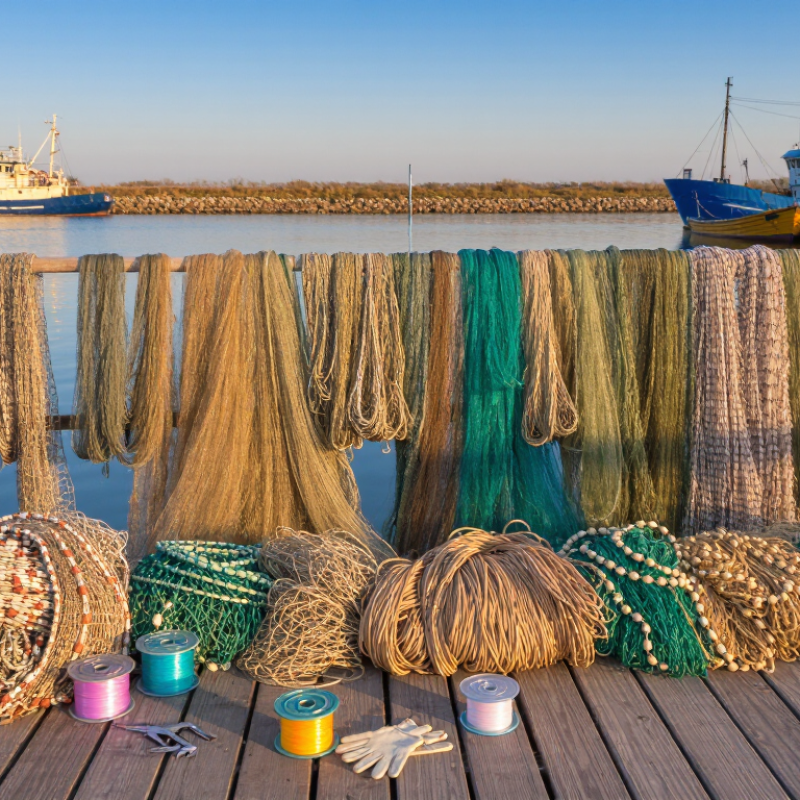
7 Fishing Net Buying Tips for Global Buyers

Identify the Fishing Method and Operating Conditions

Before comparing prices, define the fishing method: gillnetting, purse seining, trawling, or fixed-net use. Each places different loads on mesh, seams, floats, and ropes. A drifting gillnet may face waves and repeated hauling; a bottom-set net meets abrasion and snags. Small details matter. FAO’s 2024 SOFIA report records 92.3 million tonnes of wild capture in 2022. That scale does not mean one net suits every fishery.

Describe the water before specifying mesh size. Share the target species and approximate size, fishing depth, current, exposure, bottom type, and typical soak or haul time. For example, a net worked over rocky ground needs more abrasion resistance than one used in calm, open water. Mesh openings should suit the intended catch size and allow unwanted sizes to escape. Confirm twine diameter, knot style, hanging ratio, and float and sink weights against your actual operating conditions. Test a sample under routine handling. Records help.

Durability deserves equal scrutiny. A 2009 FAO technical report estimated annual fishing-net loss at 5.7%, while noting substantial uncertainty in the underlying data. Treat this as a warning, not a forecast for your fleet. Ask how UV exposure, saltwater, chafe, repair access, and storage affect service life. A field trial is still worthwhile; catalogue figures rarely capture rough handling or seasonal changes.

Compare Net Types, Materials, and Construction

Choosing a fishing net starts with matching its type to the catch and working conditions. Gill nets hold fish by the mesh, while seine nets surround schools and are hauled in. Cast nets suit small, targeted operations. Compare mesh opening, net depth, and finished dimensions; small measurement differences affect selectivity and handling. Ask suppliers for a sample panel, not just a product photo.

Material affects weight, stretch, abrasion resistance, and service life. Nylon is flexible and handles repeated movement, but may absorb water and needs drying. Polyethylene is lightweight and floats, which can suit some surface applications. Polyester generally holds its shape well. Coatings and UV stabilizers can change performance, so request material specifications and test data. Details matter.

Inspect knots, twine diameter, mesh consistency, seam stitching, and reinforced edges. Knotted nets can be easier to repair in the field; knotless designs reduce snag points, though repair methods vary. Check float and sinker spacing, too.

Tips: Compare identical mesh measurements, confirm twine thickness, and inspect a wet sample when possible. Keep a written specification sheet.

Edge reinforcement is easy to overlook, yet wear can start there. A useful reminder.

Check Mesh Size, Dimensions, and Performance Requirements

A net specification should begin with mesh size, not a vague label such as “small mesh.” State the opening size and measurement method, such as stretched mesh measured knot to knot. Also record twine diameter, material, and knot style; these affect water flow, wear, and handling. The FAO’s The State of World Fisheries and Aquaculture 2024 reports 223.2 million tonnes of global fisheries and aquaculture production in 2022. That scale makes clear why one generic net specification cannot suit every operation.

Tip: Write mesh size, twine thickness, and material on the purchase sheet. Specify finished net length and depth, plus whether dimensions are measured before or after hanging. Ask for a sample or drawing when tolerances are unclear. Small omissions matter.

Performance requirements should reflect the actual site: target species, water depth, current, abrasion, and expected load. A net used near rough surfaces may need different wear resistance from one used in calmer water. Check the supplier’s stated breaking strength and request test conditions; a strength number without test details is hard to compare. Include repair needs and storage exposure, too. UV and salt can age materials. A specification can look complete and still miss the conditions that shorten service life. Recheck the numbers against the fishing method before approving production.

Assess Supplier Quality, Testing, and Certifications

A fishing net can look sound on a factory floor and still fail at a knot. Ask suppliers for recent, batch-specific test reports, not only a polished certificate. ISO 1806:2002 describes testing mesh breaking force, while ISO 1805:2006 covers breaking force and knot strength of netting yarn. Check that reports identify the material, mesh size, sample count, and test conditions. Wet samples matter when the gear will work in water. So does repeatability. One test is not a trend.

Certification needs careful reading. Verify the issuing body, expiry date, and exact product scope; a factory quality certificate does not automatically certify every net it makes. Request traceability from yarn lot to finished net, plus records for coating, UV exposure, and dimensional checks. The FAO’s The State of World Fisheries and Aquaculture 2024 reports 223.2 million tonnes of fisheries and aquaculture production in 2022, including aquatic animals and algae. That scale makes consistent quality more than paperwork. Ask for an independent laboratory’s results and compare them with your own sample inspection. I would still hesitate if the supplier cannot explain a failed test plainly. Good documents help, but they cannot replace opening the sample, measuring the mesh, and checking its knots.

Compare Pricing, Customization, and International Shipping

A low unit price can hide important differences. Compare quotes using the same net dimensions, mesh opening, twine thickness, material, and edge finish. Ask whether floats, weights, repairs, and packing are included. Freight adds up. Request a cost breakdown that separates production, packaging, and transport. A sample can reveal stiffness, knot consistency, and finishing quality before a larger order. Check its specifications against the written quote; memory is not a reliable measuring tool.

Customization is useful when it solves a real handling or site requirement. Share a clear drawing with dimensions, mesh size, color, and attachment details. Confirm acceptable tolerances in writing, since “custom fit” can mean different things to different suppliers. Ask how the material is suited to your expected water and storage conditions, and whether any treatment affects maintenance. Small details matter. I once assumed a standard edge would work, but the sample showed otherwise; that extra check saved rework.

For international shipping, compare more than the freight total. Confirm the shipping method, estimated production and transit times, packaging dimensions, and who arranges export documents. Clarify which party handles import duties and local charges under the agreed delivery terms. Request tracking and a plan for damaged or delayed cargo. Check destination requirements with your customs broker before shipment, because paperwork errors can hold goods at the border. A cheaper route may cost more if it adds weeks or extra handling.


Powder Coat Booths

For those larger-sized parts, or smaller quantity runs, we have 2 independent powder coat booths and ovens. The quality, durability and affordability of today’s powder coating finishes make this the process of choice for world-class companies.

Powder coating advantages over other forms of coating are many. Materials used in the Powder coating process can be metals and non-metals that come in a multitude of thicknesses, textures, colors, etc. Another of Powder coating’s biggest advantages over conventional coatings is its ability to create finishes in many different textures. Powder Coating Booths allow us the ability to apply these advantages to large products.

Wet Paint Line

Tri-State Fabricators runs a full-service conveyor line for painting. Wet painting can provide protection or decoration to many different part styles. From start to finish, every project is easier to undergo random and point-based inspection by our skilled painting team.

Advantages to our Wet Paint Line are these lines start with product prep and ends with a thorough inspection of a high quality finished product. Our ability to complete large and small projects with a superior finish and doing so in a timely and economical fashion. This passes along the savings in production to our customers. When powder coating ins not an option, our Wet Paint Line gets the job done right the first time.

Wet Paint Booths

When the parts get big and heavy we roll-out our custom paint racks and oversize booth. By utilizing our partnerships with all the major paint brands, we can match virtually any color with wet paint.

The advantages of having access to a Wet Paint Booth are many. Large projects of many different shapes can be loaded into the booth. The Wet Paint Booth offers an environment that is much more controlled than a typical parts painting operation.

Not only are they used because of their controlled environment, but they’re are also advantageous when it comes to applying paint to parts that are needed in industries that require specialty coatings such as medical, aerospace, etc.

Military CARC

Our military forces have some very high standards when it comes to the finish of their vehicles and equipment. From the first pre-treatment step to final coat, it takes a great deal of knowledge and experience to protect the men and women of our armed forces. They deserve only the best, and Tri-State Fabricators provides it.

All of our processes are closely monitored by our staff and management teams. Both of which are highly trained in the processes of metal fabrication and finishing. Tri-State Fabricators’ goal is to always fully satisfy each and every customer, including the military. We will always put a 110% into what we do.

Glass-Bead Blasting

Abrasive media blasting is an excellent way to remove old paint, rust, and increase the paint/powder adhesion. Glass beads produce a much smoother and brighter finish than angular abrasives; leaving the part clean yet without any dimensional change. Chemically inert and environmentally friendly, we can recycle our beads approximately 30 times; making them a more preferred method of metal cleaning or surface finishing.

Advantages to Glass Bead Blasting are many. Glass bead blast media is used when a project is needing rough surfaces need to become smooth for applications of coatings such as paint. It is typically used to clean paint and rust from a product surface without deforming the surface it is being used on. Overall, compared to many other blasting media, Glass Bead Blasting is a very economical choice and those savings are always passed on to our customers.

Part Washing

Tri-State Fabricators utilize a zinc phosphate wash to clean and etch the material to ensure the best paint adhesion possible. The unique design of our 3-stage wash system does the work like a 5-stage. From Cleaning and rinsing to conversion coating and post-treatment, Our Part Washing process is a complete service and works throughout the fabrication service and the finishing service.

Along with the previously mentioned benefits, Curing is a vital chemical reaction that leaves the product finish hard and relatively safe from mild abrasion and aggressive corrosion. This process can be done in more than one way; ambient air-dry or in curing ovens at temps that exceed 240°.

Burn-Off Oven

From fixing paint mistakes (someone else’s of course) to simply cleaning our paint line hooks, our burn-off oven is put to good use. After a quick burn-off, a little clean up, and a fresh coat of paint, your parts will look better than new.

Why does our Burn-Off Oven work so well? Because super heating the air around parts turns the materials into ashes. From paint and powder coatings to rubber and machining oils, high temps do the job without degrading the integrity of the part.

Masking

Masking is a vital part of producing high quality products. We have die-cut masking patterns to protect machined surfaces as well as a wide range of plugs and caps to protect threaded holes and bolts. We provide permanent and temporary masking.

Masking allows the selected sections of a product to be protected from a fabrication or finishing service. This can be with both chemicals when etching and tapes, paints when only finishing just a section of the product. Masking is great in aiding the customization process of a project.

Screen Printing

Screen printing is a photographic process that transfers artwork onto a porous nylon screen which allows colored ink to flow through the screen and be deposited on an aluminum or plastic component. We can generally have just about any design created onto a screen for your parts.

Some of the advantages of Screen Printing are, brand recognition for your business displaying on your products, assembly instructions, product warnings/hazards, etc. Tri-State Fabricators produces Screen Printing of the highest quality so you know it’s durable.

Metal Finishing

Metal Finishing is the art of treating the exterior portion of product, often metal but can also be made of other materials, so that the surface is clean and free of any debris. Then the process of applying coats or either paint of powder coat takes place. This coating process improves the quality of the product in both appearance and resistance to wear and corrosion.

Tri-State Fabricators, Inc., understands that a project typically isn’t complete until a high-quality finish has been added to your product. This is why our painting and powder coating teams continuously inspect the products throughout the Metal Finishing process.



