


Choosing a China Bathroom Towel Rack supplier requires more than comparing catalogue prices. The global bathroom accessories market continues to expand, driven by housing construction, renovation, hospitality projects, and online retail. Grand View Research identifies product design, material quality, and distribution capability as important market factors in its Bathroom Accessories Market report. Fortune Business Insights also links bathroom hardware demand with residential development and consumer renovation spending. These findings make supplier evaluation a commercial decision, not merely a sourcing task.
Look beyond polished product photos. A reliable supplier should explain stainless steel grades, coating thickness, load testing, packaging methods, and production capacity. Ask for factory videos, recent inspection records, and samples from the same production line. A 304 stainless steel Bathroom Towel Rack should show consistent welding, smooth edges, and stable wall mounting. Small details matter. The screw bag should be complete. The finish should survive humid bathrooms.
Export experience also deserves verification. Trade data from the International Trade Centre and UN Comtrade can help buyers review China’s broader hardware export performance, although towel racks may appear under different customs classifications. Request references from comparable markets, especially where labeling and product safety requirements are strict. Do not rely on a single certificate.
A practical shortlist should compare audit results, response speed, defect rates, lead times, and after-sales support. Price still matters. It should not lead the decision. No supplier profile tells the whole story. Some claims may be incomplete, and buyers should test them independently. This guide explains how to identify a capable Chinese supplier, reduce sourcing risks, and build a more dependable bathroom hardware supply chain.
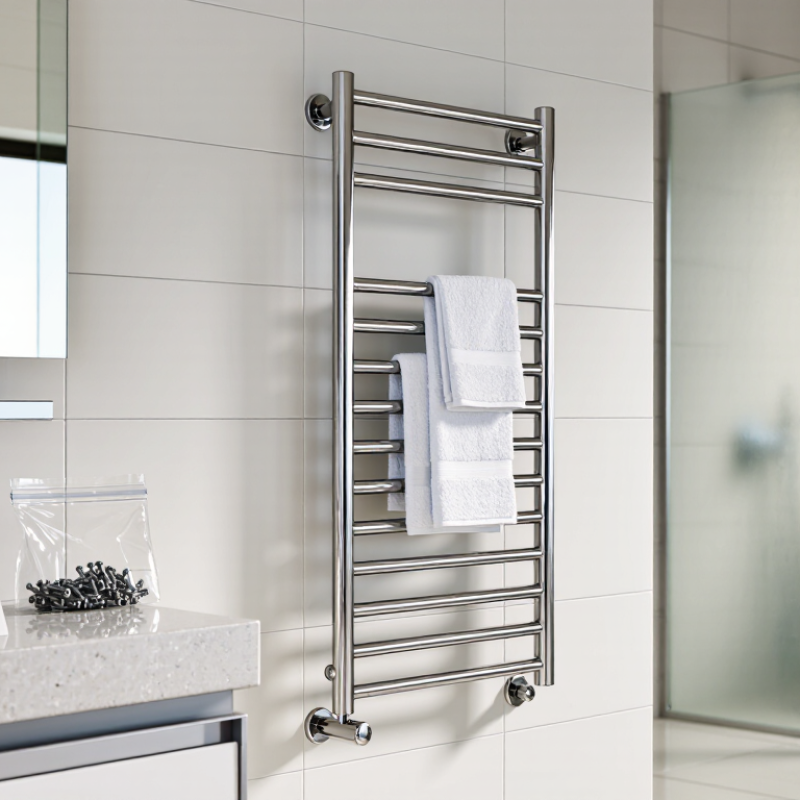
Before searching for a top China bathroom towel rack supplier, define your sourcing requirements clearly. A vague request often produces mismatched samples, delayed quotations, and unnecessary revisions. Record the rack type, dimensions, mounting method, material, finish, and expected load. For example, a wall-mounted rack may need 600 mm width, stainless steel construction, and a brushed surface for humid bathrooms.
Consider the full purchasing context. State your target quantity, packaging needs, delivery destination, and preferred production schedule. Ask whether the supplier can provide drawings, material details, sample approval, and quality inspection records. If your market requires specific safety or product documentation, identify those requirements before negotiation. Do not assume every factory uses the same material grade. I once overlooked this detail, and the sample looked excellent but felt weaker than expected.
Tips: Prepare a simple requirement sheet with photos, measurements, and acceptable tolerances. Separate essential features from optional ones. Confirm installation accessories, carton protection, logo restrictions, and replacement procedures in writing. Request a sample before placing a large order, then test its stability, surface finish, screw alignment, and resistance to bathroom moisture. A checklist helps, but it cannot replace careful inspection. Leave room for improvement. Your first specification may still miss a practical detail, such as cleaning access or wall compatibility.

Finding a top China bathroom towel rack supplier starts with focused research, not attractive product photos. Search verified trade directories, industry exhibitions, and official supplier websites. Check whether the company manufactures racks or mainly resells them. Request factory videos, production photos, business licenses, and recent export experience. A reliable supplier should explain materials, surface treatments, load capacity, and quality controls clearly.
Compare at least three suppliers using the same specification sheet. Include stainless steel grade, dimensions, tube thickness, mounting method, packaging, minimum order quantity, and lead time. Ask for physical samples. Inspect welds, screw alignment, wall plates, and the finish under bright light. Test the rack with weight and check for sharp edges. Request corrosion-resistance test details, but verify the laboratory and test method. Some documents look impressive yet reveal little. That is worth questioning.
Tips: Keep every quotation in one comparison table. Record response times, sample costs, defect policies, and payment terms. Ask for a pre-shipment inspection before final payment. A supplier that accepts reasonable inspection usually shows stronger process discipline. Still, do not rely on confidence alone. My own mistake was comparing unit prices before adding packaging and replacement costs. The cheaper offer became less attractive after these details appeared. Choose the supplier with consistent evidence, practical communication, and specifications your market can verify.
How to Find a China Top Bathroom Towel Rack Supplier?
A reliable supplier should prove more than a polished website. Request its business registration, factory address, and current quality certificates. Ask for evidence. Verify whether the legal company name matches invoices and production documents. A video tour can help, but an independent factory audit provides stronger assurance. Check the audit date, employee count, workshop condition, and quality procedures.
Product verification requires close attention to details. Request samples with the same finish, mounting method, and materials as your planned order. Inspect welds, coating uniformity, screw alignment, and load-bearing performance. Samples reveal gaps. Ask for material reports and test records when corrosion resistance matters. Product photos may look excellent, yet small defects often appear around joints and wall plates. I once trusted a sample too quickly and missed inconsistent plating on the rear surface.
Manufacturing capacity should match your order, not merely impress you. Confirm available equipment, production lines, monthly output, and peak-season schedules. Ask how the supplier handles incoming materials, in-process inspections, and final packing. A clear inspection checklist is valuable. Request recent production videos and anonymized delivery records. Also confirm backup suppliers for key components. Capacity is not only machinery. It includes trained workers, stable materials, realistic lead times, and communication discipline. Leave room for uncertainty, because factory promises can change under pressure. A smaller supplier may offer better control, while a larger one may provide stronger continuity. Compare evidence, not confident statements.
| Verification Category | Data Dimension | What to Verify | Reliable Evidence or Decision Rule | Priority |
|---|---|---|---|---|
| Supplier Qualification | Legal business identity | Confirm the supplier's registered legal name, business address, business scope, registration status, and authorized representative. | The information on the business license should match the quotation, contract, bank account, and export documents. | High |
| Supplier Qualification | Export capability | Review export records, customs documentation, shipping terms, product classification, and experience with the destination market. | The supplier should clearly explain Incoterms, packaging marks, export documents, and responsibility for customs clearance. | High |
| Supplier Qualification | Quality management system | Request a current quality-management certificate and verify the certificate number, scope, issuing body, and validity period. | A certificate such as ISO 9001 can support process control, but it should not replace product inspection or testing. | Medium |
| Supplier Qualification | Factory ownership and production location | Check whether the quoted supplier is the manufacturer, a trading company, or a hybrid operation. Match the factory address with audit documents and video-call evidence. | The supplier should disclose outsourced processes, subcontracted finishing, and the location responsible for final quality control. | High |
| Product Verification | Base material and grade | Verify the material specification for the rack body, mounting plate, screws, hooks, and other load-bearing parts. | The quotation and drawings should identify materials such as stainless steel grade, brass, aluminum, or zinc alloy instead of using only the term “metal.” | High |
| Product Verification | Dimensions and load performance | Check overall dimensions, tube diameter, wall thickness, mounting-hole spacing, fixing method, and intended load. | Use an approved technical drawing and require the supplier to state the tested or specified load under defined installation conditions. | High |
| Product Verification | Surface finish and appearance | Inspect plating, polishing, brushed texture, powder coating, color consistency, weld marks, sharp edges, pinholes, and surface contamination. | Approve a golden sample or signed reference sample before mass production and define acceptable visual defects in writing. | High |
| Product Verification | Corrosion resistance | Request the applicable corrosion-resistance test method, test duration, specimen details, result photographs, and laboratory information. | Do not accept a generic “rust-proof” claim. Compare the test method and acceptance criteria with the requirements of the target market. | High |
| Product Verification | Chemical and moisture resistance | Evaluate resistance to bathroom humidity and commonly used cleaning agents, especially for plated, painted, or adhesive-mounted products. | Require documented test conditions or conduct an independent sample test using the cleaning products expected in the target market. | Medium |
| Product Verification | Safety and installation | Review wall anchors, screws, instructions, mounting templates, edge treatment, installation limitations, and compatibility with different wall types. | Installation instructions should identify suitable wall substrates and should not claim that one fixing method is suitable for every wall. | High |
| Manufacturing Capacity | Key in-house processes | Confirm the availability of tube cutting, bending, stamping, welding, polishing, plating or coating, assembly, and packaging processes. | The supplier should provide a process flow and identify which operations are in-house and which are subcontracted. | High |
| Manufacturing Capacity | Monthly production capacity | Request capacity by specific towel-rack model or product family, together with current utilization and peak-season constraints. | Capacity figures should be supported by production records, equipment lists, staffing information, or an on-site audit rather than a general sales statement. | High |
| Manufacturing Capacity | Production lead time | Separate sample lead time, first-order lead time, repeat-order lead time, and time required for custom tooling or packaging. | The quotation should state lead times in calendar days and define when the lead-time clock starts, such as approval of samples or receipt of deposit. | High |
| Manufacturing Capacity | Tooling and engineering support | Evaluate capability for 2D drawings, 3D files, prototypes, mold or jig development, design changes, and engineering approvals. | Custom products should have documented drawing revisions, approval records, and clear ownership of tooling and design files. | Medium |
| Quality Control | Incoming material inspection | Check whether raw materials and purchased components are inspected for specification, quantity, surface condition, and traceability. | Inspection records should link material batches to production orders and should identify actions for nonconforming materials. | Medium |
| Quality Control | In-process inspection | Review checks for dimensions, weld quality, surface treatment, assembly, torque, and mounting components during production. | The supplier should use documented inspection points and acceptance criteria rather than relying only on final visual inspection. | High |
| Quality Control | Final inspection and defect handling | Confirm sampling plans, defect classification, corrective-action procedures, rework controls, and final inspection records. | Agree on an inspection standard, approved sample, critical defects, major defects, minor defects, and the procedure for resolving failed inspections. | High |
| Commercial Review | Quotation transparency | Compare unit price, tooling, sample fees, packaging, inspection, shipping terms, payment terms, taxes, and replacement policy. | A comparable quotation should use the same specification, quantity, packaging method, delivery term, and currency before price comparison. | High |
| Commercial Review | Sample-to-mass-production consistency | Compare the approved sample with pre-production samples and random finished goods before shipment. | The contract should define that material, dimensions, finish, packaging, and performance must conform to the approved specification and sample. | High |
| Final Decision | Supplier scorecard result | Score qualification, product quality, manufacturing capability, communication, delivery reliability, and commercial risk using documented evidence. | Use weighted scoring and require corrective action for any critical failure involving legal identity, material authenticity, safety, or quality traceability. | High |
How to Find a China Top Bathroom Towel Rack Supplier?
A reliable towel rack supplier should prove quality with samples, not promises. Check the material, welds, coating, and wall brackets carefully. Stainless steel should resist rust after repeated exposure to steam and water. Measure the rack’s load capacity with a practical test, such as several wet towels. Inspect sharp edges and uneven plating under bright light. I once accepted a polished sample too quickly. The production batch showed small surface marks. That experience taught me to request approval samples and clear inspection standards.
Pricing needs more than a low quotation. Compare material thickness, packaging, tooling fees, minimum order quantity, and replacement policies. Ask for a detailed cost sheet. Custom designs may require drawings, molds, or drilling tests. Confirm dimensions, finishes, logo placement, and color tolerance before production. A small change can affect the final price. Keep this in writing.
Tips: Request a sample before placing a large order. Ask for factory photos, test records, and recent production references. Shipping terms must define lead time, carton strength, export documents, and responsibility for damaged goods. Compare total landed cost, not only the unit price. Clarify the agreed Incoterm and inspection point. A supplier that answers slowly may still produce well, but unclear replies deserve careful reflection.
Supplier evaluation scorecard: quality, pricing, customization, and shipping terms
This 100-point sourcing scorecard gives the highest weight to quality because material durability, welding, surface finish, corrosion resistance, and load testing directly affect product performance. Pricing, customization capability, and shipping terms should then be reviewed together to calculate the total landed cost and delivery risk.
A reliable supplier should prove quality through samples, not promises. Request a sample with your exact dimensions, finish, tube thickness, and mounting method. Inspect the welds closely. They should look smooth, even, and free from sharp edges. Check the coating under bright light. Uneven color or tiny bubbles may indicate weak surface preparation. Test the rack on a tiled wall with a realistic towel load. A sample can look excellent yet fail during installation.
Tips: Send one clear specification sheet. Ask for material details, production photos, inspection records, and packaging samples. Confirm whether the sample matches mass production. This question is often forgotten.
During negotiation, discuss more than the unit price. Confirm minimum order quantity, sample fees, tooling costs, production time, spare parts, and replacement procedures. Ask how the supplier handles defects found before shipment. A dependable factory gives specific answers and written commitments. Compare their replies with the sample results.
If details keep changing, pause the negotiation. A lower price is not useful when poor plating creates returns and complaints. I have learned that rushed decisions often hide small costs, especially in packaging and quality checks. Leave room for correction. Even experienced buyers can miss a detail in a drawing or finish description. A transparent supplier welcomes technical questions and updates documents when needed.


For those larger-sized parts, or smaller quantity runs, we have 2 independent powder coat booths and ovens. The quality, durability and affordability of today’s powder coating finishes make this the process of choice for world-class companies.
Powder coating advantages over other forms of coating are many. Materials used in the Powder coating process can be metals and non-metals that come in a multitude of thicknesses, textures, colors, etc. Another of Powder coating’s biggest advantages over conventional coatings is its ability to create finishes in many different textures. Powder Coating Booths allow us the ability to apply these advantages to large products.
Tri-State Fabricators runs a full-service conveyor line for painting. Wet painting can provide protection or decoration to many different part styles. From start to finish, every project is easier to undergo random and point-based inspection by our skilled painting team.
Advantages to our Wet Paint Line are these lines start with product prep and ends with a thorough inspection of a high quality finished product. Our ability to complete large and small projects with a superior finish and doing so in a timely and economical fashion. This passes along the savings in production to our customers. When powder coating ins not an option, our Wet Paint Line gets the job done right the first time.
When the parts get big and heavy we roll-out our custom paint racks and oversize booth. By utilizing our partnerships with all the major paint brands, we can match virtually any color with wet paint.
The advantages of having access to a Wet Paint Booth are many. Large projects of many different shapes can be loaded into the booth. The Wet Paint Booth offers an environment that is much more controlled than a typical parts painting operation.
Not only are they used because of their controlled environment, but they’re are also advantageous when it comes to applying paint to parts that are needed in industries that require specialty coatings such as medical, aerospace, etc.
Our military forces have some very high standards when it comes to the finish of their vehicles and equipment. From the first pre-treatment step to final coat, it takes a great deal of knowledge and experience to protect the men and women of our armed forces. They deserve only the best, and Tri-State Fabricators provides it.
All of our processes are closely monitored by our staff and management teams. Both of which are highly trained in the processes of metal fabrication and finishing. Tri-State Fabricators’ goal is to always fully satisfy each and every customer, including the military. We will always put a 110% into what we do.
Abrasive media blasting is an excellent way to remove old paint, rust, and increase the paint/powder adhesion. Glass beads produce a much smoother and brighter finish than angular abrasives; leaving the part clean yet without any dimensional change. Chemically inert and environmentally friendly, we can recycle our beads approximately 30 times; making them a more preferred method of metal cleaning or surface finishing.
Advantages to Glass Bead Blasting are many. Glass bead blast media is used when a project is needing rough surfaces need to become smooth for applications of coatings such as paint. It is typically used to clean paint and rust from a product surface without deforming the surface it is being used on. Overall, compared to many other blasting media, Glass Bead Blasting is a very economical choice and those savings are always passed on to our customers.
Tri-State Fabricators utilize a zinc phosphate wash to clean and etch the material to ensure the best paint adhesion possible. The unique design of our 3-stage wash system does the work like a 5-stage. From Cleaning and rinsing to conversion coating and post-treatment, Our Part Washing process is a complete service and works throughout the fabrication service and the finishing service.
Along with the previously mentioned benefits, Curing is a vital chemical reaction that leaves the product finish hard and relatively safe from mild abrasion and aggressive corrosion. This process can be done in more than one way; ambient air-dry or in curing ovens at temps that exceed 240°.
From fixing paint mistakes (someone else’s of course) to simply cleaning our paint line hooks, our burn-off oven is put to good use. After a quick burn-off, a little clean up, and a fresh coat of paint, your parts will look better than new.
Why does our Burn-Off Oven work so well? Because super heating the air around parts turns the materials into ashes. From paint and powder coatings to rubber and machining oils, high temps do the job without degrading the integrity of the part.
Masking is a vital part of producing high quality products. We have die-cut masking patterns to protect machined surfaces as well as a wide range of plugs and caps to protect threaded holes and bolts. We provide permanent and temporary masking.
Masking allows the selected sections of a product to be protected from a fabrication or finishing service. This can be with both chemicals when etching and tapes, paints when only finishing just a section of the product. Masking is great in aiding the customization process of a project.
Screen printing is a photographic process that transfers artwork onto a porous nylon screen which allows colored ink to flow through the screen and be deposited on an aluminum or plastic component. We can generally have just about any design created onto a screen for your parts.
Some of the advantages of Screen Printing are, brand recognition for your business displaying on your products, assembly instructions, product warnings/hazards, etc. Tri-State Fabricators produces Screen Printing of the highest quality so you know it’s durable.
Metal Finishing is the art of treating the exterior portion of product, often metal but can also be made of other materials, so that the surface is clean and free of any debris. Then the process of applying coats or either paint of powder coat takes place. This coating process improves the quality of the product in both appearance and resistance to wear and corrosion.
Tri-State Fabricators, Inc., understands that a project typically isn’t complete until a high-quality finish has been added to your product. This is why our painting and powder coating teams continuously inspect the products throughout the Metal Finishing process.

