


Exterior Cladding decisions affect more than a building’s appearance; they shape weather resistance, maintenance needs, fire performance, and long-term costs. For global buyers, comparing products requires more than reviewing color cards or headline prices. Climate changes the equation. Coastal salt, intense sunlight, freeze-thaw cycles, and heavy rain can all influence material choice and service life. A fiber-cement panel suited to one project may not be the best fit for a humid or remote site. No material works everywhere.
Details matter.
A dependable comparison starts with project conditions and verifiable product information. Request current technical data sheets, test reports, warranty terms, and installation guidance from suppliers. Check that stated performance applies to the exact product and finish being quoted. Experienced procurement teams also ask about compatible fasteners, available panel sizes, replacement stock, and packaging for long-distance shipping. A sample board can reveal texture and color, but it cannot show how a full façade will look in changing light. Even careful checklists can miss practical issues, such as local installer familiarity or access to replacement parts. These deserve a second look.
The ten tips ahead offer a clear framework for comparing options, checking supplier claims, and planning installation. Use them to build a shortlist, not to replace project-specific advice. Ask questions early. A little uncertainty is normal; ignoring it is not.
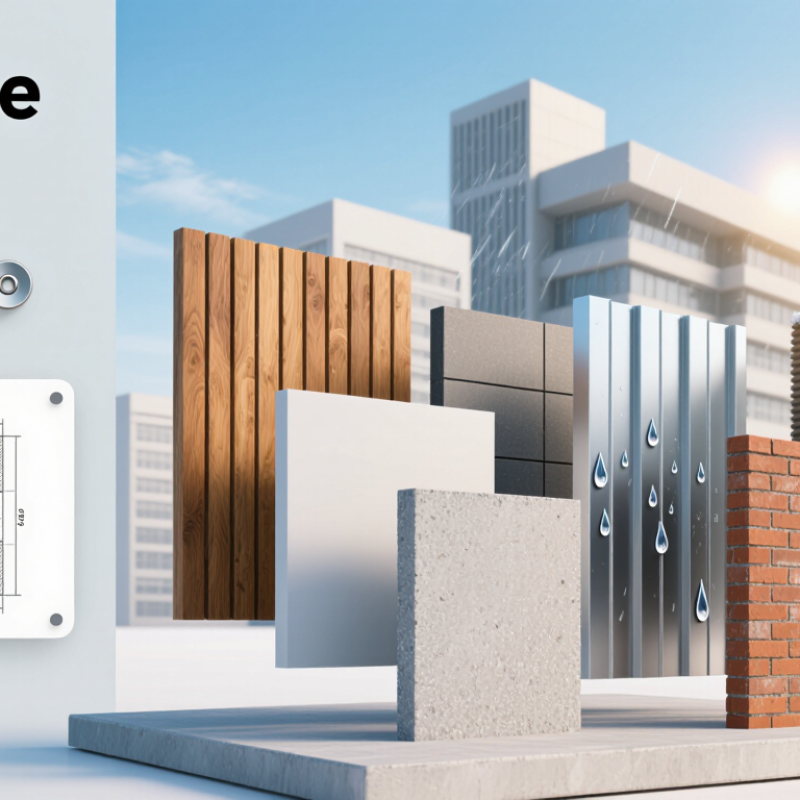
Cladding is the outer layer of a wall, but it is not usually the wall’s structure. Its job is to manage weather, support thermal performance, and shape a building’s appearance. Common options include metal sheets, fiber-cement boards, masonry, timber, and insulated panels. Each behaves differently in sun, wind, rain, and temperature changes. A material that performs well in a dry climate may need more careful detailing in a coastal or humid location.
Look beyond the visible panels. A typical rainscreen system may include cladding, a ventilated cavity, a water-resistive layer, insulation, brackets, and a supporting frame. Flashings guide water away from openings, while properly designed joints allow for movement. Small gaps matter. Poorly placed fasteners or blocked drainage paths can let moisture collect behind the surface. The exact assembly depends on the wall design, exposure, and local building requirements.
Cladding can reduce heat loss, limit rain penetration, and help control noise, but it cannot correct every weakness in a building envelope. Compare tested system details, not just attractive samples. Ask how corners, windows, and base edges are handled. A neat sample can mislead. I would also leave room for uncertainty: installation quality and site conditions may affect results more than a brochure suggests. Check maintenance needs, repair access, and compatibility with the existing wall before choosing a system.

Cladding should be selected for the weather it will actually face, not just its appearance in a sample photo. In coastal areas, salt spray and driving rain can accelerate corrosion and expose weak joints. In hot, sunny climates, surface temperature, UV exposure, and fading deserve attention. Freeze-thaw cycles create another challenge: trapped water can expand behind panels. Small details matter.
Tip: Compare materials against local temperature ranges, rainfall, wind exposure, and maintenance access. Ask for test data covering water penetration, fire performance, and impact resistance. Check how the full wall assembly handles drainage and ventilation; a durable panel cannot compensate for poor detailing. Request samples, too. A hand-sized piece may reveal texture, but it cannot show how a façade will age across a large wall.
Project requirements should guide the final choice. A lightweight system may reduce structural demands, while a busy public entrance may need stronger impact resistance. Review fixing methods, replacement access, and compatibility with the supporting wall before ordering. Confirm that performance documentation applies to the proposed assembly, not only to one component. There is no perfect material. Even careful comparisons leave some uncertainty, especially when exposure varies across a site. A shaded corner and a sunlit upper floor may age differently. Plan inspections around those differences.
| No. | Buying Tip | Material or System to Consider | Climate and Project Fit | Key Checks Before Purchase |
|---|---|---|---|---|
| 1 | Prioritize wind resistance and secure fixing design. | Lightweight panels installed on a tested rail or subframe system. | Useful for coastal, exposed, and high-rise sites where wind pressure and suction can be significant. | Confirm project-specific wind loads, panel spans, fastener type, substrate capacity, and system test documentation with the design team. |
| 2 | Design for wind-driven rain rather than relying on the panel alone. | Rainscreen cladding with a drained and ventilated cavity. | Suitable for wet and changeable climates when detailed to direct water away from the wall assembly. | Check cavity drainage, flashing, openings, insect screens, and continuity of the weather-resistive barrier. The cladding surface alone is not a substitute for sound water management. |
| 3 | Match metal selection and finish to coastal exposure. | Aluminum or other suitable metal panels with an exposure-appropriate finish. | Metal systems can be used in many climates, but salt spray and industrial pollution may accelerate corrosion. | Specify alloy, coating, edge treatment, cut-edge protection, and compatible fasteners. Request corrosion-test information relevant to the project exposure. |
| 4 | Account for thermal movement in panel and joint layouts. | Metal panels and other materials with notable temperature-related expansion. | Important in regions with large daily or seasonal temperature swings and on long façades. | Review manufacturer movement allowances, panel dimensions, sliding or fixed points, joint widths, and installation temperature. |
| 5 | Verify fire performance for the complete wall assembly. | Non-combustible cladding options or tested assemblies selected for the project. | Especially important for multi-storey buildings and projects subject to strict façade fire regulations. | Check local code requirements and applicable test evidence for the full assembly, including insulation, cavity barriers, membranes, and fixing components. |
| 6 | Choose insulation and façade detailing for the local humidity conditions. | Cladding combined with a properly designed insulation and moisture-control layer. | Relevant in both cold climates, where condensation can occur within the wall, and hot-humid climates, where inward moisture movement may matter. | Have the wall build-up assessed for local temperature, humidity, air leakage, and drying potential. Avoid selecting insulation by thickness alone. |
| 7 | Compare total wall weight with the structure and installation plan. | Lightweight panels for weight-sensitive projects; masonry or stone where the structure is designed for heavier loads. | Useful for retrofit work, modular construction, and projects with limits on foundation or frame capacity. | Check dead load, support spacing, lifting and access requirements, installation tolerances, and the capacity of the existing wall or frame. |
| 8 | Plan maintenance around the site’s moisture and exposure risks. | Timber, coated metal, fiber-cement, masonry, and other systems with different maintenance needs. | High rainfall, strong sun, salt, pollution, and biological growth can affect appearance and service requirements differently. | Request a realistic cleaning, inspection, coating-renewal, and repair schedule. For timber, consider detailing, ventilation, finish, and local maintenance capacity. |
| 9 | Check solar exposure, colour, and finish requirements. | UV-stable finishes and colour options documented for the intended exterior use. | Important in high-UV regions and on façades exposed to prolonged direct sunlight. | Ask for exterior weathering data, colour consistency tolerances, expected appearance changes, and replacement-panel availability. Dark finishes may reach higher surface temperatures than light finishes. |
| 10 | Assess supply, repairability, and compliance before final selection. | A system with available technical documentation, compatible components, and practical local support. | Relevant for international projects where shipping, local codes, installation skills, and future repairs can vary. | Confirm applicable standards, declarations and test reports, lead times, packaging, spare-panel availability, installation training, and responsibility for system coordination. |
Exterior cladding can look simple on a sample board, yet the installed wall must meet local building and fire requirements. Check the rules for the exact project location, building height, occupancy, and wall assembly. A fire rating applies to tested configurations, not just to an isolated panel. Substrate, insulation, fixings, joints, and cavity barriers can all affect performance. Details matter.
Ask suppliers for current test reports and installation instructions, then confirm that the documents match the proposed assembly. Requirements may differ between neighboring jurisdictions, and code editions can change. It is easy to assume a familiar product will be accepted everywhere. That assumption can fail. Have the local design professional or authority review unclear points before ordering, when changes are less costly.
Sustainability checks deserve the same care. Request an environmental product declaration where available, and compare declared impacts using the same life-cycle scope. Verify recycled-content claims and check whether local rules require specific disclosures or certifications. Also consider service life, repairability, and end-of-life options; a low-impact material is less useful if it needs frequent replacement. Keep the evidence with project records. Paperwork can be tedious, but gaps are harder to fix after installation.
A reliable cladding supplier should explain how its panels are made, tested, and checked before dispatch. Ask for current test reports that match the exact material, thickness, finish, and intended use. A certificate for a similar product is not enough. Check who issued each document and whether its scope is clear. Request batch traceability and written quality tolerances, such as acceptable variation in color or panel dimensions. A polished brochure proves little. Order samples, then inspect edges, coating, and color in daylight.
Look beyond price when assessing production capability. Ask how the supplier handles rejected panels, changes to specifications, and peak-season orders. If possible, review a recent project with comparable panel sizes and exposure conditions. Clarify warranty exclusions in writing; vague promises can become costly. Even careful suppliers can miss a detail, so record approved drawings, finishes, and packing requirements before production starts.
International shipping needs the same scrutiny. Confirm lead time, shipment terms, who arranges insurance, and who pays each freight charge. Ask for a packing list, commercial invoice, and accurate package dimensions before booking transport. Check that long panels fit the planned container and that crates protect corners from impact and moisture. Request photos of loaded cargo and clear instructions for unloading. Allow time for port delays and inland delivery, not just the ocean journey. Small gaps matter. A slightly late shipment can disrupt installation crews. Plan a buffer, and keep a written contact chain for damage claims.
For global buyers, cladding cost starts before panels arrive. Confirm substrate tolerances, fixing methods, cavity depth, and drainage details with the installer. A small mismatch around a window can mean extra cutting, sealant, and labor. Ask suppliers for installation guidance, replacement-part availability, and maintenance instructions in writing. Good drawings help. Site conditions still surprise people.
Plan maintenance around the actual finish and local climate. Salt, dust, freeze-thaw cycles, and strong sun can change cleaning intervals and joint performance. The International Energy Agency’s 2023 Buildings report estimates that building operations account for about 30% of global final energy use. This is not a cladding-savings forecast, but it underlines why buyers should assess the whole wall assembly, including insulation, air leakage, and moisture control.
Compare long-term costs over the same study period, not just the purchase price. Include freight, installation access, inspection, cleaning, repairs, and eventual panel replacement. NIST Handbook 135 provides a recognized framework for life-cycle cost analysis, including future costs and discounting. Request assumptions in a simple cost schedule. Then test them against local labor rates and currency changes. A low-maintenance claim can sound convincing; without a clear maintenance schedule, it is hard to price reliably.
Use this annual maintenance schedule as a planning baseline. Follow the cladding manufacturer’s instructions and adjust checks for local climate, exposure, and building regulations.
These are suggested planning frequencies, not universal requirements. Inspect after severe weather and address damage promptly.


For those larger-sized parts, or smaller quantity runs, we have 2 independent powder coat booths and ovens. The quality, durability and affordability of today’s powder coating finishes make this the process of choice for world-class companies.
Powder coating advantages over other forms of coating are many. Materials used in the Powder coating process can be metals and non-metals that come in a multitude of thicknesses, textures, colors, etc. Another of Powder coating’s biggest advantages over conventional coatings is its ability to create finishes in many different textures. Powder Coating Booths allow us the ability to apply these advantages to large products.
Tri-State Fabricators runs a full-service conveyor line for painting. Wet painting can provide protection or decoration to many different part styles. From start to finish, every project is easier to undergo random and point-based inspection by our skilled painting team.
Advantages to our Wet Paint Line are these lines start with product prep and ends with a thorough inspection of a high quality finished product. Our ability to complete large and small projects with a superior finish and doing so in a timely and economical fashion. This passes along the savings in production to our customers. When powder coating ins not an option, our Wet Paint Line gets the job done right the first time.
When the parts get big and heavy we roll-out our custom paint racks and oversize booth. By utilizing our partnerships with all the major paint brands, we can match virtually any color with wet paint.
The advantages of having access to a Wet Paint Booth are many. Large projects of many different shapes can be loaded into the booth. The Wet Paint Booth offers an environment that is much more controlled than a typical parts painting operation.
Not only are they used because of their controlled environment, but they’re are also advantageous when it comes to applying paint to parts that are needed in industries that require specialty coatings such as medical, aerospace, etc.
Our military forces have some very high standards when it comes to the finish of their vehicles and equipment. From the first pre-treatment step to final coat, it takes a great deal of knowledge and experience to protect the men and women of our armed forces. They deserve only the best, and Tri-State Fabricators provides it.
All of our processes are closely monitored by our staff and management teams. Both of which are highly trained in the processes of metal fabrication and finishing. Tri-State Fabricators’ goal is to always fully satisfy each and every customer, including the military. We will always put a 110% into what we do.
Abrasive media blasting is an excellent way to remove old paint, rust, and increase the paint/powder adhesion. Glass beads produce a much smoother and brighter finish than angular abrasives; leaving the part clean yet without any dimensional change. Chemically inert and environmentally friendly, we can recycle our beads approximately 30 times; making them a more preferred method of metal cleaning or surface finishing.
Advantages to Glass Bead Blasting are many. Glass bead blast media is used when a project is needing rough surfaces need to become smooth for applications of coatings such as paint. It is typically used to clean paint and rust from a product surface without deforming the surface it is being used on. Overall, compared to many other blasting media, Glass Bead Blasting is a very economical choice and those savings are always passed on to our customers.
Tri-State Fabricators utilize a zinc phosphate wash to clean and etch the material to ensure the best paint adhesion possible. The unique design of our 3-stage wash system does the work like a 5-stage. From Cleaning and rinsing to conversion coating and post-treatment, Our Part Washing process is a complete service and works throughout the fabrication service and the finishing service.
Along with the previously mentioned benefits, Curing is a vital chemical reaction that leaves the product finish hard and relatively safe from mild abrasion and aggressive corrosion. This process can be done in more than one way; ambient air-dry or in curing ovens at temps that exceed 240°.
From fixing paint mistakes (someone else’s of course) to simply cleaning our paint line hooks, our burn-off oven is put to good use. After a quick burn-off, a little clean up, and a fresh coat of paint, your parts will look better than new.
Why does our Burn-Off Oven work so well? Because super heating the air around parts turns the materials into ashes. From paint and powder coatings to rubber and machining oils, high temps do the job without degrading the integrity of the part.
Masking is a vital part of producing high quality products. We have die-cut masking patterns to protect machined surfaces as well as a wide range of plugs and caps to protect threaded holes and bolts. We provide permanent and temporary masking.
Masking allows the selected sections of a product to be protected from a fabrication or finishing service. This can be with both chemicals when etching and tapes, paints when only finishing just a section of the product. Masking is great in aiding the customization process of a project.
Screen printing is a photographic process that transfers artwork onto a porous nylon screen which allows colored ink to flow through the screen and be deposited on an aluminum or plastic component. We can generally have just about any design created onto a screen for your parts.
Some of the advantages of Screen Printing are, brand recognition for your business displaying on your products, assembly instructions, product warnings/hazards, etc. Tri-State Fabricators produces Screen Printing of the highest quality so you know it’s durable.
Metal Finishing is the art of treating the exterior portion of product, often metal but can also be made of other materials, so that the surface is clean and free of any debris. Then the process of applying coats or either paint of powder coat takes place. This coating process improves the quality of the product in both appearance and resistance to wear and corrosion.
Tri-State Fabricators, Inc., understands that a project typically isn’t complete until a high-quality finish has been added to your product. This is why our painting and powder coating teams continuously inspect the products throughout the Metal Finishing process.

