


An EV charger may look simple from the outside: a cable, a connector, and a status light. Inside, it must manage electrical supply and communicate with a vehicle before charging begins. An Ev Charger Tester helps technicians check whether this process works as intended. It can simulate a vehicle connection and display charging signals, allowing a controlled assessment without relying on a car as the only test tool.
Small details matter. Depending on the model, a tester may check control-pilot states, proximity signals, supply voltage, protective-earth continuity, or selected safety functions. Some models also support tests for residual-current protection, but their capabilities differ. A tester is not a universal proof of safety, and its readings need to be understood in context. Connector type, charger design, test procedure, and instrument limits all affect the result.
Not quite. A charger that responds correctly to one simulated state may still have another fault. Technicians should follow the tester and charger manufacturers’ instructions, use suitable calibrated equipment, and know when qualified electrical work is required. This article explains what an EV charger tester is, how its main functions work, and what its results can—and cannot—tell you. The goal is practical understanding, not false confidence. A careful test can reveal useful clues, but judgment still matters.
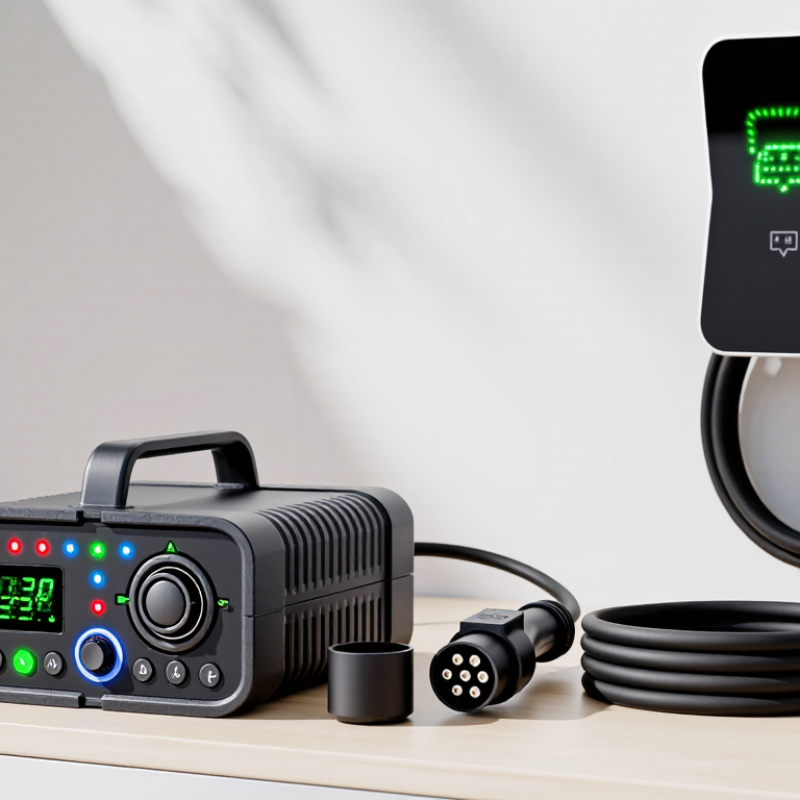
An EV charger tester is a diagnostic instrument that connects to a charging point and checks how it responds to a vehicle. Many models simulate different vehicle connection states, allowing a technician to see whether the charger detects a connection and enables power correctly. Some include a screen; others use indicator lights. The details vary.
A tester may check the control-pilot signal, which communicates charging status and the current the charger can offer. It can also indicate supply voltage and test protective-earth continuity, depending on its design. On a three-phase unit, a suitable tester may help identify phase problems. These readings can reveal issues such as a missing earth connection or a charger that fails to change state. Small signals matter.
A tester does not prove that every part of a charging system is safe or working perfectly. It may not measure actual charging performance under a vehicle’s full load, and it cannot diagnose the vehicle’s battery. That distinction is easy to miss. Technicians should compare results with the tester’s instructions and use appropriate electrical safety procedures; uncertain readings deserve a closer inspection.
| Measurement or Test | What the Tester Checks | Typical Reading or Result | Why It Matters |
|---|---|---|---|
| Supply voltage | Voltage at the charging station’s supply or output terminals, where the tester supports that measurement. | Common nominal supplies include 230 V single-phase and 400 V three-phase in many regions; actual limits depend on the local supply and installation. | Helps identify missing phases, incorrect supply voltage, or other supply problems. |
| Protective earth (PE) continuity | Whether the protective-earth path is present and continuous. | A continuity result is assessed against the test method, installation requirements, and instrument instructions; there is no single pass value for every setup. | A sound earth connection is an important part of protection against electric shock. |
| Control Pilot (CP) state | The control signal used to indicate whether a vehicle is absent, connected, or ready to charge. | For IEC 61851 AC charging, nominal positive CP levels are approximately +12 V (State A), +9 V (State B), and +6 V (State C). | Confirms that the EVSE and tester are exchanging expected connection and charging-state signals. |
| CP PWM duty cycle | The duty cycle of the pilot’s pulse-width-modulated signal, which communicates the available charging current. | For the IEC 61851 current-signalling range of 10%–85%, the advertised current is generally calculated as duty cycle × 0.6 A. For example, 50% indicates 30 A. | Checks that the EVSE communicates its current limit correctly; the vehicle must still respect that limit. |
| Proximity Pilot (PP) coding | Where applicable, the cable’s proximity circuit and its encoded current-carrying rating. | The indicated cable rating depends on the resistor coding and connector system; the tester should report the supported rating or status. | Helps verify that the charging current does not exceed the cable’s indicated capacity. |
| Contactor operation | Whether the EVSE switches its power contacts when the simulated vehicle reaches a charging-ready state. | The output should switch according to the EVSE’s control sequence and applicable test procedure. | Checks that power is enabled only under the expected conditions and is removed when charging is stopped or an unsafe condition is detected. |
| Residual-current protection | Where supported, the response of the charging circuit’s residual-current protection to specified test currents. | Test levels and permitted trip times depend on the protection device, EVSE design, local rules, and the applicable test procedure. Some installations use 30 mA RCD protection and DC fault-current detection. | Assesses an important electrical safety function. The tester’s supported tests must match the installed protection arrangement. |
| Fault simulation | Selected fault conditions, such as a missing PE or an abnormal pilot state, if the tester provides those functions. | The EVSE should respond as specified by its design and the relevant test procedure, commonly by preventing or stopping power delivery. | Shows whether the charger detects certain simulated problems and responds appropriately. |
| Overall functional check | A sequence of simulated connection, ready-to-charge, charging, and stop states. | The tester records whether the EVSE completes the expected sequence and indicates any detected errors. | Provides a practical operational check, but does not replace a full installation inspection or all required electrical tests. |
| Note: Readings and test capabilities vary by tester, EVSE type, connector system, and jurisdiction. Always follow the equipment manuals and applicable electrical safety standards. An EV charger tester is a diagnostic tool; it does not by itself certify an installation. | |||

An EV charger tester is built around a connector that matches the charging cable. Inside, control circuits imitate key signals from an electric vehicle, such as the control-pilot state that tells a charger when a vehicle is connected and ready. A proximity circuit can also represent cable-latch conditions. These signals let a technician check whether the charger responds correctly without using a car. Small details matter.
Measurement hardware checks voltage and, on some models, current or protective-earth continuity. A screen shows readings and fault states; basic models may use indicator lights instead. Some testers also include buttons or switches to select charging states and simulate faults. Results depend on the tester’s capabilities, the charger type, and the test procedure. A confusing reading does not always mean the charger is defective. A loose connector, poor contact, or incorrect setting can affect the result. Not always obvious. The casing, insulated leads, and clear markings help reduce handling errors, but they do not replace safe working practices or a qualified inspection.
An EV charger tester simulates the electrical signals a vehicle presents when it plugs in. Its connector contains circuits that imitate the car’s proximity and control-pilot functions. These signals tell the charger that a cable is connected and indicate whether the vehicle is ready to charge. That’s the handshake.
The tester can switch between simulated vehicle states using carefully selected resistance values. It also reads the charger’s control-pilot signal, including the pulse-width-modulated signal that communicates available current. During a check, a technician can observe whether the charger changes states as expected, then confirm that its contactors behave correctly. The power output should remain inactive when the simulated vehicle is not ready. Small details matter: a loose adapter or incorrect setting can produce confusing results.
A tester may also include a load function, allowing controlled checks of voltage and current under demand. Without that load, it can verify signaling but cannot show how the charger performs while delivering substantial power. This distinction is easy to miss. The simulation is useful, but it remains a simplified stand-in for a real vehicle; unusual vehicle behavior may not appear in a bench test.
Testing a charging station starts with a visual inspection. Check the housing, cable, connector pins, and screen for cracks, dirt, heat marks, or loose parts. Then confirm the unit is isolated as required before connecting a compatible EV charger tester. Small details matter.
The tester simulates a vehicle and checks the station’s control signals, voltage, grounding, and protective-device response. For AC equipment, it can verify charging states described in IEC 61851 and check connector condition against IEC 62196 requirements. A qualified technician should follow the tester and station instructions, then record measured values and any faults. The International Energy Agency reported that public charging points worldwide exceeded 4 million in 2023, an increase of about 40% from 2022. With more stations in service, repeatable checks help identify faults before they interrupt charging.
Tips: Keep the cable straight during testing, and note the ambient temperature. Retest after repairs. A passing result is useful, but it cannot reveal every intermittent fault; that limitation is easy to overlook.
An EV charger tester checks whether a charging point’s signals and basic safety functions behave as expected. During a test, observe the display and indicator lights, then compare each result with the tester’s instructions. A “pass” usually means the tested function responded correctly; it does not confirm that every part of the installation is fault-free. Small details matter. A flashing fault symbol, missing earth indication, or unexpected voltage reading can point to wiring, supply, or protective-device problems.
Read results in context. Test modes may simulate a vehicle connection or a fault, so confirm the selected mode before interpreting an alert. If a fault appears, stop charging and note the exact code, test mode, and conditions. It is easy to blame the charger too quickly; a supply issue or incorrect setup may produce similar symptoms. A clean pass is reassuring, not a guarantee. If readings conflict, repeat only the checks allowed by the tester’s instructions and have a qualified electrician investigate. Do not open equipment or probe live conductors unless trained and equipped to do so.
Tips: Photograph the screen and record the time. Check leads for damage first. Never dismiss a failed protective-function test, even if charging still works.


For those larger-sized parts, or smaller quantity runs, we have 2 independent powder coat booths and ovens. The quality, durability and affordability of today’s powder coating finishes make this the process of choice for world-class companies.
Powder coating advantages over other forms of coating are many. Materials used in the Powder coating process can be metals and non-metals that come in a multitude of thicknesses, textures, colors, etc. Another of Powder coating’s biggest advantages over conventional coatings is its ability to create finishes in many different textures. Powder Coating Booths allow us the ability to apply these advantages to large products.
Tri-State Fabricators runs a full-service conveyor line for painting. Wet painting can provide protection or decoration to many different part styles. From start to finish, every project is easier to undergo random and point-based inspection by our skilled painting team.
Advantages to our Wet Paint Line are these lines start with product prep and ends with a thorough inspection of a high quality finished product. Our ability to complete large and small projects with a superior finish and doing so in a timely and economical fashion. This passes along the savings in production to our customers. When powder coating ins not an option, our Wet Paint Line gets the job done right the first time.
When the parts get big and heavy we roll-out our custom paint racks and oversize booth. By utilizing our partnerships with all the major paint brands, we can match virtually any color with wet paint.
The advantages of having access to a Wet Paint Booth are many. Large projects of many different shapes can be loaded into the booth. The Wet Paint Booth offers an environment that is much more controlled than a typical parts painting operation.
Not only are they used because of their controlled environment, but they’re are also advantageous when it comes to applying paint to parts that are needed in industries that require specialty coatings such as medical, aerospace, etc.
Our military forces have some very high standards when it comes to the finish of their vehicles and equipment. From the first pre-treatment step to final coat, it takes a great deal of knowledge and experience to protect the men and women of our armed forces. They deserve only the best, and Tri-State Fabricators provides it.
All of our processes are closely monitored by our staff and management teams. Both of which are highly trained in the processes of metal fabrication and finishing. Tri-State Fabricators’ goal is to always fully satisfy each and every customer, including the military. We will always put a 110% into what we do.
Abrasive media blasting is an excellent way to remove old paint, rust, and increase the paint/powder adhesion. Glass beads produce a much smoother and brighter finish than angular abrasives; leaving the part clean yet without any dimensional change. Chemically inert and environmentally friendly, we can recycle our beads approximately 30 times; making them a more preferred method of metal cleaning or surface finishing.
Advantages to Glass Bead Blasting are many. Glass bead blast media is used when a project is needing rough surfaces need to become smooth for applications of coatings such as paint. It is typically used to clean paint and rust from a product surface without deforming the surface it is being used on. Overall, compared to many other blasting media, Glass Bead Blasting is a very economical choice and those savings are always passed on to our customers.
Tri-State Fabricators utilize a zinc phosphate wash to clean and etch the material to ensure the best paint adhesion possible. The unique design of our 3-stage wash system does the work like a 5-stage. From Cleaning and rinsing to conversion coating and post-treatment, Our Part Washing process is a complete service and works throughout the fabrication service and the finishing service.
Along with the previously mentioned benefits, Curing is a vital chemical reaction that leaves the product finish hard and relatively safe from mild abrasion and aggressive corrosion. This process can be done in more than one way; ambient air-dry or in curing ovens at temps that exceed 240°.
From fixing paint mistakes (someone else’s of course) to simply cleaning our paint line hooks, our burn-off oven is put to good use. After a quick burn-off, a little clean up, and a fresh coat of paint, your parts will look better than new.
Why does our Burn-Off Oven work so well? Because super heating the air around parts turns the materials into ashes. From paint and powder coatings to rubber and machining oils, high temps do the job without degrading the integrity of the part.
Masking is a vital part of producing high quality products. We have die-cut masking patterns to protect machined surfaces as well as a wide range of plugs and caps to protect threaded holes and bolts. We provide permanent and temporary masking.
Masking allows the selected sections of a product to be protected from a fabrication or finishing service. This can be with both chemicals when etching and tapes, paints when only finishing just a section of the product. Masking is great in aiding the customization process of a project.
Screen printing is a photographic process that transfers artwork onto a porous nylon screen which allows colored ink to flow through the screen and be deposited on an aluminum or plastic component. We can generally have just about any design created onto a screen for your parts.
Some of the advantages of Screen Printing are, brand recognition for your business displaying on your products, assembly instructions, product warnings/hazards, etc. Tri-State Fabricators produces Screen Printing of the highest quality so you know it’s durable.
Metal Finishing is the art of treating the exterior portion of product, often metal but can also be made of other materials, so that the surface is clean and free of any debris. Then the process of applying coats or either paint of powder coat takes place. This coating process improves the quality of the product in both appearance and resistance to wear and corrosion.
Tri-State Fabricators, Inc., understands that a project typically isn’t complete until a high-quality finish has been added to your product. This is why our painting and powder coating teams continuously inspect the products throughout the Metal Finishing process.

