


7 Electric Dump Truck Buying Tips for Global Buyers

Buying an Electric Dump Truck is not simply a choice between diesel and batteries. It is a decision about payload, duty cycle, charging access, and the cost of keeping a machine productive. The International Energy Agency’s Global EV Outlook 2024 reported nearly 54,000 electric truck sales worldwide in 2023, about 35% more than in 2022. That figure covers trucks broadly, not dump trucks alone. Still, it signals a market worth evaluating carefully—not a guarantee that every job site is ready.

The duty cycle matters most. A truck climbing a quarry ramp with a full load faces different demands from one making short, predictable trips around a construction site. Battery size, charging time, terrain, temperature, and access to service technicians can change the economics. IEA Executive Director Fatih Birol has said, “The clean energy transition is happening worldwide and it’s unstoppable. It’s not a question of ‘if’, it’s just a question of ‘how soon’—and the sooner the better for all of us.” His statement is broad, not a purchasing recommendation. Buyers still need project-specific evidence.

This guide offers seven practical checks for global buyers: assess the work cycle, verify payload and range, compare total ownership costs, inspect charging requirements, review battery and warranty terms, confirm local service support, and test the truck under real operating conditions. Ask for measured results. A polished brochure is not a quarry test. Some figures will remain uncertain, especially where routes or workloads change. That uncertainty deserves attention, not a sales promise.
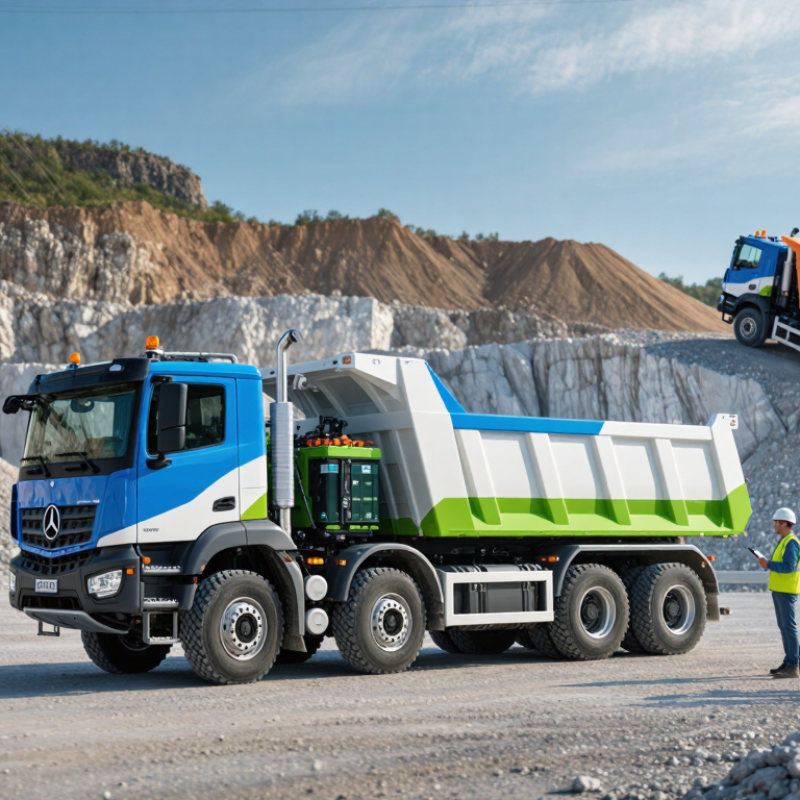
7 Electric Dump Truck Buying Tips for Global Buyers

Define Payload, Route, and Grade Requirements Before Comparing Electric Dump Trucks

Before comparing electric dump trucks, define the work they must do. Record payload by material and load, including the body, tools, and occupants. A truck carrying wet aggregate may face a very different duty cycle from one hauling dry soil. The IEA’s Global EV Outlook 2024 reports nearly 54,000 electric truck sales in 2023, about 1.2% of global truck sales. The market is growing, but operating conditions still vary widely.

Map each route in detail. Measure loaded and empty distance, daily trips, waiting time, and access to charging. Note the steepest grade and how long the truck climbs it; a short ramp differs from a sustained ascent. Ask suppliers for energy-use data from a comparable duty cycle, not just a range figure. Check how payload and grade affect range, and confirm charging time against actual shift breaks. One missed detail can distort the comparison. I would also revisit the route after a trial; site plans are not always the route drivers take.

Tip: Share payload, route, grade, and shift records with every bidder. Request a written estimate for the same operating cycle, including reserve capacity for cold weather and detours. Compare usable payload after battery weight, not rated payload alone. Keep assumptions visible. They may be imperfect.

7 Electric Dump Truck Buying Tips for Global Buyers — Define Payload, Route, and Grade Requirements Before Comparing Electric Dump Trucks
Buying Tip What to Define Information to Gather Why It Matters What to Compare
1. Set the required payload Separate the intended material payload from the truck’s tare mass and gross vehicle weight. Typical and maximum load per trip; material density; body volume; loading method; applicable local weight limits. Payload affects legal road operation, trip count, energy use, tire loading, and vehicle selection. Rated payload, gross vehicle weight, body capacity, and any stated derating for specific operating conditions.
2. Map the route and duty cycle Define the complete working cycle, including loaded and empty travel, stops, queuing, and return trips. One-way distance; daily trips; operating hours; average and peak speed; road surface; stop frequency; seasonal changes. Energy use depends on the full duty cycle, not distance alone. Frequent stops, rough surfaces, and long idle periods can change consumption. Vehicle range and energy-consumption estimates under a duty cycle that resembles the planned operation.
3. Record gradients and elevation Identify the steepest sustained grade, short ramps, and total elevation gain on loaded routes. Grade in percent; ramp length; elevation profile; loaded direction; road condition; required restart points. Climbing a grade with a load requires substantial traction and power. Regenerative braking may recover some energy downhill, but recovery varies by conditions. Gradeability at the intended payload, low-speed climbing performance, thermal limits, and braking capability on descents.
4. Match the battery to the operating day Determine the usable energy needed between charging opportunities, allowing for operating reserves. Trips per shift; route energy estimates; ambient temperature; planned charging windows; battery reserve policy. Battery capacity alone does not establish real-world range. Payload, grade, temperature, driving conditions, and auxiliary loads can all affect energy use. Usable battery capacity, expected range for the stated duty cycle, charging limits, and battery performance in local temperatures.
5. Plan charging around the shift Specify where and when charging can take place, including whether charging is available during breaks or between shifts. Available electrical supply; charger power; connector and charging protocol; parking time; number of vehicles charging at once. Charging time depends on charger output, vehicle acceptance limits, battery state, and site electrical capacity. Charging compatibility, estimated charging time for the planned window, installation requirements, and charging support in the destination market.
6. Check the body, chassis, and site conditions Confirm that the dump body, lifting system, dimensions, and vehicle configuration suit the material and loading site. Material type and density; body volume; discharge method; clearance limits; turning space; ground conditions; access restrictions. A suitable payload rating does not guarantee that the vehicle fits the loading, hauling, and tipping conditions of a particular site. Body configuration, overall dimensions, axle loading, ground clearance, turning characteristics, and compatibility with site procedures.
7. Verify support, safety, and total operating cost Assess the availability of service, parts, training, and emergency support where the truck will operate. Local service coverage; parts lead times; warranty terms; technician training; safety requirements; electricity and maintenance costs. Uptime and operating cost depend on local support as well as the vehicle itself. Requirements for high-voltage work and road approval vary by jurisdiction. Documented service arrangements, warranty coverage, safety features, regulatory compliance, and cost assumptions over the intended ownership period.

Benchmark Range Against OEM Data: Volvo FMX Electric Offers Up to 300 km

An electric dump truck’s advertised range is a starting point, not a route promise. An OEM specification may cite up to 300 km for a heavy electric model. Treat it as a best-case benchmark. Confirm the battery, body configuration, payload, and test conditions behind the figure.

A 300 km claim means little if the truck must climb a quarry ramp, queue, and return fully loaded.

Compare the published range with a representative duty cycle. Record distance, elevation gain, load weight, stop time, temperature, and charging pauses across several shifts. Ask for energy use in kWh per kilometre and usable battery capacity. Then calculate a reserve for delays or detours.

Tip: Run a loaded route trial. Start at the depot, weigh the truck, and log battery state at each turnaround. Include both a cold-weather shift and a peak-load day.

A gap between the claim and field results may reveal different route assumptions, not necessarily a fault. Still, challenge vague test notes. Request dated OEM data and check whether the stated range reflects terrain and payload comparable to yours. Small differences matter. A steep ramp, wet ground, or heater use can change the daily plan. Build charging windows around actual shift breaks. Recheck after several weeks; the first estimate may need adjustment.

Match Charger Type and Power to Site Infrastructure and Work Shifts

A charger that looks powerful on paper may still fail a dump truck’s work cycle. Check the truck’s battery capacity, its maximum charging rate, and the hours available between shifts. The U.S. Department of Energy’s Alternative Fuels Data Center describes DC fast charging as typically 50 kW or higher. That is a broad reference, not a guarantee that a site can support truck charging. Ask an electrical contractor to confirm transformer capacity, peak demand, cable reach, and room for future chargers. One missed detail: two trucks charging together can draw far more power than one.

Tip: Map each truck’s return time and next departure. Estimate the energy needed during that window, then compare it with the charger’s usable output. Include cold-weather losses and time spent connecting cables. A charger rated at 150 kW cannot deliver that rate continuously in every condition.

The International Energy Agency reported more than 54,000 electric truck sales worldwide in 2023, showing a fast-growing need for suitable charging plans. Match charger type to the site: depot charging may suit long overnight stops, while higher-power charging can help short turnarounds if the grid allows it. Test the schedule with real shift data. The first estimate may be wrong. Keep a buffer.

Compare Total Cost of Ownership Across Energy, Maintenance, and Battery Life

For global buyers, the purchase price is only one part of an electric dump truck’s cost. Compare energy use across the actual route, payload, gradients, and working hours. A flat-site estimate may not reflect a steep quarry haul. Ask suppliers for duty-cycle data, then test the figures against your own operation.

Include electricity tariffs, charger installation, and charging losses in the calculation. Check the route. If trucks run two shifts, charging time can affect output as much as energy price. Maintenance costs may fall when there are fewer moving parts, but tires, brakes, cooling systems, and electrical diagnostics still need attention. Request service intervals and realistic parts lead times for your region. Numbers can mislead.

Battery life deserves its own scenario, not a footnote. Compare warranty terms, expected capacity loss, and replacement cost under your climate and charging pattern. Very hot days, cold starts, and frequent fast charging may change operating results. Ask how the battery is assessed at resale, and whether capacity affects the truck’s usable daily range. A spreadsheet will not capture every delay; leave room for uncertainty, then update the model with measured energy use and maintenance records after the first months in service.

Check Market Readiness: IEA Reports 35% Growth in Electric Truck Sales in 2023

The IEA reported 35% growth in electric truck sales in 2023. That signals rising interest, but it does not prove every market is ready. Figures can mislead. Buyers should compare this trend with local charging access, electricity reliability, and available service support. A busy urban route may suit an electric dump truck better than a remote site with long, unpredictable hauls.

Start with the work itself. Record daily distance, payload, gradients, idle time, and shift length. Then ask suppliers to estimate range under those conditions, not just in ideal tests. Cold mornings, steep ramps, and heavy loads can reduce usable range. Check charging time against shift schedules, and confirm the site can provide the required power. A neat spreadsheet may look convincing; real operating data is often incomplete.

Compare the full cost of ownership, including energy, maintenance, battery coverage, and downtime. Ask how quickly common replacement parts can reach your region. Arrange a supervised trial if possible, using a representative load and route. Track energy use and charging interruptions for several weeks. One trial will not answer everything, but it can expose assumptions before a large purchase.

Powder Coat Booths

For those larger-sized parts, or smaller quantity runs, we have 2 independent powder coat booths and ovens. The quality, durability and affordability of today’s powder coating finishes make this the process of choice for world-class companies.

Powder coating advantages over other forms of coating are many. Materials used in the Powder coating process can be metals and non-metals that come in a multitude of thicknesses, textures, colors, etc. Another of Powder coating’s biggest advantages over conventional coatings is its ability to create finishes in many different textures. Powder Coating Booths allow us the ability to apply these advantages to large products.

Wet Paint Line

Tri-State Fabricators runs a full-service conveyor line for painting. Wet painting can provide protection or decoration to many different part styles. From start to finish, every project is easier to undergo random and point-based inspection by our skilled painting team.

Advantages to our Wet Paint Line are these lines start with product prep and ends with a thorough inspection of a high quality finished product. Our ability to complete large and small projects with a superior finish and doing so in a timely and economical fashion. This passes along the savings in production to our customers. When powder coating ins not an option, our Wet Paint Line gets the job done right the first time.

Wet Paint Booths

When the parts get big and heavy we roll-out our custom paint racks and oversize booth. By utilizing our partnerships with all the major paint brands, we can match virtually any color with wet paint.

The advantages of having access to a Wet Paint Booth are many. Large projects of many different shapes can be loaded into the booth. The Wet Paint Booth offers an environment that is much more controlled than a typical parts painting operation.

Not only are they used because of their controlled environment, but they’re are also advantageous when it comes to applying paint to parts that are needed in industries that require specialty coatings such as medical, aerospace, etc.

Military CARC

Our military forces have some very high standards when it comes to the finish of their vehicles and equipment. From the first pre-treatment step to final coat, it takes a great deal of knowledge and experience to protect the men and women of our armed forces. They deserve only the best, and Tri-State Fabricators provides it.

All of our processes are closely monitored by our staff and management teams. Both of which are highly trained in the processes of metal fabrication and finishing. Tri-State Fabricators’ goal is to always fully satisfy each and every customer, including the military. We will always put a 110% into what we do.

Glass-Bead Blasting

Abrasive media blasting is an excellent way to remove old paint, rust, and increase the paint/powder adhesion. Glass beads produce a much smoother and brighter finish than angular abrasives; leaving the part clean yet without any dimensional change. Chemically inert and environmentally friendly, we can recycle our beads approximately 30 times; making them a more preferred method of metal cleaning or surface finishing.

Advantages to Glass Bead Blasting are many. Glass bead blast media is used when a project is needing rough surfaces need to become smooth for applications of coatings such as paint. It is typically used to clean paint and rust from a product surface without deforming the surface it is being used on. Overall, compared to many other blasting media, Glass Bead Blasting is a very economical choice and those savings are always passed on to our customers.

Part Washing

Tri-State Fabricators utilize a zinc phosphate wash to clean and etch the material to ensure the best paint adhesion possible. The unique design of our 3-stage wash system does the work like a 5-stage. From Cleaning and rinsing to conversion coating and post-treatment, Our Part Washing process is a complete service and works throughout the fabrication service and the finishing service.

Along with the previously mentioned benefits, Curing is a vital chemical reaction that leaves the product finish hard and relatively safe from mild abrasion and aggressive corrosion. This process can be done in more than one way; ambient air-dry or in curing ovens at temps that exceed 240°.

Burn-Off Oven

From fixing paint mistakes (someone else’s of course) to simply cleaning our paint line hooks, our burn-off oven is put to good use. After a quick burn-off, a little clean up, and a fresh coat of paint, your parts will look better than new.

Why does our Burn-Off Oven work so well? Because super heating the air around parts turns the materials into ashes. From paint and powder coatings to rubber and machining oils, high temps do the job without degrading the integrity of the part.

Masking

Masking is a vital part of producing high quality products. We have die-cut masking patterns to protect machined surfaces as well as a wide range of plugs and caps to protect threaded holes and bolts. We provide permanent and temporary masking.

Masking allows the selected sections of a product to be protected from a fabrication or finishing service. This can be with both chemicals when etching and tapes, paints when only finishing just a section of the product. Masking is great in aiding the customization process of a project.

Screen Printing

Screen printing is a photographic process that transfers artwork onto a porous nylon screen which allows colored ink to flow through the screen and be deposited on an aluminum or plastic component. We can generally have just about any design created onto a screen for your parts.

Some of the advantages of Screen Printing are, brand recognition for your business displaying on your products, assembly instructions, product warnings/hazards, etc. Tri-State Fabricators produces Screen Printing of the highest quality so you know it’s durable.

Metal Finishing

Metal Finishing is the art of treating the exterior portion of product, often metal but can also be made of other materials, so that the surface is clean and free of any debris. Then the process of applying coats or either paint of powder coat takes place. This coating process improves the quality of the product in both appearance and resistance to wear and corrosion.

Tri-State Fabricators, Inc., understands that a project typically isn’t complete until a high-quality finish has been added to your product. This is why our painting and powder coating teams continuously inspect the products throughout the Metal Finishing process.


