10 Double Door Buying Tips for Global Buyers

Double Door purchases can look straightforward in a catalog. The real decision begins when dimensions, traffic, climate, and installation conditions meet. A pair of glazed doors may suit a bright retail entrance, while insulated solid panels may work better for a busy warehouse. Small details matter.

For global buyers, specifications need to travel clearly between the supplier, installer, and project team. Confirm the opening size, frame material, handing, glazing, hardware, finish, and packing method before approving a quotation. Ask how measurements are taken, and request drawings that show clearances and swing direction. One missing hinge detail can delay an otherwise well-planned shipment. It happens.

This guide presents ten practical checks for comparing Double Door options, assessing suppliers, and reducing avoidable surprises. It draws on common procurement and installation concerns, but no checklist can replace a site survey or qualified technical review. Buyers should also verify that product performance claims match the project’s climate, use, and applicable local requirements. “Standard size” is not always standard across markets. That deserves a second look.

Price matters, but the lowest quote may omit freight protection, compatible hardware, or installation guidance. Compare like with like, keep approvals in writing, and inspect sample finishes where possible. Even careful planning leaves room for mistakes. The aim is not perfect certainty; it is a better-informed purchase, with fewer costly assumptions from order placement through delivery and fitting.
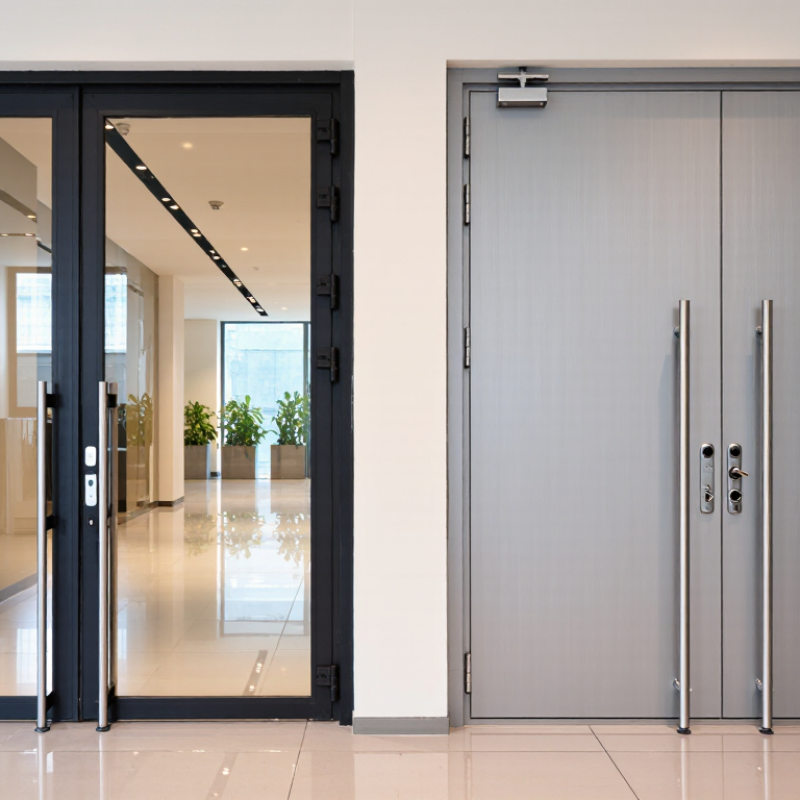
10 Double Door Buying Tips for Global Buyers

Measure the Rough Opening and Verify Pair Clearances Before Ordering

A double door can look perfectly sized on a plan and still bind on site. Measure the rough opening after checking that the framing is stable and the floor surface is final. Record the width at the top, middle, and bottom, then measure the height at both sides and the center. Use the smallest readings when comparing the opening with the door unit’s specified requirements. Close enough is risky.

Also check whether the opening is square and the jambs are plumb. A small lean can make one leaf rub while the other seems fine. Confirm the manufacturer’s required installation space; rough-opening allowances vary by unit and frame design. Then account for the finished floor, threshold, hinges, meeting stile, and any astragal. Leave the intended gap between the two leaves as specified, rather than guessing from a photo or another doorway. Check the swing path, too. Nearby walls, cabinets, and handles can block a full opening.

Measure twice. It sounds obvious, but rushed notes are easy to misread later. I would label each measurement with its location and units, then have someone verify the figures before ordering. That extra check may feel fussy. It is cheaper than discovering that the pair meets unevenly after installation.

10 Double Door Buying Tips for Global Buyers: Measure the Rough Opening and Verify Pair Clearances Before Ordering

Example dimensions (inches): The chart compares a 74 × 82.5-inch rough opening with a planned 73 × 80-inch door pair. These figures illustrate a sample project, not universal sizing requirements. Before ordering, measure the opening at multiple points and confirm jamb, head, floor, hinge-side, and center-meeting clearances against the door manufacturer’s specifications.

Compare Whole-Door U-Values (W/m²·K) with Local Energy-Code Limits

10 Double Door Buying Tips for Global Buyers

Double-door quotes can hide a crucial difference: some U-values describe the center panel, not the complete assembly. Compare whole-door ratings, including both leaves, frames, glazing, and the meeting stile. NFRC 100 defines procedures for determining fenestration U-factors; lower values indicate less heat transfer. Check that competing figures use the same test method and units.

Use local code as your buying benchmark. For example, the 2021 International Energy Conservation Code’s residential prescriptive table lists maximum fenestration U-factors of 0.30 in climate zones 4–8 and 0.40 in zones 0–3, in Btu/h·ft²·°F. That is about 1.70 and 2.27 W/m²·K, respectively. These are US examples, not universal limits. Adopted editions, amendments, building type, and exceptions can change the requirement, so verify the rule with the local authority.

Ask for a certified report showing the tested door configuration. A rating for an unglazed model may not represent a double door with decorative glass. Small details matter. Check whether the submitted size matches your opening, and confirm seals and threshold are included in the rating. I would not rely on a brochure’s “energy efficient” claim alone; even a strong U-value can disappoint if the installed meeting stile leaks air. One detail is easy to overlook: an apparently tiny unit mismatch can make two ratings look more different than they are.

Check Air Leakage at 75 Pa Using ASTM E283 Test Reports

For double doors, an ASTM E283 report is more useful than a broad “airtight” claim. The test measures air leakage through a specimen under a controlled pressure difference. Confirm that 75 Pa was the stated test pressure. Ask whether the tested specimen matched the proposed door: leaf size, frame, meeting stile, seals, hardware, and threshold all matter. Small changes can alter leakage paths. Check the report date, laboratory identification, test method edition, specimen configuration, and reported leakage rate, including its units and reference area. Read the numbers carefully.

At 75 Pa, ask how leakage was measured and whether the report separates specimen leakage from background apparatus leakage. Compare results only when pressure, door size, setup, and calculation basis align. A low figure can be misleading if it belongs to a smaller or differently sealed assembly. ASTM E283 is a test method, not a universal pass-or-fail threshold; define the acceptable rate in the project specification and confirm local performance needs. Keep the report with the quotation and installation documents. I would still request clarification when seals or thresholds differ from the tested sample. That detail is easy to miss. Air tests do not replace checks for water penetration, wind loading, or installation quality.

Specify Safety Glazing to ANSI Z97.1 or EN 12600 Standards

For a double door, specify safety glazing to ANSI Z97.1 or EN 12600, based on the project requirements. Both moving leaves matter. If the doors include sidelights or glazed panels, identify those separately in the schedule. Ask for the applicable test documentation, glass build-up, and safety classification—not just a note saying “tempered.” The standards use different test and classification systems, so their ratings should not be treated as directly interchangeable. Confirm that the tested construction matches the supplied glass thickness and type.

Looks can mislead. A clear pane may appear identical whether it is safety glass or ordinary glass. Check that product labels or permanent markings remain visible where required, and match them to the delivery paperwork. On site, a narrow etched mark near a lower corner can be easy to overlook after installation; record it before the frame conceals it. Also confirm the door’s glazing size and support details with the fabricator, since changes can affect the tested configuration. I would not rely on a verbal assurance alone. Paperwork can be imperfect, too, so resolve unclear classifications before ordering.


Verify Fire Ratings and Hardware to EN 1634-1 and Local Codes

A double door is a tested assembly, not just two fire-rated leaves. Its frame, seals, glazing, hinges, and closing hardware can all affect performance.

EN 1634-1 describes a fire-resistance test for door and shutter assemblies under specified conditions. A test result does not automatically cover every size or configuration. Check the supporting classification and evidence for the exact model and setup you plan to buy.

Hardware matters. Confirm that hinges, closers, latches, coordinators, and flush bolts are suitable for the tested assembly.

On an inactive leaf, flush bolts must engage correctly, while the coordinator must let both leaves close in the intended order. Small details count.

Ask for installation instructions, permitted clearances, and evidence covering any glazing or hardware options. A familiar-looking closer is not proof of compatibility.

Local codes may set requirements beyond the test evidence, including approved ratings, labels, installation methods, or inspection records. Requirements vary by building use and location, so have the local authority or a qualified fire-door professional verify the specification before ordering.

At delivery, compare labels and hardware with the approved documents, then check that the doors close fully without binding. Paperwork can look complete, yet a small site change may still matter.

Powder Coat Booths

For those larger-sized parts, or smaller quantity runs, we have 2 independent powder coat booths and ovens. The quality, durability and affordability of today’s powder coating finishes make this the process of choice for world-class companies.

Powder coating advantages over other forms of coating are many. Materials used in the Powder coating process can be metals and non-metals that come in a multitude of thicknesses, textures, colors, etc. Another of Powder coating’s biggest advantages over conventional coatings is its ability to create finishes in many different textures. Powder Coating Booths allow us the ability to apply these advantages to large products.

Wet Paint Line

Tri-State Fabricators runs a full-service conveyor line for painting. Wet painting can provide protection or decoration to many different part styles. From start to finish, every project is easier to undergo random and point-based inspection by our skilled painting team.

Advantages to our Wet Paint Line are these lines start with product prep and ends with a thorough inspection of a high quality finished product. Our ability to complete large and small projects with a superior finish and doing so in a timely and economical fashion. This passes along the savings in production to our customers. When powder coating ins not an option, our Wet Paint Line gets the job done right the first time.

Wet Paint Booths

When the parts get big and heavy we roll-out our custom paint racks and oversize booth. By utilizing our partnerships with all the major paint brands, we can match virtually any color with wet paint.

The advantages of having access to a Wet Paint Booth are many. Large projects of many different shapes can be loaded into the booth. The Wet Paint Booth offers an environment that is much more controlled than a typical parts painting operation.

Not only are they used because of their controlled environment, but they’re are also advantageous when it comes to applying paint to parts that are needed in industries that require specialty coatings such as medical, aerospace, etc.

Military CARC

Our military forces have some very high standards when it comes to the finish of their vehicles and equipment. From the first pre-treatment step to final coat, it takes a great deal of knowledge and experience to protect the men and women of our armed forces. They deserve only the best, and Tri-State Fabricators provides it.

All of our processes are closely monitored by our staff and management teams. Both of which are highly trained in the processes of metal fabrication and finishing. Tri-State Fabricators’ goal is to always fully satisfy each and every customer, including the military. We will always put a 110% into what we do.

Glass-Bead Blasting

Abrasive media blasting is an excellent way to remove old paint, rust, and increase the paint/powder adhesion. Glass beads produce a much smoother and brighter finish than angular abrasives; leaving the part clean yet without any dimensional change. Chemically inert and environmentally friendly, we can recycle our beads approximately 30 times; making them a more preferred method of metal cleaning or surface finishing.

Advantages to Glass Bead Blasting are many. Glass bead blast media is used when a project is needing rough surfaces need to become smooth for applications of coatings such as paint. It is typically used to clean paint and rust from a product surface without deforming the surface it is being used on. Overall, compared to many other blasting media, Glass Bead Blasting is a very economical choice and those savings are always passed on to our customers.

Part Washing

Tri-State Fabricators utilize a zinc phosphate wash to clean and etch the material to ensure the best paint adhesion possible. The unique design of our 3-stage wash system does the work like a 5-stage. From Cleaning and rinsing to conversion coating and post-treatment, Our Part Washing process is a complete service and works throughout the fabrication service and the finishing service.

Along with the previously mentioned benefits, Curing is a vital chemical reaction that leaves the product finish hard and relatively safe from mild abrasion and aggressive corrosion. This process can be done in more than one way; ambient air-dry or in curing ovens at temps that exceed 240°.

Burn-Off Oven

From fixing paint mistakes (someone else’s of course) to simply cleaning our paint line hooks, our burn-off oven is put to good use. After a quick burn-off, a little clean up, and a fresh coat of paint, your parts will look better than new.

Why does our Burn-Off Oven work so well? Because super heating the air around parts turns the materials into ashes. From paint and powder coatings to rubber and machining oils, high temps do the job without degrading the integrity of the part.

Masking

Masking is a vital part of producing high quality products. We have die-cut masking patterns to protect machined surfaces as well as a wide range of plugs and caps to protect threaded holes and bolts. We provide permanent and temporary masking.

Masking allows the selected sections of a product to be protected from a fabrication or finishing service. This can be with both chemicals when etching and tapes, paints when only finishing just a section of the product. Masking is great in aiding the customization process of a project.

Screen Printing

Screen printing is a photographic process that transfers artwork onto a porous nylon screen which allows colored ink to flow through the screen and be deposited on an aluminum or plastic component. We can generally have just about any design created onto a screen for your parts.

Some of the advantages of Screen Printing are, brand recognition for your business displaying on your products, assembly instructions, product warnings/hazards, etc. Tri-State Fabricators produces Screen Printing of the highest quality so you know it’s durable.

Metal Finishing

Metal Finishing is the art of treating the exterior portion of product, often metal but can also be made of other materials, so that the surface is clean and free of any debris. Then the process of applying coats or either paint of powder coat takes place. This coating process improves the quality of the product in both appearance and resistance to wear and corrosion.

Tri-State Fabricators, Inc., understands that a project typically isn’t complete until a high-quality finish has been added to your product. This is why our painting and powder coating teams continuously inspect the products throughout the Metal Finishing process.



