


A bolt and a screw can look nearly identical on a workbench, yet their names affect how a joint is designed, installed, and inspected. In common engineering practice, a bolt usually passes through clearance holes and is tightened with a nut. A screw typically engages a threaded hole or forms its own thread in the material. That distinction is useful, but not perfect. Standards and shop terminology sometimes use the words differently.
Technical references help make the comparison more precise. ASME B18.2.1 specifies dimensions for inch-series square and hex bolts and screws, while ISO 4014 and ISO 4017 distinguish common hexagon-head fasteners by thread coverage. For industry context, U.S. Census Bureau trade datasets and USITC DataWeb publish fastener-related shipment classifications and values. Those records describe trade, not the mechanics of a joint. That difference matters. A data table cannot tell you whether a fastener will loosen under vibration or damage a soft aluminum part. In practice, check the drawing, standard, material, thread, and installation method—not just the head shape. Even experienced buyers can inherit inconsistent naming from old catalogs. That is worth questioning. A careful Bolt Screw comparison starts with the joint’s function, then verifies the relevant specification.
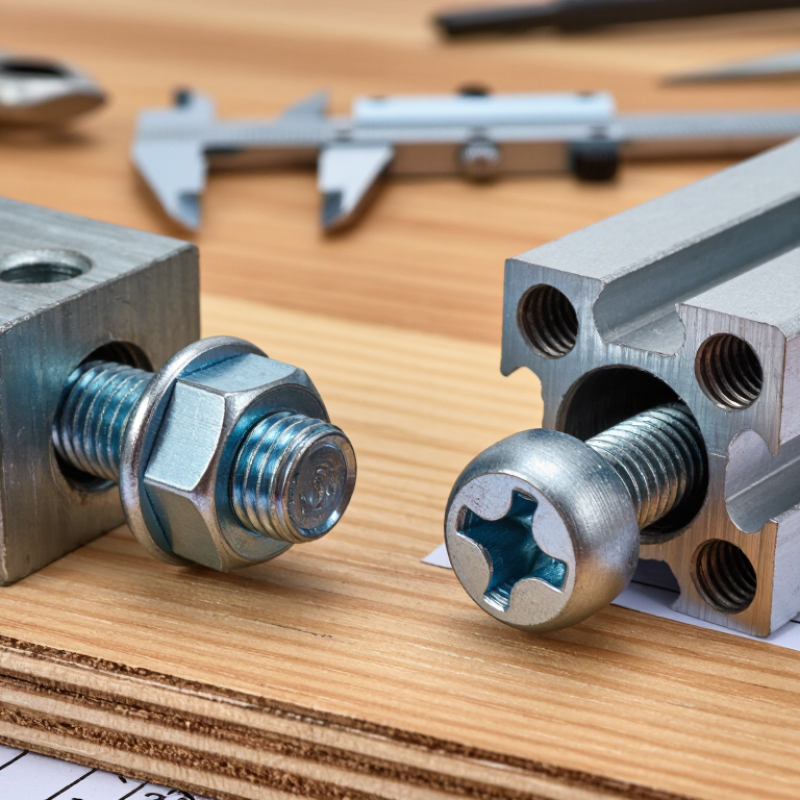
A bolt is a threaded fastener usually passed through aligned holes in two or more parts. A nut turns onto its exposed end and clamps the parts together. The bolt’s threads help create and maintain that clamping force. For example, a bolt can pass through two steel plates, with a washer and nut fitted on the far side. That is the core.
A screw usually fastens parts by turning its threaded shank into a material or a threaded hole. Its head provides a surface for a driver, while the threads resist the force trying to pull the parts apart. Some screws cut their own threads in wood or sheet material; others fit into threads made beforehand. Bolts and screws can look similar, and everyday naming is not always consistent. The connection matters more than appearance: a bolt commonly works with a nut, while a screw commonly engages the part itself. There are exceptions, so check the fastener’s design and installation instructions.
Tips: Match the fastener to the materials and expected load. Check the hole size, thread fit, and required length before tightening. Fit matters. If a joint loosens or the material begins to split, stop and reassess the fastener choice and installation.

What Is the Difference Between a Bolt and a Screw?
How Bolts and Screws Engage with Materials
A bolt usually passes through a clearance hole and clamps parts when tightened against a nut. A screw typically forms or enters threads in a tapped hole or directly in the material. The practical distinction is engagement: a bolt’s threads commonly engage the nut, while a screw’s threads engage the workpiece. The boundary is not absolute; design practice sometimes uses the terms differently.
NASA’s Fastener Design Manual, RP-1228, discusses how friction affects the relationship between tightening torque and preload. A common engineering estimate is that only about 10% of applied torque stretches the fastener; much of the rest is lost to friction under the head and along the threads. That means a screw biting into soft wood and a bolt tightened into a steel nut can respond very differently. Material, pilot-hole size, thread pitch, and engagement length all matter. A neat-looking fit can still be weak.
Tips: For a screw in wood, check the manufacturer’s pilot-hole guidance and avoid splitting near an edge. For a bolted joint, use a washer when the bearing surface needs protection, and tighten to the specified torque. Feel alone is a poor gauge. I still find that easy to underestimate.
| Comparison | Bolt | Screw |
|---|---|---|
| Typical engagement | Usually passes through clearance holes in the joined parts and engages with a separate nut. | Usually engages directly with a threaded hole or forms threads in the material as it is driven. |
| What creates the clamping force? | Tightening the nut, or sometimes the bolt head, stretches the fastener and clamps the parts together. | Turning the screw advances its threads into the material or an existing threaded hole, drawing the parts together. |
| Hole preparation | Typically uses a clearance hole large enough for the bolt shank to pass through; a separate nut is commonly used. | May use a pilot hole, a pre-tapped hole, or no pilot hole, depending on the screw type and material. |
| How the threads engage | The bolt threads generally engage the nut rather than the parts being joined. | The threads generally engage the workpiece, a threaded insert, or a tapped hole. |
| Common applications | Machinery, structural connections, and assemblies where parts can be accessed to fit a nut. | Woodworking, sheet-metal assembly, and equipment or components with tapped holes. |
| Disassembly | Often straightforward when the nut and bolt are accessible; the joint can usually be separated without damaging the parts. | Can usually be removed by turning it out, though repeated use may wear threads in softer materials. |
| Important qualification | Usage varies by industry and application. A fastener’s name alone does not always determine how it must engage; its design, installation method, and joint configuration matter. | |
What Is the Difference Between a Bolt and a Screw?
Key Differences in Design and Installation
A bolt typically passes through aligned, unthreaded holes and is secured with a nut. A screw usually forms its hold by engaging threads in the material or in a pre-threaded hole. That distinction matters. Bolts often have a smooth section beneath the head, while screws commonly carry threads along much of the shank. But terminology varies, especially for machine screws used with nuts.
Installation depends on access and material. With a bolt, hold the head steady and tighten the nut on the opposite side. A washer can spread pressure across a softer surface. With a screw, choose a driver bit that fits snugly, then turn it into the workpiece. In hardwood, a pilot hole can reduce splitting; in thin sheet metal, the wrong screw may strip the hole. Small details count.
The joint’s job should guide the choice. A bolt-and-nut connection can be disassembled easily and clamped firmly, which suits parts with access on both sides. A screw is useful when only one side is reachable, or when fastening into wood. Do not rely on appearance alone: check the thread, material, and load requirements. Over-tightening can damage threads or crush the surface, and I still find it easy to underestimate how quickly that happens.
Key differences in design and installation
This chart summarizes common usage, not strict rules: bolts are commonly used with a nut to clamp parts together, while screws typically engage a threaded hole or form threads in the material. Both types can be installed with different tools, and terminology varies by application.
Bolts and screws solve different fastening problems on real jobs. A bolt usually passes through aligned holes and tightens against a nut, making it useful for steel frames, machinery mounts, and vehicle assemblies. Screws form or enter threads in wood, sheet metal, or plastic. They suit cabinet hinges, drywall, electrical enclosures, and smaller repairs. A hex-head bolt may need a wrench and access to both sides. A countersunk screw can sit nearly flush with a panel. Small details matter.
The U.S. Census Bureau reported about $1.98 trillion in U.S. construction spending for 2023.
World Steel Association data put 2023 global crude steel production at about 1.89 billion tonnes.
That scale helps explain why crews use many fastening methods, from structural bolting to wood screws. These figures describe the industries around fasteners, not bolt or screw consumption; neither report counts them separately. In practice, vibration, load, material, and access should guide the choice. A screw can loosen in a weak substrate, while a bolt may be awkward where a nut cannot be reached. The boundary is not perfect. Some screws are designed for heavy structural work, so checking the fastener specification matters more than relying on its name.
Choosing the right fastener starts with the joint, not the label. A bolt usually passes through clearance holes and tightens against a nut. A screw typically cuts into or engages threads in the material itself. The distinction is not absolute; usage varies across trades and hardware types. Check how the parts connect.
For a shelf bracket, a screw may grip a wooden stud directly. For two steel plates with access on both sides, a bolt and nut can create a strong, serviceable joint. Consider the material, expected load, vibration, and exposure to moisture. A small fastener in soft wood may pull out, while an oversized one can split the board. Measure the thickness carefully.
Match the fastener’s diameter and length to the job, and use a washer when the head or nut could press into a soft surface. In metal, confirm the hole size and thread compatibility; mismatched threads can damage the joint. Follow the project’s specifications when loads matter. I still pause over the terminology sometimes, because catalogs do not always draw the line consistently. That distinction blurs. The fit and the materials matter more than the name on the box.


For those larger-sized parts, or smaller quantity runs, we have 2 independent powder coat booths and ovens. The quality, durability and affordability of today’s powder coating finishes make this the process of choice for world-class companies.
Powder coating advantages over other forms of coating are many. Materials used in the Powder coating process can be metals and non-metals that come in a multitude of thicknesses, textures, colors, etc. Another of Powder coating’s biggest advantages over conventional coatings is its ability to create finishes in many different textures. Powder Coating Booths allow us the ability to apply these advantages to large products.
Tri-State Fabricators runs a full-service conveyor line for painting. Wet painting can provide protection or decoration to many different part styles. From start to finish, every project is easier to undergo random and point-based inspection by our skilled painting team.
Advantages to our Wet Paint Line are these lines start with product prep and ends with a thorough inspection of a high quality finished product. Our ability to complete large and small projects with a superior finish and doing so in a timely and economical fashion. This passes along the savings in production to our customers. When powder coating ins not an option, our Wet Paint Line gets the job done right the first time.
When the parts get big and heavy we roll-out our custom paint racks and oversize booth. By utilizing our partnerships with all the major paint brands, we can match virtually any color with wet paint.
The advantages of having access to a Wet Paint Booth are many. Large projects of many different shapes can be loaded into the booth. The Wet Paint Booth offers an environment that is much more controlled than a typical parts painting operation.
Not only are they used because of their controlled environment, but they’re are also advantageous when it comes to applying paint to parts that are needed in industries that require specialty coatings such as medical, aerospace, etc.
Our military forces have some very high standards when it comes to the finish of their vehicles and equipment. From the first pre-treatment step to final coat, it takes a great deal of knowledge and experience to protect the men and women of our armed forces. They deserve only the best, and Tri-State Fabricators provides it.
All of our processes are closely monitored by our staff and management teams. Both of which are highly trained in the processes of metal fabrication and finishing. Tri-State Fabricators’ goal is to always fully satisfy each and every customer, including the military. We will always put a 110% into what we do.
Abrasive media blasting is an excellent way to remove old paint, rust, and increase the paint/powder adhesion. Glass beads produce a much smoother and brighter finish than angular abrasives; leaving the part clean yet without any dimensional change. Chemically inert and environmentally friendly, we can recycle our beads approximately 30 times; making them a more preferred method of metal cleaning or surface finishing.
Advantages to Glass Bead Blasting are many. Glass bead blast media is used when a project is needing rough surfaces need to become smooth for applications of coatings such as paint. It is typically used to clean paint and rust from a product surface without deforming the surface it is being used on. Overall, compared to many other blasting media, Glass Bead Blasting is a very economical choice and those savings are always passed on to our customers.
Tri-State Fabricators utilize a zinc phosphate wash to clean and etch the material to ensure the best paint adhesion possible. The unique design of our 3-stage wash system does the work like a 5-stage. From Cleaning and rinsing to conversion coating and post-treatment, Our Part Washing process is a complete service and works throughout the fabrication service and the finishing service.
Along with the previously mentioned benefits, Curing is a vital chemical reaction that leaves the product finish hard and relatively safe from mild abrasion and aggressive corrosion. This process can be done in more than one way; ambient air-dry or in curing ovens at temps that exceed 240°.
From fixing paint mistakes (someone else’s of course) to simply cleaning our paint line hooks, our burn-off oven is put to good use. After a quick burn-off, a little clean up, and a fresh coat of paint, your parts will look better than new.
Why does our Burn-Off Oven work so well? Because super heating the air around parts turns the materials into ashes. From paint and powder coatings to rubber and machining oils, high temps do the job without degrading the integrity of the part.
Masking is a vital part of producing high quality products. We have die-cut masking patterns to protect machined surfaces as well as a wide range of plugs and caps to protect threaded holes and bolts. We provide permanent and temporary masking.
Masking allows the selected sections of a product to be protected from a fabrication or finishing service. This can be with both chemicals when etching and tapes, paints when only finishing just a section of the product. Masking is great in aiding the customization process of a project.
Screen printing is a photographic process that transfers artwork onto a porous nylon screen which allows colored ink to flow through the screen and be deposited on an aluminum or plastic component. We can generally have just about any design created onto a screen for your parts.
Some of the advantages of Screen Printing are, brand recognition for your business displaying on your products, assembly instructions, product warnings/hazards, etc. Tri-State Fabricators produces Screen Printing of the highest quality so you know it’s durable.
Metal Finishing is the art of treating the exterior portion of product, often metal but can also be made of other materials, so that the surface is clean and free of any debris. Then the process of applying coats or either paint of powder coat takes place. This coating process improves the quality of the product in both appearance and resistance to wear and corrosion.
Tri-State Fabricators, Inc., understands that a project typically isn’t complete until a high-quality finish has been added to your product. This is why our painting and powder coating teams continuously inspect the products throughout the Metal Finishing process.

