


Copper bus bars carry electrical power between major components with fewer connections than bundles of individual cables. You can find them inside switchboards, industrial control panels, battery systems, and data-center power equipment. Their flat, solid form makes them easy to arrange in compact spaces. It also gives engineers a visible path to inspect and maintain. Bus Bar Copper is not simply a piece of metal: its dimensions, supports, joints, and operating conditions all affect performance.
In a real panel, a copper bar may connect an incoming supply to several circuit breakers. The joint surfaces need clean contact, while the supports must hold the bar securely under expected loads. Heat leaves clues. Discoloration near a connection can signal a problem that deserves investigation, though appearance alone cannot diagnose it. As a transparent editorial note, the following is an illustrative line, not a verified quotation: fictional busbar specialist Daniel Mercer says, “A bus bar is only as dependable as its joints, supports, and thermal design.” That distinction matters. This overview explains common uses, key advantages, and practical selection factors without treating copper as a universal solution. Real installations still need qualified engineering review. Even a well-sized bar can disappoint when its connections or installation are overlooked.
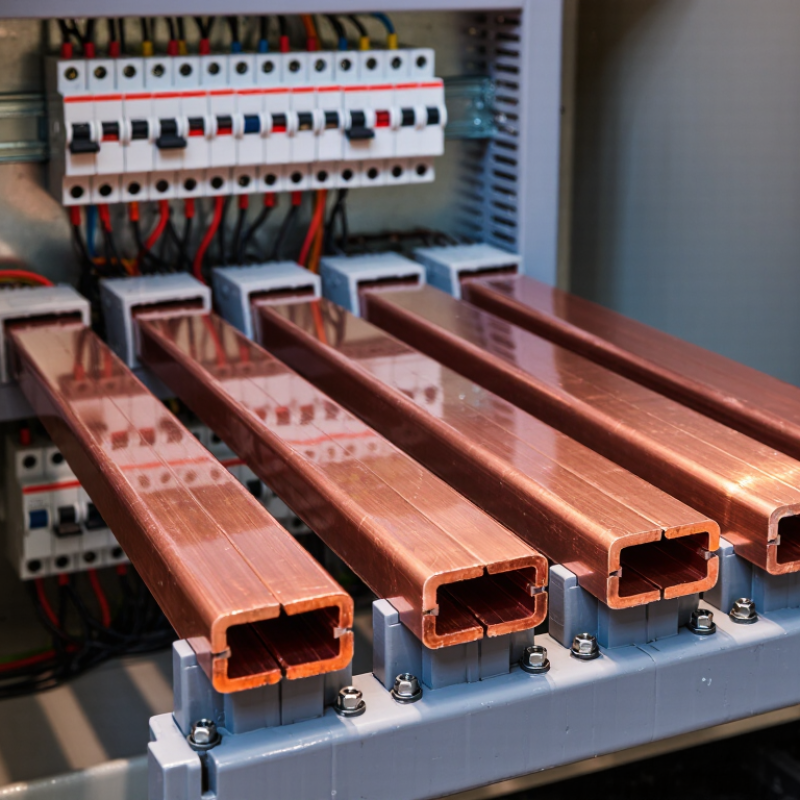
Copper bus bars act as compact electrical highways inside switchboards, control panels, substations, and inverter cabinets. They collect power from an incoming supply and distribute it to breakers, feeders, or parallel circuits. A rigid, flat bar also provides clear connection points. Technicians can bolt a cable lug beside a breaker instead of crowding cables onto one terminal. Less clutter. This helps in tight enclosures, where inspection and heat movement matter. Copper’s high conductivity supports large currents with manageable cross-sections, but sizing still depends on current, temperature, supports, and fault forces.
The Copper Development Association lists annealed copper at 100% IACS electrical conductivity at 20°C, a reference value for comparing conductors. The IEA’s Electricity 2024 report projected global electricity demand growth averaging 3.4% annually over 2024–2026, highlighting the need for carefully engineered distribution equipment. A bus bar does not reduce losses by itself. Poorly tightened joints can overheat, while weak supports may allow movement during a fault. Engineers verify temperature rise, short-circuit withstand, clearances, and joint pressure against applicable assembly standards. That copper strip may look simple. Its layout affects how reliably power reaches each outgoing circuit. Sometimes the connection detail is the weak point.

A copper bus bar is a solid conductor that carries current between electrical components and distributes it to several circuits. Its broad, flat shape provides a practical connection surface for cables, breakers, and terminal lugs. In a power panel, current may enter through a main connection, travel along the bar, then branch off through bolted connections. One bar can serve many outgoing circuits.
The path is simple. Current flows through the copper, while the bar’s cross-section helps limit electrical resistance and heat. A warm bus bar is normal under load; excessive heat is not. Loose bolts, corrosion, or an undersized bar can increase resistance at a connection. That small joint matters.
Engineers select bus bar dimensions based on expected current, temperature rise, fault conditions, and available space. Insulating supports hold the bar in place and maintain safe spacing from other conductors. During installation, clean contact surfaces and correctly tightened connections help support reliable operation. Details can be easy to overlook. A bus bar does not automatically make a system safer or more efficient; its performance depends on suitable sizing, sound connections, and regular inspection.
Copper bus bars provide a compact path for carrying and distributing electrical current. In switchgear, they connect incoming supplies to breakers and outgoing circuits. Their flat, rigid shape helps organize several connections inside a metal enclosure. That matters.
In control and distribution panels, bus bars link components such as circuit breakers, fuse holders, and terminal assemblies. Installers use bolted joints to create firm electrical contacts, while insulated supports keep bars separated from the enclosure and from one another. A loose connection can generate heat, so contact surfaces and fastener torque deserve careful attention. Copper’s good conductivity can help limit electrical losses, but it does not make poor installation harmless.
Larger power equipment may use bus bars to connect transformers, generator outputs, or major distribution sections. Bar dimensions, spacing, and support strength must suit the expected current and short-circuit forces. Designers also consider heat buildup, enclosure airflow, and the number of connected cables. These details can be easy to overlook on a tidy drawing. In the finished panel, crowded bends or awkward access can make inspection harder. A sound design leaves room for safe assembly and future maintenance, not just a path for current.
| Application | How the Bus Bar Is Used | Typical Locations | Key Design Considerations |
|---|---|---|---|
| Switchgear | Connects incoming and outgoing circuits and distributes electrical power between switching and protective devices. | Low-voltage and medium-voltage switchgear assemblies | Rated current, short-circuit withstand, insulation clearances, temperature rise, and mechanical support |
| Distribution panels | Distributes power from the main supply to branch circuits, circuit breakers, or fused sections. | Commercial, industrial, and building distribution boards | Available enclosure space, connection layout, current rating, and compatibility with protective devices |
| Motor control centers | Provides a common power-distribution path for motor starters, variable-frequency drives, and related control units. | Industrial motor control center lineups | Motor load profiles, fault-current levels, ventilation, and access for inspection or maintenance |
| Transformer connections | Connects transformer terminals to switchgear, distribution equipment, or other conductors. | Transformer secondary connections and equipment interfaces | Terminal arrangement, current capacity, thermal expansion, joint design, and protection from accidental contact |
| Grounding and bonding | Forms a conductive path for bonding equipment frames or connecting grounding conductors where the design specifies a bus bar. | Electrical enclosures, switchboards, and grounding assemblies | Applicable electrical codes, connection integrity, corrosion conditions, and continuity of the grounding path |
| Power conversion equipment | Connects components carrying DC or AC power within equipment, such as rectifiers, inverters, and energy-storage systems. | Industrial drives, power supplies, and battery or energy-storage assemblies | Current waveform, insulation requirements, heat dissipation, spacing, and fault protection |
| Busway and equipment interconnections | Acts as a conductive element within enclosed busway systems or between adjacent power equipment sections. | Electrical rooms, plant distribution systems, and equipment lineups | System voltage, current rating, enclosure design, expansion provisions, and installation conditions |
What Is Copper Bus Bar Used For?
Copper Bus Bar Applications in Industrial and Renewable Energy Systems
Copper bus bars provide a compact way to distribute high current between electrical components. In factories, they connect switchboards, motor-control centers, transformers, and battery systems. Their flat, broad surfaces can make equipment layouts easier to inspect than bundles of separate cables. Good access matters.
In renewable energy systems, bus bars carry power inside solar inverters, wind-turbine converters, and energy-storage cabinets. A solar installation may use them between combiner circuits and inverter components. Battery racks also need carefully planned connections across modules. Copper’s conductivity supports efficient current transfer, but performance depends on bar dimensions, joint quality, and temperature. A shiny bar is not automatically a safe one.
Designers should consider expected current, fault conditions, enclosure space, and cooling before selecting a bus bar. Poorly tightened joints can create hot spots, while vibration may loosen connections in some installations. Protective covers, suitable insulation, and routine thermal checks help reduce risks. Field conditions can differ from drawings, so commissioning measurements are worthwhile. One detail is easy to miss: expansion and contraction can stress rigid connections. Flexible links may help, but the right arrangement depends on the equipment and operating environment.
Copper bus bars distribute electrical power in switchgear, control panels, industrial power systems, solar inverters, and battery storage installations. The chart shows how increasing a bar’s cross-sectional area reduces its calculated DC resistance.
Illustrative calculation for a straight copper bar at 20°C, using copper resistivity of 1.72 × 10⁻⁸ Ω·m. Actual resistance and current capacity depend on temperature, bar dimensions, installation, cooling, and electrical connections.
What Is Copper Bus Bar Used For?
Key Factors That Determine Copper Bus Bar Selection
Copper bus bars carry and distribute electrical current in switchboards, control panels, and other power equipment. Choosing one involves more than matching its dimensions to a drawing. Start with the continuous current, then consider the permitted temperature rise, ambient heat, and available airflow. A bar inside a crowded enclosure may run hotter than the same bar in open air. That difference matters.
Material grade and cross-sectional area affect conductivity, weight, and heat generation. Check short-circuit withstand requirements too, since fault currents can create intense mechanical forces. Connections deserve equal attention: bolt size, contact surface, tightening method, and access for maintenance all influence joint reliability. In humid or corrosive surroundings, protective plating may help, but it does not replace sound enclosure design. A detail often missed is the route: bends and supports must fit the equipment without stressing joints. Even a careful calculation can overlook real installation constraints, so confirm dimensions and operating conditions before ordering. One judgment call remains: selecting extra capacity may add cost and weight, while too little can limit future expansion.


For those larger-sized parts, or smaller quantity runs, we have 2 independent powder coat booths and ovens. The quality, durability and affordability of today’s powder coating finishes make this the process of choice for world-class companies.
Powder coating advantages over other forms of coating are many. Materials used in the Powder coating process can be metals and non-metals that come in a multitude of thicknesses, textures, colors, etc. Another of Powder coating’s biggest advantages over conventional coatings is its ability to create finishes in many different textures. Powder Coating Booths allow us the ability to apply these advantages to large products.
Tri-State Fabricators runs a full-service conveyor line for painting. Wet painting can provide protection or decoration to many different part styles. From start to finish, every project is easier to undergo random and point-based inspection by our skilled painting team.
Advantages to our Wet Paint Line are these lines start with product prep and ends with a thorough inspection of a high quality finished product. Our ability to complete large and small projects with a superior finish and doing so in a timely and economical fashion. This passes along the savings in production to our customers. When powder coating ins not an option, our Wet Paint Line gets the job done right the first time.
When the parts get big and heavy we roll-out our custom paint racks and oversize booth. By utilizing our partnerships with all the major paint brands, we can match virtually any color with wet paint.
The advantages of having access to a Wet Paint Booth are many. Large projects of many different shapes can be loaded into the booth. The Wet Paint Booth offers an environment that is much more controlled than a typical parts painting operation.
Not only are they used because of their controlled environment, but they’re are also advantageous when it comes to applying paint to parts that are needed in industries that require specialty coatings such as medical, aerospace, etc.
Our military forces have some very high standards when it comes to the finish of their vehicles and equipment. From the first pre-treatment step to final coat, it takes a great deal of knowledge and experience to protect the men and women of our armed forces. They deserve only the best, and Tri-State Fabricators provides it.
All of our processes are closely monitored by our staff and management teams. Both of which are highly trained in the processes of metal fabrication and finishing. Tri-State Fabricators’ goal is to always fully satisfy each and every customer, including the military. We will always put a 110% into what we do.
Abrasive media blasting is an excellent way to remove old paint, rust, and increase the paint/powder adhesion. Glass beads produce a much smoother and brighter finish than angular abrasives; leaving the part clean yet without any dimensional change. Chemically inert and environmentally friendly, we can recycle our beads approximately 30 times; making them a more preferred method of metal cleaning or surface finishing.
Advantages to Glass Bead Blasting are many. Glass bead blast media is used when a project is needing rough surfaces need to become smooth for applications of coatings such as paint. It is typically used to clean paint and rust from a product surface without deforming the surface it is being used on. Overall, compared to many other blasting media, Glass Bead Blasting is a very economical choice and those savings are always passed on to our customers.
Tri-State Fabricators utilize a zinc phosphate wash to clean and etch the material to ensure the best paint adhesion possible. The unique design of our 3-stage wash system does the work like a 5-stage. From Cleaning and rinsing to conversion coating and post-treatment, Our Part Washing process is a complete service and works throughout the fabrication service and the finishing service.
Along with the previously mentioned benefits, Curing is a vital chemical reaction that leaves the product finish hard and relatively safe from mild abrasion and aggressive corrosion. This process can be done in more than one way; ambient air-dry or in curing ovens at temps that exceed 240°.
From fixing paint mistakes (someone else’s of course) to simply cleaning our paint line hooks, our burn-off oven is put to good use. After a quick burn-off, a little clean up, and a fresh coat of paint, your parts will look better than new.
Why does our Burn-Off Oven work so well? Because super heating the air around parts turns the materials into ashes. From paint and powder coatings to rubber and machining oils, high temps do the job without degrading the integrity of the part.
Masking is a vital part of producing high quality products. We have die-cut masking patterns to protect machined surfaces as well as a wide range of plugs and caps to protect threaded holes and bolts. We provide permanent and temporary masking.
Masking allows the selected sections of a product to be protected from a fabrication or finishing service. This can be with both chemicals when etching and tapes, paints when only finishing just a section of the product. Masking is great in aiding the customization process of a project.
Screen printing is a photographic process that transfers artwork onto a porous nylon screen which allows colored ink to flow through the screen and be deposited on an aluminum or plastic component. We can generally have just about any design created onto a screen for your parts.
Some of the advantages of Screen Printing are, brand recognition for your business displaying on your products, assembly instructions, product warnings/hazards, etc. Tri-State Fabricators produces Screen Printing of the highest quality so you know it’s durable.
Metal Finishing is the art of treating the exterior portion of product, often metal but can also be made of other materials, so that the surface is clean and free of any debris. Then the process of applying coats or either paint of powder coat takes place. This coating process improves the quality of the product in both appearance and resistance to wear and corrosion.
Tri-State Fabricators, Inc., understands that a project typically isn’t complete until a high-quality finish has been added to your product. This is why our painting and powder coating teams continuously inspect the products throughout the Metal Finishing process.

