


What Is a Cooled IR Camera Module and How Does It Work?

A Cooled Ir Camera Module captures infrared energy with a detector maintained below ambient temperature. This cooling reduces thermal noise and improves sensitivity, especially in the mid-wave infrared (MWIR) and long-wave infrared (LWIR) bands. In practical terms, it can reveal a faint heat signature across a dark field, through smoke, or beside a much brighter object.

According to the Yole Group’s infrared imaging market analyses, demand remains strong in defense, industrial inspection, scientific research, and gas detection. MarketsandMarkets also identifies cooled detectors as important for applications requiring high sensitivity, fast response, and precise spectral measurement. These reports point to a clear advantage. A Cooled IR Camera Module is not simply a sharper thermal camera. It is a carefully matched system involving the detector, cryocooler, optics, signal processor, and enclosure.

Prof. Michael Vollmer, a recognized infrared-imaging researcher, explains, “Every object with a temperature above absolute zero emits infrared radiation.” The module converts that radiation into measurable electrical signals. The cooler then stabilizes detector performance and suppresses unwanted noise. The result is cleaner imagery and more dependable temperature contrast. It is not perfect, though. Cooling adds size, power consumption, cost, and mechanical complexity. Designers must also consider cooldown time, vibration, calibration drift, and atmospheric absorption. That trade-off is often overlooked. Understanding how each component works makes it easier to select the right cooled architecture for demanding imaging conditions.
What Is a Cooled IR Camera Module and How Does It Work?

What Is a Cooled IR Camera Module?

A cooled IR camera module is an infrared imaging assembly with a detector maintained at very low temperatures. It usually combines an infrared sensor, optical window, signal electronics, and a mechanical cooler. The cooling system may use a miniature cryocooler to reduce detector temperature far below normal operating conditions.

Why does this matter? Infrared detectors generate electrical signals from heat radiation, but they also produce unwanted thermal noise. Cooling suppresses much of that noise. As a result, the module can detect smaller temperature differences and weaker infrared signals. This is especially useful in mid-wave and long-wave infrared imaging, where accurate measurements may depend on subtle heat patterns.

The detector does not work alone. Its optical path must transmit the target infrared band, while the electronics amplify and convert the signal into image data.

A sealed housing helps prevent moisture from reaching the cold sensor surface. In field testing, vibration, startup time, power demand, and cooler lifespan can affect actual performance. No detector is perfectly quiet.

It is easy to assume that cooling always creates a better image. That is not always true. Poor calibration, unstable optics, or incorrect focus can limit the final result. Engineers often compare noise, sensitivity, frame rate, and operating temperature before selecting a module for scientific inspection, aerospace measurement, or industrial monitoring.


Key Components of a Cooled Infrared Camera Module

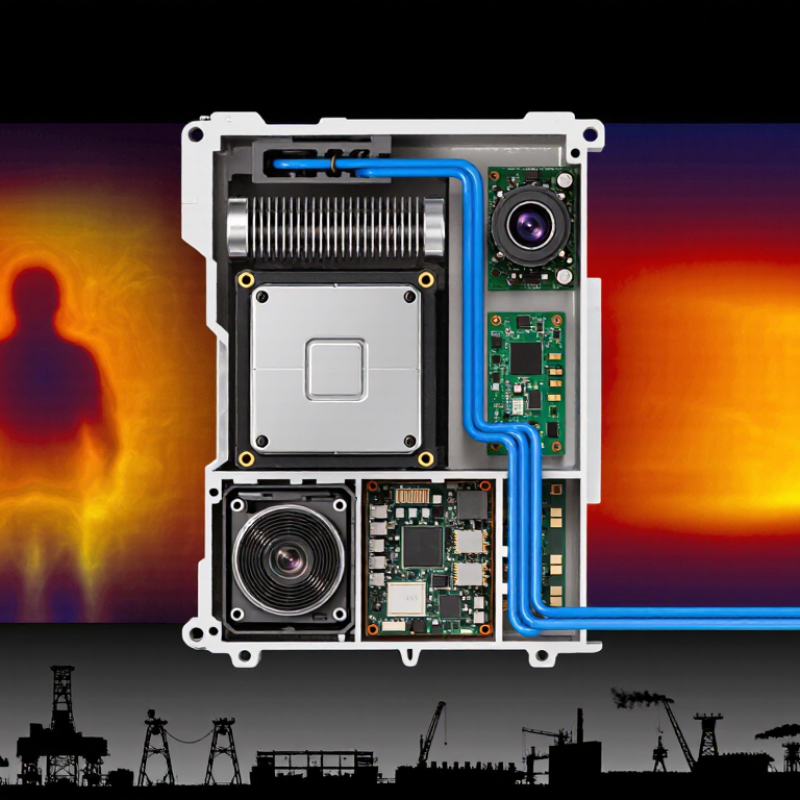
A cooled infrared camera module uses a cryogenic detector to capture faint mid-wave or long-wave infrared radiation. Its core begins with an infrared lens, which focuses thermal energy into a detector array. The array sits inside a vacuum dewar, where insulation limits heat transfer and reduces background radiation. A cold shield surrounds the detector and blocks unwanted off-axis energy. Small details matter here.

The detector converts photons into electrical signals. A readout integrated circuit then amplifies and digitizes each pixel’s response. The cryocooler, often a miniature mechanical refrigeration unit, lowers detector temperature to improve sensitivity and reduce thermal noise. Control electronics manage timing, temperature, calibration, and image output. According to a 2024 Yole Group industry outlook, cooled infrared systems remain important in high-performance sensing because they deliver longer detection ranges and finer spectral response than many uncooled designs.

The module still depends on optics and software. Calibration tables correct pixel-to-pixel differences, while image processing improves contrast and compensates for drift. A 2024 MarketsandMarkets report projects continued growth in the global thermal imaging market, driven by aerospace, industrial inspection, and surveillance applications. Yet market forecasts are not perfect. Real performance can fall when vibration affects the cooler, or when the optical window becomes contaminated. Engineers must balance cooling speed, power consumption, size, and service life. That compromise is often underestimated.

What Is a Cooled IR Camera Module and How Does It Work?

Key Components, Typical Specifications, and Operating Functions of a Cooled Infrared Camera Module

Module Component Primary Function Typical Technical Characteristics How It Supports Infrared Imaging Important Design Considerations
Infrared Detector Array Converts incoming infrared radiation into electrical signals. Common cooled detector materials include indium antimonide (InSb), mercury cadmium telluride (MCT), and some cooled indium gallium arsenide (InGaAs) arrays. Determines the spectral response, sensitivity, spatial resolution, and measurement capability of the camera. Detector material must match the intended wavelength band, target temperature range, and application environment.
Spectral Band Defines the infrared wavelengths detected by the module. Common bands include SWIR: approximately 0.9–1.7 μm; MWIR: approximately 3–5 μm; and LWIR: approximately 8–12 μm. Controls which physical phenomena can be observed, such as high-temperature emissions, gas absorption features, or thermal radiation. Atmospheric absorption, background radiation, and application-specific target temperatures influence band selection.
Cryogenic Cooler Lowers the detector temperature to reduce thermal noise. Many cooled MWIR and LWIR detectors operate at roughly 60–100 K, depending on detector material and system design. Improves signal-to-noise ratio and enables detection of small temperature differences or weak infrared signals. Cool-down time, vibration, power consumption, operating life, and acoustic noise vary with the cooler architecture.
Cold Shield and Cold Stop Limits unwanted radiation from the camera interior and defines the detector’s optical acceptance angle. Usually maintained near the detector’s cryogenic temperature and positioned within the cooled optical assembly. Reduces stray radiation and thermal background, which helps preserve image contrast and measurement accuracy. Incorrect alignment or insufficient shielding can increase background noise and reduce dynamic range.
Infrared Optics Collects and focuses infrared radiation onto the detector array. May use materials such as germanium, silicon, zinc selenide, or other infrared-transmitting optical materials, depending on the spectral band. Determines field of view, focal length, optical throughput, spatial resolution, and image uniformity. Optics must transmit the selected infrared band and remain compatible with cryogenic temperature changes when applicable.
Readout Integrated Circuit (ROIC) Collects, integrates, and multiplexes the electrical signal from each detector pixel. Key parameters include pixel pitch, integration time, full-well capacity, frame rate, and selectable gain settings. Converts individual pixel responses into an organized electronic output for image processing. ROIC design affects dynamic range, noise performance, frame rate, windowing capability, and power consumption.
Signal Processing Electronics Amplifies, digitizes, corrects, and formats the detector output. Typical functions include analog-to-digital conversion, non-uniformity correction, bad-pixel replacement, gain control, and image formatting. Transforms raw detector data into a stable and usable infrared image or measurement output. Processing latency, bit depth, calibration storage, and output interfaces should match the host system requirements.
Temperature Monitoring and Control Monitors detector and cooler temperatures and maintains the required operating condition. Uses temperature sensors, control electronics, and feedback loops to stabilize the cryogenic detector environment. Improves image repeatability by reducing sensitivity changes caused by detector temperature drift. Temperature stability is important for radiometric applications and long-duration measurements.
Vacuum Dewar or Cryostat Provides a thermally insulated, low-pressure enclosure around the cooled detector assembly. Typically includes a sealed vacuum vessel, infrared window, internal supports, and low-thermal-conductivity materials. Reduces heat transfer and prevents atmospheric moisture from condensing on cold components. Vacuum integrity, window transmission, contamination control, and mechanical robustness affect long-term reliability.
Infrared Window Allows infrared radiation to enter the cryostat while maintaining the internal vacuum. Material and coating are selected according to the operating band, pressure requirements, and environmental conditions. Provides the optical interface between the external lens system and the cryogenic detector. Window transmission, reflection losses, coating durability, and thermal expansion must be considered.
Non-Uniformity Correction (NUC) Compensates for pixel-to-pixel response variations and drift. Uses calibration data, commonly obtained from uniform references at one or more temperature levels. Produces a more uniform image and reduces fixed-pattern noise across the detector array. Calibration may need periodic updating when operating temperature, integration time, or optical conditions change.
Typical Sensitivity Indicator Describes the module’s ability to resolve small changes in infrared signal. Cooled cameras commonly achieve NETD values in the low-millikelvin to tens-of-millikelvin range, depending on detector, optics, bandwidth, and operating mode. Lower noise-equivalent temperature difference generally allows clearer detection of small thermal contrasts. NETD is not a universal performance value; measurement conditions and test methods must be stated for valid comparison.
Digital Output Interface Transfers image data, status information, and control commands to the host system. Interfaces may include high-speed serial, Camera Link-type, GigE-type, USB-type, or application-specific digital connections. Enables real-time image acquisition, remote configuration, recording, and integration with analysis software. Bandwidth, cable length, synchronization, latency, and electromagnetic compatibility influence system integration.
Power and Control Interface Supplies electrical power and provides control signals for the detector, cooler, and processing electronics. Power requirements depend on detector size, frame rate, cooler type, electronics, and operating temperature. Coordinates start-up, cool-down, imaging, temperature regulation, fault reporting, and safe shutdown. System designers should account for peak start-up power, heat dissipation, grounding, and protection circuitry.

Note: The specifications shown are representative industry ranges or commonly used design characteristics. Actual performance depends on detector architecture, optical design, cooling method, calibration conditions, and operating mode.

How the Cooling System Enables Infrared Detection

What Is a Cooled IR Camera Module and How Does It Work?

A cooled infrared camera module uses a cryogenic cooler to lower the detector’s operating temperature. Many MWIR detectors operate near 77 K, while some LWIR designs use higher setpoints. At these temperatures, thermal noise and dark current fall sharply. The detector can then measure weaker radiation from distant, small, or low-contrast targets. That difference matters when a warm object appears against a warm background.

The cooling system usually combines a miniature Stirling engine, a cold finger, temperature sensors, and a control circuit. The cold finger transfers heat away from the focal plane. Cooling may require several minutes before measurements stabilize. It also consumes power and can introduce vibration. Engineers therefore balance sensitivity, size, acoustic noise, and service life. A lower detector temperature is not automatically better. That assumption needs checking.

The 2024 MarketsandMarkets Thermal Imaging Market report projected the global market to grow from about USD 7.6 billion in 2024 to USD 11.5 billion by 2029. This growth reflects demand for higher sensitivity in research, industrial inspection, and long-range observation. Industry detector studies also show that cooling can improve signal-to-noise performance by reducing detector-generated noise, especially during longer integration times. In practice, performance depends on more than the cooler. Optical transmission, calibration stability, atmospheric absorption, and readout electronics remain critical. Small thermal leaks can still weaken the result.

What Is a Cooled IR Camera Module and How Does It Work?

Cooling reduces detector dark current and thermal noise, allowing a cooled infrared camera to detect weaker signals with higher sensitivity. The chart shows the blackbody peak-emission wavelength calculated from Wien’s displacement law: λmax = 2898 / T, where λ is measured in micrometers and T in kelvin.

How Infrared Signals Become Thermal Images

What Is a Cooled IR Camera Module and How Does It Work?

A cooled infrared camera module converts invisible heat radiation into a measurable thermal image. Its detector sits inside a sealed cooler, often operating far below room temperature. Cooling reduces electronic noise and improves sensitivity, especially during long exposures or low-temperature measurements. The lens focuses infrared energy onto detector elements, where each element responds to radiation from a small area. An analog-to-digital converter then changes these responses into numerical values. In practical testing, even a warm hand can appear clearly against a cooler wall.

The camera processes these values through calibration and non-uniformity correction. It compares detector output with known reference temperatures, then reduces pixel-to-pixel differences. Software assigns colors or grayscale tones to temperature ranges. Bright yellow may represent hotter areas, while dark blue may indicate cooler surfaces. However, the image is not a direct photograph. Surface emissivity, reflections, distance, humidity, and atmospheric absorption can change the reading. A common mistake is trusting the brightest spot without checking the material. Thermal imaging is useful, but never perfectly simple.

Tips: Keep the optical window clean and avoid touching it. Let the cooled module stabilize before precise measurements. Set emissivity carefully for each material. Check reflections from glass, polished metal, or nearby heaters. Compare suspicious readings with a calibrated reference. Small errors matter. Temperature data should be recorded with distance and environmental conditions.

Main Applications and Performance Factors of Cooled IR Modules

What Is a Cooled IR Camera Module and How Does It Work?

Main Applications and Performance Factors of Cooled IR Modules

A cooled infrared module uses a cryogenic cooler to lower the detector’s temperature, often near 77 K. This reduces thermal noise and improves sensitivity in the 3–5 µm mid-wave infrared band. The result is clearer detection of small temperature differences, even through haze, smoke, or long viewing distances.

The 2024 MarketsandMarkets report estimated the global thermal imaging market at approximately US$6.7 billion, reflecting demand from defense, industrial inspection, aerospace, and security applications.

Performance depends on more than detector resolution. Noise-equivalent temperature difference, or NETD, indicates how finely the module can distinguish temperature changes. A lower NETD is usually better. Frame rate matters during missile tracking, gas-leak monitoring, and high-speed machine inspection. Cooling time, power consumption, vibration, and calibration stability also affect field performance. A module may deliver excellent laboratory images but struggle inside a compact airborne system.

Real installations expose compromises. Cooled systems can detect a warmer pipe joint at a distance, yet their coolers add weight, cost, and mechanical complexity. Yole Group’s infrared imaging analyses consistently identify size, weight, power, and cooling reliability as major design constraints.

That warning deserves attention.

More sensitivity is not always more useful. Engineers must match the spectral band, lens, detector pitch, and cooling architecture to the scene, not simply choose the highest specification.

Powder Coat Booths

For those larger-sized parts, or smaller quantity runs, we have 2 independent powder coat booths and ovens. The quality, durability and affordability of today’s powder coating finishes make this the process of choice for world-class companies.

Powder coating advantages over other forms of coating are many. Materials used in the Powder coating process can be metals and non-metals that come in a multitude of thicknesses, textures, colors, etc. Another of Powder coating’s biggest advantages over conventional coatings is its ability to create finishes in many different textures. Powder Coating Booths allow us the ability to apply these advantages to large products.

Wet Paint Line

Tri-State Fabricators runs a full-service conveyor line for painting. Wet painting can provide protection or decoration to many different part styles. From start to finish, every project is easier to undergo random and point-based inspection by our skilled painting team.

Advantages to our Wet Paint Line are these lines start with product prep and ends with a thorough inspection of a high quality finished product. Our ability to complete large and small projects with a superior finish and doing so in a timely and economical fashion. This passes along the savings in production to our customers. When powder coating ins not an option, our Wet Paint Line gets the job done right the first time.

Wet Paint Booths

When the parts get big and heavy we roll-out our custom paint racks and oversize booth. By utilizing our partnerships with all the major paint brands, we can match virtually any color with wet paint.

The advantages of having access to a Wet Paint Booth are many. Large projects of many different shapes can be loaded into the booth. The Wet Paint Booth offers an environment that is much more controlled than a typical parts painting operation.

Not only are they used because of their controlled environment, but they’re are also advantageous when it comes to applying paint to parts that are needed in industries that require specialty coatings such as medical, aerospace, etc.

Military CARC

Our military forces have some very high standards when it comes to the finish of their vehicles and equipment. From the first pre-treatment step to final coat, it takes a great deal of knowledge and experience to protect the men and women of our armed forces. They deserve only the best, and Tri-State Fabricators provides it.

All of our processes are closely monitored by our staff and management teams. Both of which are highly trained in the processes of metal fabrication and finishing. Tri-State Fabricators’ goal is to always fully satisfy each and every customer, including the military. We will always put a 110% into what we do.

Glass-Bead Blasting

Abrasive media blasting is an excellent way to remove old paint, rust, and increase the paint/powder adhesion. Glass beads produce a much smoother and brighter finish than angular abrasives; leaving the part clean yet without any dimensional change. Chemically inert and environmentally friendly, we can recycle our beads approximately 30 times; making them a more preferred method of metal cleaning or surface finishing.

Advantages to Glass Bead Blasting are many. Glass bead blast media is used when a project is needing rough surfaces need to become smooth for applications of coatings such as paint. It is typically used to clean paint and rust from a product surface without deforming the surface it is being used on. Overall, compared to many other blasting media, Glass Bead Blasting is a very economical choice and those savings are always passed on to our customers.

Part Washing

Tri-State Fabricators utilize a zinc phosphate wash to clean and etch the material to ensure the best paint adhesion possible. The unique design of our 3-stage wash system does the work like a 5-stage. From Cleaning and rinsing to conversion coating and post-treatment, Our Part Washing process is a complete service and works throughout the fabrication service and the finishing service.

Along with the previously mentioned benefits, Curing is a vital chemical reaction that leaves the product finish hard and relatively safe from mild abrasion and aggressive corrosion. This process can be done in more than one way; ambient air-dry or in curing ovens at temps that exceed 240°.

Burn-Off Oven

From fixing paint mistakes (someone else’s of course) to simply cleaning our paint line hooks, our burn-off oven is put to good use. After a quick burn-off, a little clean up, and a fresh coat of paint, your parts will look better than new.

Why does our Burn-Off Oven work so well? Because super heating the air around parts turns the materials into ashes. From paint and powder coatings to rubber and machining oils, high temps do the job without degrading the integrity of the part.

Masking

Masking is a vital part of producing high quality products. We have die-cut masking patterns to protect machined surfaces as well as a wide range of plugs and caps to protect threaded holes and bolts. We provide permanent and temporary masking.

Masking allows the selected sections of a product to be protected from a fabrication or finishing service. This can be with both chemicals when etching and tapes, paints when only finishing just a section of the product. Masking is great in aiding the customization process of a project.

Screen Printing

Screen printing is a photographic process that transfers artwork onto a porous nylon screen which allows colored ink to flow through the screen and be deposited on an aluminum or plastic component. We can generally have just about any design created onto a screen for your parts.

Some of the advantages of Screen Printing are, brand recognition for your business displaying on your products, assembly instructions, product warnings/hazards, etc. Tri-State Fabricators produces Screen Printing of the highest quality so you know it’s durable.

Metal Finishing

Metal Finishing is the art of treating the exterior portion of product, often metal but can also be made of other materials, so that the surface is clean and free of any debris. Then the process of applying coats or either paint of powder coat takes place. This coating process improves the quality of the product in both appearance and resistance to wear and corrosion.

Tri-State Fabricators, Inc., understands that a project typically isn’t complete until a high-quality finish has been added to your product. This is why our painting and powder coating teams continuously inspect the products throughout the Metal Finishing process.
