


Why Choose CNC Machining Centers for Your Business?

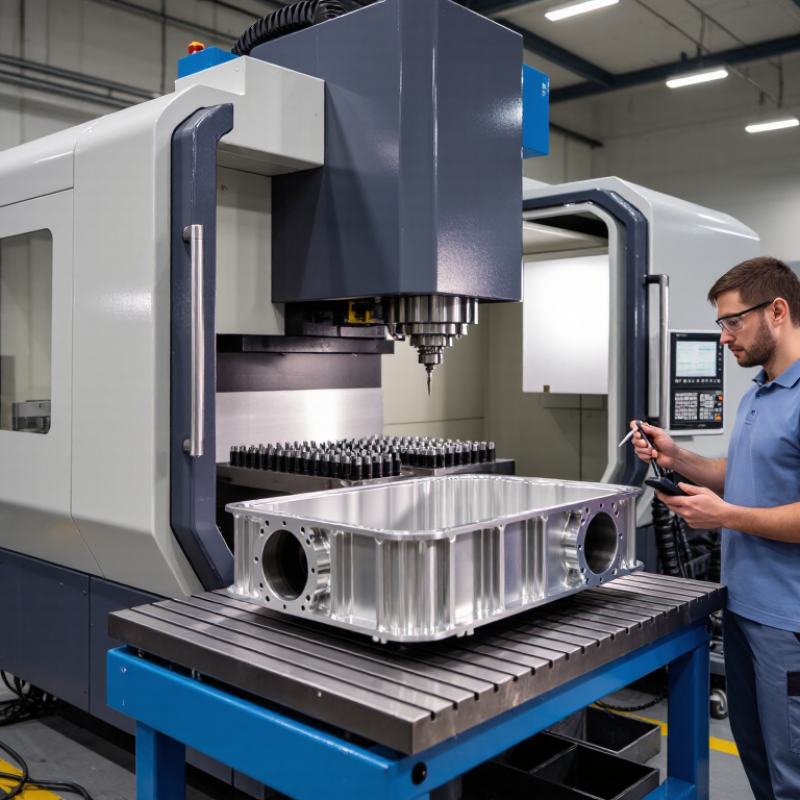
Choosing Cnc Machining Centers can change how a shop handles complex parts, tight tolerances, and shifting order volumes. One setup can combine milling, drilling, and tapping, reducing the time parts spend moving between machines. Picture an aluminum housing leaving the worktable with its mounting holes and machined faces aligned. Fewer handoffs can mean fewer opportunities for error. Not every shop needs that capability.

CNC applications engineer Martin Keller puts the decision this way: “A machine earns its place when it makes good parts consistently, not just quickly.” That principle matters more than a long list of features. A buyer should compare spindle speed, tool capacity, axis travel, control usability, and service support against actual jobs. Review representative part drawings, cycle-time estimates, and expected annual volumes. Then ask operators to assess setup access and everyday maintenance. Small details matter.

There is a trade-off. A capable machine can sit underused if programming skills, workholding, or demand fall short. I would not treat automation as an instant fix; that assumption deserves a second look. The strongest case comes from measurable bottlenecks: repeated setups, growing queues, or tolerances that vary across batches. Start with the parts already on the schedule. Compare current labor, scrap, and lead times with realistic machine estimates. A careful evaluation helps determine whether a machining center will improve throughput, consistency, and flexibility—or simply add cost and complexity.
Why Choose CNC Machining Centers for Your Business?

What Defines a CNC Machining Center: Axes, Spindle, Tool Changer, and Control

Why Choose CNC Machining Centers for Your Business?

What Defines a CNC Machining Center: Axes, Spindle, Tool Changer, and Control

A CNC machining center combines coordinated axes, a rotating spindle, an automatic tool changer, and a programmed control system. The axes determine how the cutting tool and workpiece move. A three-axis machine handles many flat parts, while additional axes can reach angled surfaces with fewer setups. More axes are not automatically better. They can add programming and setup demands.

The spindle holds and rotates the cutting tool, so its speed, power, and rigidity should match the materials and operations involved. For example, milling a broad aluminum plate calls for different cutting conditions than drilling small holes in steel. Watch for vibration and heat; both can affect surface finish and tool life. Small details count.

A tool changer moves between operations without requiring manual tool swaps. Its capacity and change time matter most when a part needs many tools or repeated production runs. The control translates the machining program into machine movements and lets operators adjust feeds, offsets, and tool data. A clear interface can reduce setup errors, but it cannot replace sound training or careful checks. In practice, choosing a center means balancing part size, tolerances, workflow, and operator skill. Some shops focus too heavily on speed and overlook setup time. That trade-off deserves a closer look.


How 3-, 4-, and 5-Axis Designs Expand Part Geometry and Reduce Setups

A three-axis machining center moves a cutting tool along X, Y, and Z. It suits flat plates, pockets, and many prismatic parts. A vise holds the workpiece while the spindle reaches exposed faces. Simple geometry can often be completed in one setup. That keeps programming and fixturing manageable. But a deep cavity may require a longer tool, which can flex and leave marks.

Add a rotary axis, and a four-axis machine can turn the part during cutting. This helps produce holes or features around a cylindrical body without repeated manual indexing. Five-axis machines tilt and rotate the tool or workpiece, reaching angled faces and compound surfaces in fewer setups. A small impeller, for example, may need several orientations on a three-axis machine, but fewer on a five-axis system. Fewer pauses. Less reclamping can reduce alignment errors, though it does not guarantee accuracy; tool condition and setup still matter. More axes also bring added programming and inspection demands. It is not magic. For a simple bracket, that extra capability may be unnecessary, and the best choice depends on the part’s geometry, batch size, and tolerance needs.

Why Choose CNC Machining Centers for Your Business? — How 3-, 4-, and 5-Axis Designs Expand Part Geometry and Reduce Setups

Comparison 3-Axis Machining Center 4-Axis Machining Center 5-Axis Machining Center
Axis movement Three linear axes (X, Y, and Z) move the cutting tool or workpiece. Three linear axes plus one rotary axis, commonly used to turn the workpiece around a single axis. Three linear axes plus two rotary axes, allowing the tool or workpiece to approach from more directions.
Typical access Best suited to features accessible from one main direction at a time. Can machine multiple sides of a part by rotating it, subject to fixture and machine access. Can reach many angled faces and complex contours in one setup; access still depends on machine configuration and part geometry.
Part geometry Flat surfaces, pockets, slots, drilled holes, and prismatic parts. Parts with features around a central axis, such as indexed holes, slots, or features on several sides. Complex angled surfaces, compound curves, impellers, molds, and parts with features on multiple faces.
Setup potential Parts needing machining on several faces often require repositioning and re-clamping. Rotary indexing can reduce repositioning for features around the rotary axis. Simultaneous or indexed positioning can reduce re-clamping for many multi-face parts.
Accuracy considerations Fewer rotary axes can simplify programming and workholding for straightforward parts. Fewer setups can help limit errors introduced during repeated part repositioning. Fewer setups can help maintain relationships between features, but machine calibration, fixturing, and programming remain important.
Tool access and cutting Tool orientation is generally fixed relative to the workpiece during cutting. Rotating the workpiece can present different faces to a fixed-orientation tool. Tilting the tool or workpiece can improve access and allow shorter tools in some applications.
Programming and operation Generally the simplest option to program and operate for basic geometries. Requires rotary-axis programming and suitable workholding; indexed operations are common. Often requires more advanced CAM programming, collision checking, and operator expertise.
Best-fit business need Cost-effective production of simpler parts and work that can be completed from a limited number of directions. Efficient machining of parts that benefit from rotary indexing without requiring full multi-directional tool motion. Producing complex parts where broader tool access and fewer setups can justify higher equipment and programming demands.

Note: The number of axes alone does not determine achievable accuracy, cycle time, or setup count. Results depend on part geometry, machine configuration, tooling, workholding, programming, and production requirements.

What Xometry’s ±0.005-Inch Standard Tolerance Means for Part Quality

A ±0.005-inch tolerance allows a feature to vary by five thousandths of an inch on either side of its target. That creates a total tolerance band of 0.010 inch, or 0.254 millimeters. The conversion follows NIST’s exact inch-to-millimeter definition. For a 1.000-inch hole, the permitted range is 0.995 to 1.005 inches. Small numbers. Real consequences. A shaft near the upper limit may bind in a mating bore, even when both parts meet their individual dimensions.

ASME Y14.5-2018 explains how geometric dimensioning and tolerancing communicates design intent. A general ±0.005-inch tolerance does not control every concern, such as flatness, position, or alignment. Those may need separate callouts. In practice, machinists consider material, tool wear, part geometry, and how the workpiece is clamped. Thin walls can shift during cutting; a second setup can also introduce variation. Measurement matters too: calipers may not resolve a tight feature as reliably as a suitable micrometer or bore gauge. The tolerance is useful, but it is not a promise that every geometry is equally easy to hold. It is worth checking critical mating features against the drawing and the inspection method before production begins.

Why Choose CNC Machining Centers? Understanding a ±0.005-Inch Tolerance

A ±0.005-inch tolerance means a feature may be up to 0.005 inch above or below its nominal dimension, giving a total tolerance range of 0.010 inch. The chart shows how that same one-sided allowance compares with different nominal sizes. These percentages are illustrative calculations, not measurements of machining performance.

How Automation Affects Throughput, Labor Needs, and Repeatability

A CNC machining center can keep cutting while an operator loads another fixture or checks finished parts. An automatic tool changer, pallet system, and probing cycle reduce pauses between jobs.

Deloitte and MAPI’s 2024 Smart Manufacturing Survey reported 10–20% production-output improvements and 7–20% employee-productivity gains among surveyed manufacturers.

These are reported ranges, not guaranteed results. A shop should treat them as benchmarks, not a promise. Small batches, poor tool-life data, or frequent setup changes can erase gains quickly.

Automation also changes labor needs rather than simply removing them. Operators spend less time tending each spindle and more time preparing fixtures, checking offsets, and diagnosing alarms. On a night shift, that difference matters.

Repeatability improves when the machine follows the same tool path and probing routine across parts, reducing variation from manual repositioning. But it is not automatic perfection: a worn tool, thermal drift, or a misplaced datum can repeat the same error all night.

CNC centers work best when staff verify the first article, monitor tool wear, and keep setup notes current. The awkward truth is that automation can make a weak process faster, too.

Why CNC Investment Matters in a $101.22B Market (Grand View Research, 2023)

Grand View Research estimated the global CNC machine market at $101.22 billion in 2023. That figure signals substantial demand for precise, repeatable production. It does not guarantee that every shop will benefit from buying a machining center. That matters.

For a business, the investment case is practical: compare machine cost with expected workload, labor, setup time, and scrap. A center that completes multiple operations in one setup may reduce handling and keep dimensions consistent. On the shop floor, that can mean fewer part transfers and less time checking alignment. But the gains depend on skilled operators, suitable programming, and steady orders. A large market cannot supply those conditions for you.

Before committing, review actual job data. Track cycle times, changeovers, tolerances, and how often existing equipment sits idle. A machine can sit idle, too. Consider tooling, maintenance, training, and floor space alongside the purchase price. The market estimate also needs context: reports define categories and time periods differently, so confirm what the $101.22 billion includes before using it in a forecast. I would not treat one headline number as a business plan. The right investment should fit the parts your customers order, not just the size of the industry.

Powder Coat Booths

For those larger-sized parts, or smaller quantity runs, we have 2 independent powder coat booths and ovens. The quality, durability and affordability of today’s powder coating finishes make this the process of choice for world-class companies.

Powder coating advantages over other forms of coating are many. Materials used in the Powder coating process can be metals and non-metals that come in a multitude of thicknesses, textures, colors, etc. Another of Powder coating’s biggest advantages over conventional coatings is its ability to create finishes in many different textures. Powder Coating Booths allow us the ability to apply these advantages to large products.

Wet Paint Line

Tri-State Fabricators runs a full-service conveyor line for painting. Wet painting can provide protection or decoration to many different part styles. From start to finish, every project is easier to undergo random and point-based inspection by our skilled painting team.

Advantages to our Wet Paint Line are these lines start with product prep and ends with a thorough inspection of a high quality finished product. Our ability to complete large and small projects with a superior finish and doing so in a timely and economical fashion. This passes along the savings in production to our customers. When powder coating ins not an option, our Wet Paint Line gets the job done right the first time.

Wet Paint Booths

When the parts get big and heavy we roll-out our custom paint racks and oversize booth. By utilizing our partnerships with all the major paint brands, we can match virtually any color with wet paint.

The advantages of having access to a Wet Paint Booth are many. Large projects of many different shapes can be loaded into the booth. The Wet Paint Booth offers an environment that is much more controlled than a typical parts painting operation.

Not only are they used because of their controlled environment, but they’re are also advantageous when it comes to applying paint to parts that are needed in industries that require specialty coatings such as medical, aerospace, etc.

Military CARC

Our military forces have some very high standards when it comes to the finish of their vehicles and equipment. From the first pre-treatment step to final coat, it takes a great deal of knowledge and experience to protect the men and women of our armed forces. They deserve only the best, and Tri-State Fabricators provides it.

All of our processes are closely monitored by our staff and management teams. Both of which are highly trained in the processes of metal fabrication and finishing. Tri-State Fabricators’ goal is to always fully satisfy each and every customer, including the military. We will always put a 110% into what we do.

Glass-Bead Blasting

Abrasive media blasting is an excellent way to remove old paint, rust, and increase the paint/powder adhesion. Glass beads produce a much smoother and brighter finish than angular abrasives; leaving the part clean yet without any dimensional change. Chemically inert and environmentally friendly, we can recycle our beads approximately 30 times; making them a more preferred method of metal cleaning or surface finishing.

Advantages to Glass Bead Blasting are many. Glass bead blast media is used when a project is needing rough surfaces need to become smooth for applications of coatings such as paint. It is typically used to clean paint and rust from a product surface without deforming the surface it is being used on. Overall, compared to many other blasting media, Glass Bead Blasting is a very economical choice and those savings are always passed on to our customers.

Part Washing

Tri-State Fabricators utilize a zinc phosphate wash to clean and etch the material to ensure the best paint adhesion possible. The unique design of our 3-stage wash system does the work like a 5-stage. From Cleaning and rinsing to conversion coating and post-treatment, Our Part Washing process is a complete service and works throughout the fabrication service and the finishing service.

Along with the previously mentioned benefits, Curing is a vital chemical reaction that leaves the product finish hard and relatively safe from mild abrasion and aggressive corrosion. This process can be done in more than one way; ambient air-dry or in curing ovens at temps that exceed 240°.

Burn-Off Oven

From fixing paint mistakes (someone else’s of course) to simply cleaning our paint line hooks, our burn-off oven is put to good use. After a quick burn-off, a little clean up, and a fresh coat of paint, your parts will look better than new.

Why does our Burn-Off Oven work so well? Because super heating the air around parts turns the materials into ashes. From paint and powder coatings to rubber and machining oils, high temps do the job without degrading the integrity of the part.

Masking

Masking is a vital part of producing high quality products. We have die-cut masking patterns to protect machined surfaces as well as a wide range of plugs and caps to protect threaded holes and bolts. We provide permanent and temporary masking.

Masking allows the selected sections of a product to be protected from a fabrication or finishing service. This can be with both chemicals when etching and tapes, paints when only finishing just a section of the product. Masking is great in aiding the customization process of a project.

Screen Printing

Screen printing is a photographic process that transfers artwork onto a porous nylon screen which allows colored ink to flow through the screen and be deposited on an aluminum or plastic component. We can generally have just about any design created onto a screen for your parts.

Some of the advantages of Screen Printing are, brand recognition for your business displaying on your products, assembly instructions, product warnings/hazards, etc. Tri-State Fabricators produces Screen Printing of the highest quality so you know it’s durable.

Metal Finishing

Metal Finishing is the art of treating the exterior portion of product, often metal but can also be made of other materials, so that the surface is clean and free of any debris. Then the process of applying coats or either paint of powder coat takes place. This coating process improves the quality of the product in both appearance and resistance to wear and corrosion.

Tri-State Fabricators, Inc., understands that a project typically isn’t complete until a high-quality finish has been added to your product. This is why our painting and powder coating teams continuously inspect the products throughout the Metal Finishing process.
