Choosing Vaping Sensors is not just a matter of comparing product specifications. A reliable system should fit the rooms, airflow patterns, and response procedures in your facility. A sensor mounted near a supply vent may behave differently from one placed in a quiet washroom or changing area. Placement matters.
Indoor-air-quality researcher Richard L. Corsi has emphasized the importance of understanding how air moves through real spaces. A useful guide to his systems-based approach is: “Measure the room, not just the device.” This is an editorial paraphrase, not a verbatim quotation. It captures a practical point: sensor readings need context.
Look for clear information about detection methods, coverage, calibration, alerts, and ongoing maintenance. Ask how the system performs in rooms with changing ventilation, humidity, or everyday aerosols. Request documentation, not just a confident sales claim. Check whether alerts can be reviewed by authorized staff and handled consistently. Privacy matters, too; choose monitoring that avoids unnecessary recording or identification. Keep the process transparent.
No sensor is perfect. Some conditions can cause missed events or false alerts, and a dashboard cannot replace thoughtful facility procedures. Test proposed devices in representative spaces before expanding deployment. Record where units are installed, review alert patterns, and revisit placement when room use changes. Small details count. The right Vaping Sensors should provide useful, understandable signals that help staff respond calmly and improve indoor conditions—not promise certainty.
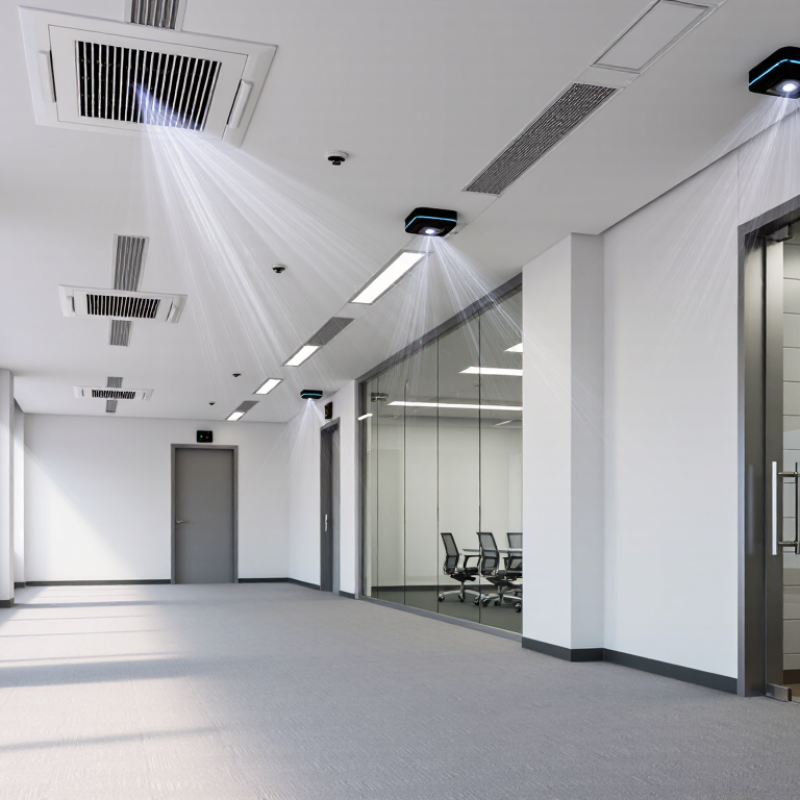
Vaping sensors do not “see” a device; they detect changes in the air. Optical particle sensors shine light through a sample and measure scattered light, estimating airborne particle levels. Some units also track volatile organic compounds (VOCs), humidity, or temperature. Together, these signals can flag a sudden aerosol-like event. But they cannot identify its source with certainty. Cooking, cleaning sprays, steam, and dust can produce similar readings. Not a fingerprint.
The CDC’s 2023 National Youth Tobacco Survey estimated 2.13 million current e-cigarette users among U.S. middle and high school students. That is population context, not a room-level measurement. The EPA’s Air Sensor Guidebook stresses evaluating sensor performance and interpreting readings in context.
Place sensors near likely breathing zones, but away from supply vents, windows, humidifiers, and cooking areas. Airflow can dilute or carry aerosol before a sensor samples it.
Paired particle and gas signals may improve detection, but thresholds need local testing. Sensor outputs are estimates, not laboratory-grade chemical identification. A false alert is still a design lesson.
Assess vaping risk by looking at how each space is used, not simply by counting rooms. A restroom near a busy gym entrance may need closer attention than a large, rarely used storage area. Review incident reports, occupancy patterns, ventilation, and places where people can remain unseen. Ask facilities staff what they have observed during different shifts. Their notes may reveal patterns that floor plans miss. No single indicator proves a problem.
Tips: Map entrances, restrooms, locker areas, and quiet corridors. Mark airflow outlets and sensor power access. Compare coverage with actual foot traffic, then revisit the map after schedule changes. A sensor blocked by a beam or placed beside a strong air vent may provide misleading readings.
Choose coverage based on risk, not a uniform grid. Place units where airflow and room layout support reliable sampling, while avoiding direct exposure to showers, steam, or cleaning sprays. These can cause confusing readings. Check installation guidance, test alerts during normal building conditions, and document adjustments. Sensors indicate airborne changes; they do not identify a person or explain the source. Review alerts alongside staff observations before responding. Coverage is never perfect. A pilot in one busy area can expose blind spots, though the results may still need rethinking.
A useful comparison starts with the signal each sensor measures. Optical particle sensors detect changes in airborne particles, which can help identify a brief aerosol plume near a doorway. However, steam from a shower or dust from maintenance may trigger similar readings. VOC sensors measure selected gases, but cleaning products and fresh paint can also affect them. No single signal tells the whole story.
Look closely at response time, detection range, and false-alarm performance. A fast sensor may react within seconds, yet still miss a plume outside its effective coverage. Check whether the stated range assumes open air or a specific room layout. Ceiling height matters. So do vents, fans, and air returns. Combined particle, gas, temperature, and humidity readings can provide useful context, though they may increase setup and maintenance needs.
Ask how often the device needs calibration and what happens when readings drift. Review alert delays, data logging, and integration with existing building systems. Test placement in busy rooms and near airflow changes, not just in a quiet office. Use controlled, benign test conditions recommended by the supplier. Record nuisance alerts over several weeks. That evidence may challenge your first choice—and it should.
A vaping sensor should be assessed at the actual installation point, not just from a product sheet. Walk the rooms and note airflow, ceiling height, vents, and likely sources of false alarms. A sensor near a supply vent may miss a changing plume; one beside a shower may trigger unnecessarily. Ask the installer to document coverage, calibration, alert delay, and test results. Then test alerts during normal building use. Imperfect results are possible. That is worth planning for.
Check whether alerts can connect to existing building dashboards or require a separate system. Confirm who can view event logs and how long they remain available. Avoid collecting audio or video when event detection is the goal. The 2024 Data Breach Investigations Report found that human involvement featured in 68% of breaches; the figure is not specific to facility sensors, but it underscores the need for access controls. A 2024 global data-breach cost report put the average breach cost at $4.88 million. Treat that as broad context, not a forecast for your site. NIST’s Privacy Framework can guide data minimization and access reviews. Be explicit with staff about what is recorded, and revisit the policy after a pilot. The first layout may need changing.

Test vaping sensors as room instruments, not simple alarm buttons. Before installation, run the manufacturer-approved test and record alert delay, peak reading, recovery time, and missed detections. Keep doors, HVAC settings, and sensor height consistent. A hallway draft can distort results. Test it twice. Place a reference particle monitor beside the sensor, and repeat under different humidity conditions. The U.S. EPA’s Air Sensor Guidebook recommends comparing sensor readings with reference monitors, since environmental conditions can affect performance.
Review trends monthly and after ventilation changes. Log false alerts, occupied hours, and maintenance; a clean-looking dashboard can still hide a blind spot. The U.S. EPA’s 2024 PM2.5 rule lowered the annual ambient-air standard from 12 to 9 micrograms per cubic meter. That figure is useful context, not a vaping alarm threshold. Compare sensor readings with the facility’s own baseline instead. Clean inlets as directed, check power and network connections, and document each service date. One missed alert needs investigation, not an instant sensitivity adjustment. Keep the log. Recheck performance after repairs, and question results that look unusually perfect.


For those larger-sized parts, or smaller quantity runs, we have 2 independent powder coat booths and ovens. The quality, durability and affordability of today’s powder coating finishes make this the process of choice for world-class companies.
Powder coating advantages over other forms of coating are many. Materials used in the Powder coating process can be metals and non-metals that come in a multitude of thicknesses, textures, colors, etc. Another of Powder coating’s biggest advantages over conventional coatings is its ability to create finishes in many different textures. Powder Coating Booths allow us the ability to apply these advantages to large products.
Tri-State Fabricators runs a full-service conveyor line for painting. Wet painting can provide protection or decoration to many different part styles. From start to finish, every project is easier to undergo random and point-based inspection by our skilled painting team.
Advantages to our Wet Paint Line are these lines start with product prep and ends with a thorough inspection of a high quality finished product. Our ability to complete large and small projects with a superior finish and doing so in a timely and economical fashion. This passes along the savings in production to our customers. When powder coating ins not an option, our Wet Paint Line gets the job done right the first time.
When the parts get big and heavy we roll-out our custom paint racks and oversize booth. By utilizing our partnerships with all the major paint brands, we can match virtually any color with wet paint.
The advantages of having access to a Wet Paint Booth are many. Large projects of many different shapes can be loaded into the booth. The Wet Paint Booth offers an environment that is much more controlled than a typical parts painting operation.
Not only are they used because of their controlled environment, but they’re are also advantageous when it comes to applying paint to parts that are needed in industries that require specialty coatings such as medical, aerospace, etc.
Our military forces have some very high standards when it comes to the finish of their vehicles and equipment. From the first pre-treatment step to final coat, it takes a great deal of knowledge and experience to protect the men and women of our armed forces. They deserve only the best, and Tri-State Fabricators provides it.
All of our processes are closely monitored by our staff and management teams. Both of which are highly trained in the processes of metal fabrication and finishing. Tri-State Fabricators’ goal is to always fully satisfy each and every customer, including the military. We will always put a 110% into what we do.
Abrasive media blasting is an excellent way to remove old paint, rust, and increase the paint/powder adhesion. Glass beads produce a much smoother and brighter finish than angular abrasives; leaving the part clean yet without any dimensional change. Chemically inert and environmentally friendly, we can recycle our beads approximately 30 times; making them a more preferred method of metal cleaning or surface finishing.
Advantages to Glass Bead Blasting are many. Glass bead blast media is used when a project is needing rough surfaces need to become smooth for applications of coatings such as paint. It is typically used to clean paint and rust from a product surface without deforming the surface it is being used on. Overall, compared to many other blasting media, Glass Bead Blasting is a very economical choice and those savings are always passed on to our customers.
Tri-State Fabricators utilize a zinc phosphate wash to clean and etch the material to ensure the best paint adhesion possible. The unique design of our 3-stage wash system does the work like a 5-stage. From Cleaning and rinsing to conversion coating and post-treatment, Our Part Washing process is a complete service and works throughout the fabrication service and the finishing service.
Along with the previously mentioned benefits, Curing is a vital chemical reaction that leaves the product finish hard and relatively safe from mild abrasion and aggressive corrosion. This process can be done in more than one way; ambient air-dry or in curing ovens at temps that exceed 240°.
From fixing paint mistakes (someone else’s of course) to simply cleaning our paint line hooks, our burn-off oven is put to good use. After a quick burn-off, a little clean up, and a fresh coat of paint, your parts will look better than new.
Why does our Burn-Off Oven work so well? Because super heating the air around parts turns the materials into ashes. From paint and powder coatings to rubber and machining oils, high temps do the job without degrading the integrity of the part.
Masking is a vital part of producing high quality products. We have die-cut masking patterns to protect machined surfaces as well as a wide range of plugs and caps to protect threaded holes and bolts. We provide permanent and temporary masking.
Masking allows the selected sections of a product to be protected from a fabrication or finishing service. This can be with both chemicals when etching and tapes, paints when only finishing just a section of the product. Masking is great in aiding the customization process of a project.
Screen printing is a photographic process that transfers artwork onto a porous nylon screen which allows colored ink to flow through the screen and be deposited on an aluminum or plastic component. We can generally have just about any design created onto a screen for your parts.
Some of the advantages of Screen Printing are, brand recognition for your business displaying on your products, assembly instructions, product warnings/hazards, etc. Tri-State Fabricators produces Screen Printing of the highest quality so you know it’s durable.
Metal Finishing is the art of treating the exterior portion of product, often metal but can also be made of other materials, so that the surface is clean and free of any debris. Then the process of applying coats or either paint of powder coat takes place. This coating process improves the quality of the product in both appearance and resistance to wear and corrosion.
Tri-State Fabricators, Inc., understands that a project typically isn’t complete until a high-quality finish has been added to your product. This is why our painting and powder coating teams continuously inspect the products throughout the Metal Finishing process.




