


Choosing Translucent Glass is not just a question of appearance. It shapes daylight, privacy, and how a room feels throughout the day. A ribbed panel can soften a bright hallway, while frosted glass may blur views more evenly. Small samples help, but they can mislead: full-size panels may reveal stronger textures and color shifts. Light changes everything.
The right choice depends on where the glass will sit and what it needs to do. A bathroom screen has different privacy and cleaning needs than an office partition or kitchen cabinet door. Consider thickness, edge finish, panel size, framing, and the product’s intended use. Ask suppliers for technical data, performance ratings, and care instructions. If a panel is near a door, stair, or wet area, confirm suitable specifications with a qualified glazier or designer. Appearance alone is not enough.
This guide explains how to compare common translucent finishes, assess light transmission and privacy, and match glass to practical constraints. It also considers trade-offs: more texture can obscure detail, yet may soften the crispness of daylight. There is no universally best option. A sample may still look different after installation, so view it in the actual space when possible. That extra check is easy to skip. It can also prevent an expensive mismatch. A sound choice balances visual intent with documented performance—and leaves room to reconsider.
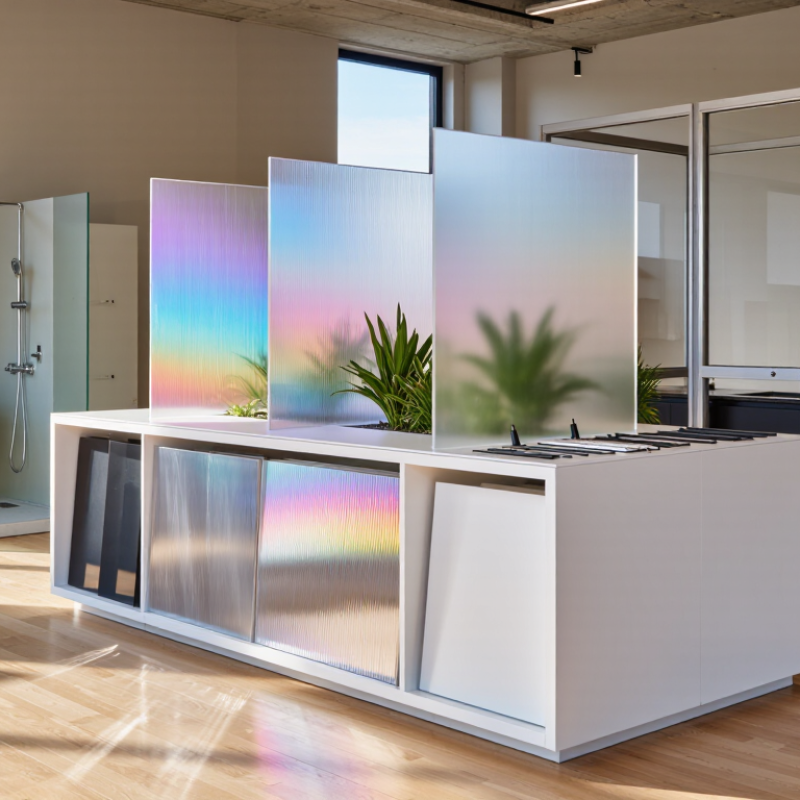
Translucent glass lets daylight pass while scattering it, so objects behind it appear softened rather than sharply defined. Clear glass transmits light with little diffusion; edges, colors, and movement usually remain crisp. The difference often comes from the glass surface or its construction. Frosted finishes, patterned textures, and certain interlayers scatter light in distinct ways. Not all translucent glass behaves alike.
At a bathroom window, a fine satin finish may blur a face while keeping the room bright. A deeper texture can obscure more detail, but may also reduce incoming light and collect dust in its grooves. Check a sample in the actual opening, in daylight and with indoor lights on. Hold a hand or printed page behind it at several distances. Small test, useful clue. The effect can change with viewing angle, thickness, and lighting, so a showroom swatch may not tell the whole story. For a door or partition, consider whether softened outlines provide enough privacy or whether you need stronger visual screening. Translucent does not mean opaque. That distinction is easy to overlook.

How to Choose Translucent Glass for Your Project
Translucent glass softens views without shutting out daylight. The balance depends on visible light transmission, surface pattern, and the room’s sightlines. The U.S. Department of Energy’s daylighting guidance notes that well-designed daylighting can reduce lighting energy use by 20–60%, depending on design and controls. That is potential, not a guarantee. A deeply etched panel may blur faces near a doorway, yet still reveal movement when backlit. Fine ribbing can spread light across a hallway, but may create distracting stripes on a nearby wall. Check samples in the actual opening, at different times of day. I once underestimated how strongly a west-facing window would sharpen a subtle texture. It is an easy detail to miss.
Tips: Compare samples against a person standing behind them, not just against a white wall. Check them in morning and evening light. For bathrooms or street-facing rooms, test privacy from outside after dark, with interior lights on. If the effect feels slightly imperfect, adjust the texture or panel placement before ordering.
Balance daylight, privacy, and visual texture by comparing common glass treatments.
Clear glass maximizes daylight but offers little visual privacy. Acid-etched and reeded glass soften views while retaining useful daylight; patterned obscure glass generally provides the greatest screening. Values are indicative planning estimates, not certified product specifications. Actual visible light transmission varies by product, thickness, tint, and pattern, so confirm tested data with the manufacturer. Privacy scores are relative design ratings from 1 (low) to 5 (high).
The right translucent glass depends on what you need to hide, how much daylight you want, and where the panel will be installed. Frosted or acid-etched glass softens views while spreading light across a room. It works well for bathroom doors and office partitions, though fingerprints may show on frequently touched surfaces. Light still matters.
Patterned glass adds texture and can blur outlines more strongly in some designs. It suits entry doors, cabinet fronts, and feature windows where visual character matters as much as privacy. Laminated glass with a translucent interlayer can hold fragments together if the glass breaks, making it worth considering for doors or other impact-prone areas. The finish and safety construction are separate choices.
Think about viewing distance and changing light. A panel that looks private in a showroom may reveal silhouettes when a room is lit at night. I would not choose from a small catalog photo alone; ask for a sample and check it in the actual space. Also confirm the required thickness, edge finish, and safety-glazing specification with a qualified installer. The perfect balance can be awkward to find. A little less privacy may bring noticeably more daylight.
How to Choose Translucent Glass for Your Project
Translucent glass should be judged against safety, energy, and durability needs—not appearance alone. Start by asking where people may touch or strike it. A door, shower enclosure, or low-level partition may need safety glazing, such as tempered or laminated glass. The right choice depends on the installation and local building requirements, so confirm specifications with a qualified glazier. Edges matter. Chips or poor support can weaken a panel, even when its surface looks sound.
Energy performance needs equal attention. Check the glass’s U-factor and solar heat gain coefficient, then consider window direction and climate. A west-facing room with strong afternoon sun may need a different balance from a shaded hallway. Translucent finishes soften views, but they do not automatically control heat or glare. Coatings and insulated glass units can help; compare tested performance data rather than relying on appearance. Small differences add up.
Durability is more than resistance to impact. In wet rooms, ask about moisture exposure, sealants, and cleaning methods. Textured surfaces can hide fingerprints, yet some collect soap residue in their recesses. That trade-off is rarely neat. I would avoid specifying glass before checking how it will be cleaned and replaced; that step is easy to overlook. Review sample panels in the actual lighting, since a finish that feels private in a showroom may look surprisingly transparent at night.
| Glass option | Typical visible light transmission (VLT) | Safety characteristics | Energy performance | Durability and maintenance | Best suited for |
|---|---|---|---|---|---|
| Acid-etched or sandblasted annealed glass | Often about 70–90% for lightly treated clear glass; heavier etching and patterns can reduce transmission. | Annealed glass breaks into large, sharp shards. It is not safety glazing unless the complete product is tested and approved for the required application. | Usually similar to the clear glass substrate. A single pane provides limited insulation; a low-emissivity coating or insulated glass unit can improve thermal performance. | The exposed matte surface can show fingerprints and may need gentle, regular cleaning. Abrasive cleaners can damage the finish. | Privacy screens or interior partitions where impact-safety rules do not require safety glazing. |
| Tempered patterned or frosted glass | Commonly about 40–80%, depending on glass thickness, texture, and pattern. | Heat-treated tempered glass generally has greater resistance to thermal stress and impact than annealed glass of comparable thickness. When it breaks, it usually fragments into small pieces; it does not remain in the frame. | Tempering itself does not significantly improve insulation. Thermal performance depends on the glass build-up, coatings, and framing. | Suitable for many doors, shower enclosures, and other applications when the required specification is met. Glass edges and surfaces still require protection from damage. | Locations where breakage risk makes safety glazing important, subject to local code and product certification. |
| Laminated translucent glass | Often about 40–80%; interlayer color, texture, and glass selection affect the result. | A plastic interlayer bonds the glass layers and helps hold fragments after breakage. Whether it meets a specific safety or security requirement depends on the tested construction. | A single laminated pane offers limited insulation. Combining laminated glass with an insulating glass unit can improve thermal performance and may also help reduce sound transmission. | Typically retains broken glass in the opening, but edge protection and correct installation are important. Damaged or exposed edges should be assessed and repaired as needed. | Overhead glazing, façades, or areas where fragment retention is a priority, when the specified system is approved for the application. |
| Translucent low-E insulating glass unit (IGU) | Often about 30–70%, depending on the diffusing layer, coatings, and number of panes. | Safety depends on the individual panes: an IGU can include tempered or laminated glass where required. An IGU alone does not guarantee safety-glazing compliance. | A double-glazed unit with a low-E coating and gas fill can have a center-of-glass U-factor roughly in the range of 1.0–1.6 W/m²·K. Whole-window performance is affected by the frame, spacer, size, and installation. | Sealed units require sound seals and correct installation. Seal failure can cause condensation between panes and may require replacement of the unit. | Exterior windows and façades where daylight, privacy, and better insulation are all priorities. |
| Translucent glass with a ceramic frit or printed pattern | Varies widely; coverage, color, and pattern density determine how much light passes through. | The frit or print does not by itself make glass safety-rated. The underlying glass and full assembly must meet the project’s safety requirements. | Fritting does not automatically improve insulation. Solar heat gain depends on the glass, coating, pattern coverage, and orientation. | Fired ceramic frit is generally durable, but performance depends on the product and exposure. Confirm cleaning instructions and compatibility with coatings. | Façades, privacy bands, and design features that need controlled visibility or light diffusion. |
Selection note: VLT and thermal values are indicative ranges, not guarantees; actual results vary by thickness, glass composition, coating, texture, spacer, and test method. Confirm current product data, applicable building codes, and required safety-glazing certification for the project location and installation.
Translucent glass needs a sound installation plan, not just a pleasing finish. Measure the opening at several points; older frames are rarely perfectly square. Leave room for setting blocks, drainage, and movement, following the glass fabricator’s specifications. Tight contact with metal or masonry can create stress and edge damage. Small gaps matter. The U.S. Department of Energy’s Energy Saver guidance estimates that heat gain and loss through windows account for 25–30% of residential heating and cooling energy use. For exterior applications, compare rated U-factor and solar heat gain coefficient values on National Fenestration Rating Council labels, then check whether the frame and seals suit the exposure. A beautiful sample won’t reveal a poor sill detail.
Plan cleaning access before the glass is installed, especially for high panels or textured surfaces that collect dust. Use clean water, a soft cloth, and a mild, non-abrasive cleaner; grit can leave fine scratches when wiped across the surface. Rinse away residue, then inspect edges and sealant for gaps or discoloration during routine maintenance. Keep a record of cleaning products and repairs. It sounds fussy, but it helps identify what is actually causing a problem. Long-term performance also depends on the glass type, edge quality, support, and local weather; no single cleaning schedule suits every building. Revisit the installation after the first seasonal temperature changes. That first review is easy to overlook.


For those larger-sized parts, or smaller quantity runs, we have 2 independent powder coat booths and ovens. The quality, durability and affordability of today’s powder coating finishes make this the process of choice for world-class companies.
Powder coating advantages over other forms of coating are many. Materials used in the Powder coating process can be metals and non-metals that come in a multitude of thicknesses, textures, colors, etc. Another of Powder coating’s biggest advantages over conventional coatings is its ability to create finishes in many different textures. Powder Coating Booths allow us the ability to apply these advantages to large products.
Tri-State Fabricators runs a full-service conveyor line for painting. Wet painting can provide protection or decoration to many different part styles. From start to finish, every project is easier to undergo random and point-based inspection by our skilled painting team.
Advantages to our Wet Paint Line are these lines start with product prep and ends with a thorough inspection of a high quality finished product. Our ability to complete large and small projects with a superior finish and doing so in a timely and economical fashion. This passes along the savings in production to our customers. When powder coating ins not an option, our Wet Paint Line gets the job done right the first time.
When the parts get big and heavy we roll-out our custom paint racks and oversize booth. By utilizing our partnerships with all the major paint brands, we can match virtually any color with wet paint.
The advantages of having access to a Wet Paint Booth are many. Large projects of many different shapes can be loaded into the booth. The Wet Paint Booth offers an environment that is much more controlled than a typical parts painting operation.
Not only are they used because of their controlled environment, but they’re are also advantageous when it comes to applying paint to parts that are needed in industries that require specialty coatings such as medical, aerospace, etc.
Our military forces have some very high standards when it comes to the finish of their vehicles and equipment. From the first pre-treatment step to final coat, it takes a great deal of knowledge and experience to protect the men and women of our armed forces. They deserve only the best, and Tri-State Fabricators provides it.
All of our processes are closely monitored by our staff and management teams. Both of which are highly trained in the processes of metal fabrication and finishing. Tri-State Fabricators’ goal is to always fully satisfy each and every customer, including the military. We will always put a 110% into what we do.
Abrasive media blasting is an excellent way to remove old paint, rust, and increase the paint/powder adhesion. Glass beads produce a much smoother and brighter finish than angular abrasives; leaving the part clean yet without any dimensional change. Chemically inert and environmentally friendly, we can recycle our beads approximately 30 times; making them a more preferred method of metal cleaning or surface finishing.
Advantages to Glass Bead Blasting are many. Glass bead blast media is used when a project is needing rough surfaces need to become smooth for applications of coatings such as paint. It is typically used to clean paint and rust from a product surface without deforming the surface it is being used on. Overall, compared to many other blasting media, Glass Bead Blasting is a very economical choice and those savings are always passed on to our customers.
Tri-State Fabricators utilize a zinc phosphate wash to clean and etch the material to ensure the best paint adhesion possible. The unique design of our 3-stage wash system does the work like a 5-stage. From Cleaning and rinsing to conversion coating and post-treatment, Our Part Washing process is a complete service and works throughout the fabrication service and the finishing service.
Along with the previously mentioned benefits, Curing is a vital chemical reaction that leaves the product finish hard and relatively safe from mild abrasion and aggressive corrosion. This process can be done in more than one way; ambient air-dry or in curing ovens at temps that exceed 240°.
From fixing paint mistakes (someone else’s of course) to simply cleaning our paint line hooks, our burn-off oven is put to good use. After a quick burn-off, a little clean up, and a fresh coat of paint, your parts will look better than new.
Why does our Burn-Off Oven work so well? Because super heating the air around parts turns the materials into ashes. From paint and powder coatings to rubber and machining oils, high temps do the job without degrading the integrity of the part.
Masking is a vital part of producing high quality products. We have die-cut masking patterns to protect machined surfaces as well as a wide range of plugs and caps to protect threaded holes and bolts. We provide permanent and temporary masking.
Masking allows the selected sections of a product to be protected from a fabrication or finishing service. This can be with both chemicals when etching and tapes, paints when only finishing just a section of the product. Masking is great in aiding the customization process of a project.
Screen printing is a photographic process that transfers artwork onto a porous nylon screen which allows colored ink to flow through the screen and be deposited on an aluminum or plastic component. We can generally have just about any design created onto a screen for your parts.
Some of the advantages of Screen Printing are, brand recognition for your business displaying on your products, assembly instructions, product warnings/hazards, etc. Tri-State Fabricators produces Screen Printing of the highest quality so you know it’s durable.
Metal Finishing is the art of treating the exterior portion of product, often metal but can also be made of other materials, so that the surface is clean and free of any debris. Then the process of applying coats or either paint of powder coat takes place. This coating process improves the quality of the product in both appearance and resistance to wear and corrosion.
Tri-State Fabricators, Inc., understands that a project typically isn’t complete until a high-quality finish has been added to your product. This is why our painting and powder coating teams continuously inspect the products throughout the Metal Finishing process.

