How to Choose the Right Water Cooler Evaporator?

Choosing the right Water Cooler Evaporator is not simply a matter of matching horsepower. The component must suit water temperature, flow rate, ambient conditions, refrigerant, and available space. A small mismatch can create weak cooling, excessive frost, unstable pressure, or unnecessary energy use. Picture a crowded beverage station, warm water entering continuously, and a compressor cycling every few minutes. The evaporator carries that burden.

Refrigeration specialist Andy Pearson has emphasized a practical principle: “The evaporator must be selected around the real cooling duty, not the catalog headline.” That advice deserves attention. Product labels can look impressive, yet laboratory capacity may differ from field performance. Engineers should check heat-transfer area, coil material, circuit design, pressure drop, and compatibility with the complete refrigeration system. Stainless steel often supports hygiene and durability, while copper may provide excellent thermal conductivity. The best choice depends on the application.

Start with measured data. Record inlet temperature, outlet temperature, water flow, room temperature, and daily usage. Then compare those figures with the manufacturer’s tested conditions. Do not guess.

There is room for uncertainty. Actual demand changes throughout the day. Maintenance also affects performance. A dirty coil, restricted airflow, or poor insulation can make a suitable Water Cooler Evaporator appear defective. This guide examines those variables carefully, helping buyers balance cooling speed, reliability, energy consumption, installation limits, and long-term service needs. A perfect choice is rare. A well-documented choice is far more dependable.
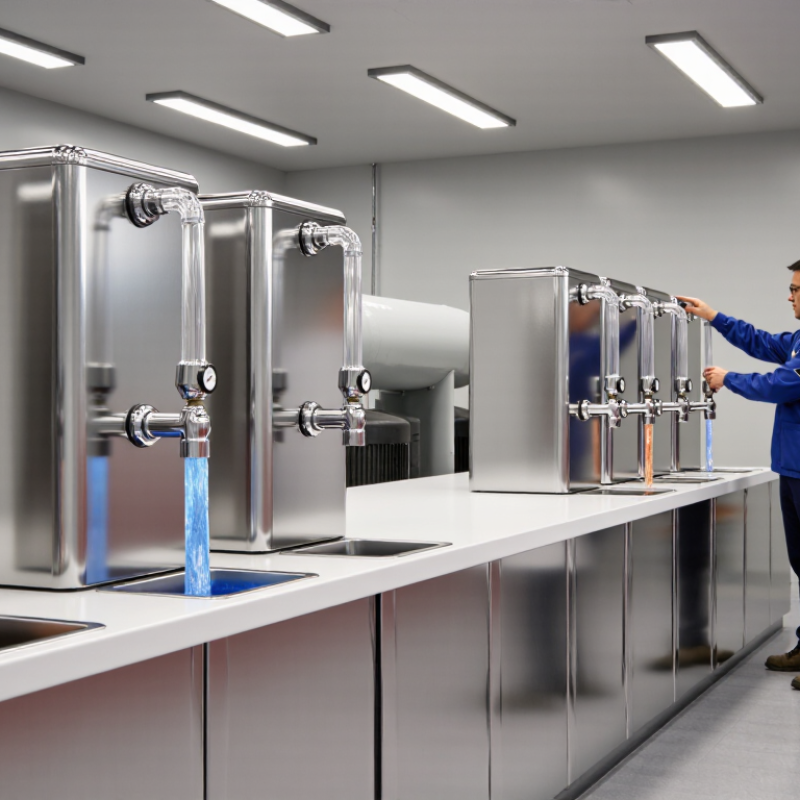
How to Choose the Right Water Cooler Evaporator?

Understanding the Role of an Evaporator in a Water Cooler

An evaporator is the working heart of a water cooler’s refrigeration system. It absorbs heat from the stored water through a cold surface or cooling coil. Refrigerant inside the evaporator changes from liquid to vapor as it collects this heat. The water becomes colder, while the refrigerant moves onward through the cycle. Without efficient heat transfer, even a powerful compressor may deliver disappointing cooling.

Choosing the right evaporator requires more than checking its physical size. Consider cooling capacity, water temperature, ambient conditions, refrigerant compatibility, and available installation space. A coil with too little surface area may cool slowly during busy periods. A larger unit is not automatically better. It can increase cost, restrict airflow, or create uneven temperatures inside the tank. Practical measurements matter.

Material selection also deserves careful attention. The evaporator should resist corrosion and remain suitable for contact with the cooling system’s components. Technicians should inspect joints, insulation, frost patterns, and temperature readings during operation. Strange cycling often indicates poor airflow, incorrect refrigerant charge, or a mismatched evaporator. These signs should not be ignored. A common mistake is choosing by capacity alone, while overlooking maintenance access. That decision may look efficient on paper. It can become frustrating during service. Reliable selection combines manufacturer data, field conditions, and testing after installation. Temperature stability matters more than a quick first impression.

How to Choose the Right Water Cooler Evaporator?

The refrigerant’s normal boiling point is an important screening factor when selecting an evaporator. A lower boiling point can support lower evaporating temperatures, but the final evaporator design must also consider cooling capacity, operating pressure, heat-transfer area, material compatibility, and safety requirements.

Reference values shown are approximate normal boiling points at 1 atmosphere. Actual evaporator operating temperatures depend on system pressure, load, superheat, and equipment design.

Identifying Key Evaporator Types and Their Operating Differences

Choosing the right water cooler evaporator starts with understanding how refrigerant and water exchange heat. In a direct-expansion evaporator, refrigerant boils inside tubes while chilled water flows around them. This design usually responds quickly to changing loads and needs a smaller refrigerant charge. However, poor control can create local freezing. That detail matters.

Flooded evaporators place liquid refrigerant around the tubes, with water flowing inside them. Their larger heat-transfer surface often supports stable operation and strong part-load efficiency. They may also require more refrigerant, careful oil management, and reliable liquid-level control.

Falling-film designs reduce refrigerant inventory by distributing liquid across tube surfaces. They can perform efficiently, but uneven wetting may weaken heat transfer during low-load operation.

Brazed-plate evaporators are compact and provide close temperature approaches, making them useful where installation space is limited. Their narrow passages demand clean water and effective filtration. A small amount of fouling can noticeably increase pressure drop. AHRI Standard 550/590 evaluates water-chiller performance near standard conditions, including 44°F leaving chilled water and 85°F entering condenser water. Real projects rarely stay there. The U.S. Department of Energy also emphasizes part-load performance because cooling systems spend substantial operating time below peak demand. Compare evaporator data at design and reduced loads, then check freeze protection, water quality, service access, and control stability. Selecting only by maximum capacity is an easy mistake.

Matching Evaporator Capacity to Cooling Load and Water Demand

How to Choose the Right Water Cooler Evaporator?

Matching evaporator capacity to cooling load and water demand starts with measured data. Estimate heat from water flow, inlet temperature, outlet temperature, and operating hours. A useful calculation is Q = 4.186 × flow rate × temperature difference. Use flow in kilograms per second and temperature difference in Celsius.

Do not size only for average demand. Peak filling periods can overload an evaporator quickly. Small mismatch, large trouble. Check the highest hourly water demand and the required pull-down time. A buffer tank may reduce sudden load changes, but it does not replace adequate evaporator capacity. Allow around 10–15% extra capacity for heat gains, fouling, and uncertain measurements. Excessive oversizing can create short cycling and unstable temperatures.

Site conditions also affect selection. Warm inlet water, high room temperature, restricted airflow, and mineral buildup reduce practical performance. Water quality deserves attention. Hard water can form deposits on heat-transfer surfaces, lowering efficiency over time. During commissioning, compare actual flow and temperatures with the design values. One common sizing mistake is trusting a nominal flow rate without checking real usage. Re-measure after installation. Demand often changes with seasons, production schedules, or user habits. A slightly conservative design is useful, but unexplained assumptions should be recorded and reviewed.


Evaluating Materials, Efficiency, Durability, and Maintenance Needs

Choosing a water cooler evaporator requires more than comparing cooling speed. Material selection affects heat transfer, corrosion resistance, and service life. Copper offers excellent thermal conductivity, while aluminum is lighter and often less expensive. Stainless steel provides stronger corrosion resistance, especially where water quality is inconsistent. However, no material is perfect. A highly conductive coil can still perform poorly if dust covers its fins or airflow is restricted.

Efficiency deserves measured attention. The International Energy Agency reports that cooling represents about 10% of global electricity consumption. Even a small evaporator inefficiency can increase operating costs over years of daily use. Review cooling capacity, compressor compatibility, insulation quality, and fan power together. ASHRAE Handbook—Refrigeration emphasizes proper airflow and clean heat-transfer surfaces for stable refrigeration performance. Ask for tested capacity data, not only advertised temperature claims. Numbers can be incomplete.

Tips: Check coil spacing before purchase. Narrow fins cool efficiently but collect dust faster. For hard water, inspect internal surfaces for scale resistance. Choose accessible drain paths and removable panels. Clean condenser and evaporator surfaces on a scheduled basis. A soft brush is safer than aggressive scraping. Keep records of temperature, noise, and energy use. Small changes reveal problems early. In practice, maintenance estimates are often too optimistic. A cooler near a dusty dispenser area may need attention sooner than the manual suggests. Evaluate the service conditions, not just the specification sheet.

Checking Compatibility, Installation Requirements, and Total Operating Cost

How to Choose the Right Water Cooler Evaporator?

Compatibility should be checked before comparing purchase prices. Match the evaporator with the refrigerant, cooling capacity, water flow, entering-water temperature, and system pressure. Connection sizes must also suit existing pipes, valves, sensors, and pumps. A small mismatch can cause unstable cooling or repeated compressor cycling. ASHRAE Standard 90.1 and AHRI 550/590 provide recognized methods for evaluating chiller efficiency under defined operating conditions. Use comparable data, not attractive brochure numbers.

Installation conditions directly affect performance. Confirm service clearance, drainage, insulation, electrical capacity, vibration control, and water treatment access. The U.S. Department of Energy reports that HVAC systems account for roughly 40% of commercial building energy use. This makes pump power and control settings important, not secondary details.

Check full-load efficiency, part-load performance, and seasonal operating hours. The International Energy Agency also expects global cooling demand to rise substantially by 2050.

Operating cost includes electricity, water, chemicals, cleaning, replacement parts, and technician time. A lower-priced evaporator may require frequent descaling in hard-water areas. That is expensive. Build a five-year estimate using local electricity and water tariffs. Include downtime, too. A spreadsheet can still mislead when maintenance labor is ignored. I would also request measured performance from a comparable installation, although this information is sometimes incomplete. Practical evidence deserves more weight than a perfect laboratory figure.

Powder Coat Booths

For those larger-sized parts, or smaller quantity runs, we have 2 independent powder coat booths and ovens. The quality, durability and affordability of today’s powder coating finishes make this the process of choice for world-class companies.

Powder coating advantages over other forms of coating are many. Materials used in the Powder coating process can be metals and non-metals that come in a multitude of thicknesses, textures, colors, etc. Another of Powder coating’s biggest advantages over conventional coatings is its ability to create finishes in many different textures. Powder Coating Booths allow us the ability to apply these advantages to large products.

Wet Paint Line

Tri-State Fabricators runs a full-service conveyor line for painting. Wet painting can provide protection or decoration to many different part styles. From start to finish, every project is easier to undergo random and point-based inspection by our skilled painting team.

Advantages to our Wet Paint Line are these lines start with product prep and ends with a thorough inspection of a high quality finished product. Our ability to complete large and small projects with a superior finish and doing so in a timely and economical fashion. This passes along the savings in production to our customers. When powder coating ins not an option, our Wet Paint Line gets the job done right the first time.

Wet Paint Booths

When the parts get big and heavy we roll-out our custom paint racks and oversize booth. By utilizing our partnerships with all the major paint brands, we can match virtually any color with wet paint.

The advantages of having access to a Wet Paint Booth are many. Large projects of many different shapes can be loaded into the booth. The Wet Paint Booth offers an environment that is much more controlled than a typical parts painting operation.

Not only are they used because of their controlled environment, but they’re are also advantageous when it comes to applying paint to parts that are needed in industries that require specialty coatings such as medical, aerospace, etc.

Military CARC

Our military forces have some very high standards when it comes to the finish of their vehicles and equipment. From the first pre-treatment step to final coat, it takes a great deal of knowledge and experience to protect the men and women of our armed forces. They deserve only the best, and Tri-State Fabricators provides it.

All of our processes are closely monitored by our staff and management teams. Both of which are highly trained in the processes of metal fabrication and finishing. Tri-State Fabricators’ goal is to always fully satisfy each and every customer, including the military. We will always put a 110% into what we do.

Glass-Bead Blasting

Abrasive media blasting is an excellent way to remove old paint, rust, and increase the paint/powder adhesion. Glass beads produce a much smoother and brighter finish than angular abrasives; leaving the part clean yet without any dimensional change. Chemically inert and environmentally friendly, we can recycle our beads approximately 30 times; making them a more preferred method of metal cleaning or surface finishing.

Advantages to Glass Bead Blasting are many. Glass bead blast media is used when a project is needing rough surfaces need to become smooth for applications of coatings such as paint. It is typically used to clean paint and rust from a product surface without deforming the surface it is being used on. Overall, compared to many other blasting media, Glass Bead Blasting is a very economical choice and those savings are always passed on to our customers.

Part Washing

Tri-State Fabricators utilize a zinc phosphate wash to clean and etch the material to ensure the best paint adhesion possible. The unique design of our 3-stage wash system does the work like a 5-stage. From Cleaning and rinsing to conversion coating and post-treatment, Our Part Washing process is a complete service and works throughout the fabrication service and the finishing service.

Along with the previously mentioned benefits, Curing is a vital chemical reaction that leaves the product finish hard and relatively safe from mild abrasion and aggressive corrosion. This process can be done in more than one way; ambient air-dry or in curing ovens at temps that exceed 240°.

Burn-Off Oven

From fixing paint mistakes (someone else’s of course) to simply cleaning our paint line hooks, our burn-off oven is put to good use. After a quick burn-off, a little clean up, and a fresh coat of paint, your parts will look better than new.

Why does our Burn-Off Oven work so well? Because super heating the air around parts turns the materials into ashes. From paint and powder coatings to rubber and machining oils, high temps do the job without degrading the integrity of the part.

Masking

Masking is a vital part of producing high quality products. We have die-cut masking patterns to protect machined surfaces as well as a wide range of plugs and caps to protect threaded holes and bolts. We provide permanent and temporary masking.

Masking allows the selected sections of a product to be protected from a fabrication or finishing service. This can be with both chemicals when etching and tapes, paints when only finishing just a section of the product. Masking is great in aiding the customization process of a project.

Screen Printing

Screen printing is a photographic process that transfers artwork onto a porous nylon screen which allows colored ink to flow through the screen and be deposited on an aluminum or plastic component. We can generally have just about any design created onto a screen for your parts.

Some of the advantages of Screen Printing are, brand recognition for your business displaying on your products, assembly instructions, product warnings/hazards, etc. Tri-State Fabricators produces Screen Printing of the highest quality so you know it’s durable.

Metal Finishing

Metal Finishing is the art of treating the exterior portion of product, often metal but can also be made of other materials, so that the surface is clean and free of any debris. Then the process of applying coats or either paint of powder coat takes place. This coating process improves the quality of the product in both appearance and resistance to wear and corrosion.

Tri-State Fabricators, Inc., understands that a project typically isn’t complete until a high-quality finish has been added to your product. This is why our painting and powder coating teams continuously inspect the products throughout the Metal Finishing process.



