How to Choose the Right Voltage Instrument
Choosing a Voltage Instrument begins with the work it must do, not the widest feature list. A technician checking a household outlet needs different capabilities from an engineer testing a low-voltage sensor or a variable-frequency drive. The voltage range, AC or DC measurement, and expected signal shape all affect the choice. Small detail. Yet this is where mistakes often begin: a familiar-looking meter may not measure the signal accurately.
Check the instrument’s stated accuracy, resolution, input impedance, and measurement category against the task. Accuracy describes how close a reading may be to the true value; resolution shows the smallest displayed change. These are not interchangeable. For sensitive circuits, input impedance can influence the reading itself, so consult the manufacturer’s specifications rather than relying on display digits alone. A clear manual matters.
Safety and usability deserve equal attention. Inspect probe condition, insulation, ratings, and the instrument’s protection features before use. Select a model designed for the electrical environment, and follow its operating instructions. A sturdy case, readable screen, and accessible controls can make repeated measurements less error-prone, especially in dim or crowded work areas. Still, no specification sheet can replace sound judgment or suitable training.
Compare candidate instruments using the same real-world task, such as checking a known source or measuring a representative circuit. Keep calibration status and maintenance in view, particularly where results guide important decisions. There is no universally perfect choice. Needs change, and specifications can be easy to misread; verify them with the manufacturer or a qualified specialist when uncertainty remains.
Types of Voltage Instruments and Their Measurement Principles
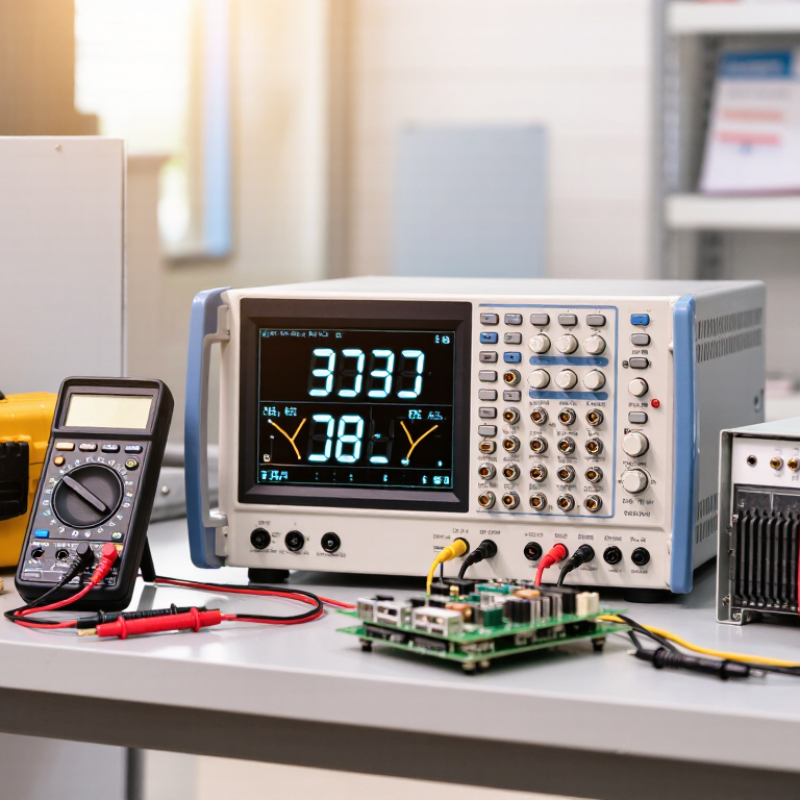
Voltage instruments differ by the quantity they reveal and the way they sense it. A digital multimeter typically uses an input divider and analogue-to-digital converter to display a stable voltage reading. Its high input impedance helps limit circuit loading, but it may miss fast changes. An oscilloscope samples voltage over time, showing ripple, spikes, and waveform shape; probe bandwidth and grounding can affect what appears on screen. A non-contact detector senses an electric field. Handy near insulated wiring, it does not confirm a precise voltage.
For steady readings, choose a meter whose range and accuracy fit the circuit. For switching supplies or motor drives, waveform capture can expose brief transients that a display averages away. Check the instrument’s marked measurement category and voltage rating, too. IEC 61010-2-030:2017 addresses safety requirements for testing and measuring circuits; a CAT III 600 V marking identifies a category and rated voltage, not a promise of measurement accuracy. A useful distinction.
Measurement uncertainty deserves attention. NIST Technical Note 1297 describes how to evaluate and report uncertainty; in practice, include instrument specifications, probe effects, and reading variation. I would not treat a single displayed digit as certainty. Even a good meter can mislead when its leads are damaged, its range is wrong, or the circuit changes faster than it can respond.
Key Electrical Ratings and Measurement Requirements
How to Choose the Right Voltage Instrument
Key Electrical Ratings and Measurement Requirements
Start with the circuit, not the display. Check its expected voltage, whether it is AC, DC, or both, and how much variation may occur. The instrument’s rated range must cover the highest likely reading. A rating that barely fits can leave little margin. On a distribution panel, also check the measurement category and voltage rating together; the category reflects the environment’s transient risks. Read the instrument and probe markings, not just the product description. Small details matter.
Accuracy, input impedance, and frequency response affect whether a reading is useful. A meter with high input impedance can reduce loading on sensitive circuits, while a suitable bandwidth matters when measuring signals beyond ordinary mains frequencies. Check whether the stated accuracy applies across the range you plan to use. It may not. I look closely at the probe condition, too: cracked insulation or a loose tip can undermine an otherwise appropriate instrument. Choose probes rated for the same circuit conditions, and keep fingers behind their guards. If the reading seems inconsistent, pause and verify the setup rather than assuming the instrument is wrong. A clear display helps, but it cannot compensate for an unsuitable rating or poor measurement method.
How to Match an Instrument to the Voltage Range
Match the instrument’s voltage range to the highest expected value, including brief surges—not just the normal reading. For a 24 V control circuit, a 60 V range may provide useful headroom while retaining finer display resolution than a 600 V range. That matters. Check whether the instrument measures AC, DC, or both, and whether its stated accuracy applies across the selected range. IEC 61010-2-030 covers safety requirements for testing and measuring circuits; common instrument markings include CAT III 600 V and CAT II 300 V. These ratings describe different measurement environments, not interchangeable voltage limits.
Range is only half the match. Review the accuracy specification, input impedance, and resolution at the voltage you expect to measure. A display showing 0.1 V steps may hide a small change on a low-voltage sensor line. NIST Technical Note 1297 explains how measurement uncertainty should account for both statistical and non-statistical contributors; in practice, probe contact and electrical noise can matter too. I have seen range selection get more attention than these details. That is an easy oversight. Compare the instrument’s stated uncertainty with the tolerance of the circuit, and leave margin for unexpected peaks.
Safety Features and Environmental Considerations
A voltage instrument is only as safe as its weakest-rated part. Match its measurement category and voltage rating to the installation point, then check the probes and leads separately. IEC 61010-1 sets safety requirements for electrical test and measurement equipment. Treat it as a baseline, not a substitute for reading the instrument’s markings. At a distribution panel, a cracked probe guard or worn insulation can change the risk. Inspect before use, keep fingers behind the guards, and verify the meter on a known source before and after testing. Small habits matter. The U.S. Bureau of Labor Statistics recorded 145 fatal work injuries involving electricity in 2022. That figure makes safety a practical selection issue, not paperwork.
Environmental conditions matter, too. Check the stated operating temperature and humidity range, and choose enclosure protection for likely dust or moisture. An IP rating alone does not establish suitability for every site. The Global E-waste Monitor 2024 reports that the world generated 62 million tonnes of electronic waste in 2022, while only 22.3% was documented as formally collected and recycled. Instrument lifespan deserves attention. Replaceable batteries, serviceable parts, and durable leads may help reduce early disposal. I would not trade a suitable safety rating for easier repair, though; that balance is easy to get wrong.
Accuracy, Usability, and Long-Term Value in Selection
Accuracy should be judged against the work, not a catalog headline. Measuring low-voltage control signals calls for different resolution and input protection than checking distribution circuits. Compare the stated uncertainty across your actual voltage range, frequency, and operating temperature. A meter’s performance at room temperature may not tell the whole story inside a warm panel. Small details matter.
Usability affects both speed and confidence. Check whether the display is readable at an angle, probes fit the terminals, and common ranges are easy to select. NIST Technical Note 1297 explains that a coverage factor of k=2 gives roughly 95% coverage under suitable assumptions. Use that guidance to understand uncertainty, not as a substitute for checking instrument specifications. For long-term value, include calibration, replacement probes, batteries, and downtime in the purchase calculation. A cheaper instrument can cost more over several years. One easy mistake is focusing only on purchase price; I would also ask how often calibration is needed and whether the instrument can be serviced. That adds up.
How to Choose the Right Voltage Instrument
Compare accuracy, usability, and long-term value against your measurement needs.
Example selection scores from 1 (low) to 5 (high), not manufacturer specifications. A handheld digital multimeter suits general field work, a bench multimeter favors repeatable lab measurements, and a high-voltage probe system is designed for measurements beyond a standard meter’s direct input range. Check each instrument’s datasheet, measurement category, voltage limits, and calibration requirements before selection.





