


Choosing a Tennis Stringing Machine is less about buying the most expensive model and more about matching tools to workload, skill, and service expectations. The International Tennis Federation’s Global Tennis Report 2021 estimated that 87 million people played tennis worldwide. That figure signals a broad equipment market, but it does not tell buyers which machine performs best. Numbers matter. So does the work done at the string bed.
Start with three practical questions: How many racquets will you string each week? Do you need portability? How precisely can the machine maintain tension? A busy shop may value an electronic tension head, dependable clamps, and fast mounting. A home stringer might prefer a sturdy drop-weight model that is easier to service. Check the turntable, fixed or flying clamps, mounting supports, tension range, and parts availability before comparing prices. Ask how the manufacturer recommends checking calibration; a display alone cannot prove accuracy. Small details count, like clamp marks on a fresh string or a racquet that shifts during tensioning. They affect confidence and workflow.
Industry participation reports describe tennis activity, not controlled tests of stringing-machine performance. Be wary of claims that treat popularity as proof of quality. I once assumed more automation always meant a better choice. That is too simple. Automation can save time, yet maintenance, training, and repair support matter too. Use this guide to weigh those trade-offs and choose a machine suited to your real workload—not an imagined one.
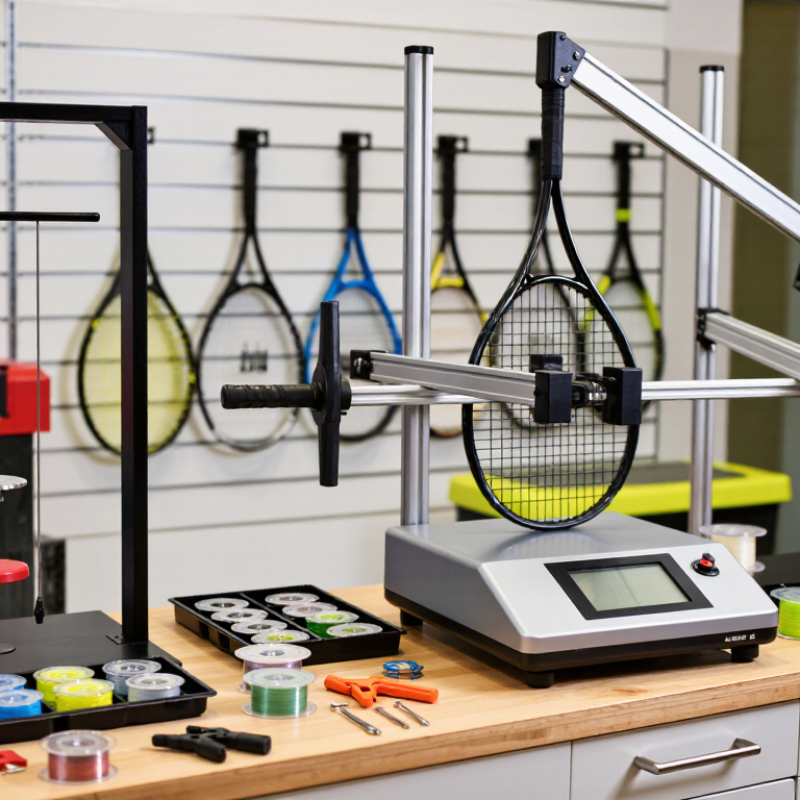
How to Choose a Tennis Stringing Machine?
Understanding How a Tennis Stringing Machine Works
A tennis stringing machine holds the racket steady while guiding each string through the frame. Its mounting supports keep the hoop from shifting under pressure. String is fed through the grommets, then pulled to a chosen tension by a tension head. The head may use a manual crank, a drop weight, or an electronic system. Each type applies force differently, so the operator’s technique still matters. Small details count.
Clamps grip the tensioned string while the next section is pulled. On a two-piece job, the mains are usually installed before the crosses, following the racket’s stringing pattern. The stringer adjusts tension, secures knots, and checks that clamps hold without crushing the string. A clean work area helps prevent dirt from entering the grommets. It also makes missed steps easier to spot.
Machine readings are useful, but they do not guarantee identical string-bed feel. Friction at the grommets and clamps can affect the final result. Even experienced stringers may need to check calibration and refine their process. I would not assume that a more complex machine automatically produces better results. Consistency, careful mounting, and a sound understanding of the tension system matter just as much. One overlooked clamp can change the outcome.

Choosing a tennis stringing machine starts with an honest look at how often you restring. A player restringing a few rackets each season may be well served by a straightforward manual machine. A coach or busy stringer handling several frames each week may value faster tensioning and a smoother workflow. Think about your actual workload, not the one you hope to have.
Skill matters, too. Beginners benefit from clear tension settings, stable frame supports, and clamps that hold strings without slipping. These features make it easier to learn consistent technique. An electronic machine can simplify pulling tension, but it will not correct poor mounting or careless knotting. Practice still counts. Watch how the frame sits on the supports, and check that each string stays secure as you weave the next one. Small errors add up.
Consider your workspace and patience. A heavy tabletop machine needs a solid bench, while a portable model may suit a shared or tight space. Check whether calibration and basic maintenance seem manageable; a tension reading is useful only when the machine is working properly. I would not choose by speed alone. It is tempting, but quiet, repeatable operation may matter more during a long evening of restringing. Leave room to revise your choice as your skills and workload change.
Manual, electronic, and drop-weight machines create tension in different ways. A manual crank pulls string to a set tension, then locks in place. It is often a practical choice for occasional stringing, but the operator must work steadily. Electronic machines can maintain tension as the string stretches, which may improve consistency across a full racket. They are usually faster, though they need power and may require more upkeep. Drop-weight machines use a weighted arm and gravity. They are simple and portable, but the arm must settle level before each pull. Small setup errors matter.
Consider your workload, budget, and patience. For a few rackets each month, a drop-weight machine can be enough. A busy shop may benefit from electronic tensioning and quicker adjustments. Manual machines sit between those options, depending on their design. No machine removes the need for careful technique. Clamp cleanliness, mounting pressure, and regular calibration all affect the result. Even experienced stringers can overlook a slipping clamp.
Tips: Check that the frame is held securely without being squeezed too tightly. Keep strings aligned, and note the tension settings you use. If results feel inconsistent, inspect the clamps and test calibration before changing your technique. Simple checks help.
A tennis stringing machine should be judged by repeatable results, not a crowded feature list. Check that the tension unit is easy to calibrate, the clamps hold without crushing the string, and the turntable stays steady during a pull. The ITF’s 2021 Global Tennis Report estimated 87 million players across 199 countries. That scale makes reliable racquet service relevant, but it does not prove any machine’s accuracy. Test a sample pull with a calibrated tension gauge.
Accuracy depends on more than the display. A slipping clamp or uneven mounting can change the finished string bed, even when the set tension looks correct. String several racquets with the same string and settings, then compare readings and feel. Small differences matter. The ITF Rules of Tennis specify a flat, uniform stringing surface; they do not prescribe a machine’s tension tolerance, so check calibration against the maker’s instructions rather than assuming a digital readout is exact.
Maintenance affects consistency over time. Wipe dust and string residue from the clamps, rails, and turntable, and inspect jaws for wear. Check the tension mechanism at the interval stated in its manual. A quarterly check may suit a busy shop, but usage and local dust levels differ. I would not ignore a clamp that feels slightly loose; that judgment can be wrong, so verify it with a test pull before serving customers.
| Machine Type | How Tension Is Applied | Typical Tension Range | Accuracy Considerations | Key Features to Check | Maintenance | Best Suited For |
|---|---|---|---|---|---|---|
| Drop-weight | A weighted bar applies tension through gravity; the bar must be level for the intended setting. | Often about 10–90 lb (4.5–41 kg), depending on the model. | Results depend on correct bar alignment, smooth movement, and consistent technique. Verify settings with a suitable tension calibrator. | Stable base, smooth tension arm, secure mounting system, and clamps that hold string without slipping. | Keep the bar, track, clamps, and gripper clean. Check clamp hold and inspect for wear regularly. | Home stringers and users who value simple operation and do not mind a slower workflow. |
| Spring-crank (lockout) | A spring mechanism pulls string to the selected setting, then locks out when that tension is reached. | Often about 10–90 lb (4.5–41 kg), depending on the model. | Tension can change as string stretches after lockout. Pull smoothly and use a consistent delay before clamping. | Smooth crank action, repeatable lockout, easy-to-read adjustment scale, and a stable frame mount. | Clean the gripper and clamps; check calibration periodically and inspect the spring and moving parts for wear. | Regular recreational use where a faster process than a drop-weight machine is desired. |
| Electronic constant-pull | A motor or electronic drive continues adjusting the pull to maintain the selected tension until the string is clamped. | Commonly about 10–90 lb (4.5–41 kg), though the available range varies by model. | Can provide repeatable pulls when correctly calibrated. Check readings at several settings with a suitable tension calibrator. | Clear controls, dependable pull cycle, appropriate pull speed settings, and a secure mounting and clamping system. | Keep clamps and gripper clean; follow the manual for calibration, inspection, and care of electrical components. | Frequent stringing or users who prioritize speed, convenience, and consistent pulling. |
| Electronic machine with programmable functions | An electronic tension head may offer selectable pull speeds, pre-stretch, or other settings in addition to constant pull. | Varies by model; many machines cover a broad range suitable for common tennis stringing tensions. | Extra settings do not guarantee greater accuracy. Confirm calibration and use the same settings and technique for repeatable results. | Check that functions are easy to understand, settings can be repeated, and the machine has accessible support and documentation. | In addition to cleaning and calibration, follow the manual for software, electrical, and service checks. | High-volume users or stringers who will make practical use of programmable options. |
| Mounting and support system | The frame supports the racquet while mounting posts and supports hold it in position during stringing. | Not applicable; confirm compatibility with the racquet sizes and shapes you string. | A secure, even mount helps reduce frame movement. Tighten supports as instructed without overtightening. | Look for stable support points, convenient adjustment, and access to shared or blocked grommet areas. | Keep contact surfaces clean and inspect adjustment points and supports for looseness or damage. | Every user; mounting stability matters regardless of tension-head type. |
| Clamp and gripper system | Clamps hold tensioned string while the next pull is made; the gripper draws and holds string during a pull. | Not applicable; performance depends on condition, adjustment, and string type. | Slippage or excessive clamping pressure can affect results and damage string. Test grip using the strings you commonly use. | Check for smooth movement, secure holding, suitable clamp spacing, and easy adjustment. | Remove residue with an appropriate cleaning method; inspect gripping surfaces and adjust clamps when needed. | Every user; clamp quality and condition directly affect ease of use and consistency. |
Note: Tension ranges are typical examples, not universal specifications; check the machine’s documentation before purchase. There is no single accuracy figure that applies to every machine. For a practical check, compare the selected setting with a suitable tension calibrator and follow the manufacturer’s calibration guidance.
Choosing a tennis stringing machine starts with an honest look at your budget and workspace. A manual machine may suit occasional home restringing, while a busy practice space may benefit from faster tension adjustment. Compare the full cost, not just the machine: mounting tools, spare clamps, and occasional calibration can add up. Consistent tension depends on proper setup and careful technique, too.
Measure your work surface before buying. Leave room for the machine base, the racket to rotate, and your hands to move around the frame. A crowded corner can make simple jobs awkward. Check the machine’s listed dimensions, then allow extra clearance for trays or tools. A stable bench matters; a wobbly table can undermine careful work. I once underestimated that space, and moving everything later was frustrating.
Tips: Set a spending limit that includes essential tools. If possible, test a similar machine before committing. For a small room, measure twice. Think about noise, storage, and how often you will string. A cheaper option may be perfectly adequate, but only if its adjustment range and support suit your workload. You may not need every feature—and that part is easy to misjudge.


For those larger-sized parts, or smaller quantity runs, we have 2 independent powder coat booths and ovens. The quality, durability and affordability of today’s powder coating finishes make this the process of choice for world-class companies.
Powder coating advantages over other forms of coating are many. Materials used in the Powder coating process can be metals and non-metals that come in a multitude of thicknesses, textures, colors, etc. Another of Powder coating’s biggest advantages over conventional coatings is its ability to create finishes in many different textures. Powder Coating Booths allow us the ability to apply these advantages to large products.
Tri-State Fabricators runs a full-service conveyor line for painting. Wet painting can provide protection or decoration to many different part styles. From start to finish, every project is easier to undergo random and point-based inspection by our skilled painting team.
Advantages to our Wet Paint Line are these lines start with product prep and ends with a thorough inspection of a high quality finished product. Our ability to complete large and small projects with a superior finish and doing so in a timely and economical fashion. This passes along the savings in production to our customers. When powder coating ins not an option, our Wet Paint Line gets the job done right the first time.
When the parts get big and heavy we roll-out our custom paint racks and oversize booth. By utilizing our partnerships with all the major paint brands, we can match virtually any color with wet paint.
The advantages of having access to a Wet Paint Booth are many. Large projects of many different shapes can be loaded into the booth. The Wet Paint Booth offers an environment that is much more controlled than a typical parts painting operation.
Not only are they used because of their controlled environment, but they’re are also advantageous when it comes to applying paint to parts that are needed in industries that require specialty coatings such as medical, aerospace, etc.
Our military forces have some very high standards when it comes to the finish of their vehicles and equipment. From the first pre-treatment step to final coat, it takes a great deal of knowledge and experience to protect the men and women of our armed forces. They deserve only the best, and Tri-State Fabricators provides it.
All of our processes are closely monitored by our staff and management teams. Both of which are highly trained in the processes of metal fabrication and finishing. Tri-State Fabricators’ goal is to always fully satisfy each and every customer, including the military. We will always put a 110% into what we do.
Abrasive media blasting is an excellent way to remove old paint, rust, and increase the paint/powder adhesion. Glass beads produce a much smoother and brighter finish than angular abrasives; leaving the part clean yet without any dimensional change. Chemically inert and environmentally friendly, we can recycle our beads approximately 30 times; making them a more preferred method of metal cleaning or surface finishing.
Advantages to Glass Bead Blasting are many. Glass bead blast media is used when a project is needing rough surfaces need to become smooth for applications of coatings such as paint. It is typically used to clean paint and rust from a product surface without deforming the surface it is being used on. Overall, compared to many other blasting media, Glass Bead Blasting is a very economical choice and those savings are always passed on to our customers.
Tri-State Fabricators utilize a zinc phosphate wash to clean and etch the material to ensure the best paint adhesion possible. The unique design of our 3-stage wash system does the work like a 5-stage. From Cleaning and rinsing to conversion coating and post-treatment, Our Part Washing process is a complete service and works throughout the fabrication service and the finishing service.
Along with the previously mentioned benefits, Curing is a vital chemical reaction that leaves the product finish hard and relatively safe from mild abrasion and aggressive corrosion. This process can be done in more than one way; ambient air-dry or in curing ovens at temps that exceed 240°.
From fixing paint mistakes (someone else’s of course) to simply cleaning our paint line hooks, our burn-off oven is put to good use. After a quick burn-off, a little clean up, and a fresh coat of paint, your parts will look better than new.
Why does our Burn-Off Oven work so well? Because super heating the air around parts turns the materials into ashes. From paint and powder coatings to rubber and machining oils, high temps do the job without degrading the integrity of the part.
Masking is a vital part of producing high quality products. We have die-cut masking patterns to protect machined surfaces as well as a wide range of plugs and caps to protect threaded holes and bolts. We provide permanent and temporary masking.
Masking allows the selected sections of a product to be protected from a fabrication or finishing service. This can be with both chemicals when etching and tapes, paints when only finishing just a section of the product. Masking is great in aiding the customization process of a project.
Screen printing is a photographic process that transfers artwork onto a porous nylon screen which allows colored ink to flow through the screen and be deposited on an aluminum or plastic component. We can generally have just about any design created onto a screen for your parts.
Some of the advantages of Screen Printing are, brand recognition for your business displaying on your products, assembly instructions, product warnings/hazards, etc. Tri-State Fabricators produces Screen Printing of the highest quality so you know it’s durable.
Metal Finishing is the art of treating the exterior portion of product, often metal but can also be made of other materials, so that the surface is clean and free of any debris. Then the process of applying coats or either paint of powder coat takes place. This coating process improves the quality of the product in both appearance and resistance to wear and corrosion.
Tri-State Fabricators, Inc., understands that a project typically isn’t complete until a high-quality finish has been added to your product. This is why our painting and powder coating teams continuously inspect the products throughout the Metal Finishing process.

