


Choosing the right Suspended Led Panel is more than comparing wattage and price. It involves light quality, ceiling height, room purpose, installation safety, and long-term maintenance. A bright panel may still create uncomfortable glare above a desk. A stylish fixture may offer poor efficiency or limited driver access.
This guide explains the decisions that matter in real commercial and residential spaces. It considers lumen output, color temperature, color rendering, beam distribution, dimming compatibility, and UGR performance. For example, a meeting room may need balanced, low-glare illumination, while a retail counter may benefit from stronger vertical lighting. The mounting system also deserves attention. Check ceiling structure, suspension length, cable adjustment, and access for future cleaning or driver replacement.
Details matter.
Reliable selection should begin with verified product data, not attractive photographs. Look for test reports, safety certifications, warranty terms, and clearly stated operating temperatures. Reputable manufacturers should explain their LED lifetime claims and control compatibility. Local electrical requirements must also be reviewed by a qualified professional before installation.
There is no perfect panel for every project. That is easy to forget. A lower-cost model may seem practical, yet frequent flicker or uneven color can become expensive later. Conversely, premium features may be unnecessary in a low-use corridor. This article helps readers compare those compromises honestly, using practical checkpoints that support comfort, visual performance, energy control, and dependable ownership.
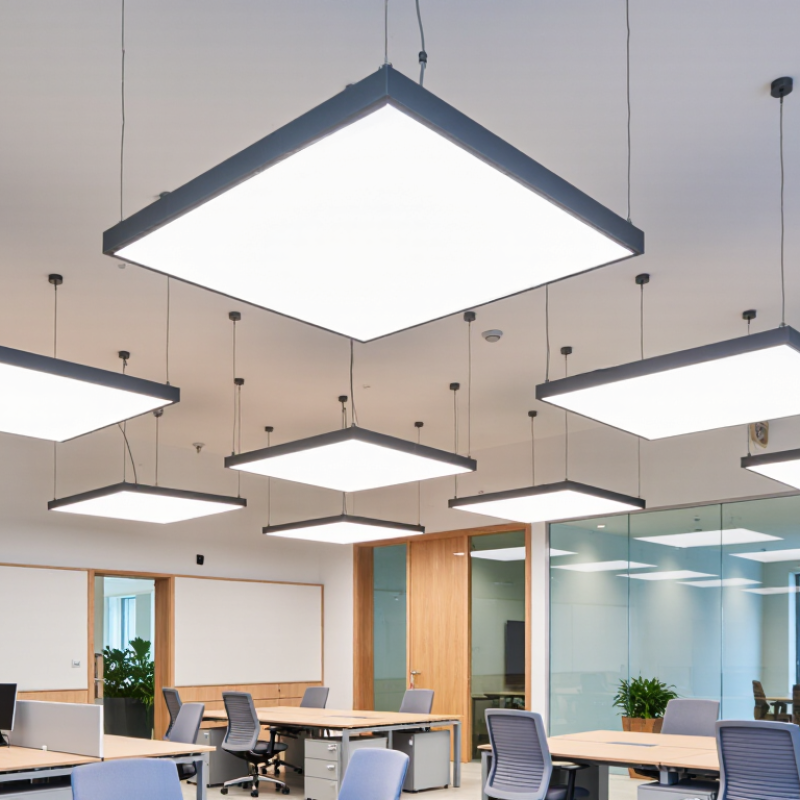
Choosing a suspended LED panel starts with purpose, not appearance. An open office may need even, low-glare light for screens and paperwork. A meeting room may need adjustable brightness for presentations. Under EN 12464-1 guidance, office work commonly targets about 500 lux with controlled glare. That figure is useful, but not universal.
Measure the room before selecting the panel. Record floor area, ceiling height, desk positions, daylight, and screen locations. For a 40-square-metre office, four panels may appear sufficient, yet dark wall finishes can reduce perceived brightness. IES recommendations often place general office lighting between 300 and 500 lux. The correct quantity depends on layout, maintenance, and actual fixture output.
Suspension height also shapes comfort. Panels hung too low create bright visual fields and uneven shadows. Panels hung too high may waste light above the working plane. The U.S. Department of Energy’s Energy Savings Forecast of Solid-State Lighting estimated that solid-state lighting could save 6.7 quadrillion British thermal units annually by 2035, compared with conventional technology. Efficiency matters, but poor placement can erase practical benefits. A lighting simulation or on-site lux check is worth using. Plans can still be wrong. Reflectance, furniture changes, and user preferences are easy to underestimate. Choose controls only after defining the task, occupancy pattern, and daylight contribution.

Choosing the right suspended LED panel begins with the room, not the fixture. Measure the ceiling, desk layout, and walking paths before comparing products. A 600-by-600-millimeter panel suits many modular ceilings and smaller work areas. Larger rectangular panels spread light across long tables with fewer dark gaps. Square panels feel balanced in compact rooms. Linear or curved shapes can guide attention above corridors, reception counters, or collaborative tables. Shape matters too. I once chose a wide panel for a narrow room, and it looked heavier than expected.
Brightness should match the task and surrounding surfaces. Many office installations target roughly 300 to 500 lux on the workplane. Detailed drawing, inspection, or craft work may require stronger, controlled illumination. Do not judge performance from lumens alone. Room size, mounting height, ceiling reflectance, and diffuser efficiency change the result. A bright panel can still create glare on monitors. Check glare ratings when available, then test one sample at desk height. Test one sample.
Color temperature changes mood and visual accuracy. Around 300K feels warm in lounges and hospitality areas. Neutral white, near 4000K, often supports focused office work without feeling clinical. Higher temperatures appear crisp, but they may tire occupants over long periods. Warm is not better. Color rendering matters when people inspect fabrics, printed materials, or skin tones. Confirm photometric data and color consistency before installation. My own shortcut failed once.
A suspended LED panel is more than a light fixture. Its mounting system must suit the ceiling structure, room height, and maintenance plan. Wire suspension creates a clean, floating appearance, but each anchor point needs verified load capacity. For heavy panels, use secondary safety cables and adjustable aircraft-grade wire. Ceiling grids may look strong, yet many are designed for acoustic tiles, not suspended loads.
Check compatibility before ordering. Concrete ceilings usually need tested anchors and accurate drilling. Steel decks may require approved clamps or threaded rods. Plasterboard ceilings need attachment to structural framing, not just the board. The National Electrical Contractors Association stresses that support systems should match the building substrate and installation conditions. Small errors can create visible tilt.
Lighting design also affects the mounting choice. The U.S. Department of Energy’s Energy Savings Potential of Solid-State Lighting report projected major energy reductions from LED adoption through 2035. However, poor alignment can cause glare and uneven illumination, reducing those practical benefits. The Illuminating Engineering Society recommends evaluating mounting height, spacing, and glare control together. Do not trust a generic layout.
I have seen installers choose suspension lengths by appearance alone. That approach often fails when ceiling services compete for space. Measure ducts, sprinklers, and access panels first. Leave room for cleaning and driver replacement. The best choice is sometimes less elegant, but safer and easier to maintain.
How to Choose the Right Suspended LED Panel?
Energy efficiency should begin with the whole fixture, not the LED chip alone. Check lumens per watt, standby power, and expected operating life. A panel producing 120 lumens per watt may still waste energy through poor drivers or excessive brightness. Compare the stated performance with the room’s actual needs. Open offices rarely need the same output as high-bay work areas. Small details matter.
Lighting quality affects comfort, concentration, and visual accuracy. Look for a high color rendering index, especially in design studios, classrooms, and medical spaces. A low flicker rating can reduce visible pulsing on cameras and during prolonged work. Glare also deserves attention. Review the unified glare rating and diffuser design before installation. I have learned that attractive light can still feel harsh after several hours.
Controls should match daily behavior. Occupancy sensors can lower consumption in meeting rooms, while daylight harvesting suits areas near windows. Confirm that dimming systems communicate correctly with the panel’s driver. Compatibility is often overlooked. Safety requires documented testing, electrical protection, suitable fire ratings, and installation instructions for the ceiling structure. Check local certification requirements and use a qualified installer when wiring is involved. Specifications can be incomplete, so question unclear test conditions and verify them with independent documentation.
Compare energy use under different control strategies, then verify lighting quality and safety requirements before selecting a suspended LED panel.
Compare luminous efficacy in lumens per watt and calculate annual kWh from actual power, operating hours, and control schedules.
For typical office lighting, check CRI/Ra ≥ 80 and glare performance such as UGR ≤ 19 where applicable.
Occupancy sensing and daylight dimming can reduce operating hours or output, but actual savings depend on the room and control settings.
Confirm applicable IEC 60598 luminaire requirements, electrical safety, emergency-lighting compatibility, flicker limits, and correct suspension installation.
Chart basis: illustrative calculation for one 40 W panel operating 3,000 hours per year. Annual energy equals rated power × operating hours × average output factor. The control factors are planning assumptions, not product performance claims.
How to Choose the Right Suspended LED Panel?
When evaluating a suspended LED panel, look beyond its initial brightness. Durability starts with the housing, suspension cables, diffuser, and internal driver. Inspect the frame for firm joints and resistance to bending. A rigid aluminum or steel body usually handles busy commercial spaces better. Check whether the diffuser resists yellowing, cracking, and light impact. Request photometric and safety test reports before approving a large installation. A bright panel is not enough. One weak cable can create a serious maintenance problem.
Tips: Ask an electrician to inspect mounting points and cable strain relief. Keep spare drivers available for high-use areas. Record installation dates and cleaning schedules. Use a soft, dry cloth; aggressive chemicals may damage the diffuser. I once saw dust reduce light output because the upper housing was ignored during cleaning. That mistake was avoidable, but maintenance plans are often too optimistic.
Review the warranty carefully. Confirm its duration, covered components, labor terms, and claim process. Some warranties exclude incorrect installation or unstable power supplies. The lowest purchase price may hide higher costs for lifts, replacement labor, downtime, and disposal. Calculate total cost over the expected service life, not just the invoice amount. Include energy use and cleaning frequency. Also consider access height. A cheaper panel can become expensive above a difficult ceiling. I would compare at least three quotations, though comparing only price is still an imperfect method. Pay attention to documented failure rates and available replacement parts.
| Suspended LED Panel Configuration | Rated Power | Expected Service Life | Durability Indicators | Routine Maintenance | Typical Warranty | Estimated 10-Year Total Cost | Best-Fit Application |
|---|---|---|---|---|---|---|---|
| Standard office panel 600 × 600 mm, fixed white output | 40 W Approximately 100 lm/W | 50,000 hours to L70 | Aluminum frame; IP20; operating temperature typically 0–40°C | Dust cleaning every 6–12 months; inspect suspension cables annually; driver replacement may be required during extended use | 3 years | About US$440 Purchase, suspension kit, installation, energy, and routine maintenance included | General offices, classrooms, corridors, and low-maintenance commercial areas |
| High-efficiency office panel 600 × 600 mm, low-glare optic | 36 W Approximately 125 lm/W | 70,000 hours to L70 | Reinforced aluminum housing; IP20; improved thermal management; operating temperature typically 0–45°C | Dust cleaning every 12 months; annual cable and connector inspection; lower expected driver stress because of reduced wattage | 5 years | About US$435 Higher initial price offset by lower electricity use and reduced maintenance provision | Workspaces operating for long hours where energy efficiency and visual comfort are priorities |
| High-output panel 1200 × 300 mm, high-lumen configuration | 50 W Approximately 110 lm/W | 50,000 hours to L70 | Aluminum body; IP20; higher thermal load; operating temperature typically 0–40°C | Dust cleaning every 6–12 months; inspect suspension points and drivers annually; allow clear airflow around the housing | 3 years | About US$505 Higher energy consumption and installation cost than standard configurations | High-ceiling spaces, retail areas, studios, and locations requiring stronger illumination |
| Dimmable and tunable-white panel 600 × 600 mm, control-ready driver | 40 W Approximately 100–115 lm/W | 50,000 hours to L70 | Aluminum frame; IP20; additional control components; operating temperature typically 0–40°C | Dust cleaning every 6–12 months; annual inspection of control wiring, drivers, connectors, and suspension cables | 5 years | About US$535 Higher acquisition and control-system cost, with potential operational savings from scheduled dimming | Meeting rooms, learning spaces, healthcare support areas, and buildings using lighting controls |
| Cost assumptions: 10-year ownership period; 3,000 operating hours per year; electricity at US$0.15/kWh; one suspension kit and standard installation included; estimated maintenance allowance of US$10–US$20 per panel per year; no major building rewiring or ceiling reinforcement included. Actual prices, warranty terms, service life, and maintenance costs vary by installation environment and supplier specification. IP20 panels are intended for dry indoor areas and should not be used where water or heavy dust exposure is expected. | |||||||


For those larger-sized parts, or smaller quantity runs, we have 2 independent powder coat booths and ovens. The quality, durability and affordability of today’s powder coating finishes make this the process of choice for world-class companies.
Powder coating advantages over other forms of coating are many. Materials used in the Powder coating process can be metals and non-metals that come in a multitude of thicknesses, textures, colors, etc. Another of Powder coating’s biggest advantages over conventional coatings is its ability to create finishes in many different textures. Powder Coating Booths allow us the ability to apply these advantages to large products.
Tri-State Fabricators runs a full-service conveyor line for painting. Wet painting can provide protection or decoration to many different part styles. From start to finish, every project is easier to undergo random and point-based inspection by our skilled painting team.
Advantages to our Wet Paint Line are these lines start with product prep and ends with a thorough inspection of a high quality finished product. Our ability to complete large and small projects with a superior finish and doing so in a timely and economical fashion. This passes along the savings in production to our customers. When powder coating ins not an option, our Wet Paint Line gets the job done right the first time.
When the parts get big and heavy we roll-out our custom paint racks and oversize booth. By utilizing our partnerships with all the major paint brands, we can match virtually any color with wet paint.
The advantages of having access to a Wet Paint Booth are many. Large projects of many different shapes can be loaded into the booth. The Wet Paint Booth offers an environment that is much more controlled than a typical parts painting operation.
Not only are they used because of their controlled environment, but they’re are also advantageous when it comes to applying paint to parts that are needed in industries that require specialty coatings such as medical, aerospace, etc.
Our military forces have some very high standards when it comes to the finish of their vehicles and equipment. From the first pre-treatment step to final coat, it takes a great deal of knowledge and experience to protect the men and women of our armed forces. They deserve only the best, and Tri-State Fabricators provides it.
All of our processes are closely monitored by our staff and management teams. Both of which are highly trained in the processes of metal fabrication and finishing. Tri-State Fabricators’ goal is to always fully satisfy each and every customer, including the military. We will always put a 110% into what we do.
Abrasive media blasting is an excellent way to remove old paint, rust, and increase the paint/powder adhesion. Glass beads produce a much smoother and brighter finish than angular abrasives; leaving the part clean yet without any dimensional change. Chemically inert and environmentally friendly, we can recycle our beads approximately 30 times; making them a more preferred method of metal cleaning or surface finishing.
Advantages to Glass Bead Blasting are many. Glass bead blast media is used when a project is needing rough surfaces need to become smooth for applications of coatings such as paint. It is typically used to clean paint and rust from a product surface without deforming the surface it is being used on. Overall, compared to many other blasting media, Glass Bead Blasting is a very economical choice and those savings are always passed on to our customers.
Tri-State Fabricators utilize a zinc phosphate wash to clean and etch the material to ensure the best paint adhesion possible. The unique design of our 3-stage wash system does the work like a 5-stage. From Cleaning and rinsing to conversion coating and post-treatment, Our Part Washing process is a complete service and works throughout the fabrication service and the finishing service.
Along with the previously mentioned benefits, Curing is a vital chemical reaction that leaves the product finish hard and relatively safe from mild abrasion and aggressive corrosion. This process can be done in more than one way; ambient air-dry or in curing ovens at temps that exceed 240°.
From fixing paint mistakes (someone else’s of course) to simply cleaning our paint line hooks, our burn-off oven is put to good use. After a quick burn-off, a little clean up, and a fresh coat of paint, your parts will look better than new.
Why does our Burn-Off Oven work so well? Because super heating the air around parts turns the materials into ashes. From paint and powder coatings to rubber and machining oils, high temps do the job without degrading the integrity of the part.
Masking is a vital part of producing high quality products. We have die-cut masking patterns to protect machined surfaces as well as a wide range of plugs and caps to protect threaded holes and bolts. We provide permanent and temporary masking.
Masking allows the selected sections of a product to be protected from a fabrication or finishing service. This can be with both chemicals when etching and tapes, paints when only finishing just a section of the product. Masking is great in aiding the customization process of a project.
Screen printing is a photographic process that transfers artwork onto a porous nylon screen which allows colored ink to flow through the screen and be deposited on an aluminum or plastic component. We can generally have just about any design created onto a screen for your parts.
Some of the advantages of Screen Printing are, brand recognition for your business displaying on your products, assembly instructions, product warnings/hazards, etc. Tri-State Fabricators produces Screen Printing of the highest quality so you know it’s durable.
Metal Finishing is the art of treating the exterior portion of product, often metal but can also be made of other materials, so that the surface is clean and free of any debris. Then the process of applying coats or either paint of powder coat takes place. This coating process improves the quality of the product in both appearance and resistance to wear and corrosion.
Tri-State Fabricators, Inc., understands that a project typically isn’t complete until a high-quality finish has been added to your product. This is why our painting and powder coating teams continuously inspect the products throughout the Metal Finishing process.

