How to Choose a Steel Pipe Making Machine

Choosing a Steel Pipe Making Machine is a production decision, not just a purchase. The right line must match the pipe dimensions, material grades, target output, and quality checks your customers require. A machine that runs quickly but struggles with thin-wall accuracy can create scrap, rework, and missed delivery dates. The details matter: coil width, forming stands, welding method, sizing section, and cutting system all affect the finished tube.

The scale of the steel industry makes careful equipment selection consequential. World Steel Association’s World Steel in Figures 2024 reports that global crude steel production reached 1,892.2 million tonnes in 2023. That figure describes steelmaking, not pipe-machine sales, but it shows the enormous material base behind downstream products. For buyers, published market totals are only a starting point. Compare machine specifications against actual product drawings, sample runs, energy use, changeover time, and the supplier’s service record.

A useful selection rule is simple: buy for the pipe you will reliably make, not the maximum speed printed in a brochure. Small differences show up on the shop floor. Ask to inspect a comparable line and review its weld consistency and dimensional records. No source material was provided for a verifiable, named expert quotation on machine selection, so I have not invented one. That limitation matters; confirm any expert quote and report figures before publication.
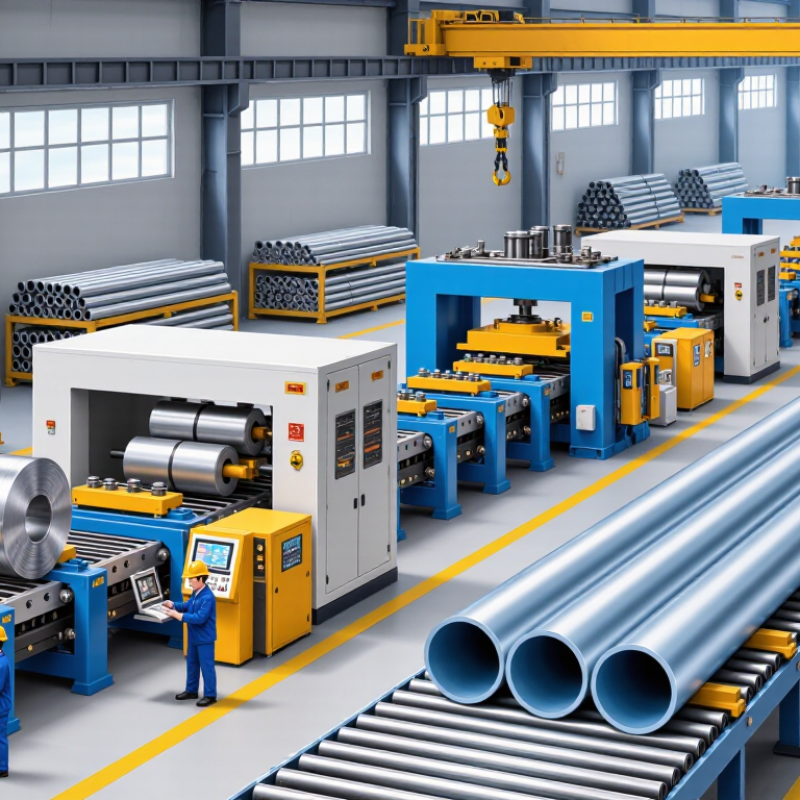
How to Choose a Steel Pipe Making Machine

Define Pipe Specifications and Production Requirements

Before comparing steel pipe making machines, define the finished pipe. Record its outside diameter, wall thickness, steel grade, length, tolerance, and surface finish. State whether production includes round, square, or rectangular profiles. Small details matter. A change from thin-wall to heavy-wall tube can affect forming, welding, sizing, and cutting requirements. Also specify the joining process and quality checks; “standard pipe” is not a useful machine specification.

Translate sales forecasts into a realistic production plan. Estimate good pieces per shift, product changeovers, scrap, maintenance stops, and required delivery volume. A useful starting calculation is planned output divided by available running hours, adjusted for expected yield. Leave room for variation. I have seen targets look sound on paper, then falter when frequent size changes consume production time.

Industry figures offer context, not a machine-size formula. World Steel Association’s World Steel in Figures 2024 reports 1,892.2 million tonnes of crude steel produced globally in 2023. Its October 2024 Short Range Outlook forecast global steel demand at 1,751 million tonnes in 2024 and 1,772 million tonnes in 2025. These broad figures cannot predict your pipe orders. Use your own order mix to set line speed, tooling range, coil width, and changeover needs. Check sample pipes against the stated tolerances before finalizing capacity. A trial run is not wasted time.

Compare Steel Pipe Forming Machine Types

ERW lines form strip into a tube and join its edges with high-frequency welding. They suit high-volume production of consistent small- and medium-diameter pipe. Compare the forming stands, weld control, and changeover time; a fast line can still lose hours when switching sizes. The World Steel Association’s World Steel in Figures 2025 reports 1.88 billion tonnes of crude steel production in 2024. That scale signals a demanding supply chain, but it does not make every mill configuration suitable.

For large diameters, spiral SAW lines form coiled plate into a helix, while longitudinal SAW lines shape plate along the pipe’s length. Spiral forming can use narrower coil, but weld length and inspection needs deserve close review. Longitudinal lines often suit heavy-wall, large-diameter products, though plate handling takes space.

Seamless mills use piercing and rolling rather than a welded seam; they involve more complex equipment and process control. Not a simple upgrade.

Compare target diameter, wall thickness, steel grades, output, and available floor space against each process. Ask suppliers for sample run data, scrap rates, and changeover times. I would still verify those figures under the buyer’s actual material and operating conditions.

Evaluate Capacity, Materials, and Automation Features

A steel pipe line should be sized for saleable output, not brochure speed. Specify diameter, wall thickness, steel grade, and shifts. Then compare annual demand with realistic uptime and scrap rates. A line rated in metres per minute may still miss targets after coil changes, weld inspection, and tooling adjustments. Details matter.

The World Steel Association’s World Steel in Figures 2024 reports global crude steel production of 1.892 billion tonnes in 2023. That figure does not predict your mill’s supply, but it reflects the scale and diversity of steel production. Match forming stands, welding methods, and sizing tools to the carbon or stainless grades and thicknesses you actually process. Request sample runs using your own coil. Paper specifications can flatter.

Automation deserves equal scrutiny. The International Federation of Robotics’ World Robotics 2024 reports 541,302 industrial robots installed worldwide in 2023. This is broad manufacturing data, not pipe-line performance, but it provides useful context. Compare automated loading, weld tracking, cutting, and fault logging against labor needs and changeover time. Check how operators can respond safely when sensors drift; this detail is easy to underestimate. A faster line is not always better.

How to Choose a Steel Pipe Making Machine

Example decision priorities for different production needs

The bars show illustrative decision-weight allocations, not machine performance data. Prioritize material flexibility for varied product runs, capacity for high-volume production, and automation when consistent throughput and reduced manual handling are key.

Assess Tooling, Quality Control, and Safety Systems

How to Choose a Steel Pipe Making Machine

Assess the tooling before judging a machine by its advertised speed. Forming rolls should suit the pipe diameter range, wall thickness, and steel grades you plan to run. Ask how quickly rolls can be changed and how alignment is checked after a changeover. Small marks matter. Scratches or uneven forming can signal worn tooling or poor adjustment. Request sample pipes made with comparable material, then inspect their roundness, weld seam, and cut ends.

Quality control should be built into the production process, not left to a final visual check. Look for clear procedures for measuring diameter, wall thickness, and seam consistency. Ask whether gauges are calibrated and how readings are recorded. If the line includes automatic monitoring, find out what it detects and what happens when a reading falls outside the set range. It is tempting to judge a line by speed alone; that can be a costly blind spot. Production records and real sample results offer a more useful picture.

Safety systems deserve the same careful review. Check guarding around moving rolls, pinch points, and cutting equipment. Test that emergency stops are easy to reach and that interlocks prevent access during hazardous operation. Ask how fumes, hot material, and routine cleaning are managed. Check the basics. A tidy demonstration area may not reflect daily conditions, so ask to see maintenance and operator procedures. Small gaps in training or guarding can become serious risks.


Verify Installation, Service, and Total Operating Costs

How to Choose a Steel Pipe Making Machine

Verify Installation, Service, and Total Operating Costs

A machine price is only one line in the purchase. Ask for a written installation scope covering foundations, power supply, cooling, compressed air, alignment, and operator training. Before shipment, confirm who provides lifting equipment and who signs off on commissioning. Run acceptance tests using your actual steel grades and pipe sizes, not only easy sample material. Record line speed, weld quality, scrap, and changeover time.

Energy and service costs deserve the same scrutiny. The International Energy Agency’s Energy Efficiency 2023 report says industry used about 37% of global final energy in 2022. That is a sector-wide figure, not a forecast for your mill, but it makes measured energy use worth requesting. The U.S. Department of Energy notes compressed air can account for roughly 10% of electricity use in U.S. manufacturing. Include air leaks, cooling, and idle time in your estimate. Small details matter.

Compare annual costs for tooling, maintenance, spare parts, training, and planned downtime. Ask for service-response times, remote-support limits, and parts availability in writing. A low-cost machine can become expensive if one small roller stops production for days. Get a cost model based on your expected shifts and product mix. Then challenge its assumptions: scrap rates and maintenance intervals often look optimistic on paper. A local service plan may cost more upfront, yet prevent costly delays.

Powder Coat Booths

For those larger-sized parts, or smaller quantity runs, we have 2 independent powder coat booths and ovens. The quality, durability and affordability of today’s powder coating finishes make this the process of choice for world-class companies.

Powder coating advantages over other forms of coating are many. Materials used in the Powder coating process can be metals and non-metals that come in a multitude of thicknesses, textures, colors, etc. Another of Powder coating’s biggest advantages over conventional coatings is its ability to create finishes in many different textures. Powder Coating Booths allow us the ability to apply these advantages to large products.

Wet Paint Line

Tri-State Fabricators runs a full-service conveyor line for painting. Wet painting can provide protection or decoration to many different part styles. From start to finish, every project is easier to undergo random and point-based inspection by our skilled painting team.

Advantages to our Wet Paint Line are these lines start with product prep and ends with a thorough inspection of a high quality finished product. Our ability to complete large and small projects with a superior finish and doing so in a timely and economical fashion. This passes along the savings in production to our customers. When powder coating ins not an option, our Wet Paint Line gets the job done right the first time.

Wet Paint Booths

When the parts get big and heavy we roll-out our custom paint racks and oversize booth. By utilizing our partnerships with all the major paint brands, we can match virtually any color with wet paint.

The advantages of having access to a Wet Paint Booth are many. Large projects of many different shapes can be loaded into the booth. The Wet Paint Booth offers an environment that is much more controlled than a typical parts painting operation.

Not only are they used because of their controlled environment, but they’re are also advantageous when it comes to applying paint to parts that are needed in industries that require specialty coatings such as medical, aerospace, etc.

Military CARC

Our military forces have some very high standards when it comes to the finish of their vehicles and equipment. From the first pre-treatment step to final coat, it takes a great deal of knowledge and experience to protect the men and women of our armed forces. They deserve only the best, and Tri-State Fabricators provides it.

All of our processes are closely monitored by our staff and management teams. Both of which are highly trained in the processes of metal fabrication and finishing. Tri-State Fabricators’ goal is to always fully satisfy each and every customer, including the military. We will always put a 110% into what we do.

Glass-Bead Blasting

Abrasive media blasting is an excellent way to remove old paint, rust, and increase the paint/powder adhesion. Glass beads produce a much smoother and brighter finish than angular abrasives; leaving the part clean yet without any dimensional change. Chemically inert and environmentally friendly, we can recycle our beads approximately 30 times; making them a more preferred method of metal cleaning or surface finishing.

Advantages to Glass Bead Blasting are many. Glass bead blast media is used when a project is needing rough surfaces need to become smooth for applications of coatings such as paint. It is typically used to clean paint and rust from a product surface without deforming the surface it is being used on. Overall, compared to many other blasting media, Glass Bead Blasting is a very economical choice and those savings are always passed on to our customers.

Part Washing

Tri-State Fabricators utilize a zinc phosphate wash to clean and etch the material to ensure the best paint adhesion possible. The unique design of our 3-stage wash system does the work like a 5-stage. From Cleaning and rinsing to conversion coating and post-treatment, Our Part Washing process is a complete service and works throughout the fabrication service and the finishing service.

Along with the previously mentioned benefits, Curing is a vital chemical reaction that leaves the product finish hard and relatively safe from mild abrasion and aggressive corrosion. This process can be done in more than one way; ambient air-dry or in curing ovens at temps that exceed 240°.

Burn-Off Oven

From fixing paint mistakes (someone else’s of course) to simply cleaning our paint line hooks, our burn-off oven is put to good use. After a quick burn-off, a little clean up, and a fresh coat of paint, your parts will look better than new.

Why does our Burn-Off Oven work so well? Because super heating the air around parts turns the materials into ashes. From paint and powder coatings to rubber and machining oils, high temps do the job without degrading the integrity of the part.

Masking

Masking is a vital part of producing high quality products. We have die-cut masking patterns to protect machined surfaces as well as a wide range of plugs and caps to protect threaded holes and bolts. We provide permanent and temporary masking.

Masking allows the selected sections of a product to be protected from a fabrication or finishing service. This can be with both chemicals when etching and tapes, paints when only finishing just a section of the product. Masking is great in aiding the customization process of a project.

Screen Printing

Screen printing is a photographic process that transfers artwork onto a porous nylon screen which allows colored ink to flow through the screen and be deposited on an aluminum or plastic component. We can generally have just about any design created onto a screen for your parts.

Some of the advantages of Screen Printing are, brand recognition for your business displaying on your products, assembly instructions, product warnings/hazards, etc. Tri-State Fabricators produces Screen Printing of the highest quality so you know it’s durable.

Metal Finishing

Metal Finishing is the art of treating the exterior portion of product, often metal but can also be made of other materials, so that the surface is clean and free of any debris. Then the process of applying coats or either paint of powder coat takes place. This coating process improves the quality of the product in both appearance and resistance to wear and corrosion.

Tri-State Fabricators, Inc., understands that a project typically isn’t complete until a high-quality finish has been added to your product. This is why our painting and powder coating teams continuously inspect the products throughout the Metal Finishing process.



