Choosing the right Roller Conveyor Supplier in 2026 requires more than comparing prices. A conveyor may look simple, yet its performance depends on frame strength, roller spacing, motor quality, controls, and after-sales support. In a busy warehouse, one damaged bearing can slow an entire packing line. Small design decisions matter.
This guide examines practical criteria for evaluating suppliers with confidence. It considers load capacity, carton dimensions, conveyor speed, noise levels, safety features, and maintenance access. It also explores integration with warehouse software, sensors, robotic systems, and energy-efficient drives. Experienced suppliers should provide clear drawings, load calculations, testing records, and realistic delivery schedules. They should explain limitations, not hide them.
Site conditions deserve close attention. Dust, moisture, temperature changes, and frequent washdown can affect materials and service life. A supplier’s references can reveal how equipment performs after installation, not merely how it appears in a showroom. Speak with previous customers. Inspect similar systems when possible. No checklist is perfect. We might overlook future product changes or underestimate cleaning time. That is why a reliable evaluation includes technical evidence, operator feedback, spare-parts availability, and responsive service. The strongest supplier is not always the largest or cheapest. It is the partner that understands your workflow, documents its recommendations, and accepts responsibility when assumptions prove wrong.
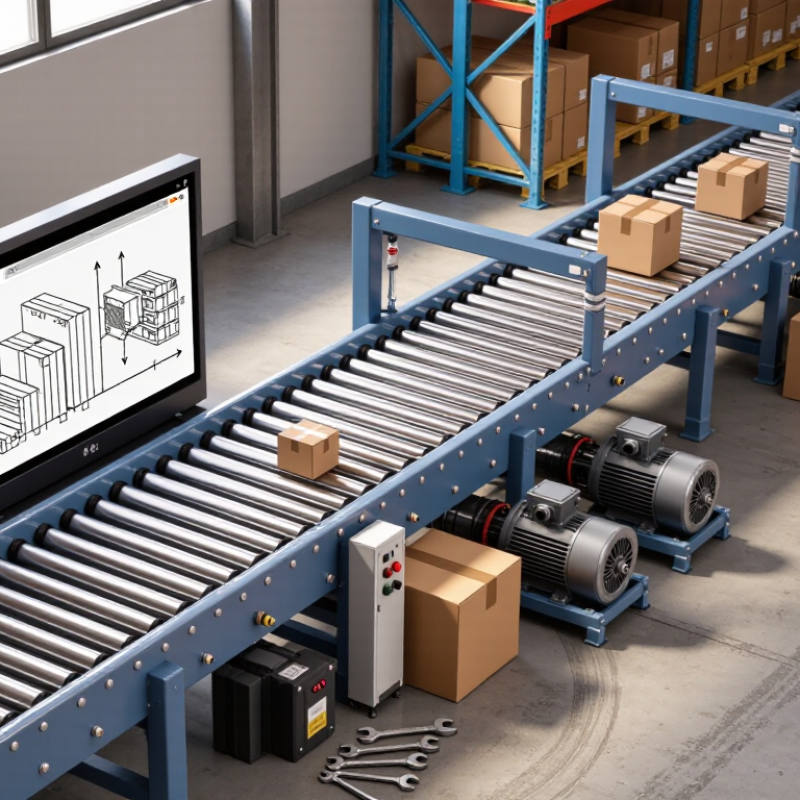
Choosing a roller conveyor supplier in 2026 starts with measurable requirements, not a catalog photograph. Record the heaviest unit, normal unit, and any unstable load. Include packaging, transfer impact, and the gap between rollers. A carton that looks light can still overload one roller when its base flexes. During a warehouse trial, measure actual contact points instead of trusting the stated product weight.
Speed must match the process, not merely the motor rating. Specify metres per minute, acceleration, stopping frequency, and whether loads queue. For fragile goods, sudden starts can cause sliding, corner damage, or uneven spacing. Set conveyor width from the load footprint. Allow side clearance without letting cartons rotate. Ask the supplier for calculations covering roller diameter, pitch, frame capacity, and drive torque. Request test results under your load profile.
A 24/7 duty cycle changes the conversation. Confirm operating hours, ambient temperature, cleaning method, noise limits, and maintenance access. Check bearing life, motor duty classification, spare-part availability, and response times in writing. Experience has taught us that a “continuous” label can hide frequent manual resets. That detail deserves challenge. Require a witnessed trial long enough to expose heat buildup and tracking problems. Leave a practical capacity margin, although excessive margin can waste money and floor space. A reliable supplier explains assumptions, admits limits, and adjusts the design when field measurements disagree.
Define roller conveyor requirements: load, speed, width, and 24/7 duty cycle.
Choosing a roller conveyor supplier in 2026 requires more than comparing catalog prices. Ask for engineering calculations, not general assurances. The supplier should size the motor for load, roller friction, incline, acceleration, and duty cycle. Request the input assumptions and a sample calculation for your heaviest carton. A conveyor moving at 0.1 m/s needs different torque behavior from one running at 0.5 m/s. Both speeds can look acceptable during a showroom test. Real production is less forgiving. Warm motors, uneven pallets, and frequent starts expose weak design.
Tips: Test with your actual cartons, not empty rollers. Require speed measurements at minimum and maximum settings. Check overload protection and thermal monitoring. Ask how 99% uptime is calculated. Is it measured monthly, excluding planned maintenance, or based on a short trial? Those definitions matter. Review service response times, spare-part storage, and maintenance intervals. One uncomfortable question helps: what failure data supports the uptime claim?
An experienced supplier will explain assumptions clearly and admit where testing is still needed. Look for guarded drive components, accessible bearings, and documented electrical ratings. Ask for a load test at 0.5 m/s, then observe stopping and restarting under full load. At 0.1 m/s, watch for hesitation or motor overheating during repeated starts. Do not accept 99% uptime as a slogan. Put acceptance criteria in writing, including allowable downtime, measurement method, and corrective action. I would leave a modest design margin, although excessive margin can waste energy and reduce control quality. The calculation may still need revision.
When choosing a roller conveyor supplier in 2026, inspect materials beyond surface appearance. In plant audits, I have seen painted steel hide weak welds and uneven roller walls. Ask for steel grade certificates, coating thickness records, and load-test results. Carbon steel suits dry areas and heavy loads. Galvanized steel handles moderate moisture. Stainless steel is safer near washdown zones, but it costs more.
Check every transfer point, chain drive, and roller nip. Effective guarding should prevent hand access while keeping cleaning practical. Guards need secure fasteners, clear visibility, and controlled access for maintenance. Ask how the supplier protects operators from falling products and unexpected starts. Small details matter. A guard that vibrates loose is not reliable protection.
ISO 13849 compliance requires more than displaying a certificate. Request the risk assessment, required Performance Level, safety circuit calculations, and validation records. Confirm that emergency stops, interlocks, and restart controls match the conveyor’s actual hazards. The supplier should explain component traceability and software assumptions clearly. I would also inspect a working installation, not only review documents. Documentation can look complete while field conditions reveal gaps. My own checks are not perfect, so independent validation remains valuable. Suppliers willing to discuss weaknesses usually provide more trustworthy engineering evidence.

Choosing a roller conveyor supplier in 2026 requires more than comparing purchase quotes. Ask for a ten-year cost model, not a polished spreadsheet alone. It should include energy consumption, scheduled service, spare parts, labor, downtime, and disposal. Request test data at your actual load, speed, incline, and operating hours. A conveyor moving cartons eight hours daily has different economics from one running continuously. Measure real conditions.
Energy costs can hide in standby motors and poorly sized drives. Compare gravity sections with powered zones where process flow allows. Check idle-power settings, motor efficiency, control logic, and recovery after stoppages. A supplier should explain assumptions in kilowatt-hours, not only percentages. Maintenance intervals deserve equal scrutiny. Ask how often bearings, belts, rollers, sensors, and gear units need inspection or replacement. Confirm whether technicians can reach service points without dismantling adjacent equipment. That detail affects labor and production risk.
For lifecycle value, price each planned intervention and estimate lost output per hour. Use conservative figures; optimistic downtime estimates can distort the result. Compare total ten-year cost under low, normal, and heavy-use scenarios. Include training, software support, critical spares, and expected energy-price changes. Models can be wrong. Small assumptions become expensive. A lower-priced conveyor may win the quote yet lose after repeated stoppages. Ask the supplier to show evidence from comparable applications, with service records and measurable operating data. If they cannot, treat the forecast as incomplete, not reliable.
Choosing a roller conveyor supplier in 2026 requires more than comparing prices. Audit the quality system before reviewing the quotation. ISO 9001 certification should include the actual manufacturing site and conveyor scope, not only a trading office. Request the latest audit findings, corrective actions, and calibration records. A certificate alone proves little.
Ask for documented load testing. The supplier should show test methods, rated capacity, safety factors, and results for rollers, frames, bearings, and drive components. Require testing under realistic loads, including starts, stops, uneven cartons, and continuous operation.
MHI’s 2024 Industry Report found that 83% of supply-chain professionals expected technology investment to rise during the next five years. That pressure can encourage rushed automation decisions. Do not let it replace engineering evidence.
Spare-parts control often exposes weak suppliers. Request a parts list, stock locations, replacement lead times, and interchangeability details. Critical items should have defined availability periods. Service agreements need measurable SLAs, such as remote response within four hours and onsite support within 48 hours.
Specify exclusions, escalation contacts, repair reporting, and compensation for missed targets. The 2023 MHI industry research also identified labor shortages as a continuing operational challenge, making dependable service more valuable than attractive installation promises. Still, SLAs can look impressive and fail in practice. Test them with a small pre-sales question. The response speed is useful evidence.


For those larger-sized parts, or smaller quantity runs, we have 2 independent powder coat booths and ovens. The quality, durability and affordability of today’s powder coating finishes make this the process of choice for world-class companies.
Powder coating advantages over other forms of coating are many. Materials used in the Powder coating process can be metals and non-metals that come in a multitude of thicknesses, textures, colors, etc. Another of Powder coating’s biggest advantages over conventional coatings is its ability to create finishes in many different textures. Powder Coating Booths allow us the ability to apply these advantages to large products.
Tri-State Fabricators runs a full-service conveyor line for painting. Wet painting can provide protection or decoration to many different part styles. From start to finish, every project is easier to undergo random and point-based inspection by our skilled painting team.
Advantages to our Wet Paint Line are these lines start with product prep and ends with a thorough inspection of a high quality finished product. Our ability to complete large and small projects with a superior finish and doing so in a timely and economical fashion. This passes along the savings in production to our customers. When powder coating ins not an option, our Wet Paint Line gets the job done right the first time.
When the parts get big and heavy we roll-out our custom paint racks and oversize booth. By utilizing our partnerships with all the major paint brands, we can match virtually any color with wet paint.
The advantages of having access to a Wet Paint Booth are many. Large projects of many different shapes can be loaded into the booth. The Wet Paint Booth offers an environment that is much more controlled than a typical parts painting operation.
Not only are they used because of their controlled environment, but they’re are also advantageous when it comes to applying paint to parts that are needed in industries that require specialty coatings such as medical, aerospace, etc.
Our military forces have some very high standards when it comes to the finish of their vehicles and equipment. From the first pre-treatment step to final coat, it takes a great deal of knowledge and experience to protect the men and women of our armed forces. They deserve only the best, and Tri-State Fabricators provides it.
All of our processes are closely monitored by our staff and management teams. Both of which are highly trained in the processes of metal fabrication and finishing. Tri-State Fabricators’ goal is to always fully satisfy each and every customer, including the military. We will always put a 110% into what we do.
Abrasive media blasting is an excellent way to remove old paint, rust, and increase the paint/powder adhesion. Glass beads produce a much smoother and brighter finish than angular abrasives; leaving the part clean yet without any dimensional change. Chemically inert and environmentally friendly, we can recycle our beads approximately 30 times; making them a more preferred method of metal cleaning or surface finishing.
Advantages to Glass Bead Blasting are many. Glass bead blast media is used when a project is needing rough surfaces need to become smooth for applications of coatings such as paint. It is typically used to clean paint and rust from a product surface without deforming the surface it is being used on. Overall, compared to many other blasting media, Glass Bead Blasting is a very economical choice and those savings are always passed on to our customers.
Tri-State Fabricators utilize a zinc phosphate wash to clean and etch the material to ensure the best paint adhesion possible. The unique design of our 3-stage wash system does the work like a 5-stage. From Cleaning and rinsing to conversion coating and post-treatment, Our Part Washing process is a complete service and works throughout the fabrication service and the finishing service.
Along with the previously mentioned benefits, Curing is a vital chemical reaction that leaves the product finish hard and relatively safe from mild abrasion and aggressive corrosion. This process can be done in more than one way; ambient air-dry or in curing ovens at temps that exceed 240°.
From fixing paint mistakes (someone else’s of course) to simply cleaning our paint line hooks, our burn-off oven is put to good use. After a quick burn-off, a little clean up, and a fresh coat of paint, your parts will look better than new.
Why does our Burn-Off Oven work so well? Because super heating the air around parts turns the materials into ashes. From paint and powder coatings to rubber and machining oils, high temps do the job without degrading the integrity of the part.
Masking is a vital part of producing high quality products. We have die-cut masking patterns to protect machined surfaces as well as a wide range of plugs and caps to protect threaded holes and bolts. We provide permanent and temporary masking.
Masking allows the selected sections of a product to be protected from a fabrication or finishing service. This can be with both chemicals when etching and tapes, paints when only finishing just a section of the product. Masking is great in aiding the customization process of a project.
Screen printing is a photographic process that transfers artwork onto a porous nylon screen which allows colored ink to flow through the screen and be deposited on an aluminum or plastic component. We can generally have just about any design created onto a screen for your parts.
Some of the advantages of Screen Printing are, brand recognition for your business displaying on your products, assembly instructions, product warnings/hazards, etc. Tri-State Fabricators produces Screen Printing of the highest quality so you know it’s durable.
Metal Finishing is the art of treating the exterior portion of product, often metal but can also be made of other materials, so that the surface is clean and free of any debris. Then the process of applying coats or either paint of powder coat takes place. This coating process improves the quality of the product in both appearance and resistance to wear and corrosion.
Tri-State Fabricators, Inc., understands that a project typically isn’t complete until a high-quality finish has been added to your product. This is why our painting and powder coating teams continuously inspect the products throughout the Metal Finishing process.




