How to Choose the Right Pneumatic Conveyor?

Choosing the right Pneumatic Conveyor begins with the material, not the catalog. Fine flour behaves differently from plastic pellets. A system that handles one smoothly may plug, degrade, or create excess dust with another. Small details matter.

David Mills, author of Pneumatic Conveying Design Guide, is a recognized specialist in conveying-system design. A practical paraphrase of his design approach is: “Match the conveying method to the material and operating conditions.” This is a paraphrase, not a verbatim quotation. It captures an important point: reliable selection depends on measured properties, not assumptions.

Start by recording particle size, bulk density, moisture, abrasiveness, and fragility. Then define the required throughput, route length, number of bends, and pickup and discharge points. A 30-meter line with several elbows presents different challenges from a short, straight transfer. These details influence whether dilute-phase or dense-phase conveying is more suitable, and how much air and pressure the system needs.

This guide explains the main system types, key design factors, and questions to ask suppliers. It also considers maintenance access, filtration, energy use, and future capacity. No single conveyor suits every plant. Even a careful estimate can miss a material’s tendency to bridge or separate, so representative testing may be worthwhile. Ask for the assumptions behind performance figures, and compare them against real operating conditions. A little skepticism helps. The right choice is the one that moves your material consistently, safely, and economically—not simply the one with the highest advertised capacity.
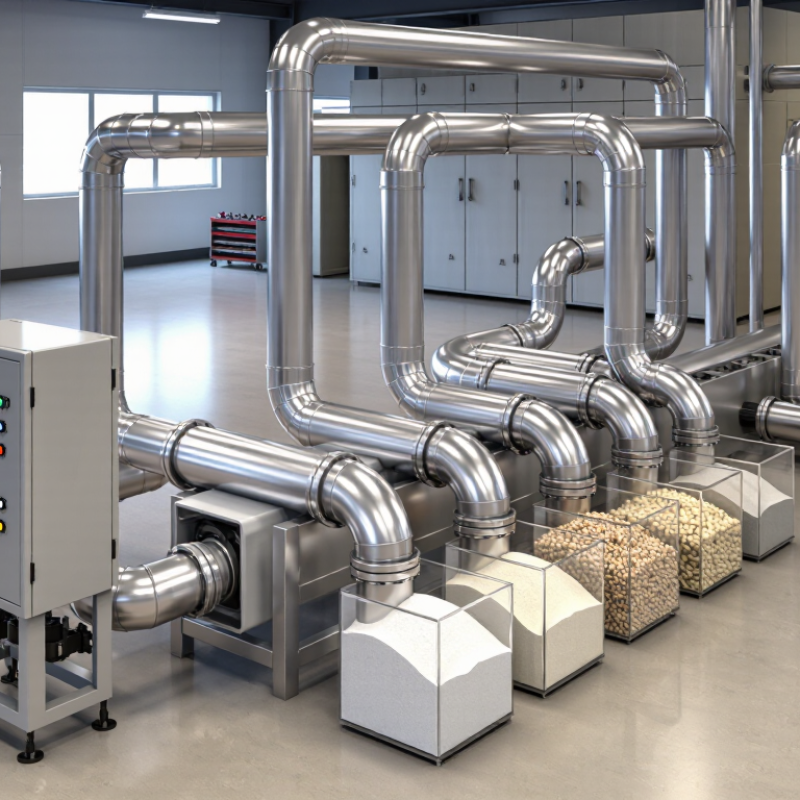
How to Choose the Right Pneumatic Conveyor?

Define the Material and Conveying Requirements

Start with the material, not the equipment catalogue. Collect a representative sample and record particle size, bulk density, moisture, temperature, abrasiveness, and friability. Note whether the product cakes, segregates, or breaks under impact. Small details matter. A dry sample from the lab may behave differently on a humid production floor. Ask operators about seasonal changes and batch variation; these are easy to overlook.

Next, define the conveying duty: target throughput in kilograms per hour, route length, vertical lift, bends, operating hours, and available space. The U.S. Department of Energy’s 2016 report, Improving Compressed Air System Performance: A Sourcebook for Industry, says compressed-air systems use about 10% of electricity in U.S. manufacturing, rising to 30% at some facilities. This is a plant-wide benchmark, not a conveyor-specific estimate, but it shows why air demand deserves attention. Use actual material in conveying trials where possible. Confirm that the proposed rate avoids plugging, excessive product damage, and unstable flow. Be cautious with early estimates; moisture and pipe layout can change the result.

Compare Dilute-Phase and Dense-Phase Systems

Choosing between dilute-phase and dense-phase conveying starts with the material, not the pipe. Dilute-phase systems suspend particles in fast-moving air, making them practical for longer routes and flexible layouts. Mills’ Pneumatic Conveying Design Guide gives typical conveying velocities of roughly 15–30 m/s for dilute phase and 3–10 m/s for dense phase; actual values depend on material and system design. At higher speeds, fragile granules may chip, and bends can become wear points. Check particle size, bulk density, moisture, and how much breakage the product can tolerate.

Dense phase moves material in slower, more concentrated plugs or dunes. It can reduce particle damage and air demand, but needs careful pressure control and a feeder suited to the material. A damp, cohesive powder may not flow reliably just because the conveying speed is low.

Not a perfect rule.

For a test, measure throughput, pressure, product damage, and residue after conveying. Keep the test route representative, including its bends and vertical lift. Compare the results with the planned operating hours and cleaning needs. A short trial can reveal what a spreadsheet misses. For design context, consult Mills’ guide alongside material-specific conveying tests; published velocity ranges are starting points, not guarantees.

Select the Conveying Route and Equipment Configuration

A pneumatic conveyor should be designed around the material’s journey, not just the distance between two machines. Map each transfer point, elevation change, and required delivery rate. A route with fewer bends is often easier to operate, but a straight line is not always practical. Check whether pipes can be inspected and cleared without moving nearby equipment. Small access details matter.

Material behavior guides the conveying method. Fine, free-flowing powder may suit dilute-phase transport, while fragile or abrasive particles may need gentler handling. Dense-phase systems can reduce particle speed, but they require careful matching of pressure, feed rate, and pipe layout. Test the material when possible. A sample that pours neatly into a container may still bridge in a hopper or separate during conveying.

Configure the feeder, blower or compressor, receiver, filters, and controls as one system. Size the air source for the full route, including vertical lifts and bends, rather than relying on a simple distance estimate. Allow space for filter changes and safe access to valves. Instrument readings can reveal pressure loss or unstable feeding, though they do not explain every problem. Real plants are rarely perfect; leave room to adjust the layout after observing actual operation.

Size the Pipeline and Specify Airflow Requirements

Sizing a pneumatic conveyor starts with the material, not the pipe catalog. Record the required mass flow, particle size, bulk density, moisture, and whether the product breaks easily. Then map the route, including elbows, vertical lifts, and the receiving vessel. These details affect pressure loss and the airflow needed to keep solids moving. There is no magic diameter. An undersized line can raise pressure loss and wear; an oversized one may need more air than the process requires. Specify airflow at stated reference conditions, plus conveying pressure at the pickup point. “Actual” and “standard” flow are not interchangeable.

Use a conveying calculation based on the material and route, then verify it with operating data or a representative trial. Track pressure at the blower and receiver, product rate, and signs of settling at bends. The U.S. Department of Energy’s Improving Compressed Air System Performance: A Sourcebook for Industry reports that compressed air systems account for about 10% of industrial electricity use. That figure is not a conveyor-sizing rule, but it shows why excess airflow deserves attention. A calculation can still miss changes in moisture or feed consistency. Check those assumptions before locking in the pipeline and airflow specification.

How to Choose the Right Pneumatic Conveyor: Pipeline Size and Airflow

This chart shows the theoretical airflow needed to maintain an air velocity of 20 m/s in pipes of different internal diameters. Actual system requirements depend on the material, solids loading, pressure drop, bends, and elevation changes.


Evaluate Energy Use, Reliability, and Operating Costs

How to Choose the Right Pneumatic Conveyor?

Evaluate Energy Use, Reliability, and Operating Costs

Compare energy per ton conveyed, not just motor size. Include the compressor, dryer, filters, and conveying line in your estimate.

The U.S. Department of Energy’s Improving Compressed Air System Performance sourcebook notes that compressed air can account for about 10% of industrial electricity use. It also reports that leaks can waste 20–30% of a plant’s compressed air. These are plant-wide figures, not guarantees for a conveyor. That distinction matters.

Ask for performance data using your material, route length, and target throughput.

Reliability shows up in daily details: filter pressure drop, blocked bends, seal wear, and how often operators clear the line. Dense-phase systems can reduce particle velocity, but results depend on material and layout.

Request operating data at both peak and reduced throughput. Track kilowatt-hours per ton, downtime, maintenance hours, and replacement parts during a trial.

A low purchase price can hide higher energy or service costs. And a tidy spreadsheet may still miss the cost of unplanned stoppages.

Tips: Check that quoted energy use includes the air supply. Record pressure and filter readings during normal shifts, not only during commissioning. Recheck assumptions after the first month. They may be off.

Powder Coat Booths

For those larger-sized parts, or smaller quantity runs, we have 2 independent powder coat booths and ovens. The quality, durability and affordability of today’s powder coating finishes make this the process of choice for world-class companies.

Powder coating advantages over other forms of coating are many. Materials used in the Powder coating process can be metals and non-metals that come in a multitude of thicknesses, textures, colors, etc. Another of Powder coating’s biggest advantages over conventional coatings is its ability to create finishes in many different textures. Powder Coating Booths allow us the ability to apply these advantages to large products.

Wet Paint Line

Tri-State Fabricators runs a full-service conveyor line for painting. Wet painting can provide protection or decoration to many different part styles. From start to finish, every project is easier to undergo random and point-based inspection by our skilled painting team.

Advantages to our Wet Paint Line are these lines start with product prep and ends with a thorough inspection of a high quality finished product. Our ability to complete large and small projects with a superior finish and doing so in a timely and economical fashion. This passes along the savings in production to our customers. When powder coating ins not an option, our Wet Paint Line gets the job done right the first time.

Wet Paint Booths

When the parts get big and heavy we roll-out our custom paint racks and oversize booth. By utilizing our partnerships with all the major paint brands, we can match virtually any color with wet paint.

The advantages of having access to a Wet Paint Booth are many. Large projects of many different shapes can be loaded into the booth. The Wet Paint Booth offers an environment that is much more controlled than a typical parts painting operation.

Not only are they used because of their controlled environment, but they’re are also advantageous when it comes to applying paint to parts that are needed in industries that require specialty coatings such as medical, aerospace, etc.

Military CARC

Our military forces have some very high standards when it comes to the finish of their vehicles and equipment. From the first pre-treatment step to final coat, it takes a great deal of knowledge and experience to protect the men and women of our armed forces. They deserve only the best, and Tri-State Fabricators provides it.

All of our processes are closely monitored by our staff and management teams. Both of which are highly trained in the processes of metal fabrication and finishing. Tri-State Fabricators’ goal is to always fully satisfy each and every customer, including the military. We will always put a 110% into what we do.

Glass-Bead Blasting

Abrasive media blasting is an excellent way to remove old paint, rust, and increase the paint/powder adhesion. Glass beads produce a much smoother and brighter finish than angular abrasives; leaving the part clean yet without any dimensional change. Chemically inert and environmentally friendly, we can recycle our beads approximately 30 times; making them a more preferred method of metal cleaning or surface finishing.

Advantages to Glass Bead Blasting are many. Glass bead blast media is used when a project is needing rough surfaces need to become smooth for applications of coatings such as paint. It is typically used to clean paint and rust from a product surface without deforming the surface it is being used on. Overall, compared to many other blasting media, Glass Bead Blasting is a very economical choice and those savings are always passed on to our customers.

Part Washing

Tri-State Fabricators utilize a zinc phosphate wash to clean and etch the material to ensure the best paint adhesion possible. The unique design of our 3-stage wash system does the work like a 5-stage. From Cleaning and rinsing to conversion coating and post-treatment, Our Part Washing process is a complete service and works throughout the fabrication service and the finishing service.

Along with the previously mentioned benefits, Curing is a vital chemical reaction that leaves the product finish hard and relatively safe from mild abrasion and aggressive corrosion. This process can be done in more than one way; ambient air-dry or in curing ovens at temps that exceed 240°.

Burn-Off Oven

From fixing paint mistakes (someone else’s of course) to simply cleaning our paint line hooks, our burn-off oven is put to good use. After a quick burn-off, a little clean up, and a fresh coat of paint, your parts will look better than new.

Why does our Burn-Off Oven work so well? Because super heating the air around parts turns the materials into ashes. From paint and powder coatings to rubber and machining oils, high temps do the job without degrading the integrity of the part.

Masking

Masking is a vital part of producing high quality products. We have die-cut masking patterns to protect machined surfaces as well as a wide range of plugs and caps to protect threaded holes and bolts. We provide permanent and temporary masking.

Masking allows the selected sections of a product to be protected from a fabrication or finishing service. This can be with both chemicals when etching and tapes, paints when only finishing just a section of the product. Masking is great in aiding the customization process of a project.

Screen Printing

Screen printing is a photographic process that transfers artwork onto a porous nylon screen which allows colored ink to flow through the screen and be deposited on an aluminum or plastic component. We can generally have just about any design created onto a screen for your parts.

Some of the advantages of Screen Printing are, brand recognition for your business displaying on your products, assembly instructions, product warnings/hazards, etc. Tri-State Fabricators produces Screen Printing of the highest quality so you know it’s durable.

Metal Finishing

Metal Finishing is the art of treating the exterior portion of product, often metal but can also be made of other materials, so that the surface is clean and free of any debris. Then the process of applying coats or either paint of powder coat takes place. This coating process improves the quality of the product in both appearance and resistance to wear and corrosion.

Tri-State Fabricators, Inc., understands that a project typically isn’t complete until a high-quality finish has been added to your product. This is why our painting and powder coating teams continuously inspect the products throughout the Metal Finishing process.



