


How to Choose the Right Padlock Lockout for Global Sourcing?

Choosing the Right Padlock Lockout for Global Sourcing requires more than comparing prices. The device must match the isolating point, workplace conditions, and users’ daily habits. A lockout that fits one breaker may fail on another model.

Safety trainer Jeffrey Dalto captures this practical concern: “The best lockout device is the one workers will use correctly, every time.” That principle matters during international purchasing. Buyers should examine jaw diameter, body material, shackle clearance, and label visibility. A compact nylon body may suit indoor panels. A reinforced design may perform better near dust, moisture, or vibration. The details are small. The consequences are not.

Global sourcing also demands disciplined supplier verification. Request dimensional drawings, material declarations, test records, and clear product photographs. Confirm whether the Padlock Lockout supports the padlocks already used by maintenance teams. Check keying options, color consistency, packaging protection, and replacement availability. A sample should be tested on the actual disconnects before a large order is released. That step can reveal awkward clearance, weak grip, or confusing identification.

Experience still has limits. A polished specification sheet does not prove field usability. One supplier may offer a lower unit price but weaker documentation. Another may cost more while reducing training time and replacement delays. The better choice balances fit, durability, traceability, and worker acceptance. Buyers should also review relevant occupational safety expectations in each destination market. Requirements can differ. Assumptions create risk. A careful sourcing decision leaves room for inspection, feedback, and revision after real workplace use.
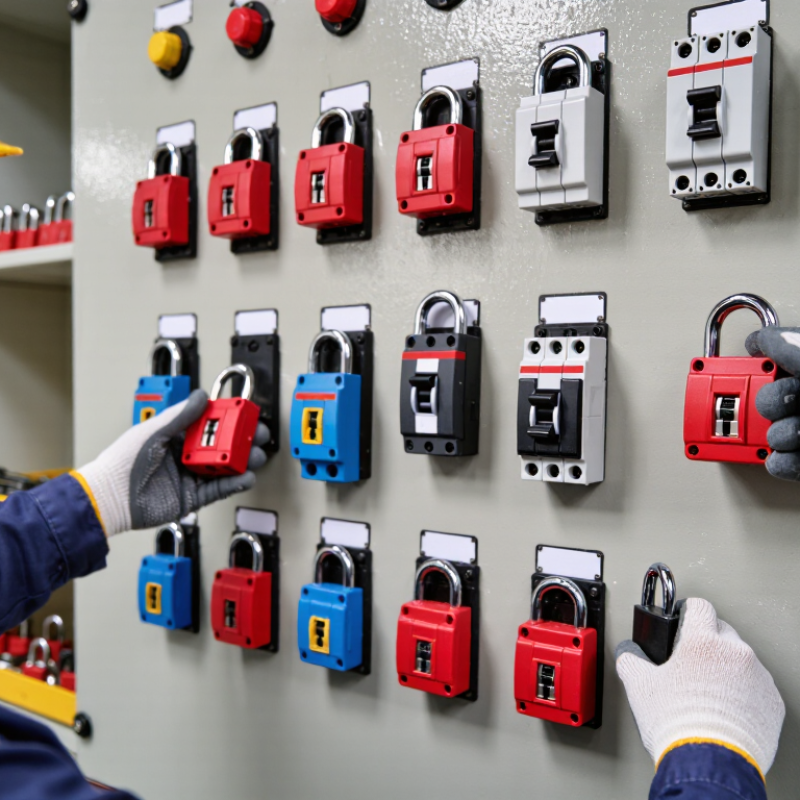
How to Choose the Right Padlock Lockout for Global Sourcing?

Define the Purpose and Scope of the Padlock Lockout

How to Choose the Right Padlock Lockout for Global Sourcing?

Define the Purpose and Scope of the Padlock Lockout

Purpose comes first. A padlock lockout should prevent unauthorized operation during maintenance, inspection, or equipment adjustment. Define the energy source before selecting the device. Electrical switches, valves, and compact disconnects may require different lockout designs. A clear purpose prevents buyers from choosing a product based only on price or appearance.

Scope matters just as much. Identify who will use the lockout, how many workers need protection, and where it will operate. A factory with oily floors may need a durable, corrosion-resistant body and a highly visible finish. Outdoor sites may require stable performance under rain, dust, and temperature changes. Measure the shackle diameter and clearance carefully. Measure before ordering.

From practical sourcing experience, small dimensional errors often create large delays. The device may fit a sample switch but fail on older equipment. Request drawings, material details, load information, and test records from suppliers. Confirm packaging, labeling, replacement parts, and inspection procedures for each destination market. These details support traceability and consistent quality across multiple shipments.

No selection is perfect. One earlier assumption may prove wrong after a site trial. A pilot order can reveal access problems, awkward handling, or poor visibility before full production. Review those findings with maintenance staff and procurement teams. Their feedback often exposes risks that a catalog cannot show.


Compare Lockout Materials, Designs, and Safety Features

Choosing a padlock lockout for global sourcing requires more than comparing prices. Material selection affects durability, visibility, and performance in different work environments. Nylon or reinforced polymer bodies resist electrical conductivity and many chemicals. Stainless steel bodies offer stronger resistance against impact, moisture, and outdoor corrosion. However, no material performs perfectly everywhere. Review temperature changes, dust, humidity, and chemical exposure before approving a specification.

Design details also influence daily use. A compact body fits crowded control panels, while a longer shackle may reach isolated energy points. Keyed-alike systems can simplify authorized access management across multiple facilities. Different colors help workers identify equipment ownership quickly. Engraved identification can remain readable after repeated handling. Avoid oversized designs when workers must attach several devices in one location. Small choices matter.

Safety features should support clear procedures, not replace them. Select lockouts with durable labels, tamper-resistant construction, and a consistent key-control process. Confirm that the shackle diameter matches the lockout hasp and isolation point. Test samples with gloves, cold hands, and limited visibility. I once focused too heavily on body strength and overlooked label readability. That mistake delayed field use. Suppliers should provide material data, inspection records, and realistic sample testing. Requirements may differ by country, so verify applicable workplace safety standards before placing a large order.

Match Lockout Specifications With Global Compliance Requirements

When sourcing padlock lockouts globally, compliance starts with the worksite, not the catalog. Each destination may follow different occupational safety rules, testing expectations, and labeling practices. Match the lockout with the equipment’s isolation point, energy source, and local procedures. A lockout for a narrow breaker handle may fail on a thicker switch. Measure before ordering.

Specification details matter. Check shackle diameter, clearance, body material, corrosion resistance, and operating temperature. Nonconductive materials can reduce electrical exposure risks, but they do not replace proper isolation procedures. Confirm that the lock accepts the required key system and supports controlled key ownership. Some sites require one employee, one key, and one identifiable lock. Others use group lockout arrangements. The product must fit both systems.

In sourcing reviews, I request drawings, material data, test records, and sample units. I also compare labels with the languages used by workers at each facility. Small text can become a serious usability problem. Ask whether markings remain readable after oil, dust, sunlight, and repeated handling. Certification claims need verification through current documents, not sales language. A neat specification sheet is not enough.

I also check packaging and traceability. Lot numbers, inspection dates, and replacement records support reliable audits. Yet global compliance is rarely perfect at the first attempt. I once treated a universal fit as a safe assumption; the clearance was wrong. Rechecking the actual isolation points would have prevented that mistake. Build a review step into every purchase.

Evaluate Suppliers, Certifications, and International Shipping Factors

Choosing a padlock lockout for global sourcing starts with the supplier, not the product photo.

Request factory addresses, audit records, material specifications, and recent inspection reports. ISO 9001 shows a quality management system, but it does not automatically certify lockout performance. Ask for independent test evidence against the standards required in your target market. A certificate without a clear scope is only paper.

Check practical details. Does the lock body resist corrosion in humid storage? Does the shackle fit common isolation points? Can each unit carry a durable identification label?

In procurement reviews, sample testing often reveals issues that documents miss, including stiff mechanisms or inconsistent key control. That part is easy to underestimate. A small failure can delay an entire maintenance program.

Shipping needs equal attention. UNCTAD’s Review of Maritime Transport 2023 reports that over 80% of global merchandise trade by volume moves by sea. Confirm the Incoterm, export documents, HS classification, carton dimensions, and port handling responsibilities before placing an order.

World Bank’s Logistics Performance Index 2023 evaluates customs, infrastructure, tracking, and timeliness; these factors affect replenishment more than a low unit price. Build a realistic buffer for inspections and port delays.

I would not trust a promised lead time until a trial shipment proves it. Supplier ratings can also change, and that uncomfortable possibility deserves a documented backup plan.

Verify Product Quality Through Testing and Workplace Trial Use

How to Choose the Right Padlock Lockout for Global Sourcing?

Product quality should be verified before approving a padlock lockout for global sourcing. OSHA estimates that lockout/tagout controls prevent about 120 fatalities and 50,000 injuries annually. This figure shows why appearance alone is insufficient. Request material certificates, dimensional drawings, and independent laboratory reports. Testing should cover shackle tensile strength, corrosion resistance, key operation, and temperature exposure. An ISO/IEC 17025-accredited laboratory can improve confidence in reported results.

Small details matter. Test the lockout with gloves, wet hands, and limited visibility. Check whether it fits common energy-isolation points and group hasps. Trial users should attach and remove it repeatedly during routine maintenance simulations. Record jammed keys, unclear labels, sharp edges, and accidental interference with nearby controls. A lockout that passes a bench test may fail inside a crowded electrical cabinet. That weakness is easy to miss.

Field testing also needs realistic stress. Use dust, oil, moisture, and repeated handling. HSE guidance emphasizes that isolation procedures must work in real workplaces, not only on paper. Keep batch samples for comparison, especially when changing suppliers. One honest concern remains: a perfect sample may not represent full production. Therefore, inspect incoming batches and repeat workplace trials after design or material changes. Quality is never a single certificate.

How to Choose the Right Padlock Lockout for Global Sourcing? - Verify Product Quality Through Testing and Workplace Trial Use

Procurement Evaluation Matrix: Compare product construction, test requirements, field-trial results, and sourcing suitability before approving a padlock lockout for global purchasing.
Evaluation Dimension Compact Nylon Padlock Safety Aluminum Padlock Weather-Resistant Steel Padlock Non-Conductive Composite Padlock Sourcing Interpretation
Typical use case Indoor electrical panels and light-duty isolation points General industrial lockout and group lockout stations Outdoor utilities, construction, and humid production areas Electrical environments where reduced conductivity is preferred Select the construction according to exposure, electrical risk, and frequency of use.
Body material Engineering nylon or equivalent polymer Anodized or powder-coated aluminum Coated or stainless steel body Glass-filled engineering polymer Request material declarations and coating specifications for every production batch.
Typical shackle diameter 6 mm 6 mm 6–8 mm 6 mm Confirm compatibility with the lockout hasp, valve cover, breaker device, and energy-isolation point.
Key-control feature Key-retaining cylinder recommended Key-retaining cylinder recommended Key-retaining cylinder recommended Key-retaining cylinder recommended Verify that the key cannot be removed while the shackle is open, where required by the site procedure.
Corrosion test benchmark Target: 24–48 h neutral salt spray with no functional impairment Target: 48–96 h neutral salt spray with no seizure Target: 96–240 h neutral salt spray, depending on coating system Target: 48–96 h neutral salt spray with no functional impairment Use ASTM B117 or an equivalent documented laboratory method; define acceptance criteria before testing.
Mechanical test plan Key cycling, shackle pull, torsion, and drop testing Key cycling, shackle pull, torsion, and drop testing Key cycling, shackle pull, torsion, impact, and drop testing Key cycling, shackle pull, torsion, and drop testing Test after environmental exposure and confirm that the lock still opens, closes, and retains the key correctly.
Suggested temperature range Approximately −20°C to +80°C; verify polymer grade Approximately −20°C to +80°C; verify coating and cylinder lubricant Approximately −30°C to +100°C; verify seal and lubricant Approximately −20°C to +80°C; verify polymer grade Obtain supplier temperature limits and conduct low/high-temperature functional checks for the target region.
Workplace trial duration 2–4 weeks 4–8 weeks 8–12 weeks, including wet or outdoor exposure 4–8 weeks Include multiple shifts, gloved operation, cleaning routines, and representative lockout devices.
Trial-use acceptance criteria No cracked body, seized cylinder, accidental opening, or unreadable identification No functional failure; clear identification after repeated handling No severe corrosion, seized mechanism, or loss of shackle retention No cracking, deformation, electrical-use restriction conflict, or key-control failure Record failures per 100 uses, user feedback, installation time, and compatibility issues.
Identification and traceability Color coding and engraved or printed identifier Color coding and durable identifier Durable identifier suitable for outdoor exposure Color coding and durable identifier Require batch numbers, inspection records, material details, and change-control notifications.
Global sourcing documents Technical drawing, test report, material declaration, packing specification Technical drawing, test report, coating specification, packing specification Technical drawing, corrosion report, coating specification, inspection plan Technical drawing, material declaration, test report, electrical-use statement Request documents in English and verify that the tested configuration matches the production configuration.
Recommended sourcing position Best for indoor, lightweight applications Balanced option for general industrial use Preferred for harsh outdoor conditions Preferred where non-conductive construction is required Approve only after document review, laboratory testing, sample inspection, and workplace trial use.
Recommended approval sequence
Document review → Sample inspection → Mechanical and corrosion testing → Workplace trial → Final supplier approval.
Important control point
Test reports should identify the exact material, dimensions, cylinder configuration, coating, production batch, and test method.

Note: Performance targets should be confirmed against the buyer’s risk assessment, local occupational-safety requirements, electrical procedures, environmental conditions, and the supplier’s validated test data.

Powder Coat Booths

For those larger-sized parts, or smaller quantity runs, we have 2 independent powder coat booths and ovens. The quality, durability and affordability of today’s powder coating finishes make this the process of choice for world-class companies.

Powder coating advantages over other forms of coating are many. Materials used in the Powder coating process can be metals and non-metals that come in a multitude of thicknesses, textures, colors, etc. Another of Powder coating’s biggest advantages over conventional coatings is its ability to create finishes in many different textures. Powder Coating Booths allow us the ability to apply these advantages to large products.

Wet Paint Line

Tri-State Fabricators runs a full-service conveyor line for painting. Wet painting can provide protection or decoration to many different part styles. From start to finish, every project is easier to undergo random and point-based inspection by our skilled painting team.

Advantages to our Wet Paint Line are these lines start with product prep and ends with a thorough inspection of a high quality finished product. Our ability to complete large and small projects with a superior finish and doing so in a timely and economical fashion. This passes along the savings in production to our customers. When powder coating ins not an option, our Wet Paint Line gets the job done right the first time.

Wet Paint Booths

When the parts get big and heavy we roll-out our custom paint racks and oversize booth. By utilizing our partnerships with all the major paint brands, we can match virtually any color with wet paint.

The advantages of having access to a Wet Paint Booth are many. Large projects of many different shapes can be loaded into the booth. The Wet Paint Booth offers an environment that is much more controlled than a typical parts painting operation.

Not only are they used because of their controlled environment, but they’re are also advantageous when it comes to applying paint to parts that are needed in industries that require specialty coatings such as medical, aerospace, etc.

Military CARC

Our military forces have some very high standards when it comes to the finish of their vehicles and equipment. From the first pre-treatment step to final coat, it takes a great deal of knowledge and experience to protect the men and women of our armed forces. They deserve only the best, and Tri-State Fabricators provides it.

All of our processes are closely monitored by our staff and management teams. Both of which are highly trained in the processes of metal fabrication and finishing. Tri-State Fabricators’ goal is to always fully satisfy each and every customer, including the military. We will always put a 110% into what we do.

Glass-Bead Blasting

Abrasive media blasting is an excellent way to remove old paint, rust, and increase the paint/powder adhesion. Glass beads produce a much smoother and brighter finish than angular abrasives; leaving the part clean yet without any dimensional change. Chemically inert and environmentally friendly, we can recycle our beads approximately 30 times; making them a more preferred method of metal cleaning or surface finishing.

Advantages to Glass Bead Blasting are many. Glass bead blast media is used when a project is needing rough surfaces need to become smooth for applications of coatings such as paint. It is typically used to clean paint and rust from a product surface without deforming the surface it is being used on. Overall, compared to many other blasting media, Glass Bead Blasting is a very economical choice and those savings are always passed on to our customers.

Part Washing

Tri-State Fabricators utilize a zinc phosphate wash to clean and etch the material to ensure the best paint adhesion possible. The unique design of our 3-stage wash system does the work like a 5-stage. From Cleaning and rinsing to conversion coating and post-treatment, Our Part Washing process is a complete service and works throughout the fabrication service and the finishing service.

Along with the previously mentioned benefits, Curing is a vital chemical reaction that leaves the product finish hard and relatively safe from mild abrasion and aggressive corrosion. This process can be done in more than one way; ambient air-dry or in curing ovens at temps that exceed 240°.

Burn-Off Oven

From fixing paint mistakes (someone else’s of course) to simply cleaning our paint line hooks, our burn-off oven is put to good use. After a quick burn-off, a little clean up, and a fresh coat of paint, your parts will look better than new.

Why does our Burn-Off Oven work so well? Because super heating the air around parts turns the materials into ashes. From paint and powder coatings to rubber and machining oils, high temps do the job without degrading the integrity of the part.

Masking

Masking is a vital part of producing high quality products. We have die-cut masking patterns to protect machined surfaces as well as a wide range of plugs and caps to protect threaded holes and bolts. We provide permanent and temporary masking.

Masking allows the selected sections of a product to be protected from a fabrication or finishing service. This can be with both chemicals when etching and tapes, paints when only finishing just a section of the product. Masking is great in aiding the customization process of a project.

Screen Printing

Screen printing is a photographic process that transfers artwork onto a porous nylon screen which allows colored ink to flow through the screen and be deposited on an aluminum or plastic component. We can generally have just about any design created onto a screen for your parts.

Some of the advantages of Screen Printing are, brand recognition for your business displaying on your products, assembly instructions, product warnings/hazards, etc. Tri-State Fabricators produces Screen Printing of the highest quality so you know it’s durable.

Metal Finishing

Metal Finishing is the art of treating the exterior portion of product, often metal but can also be made of other materials, so that the surface is clean and free of any debris. Then the process of applying coats or either paint of powder coat takes place. This coating process improves the quality of the product in both appearance and resistance to wear and corrosion.

Tri-State Fabricators, Inc., understands that a project typically isn’t complete until a high-quality finish has been added to your product. This is why our painting and powder coating teams continuously inspect the products throughout the Metal Finishing process.
