How to Choose the Right Graphite Sheet for Your Needs?
A Graphite Sheet may look like a simple black layer, but its performance depends on more than appearance. Sheets can differ in thickness, density, flexibility, thermal conductivity, and electrical behavior. Those differences matter when the material must spread heat from an electronic component, compress around a flange, or remain stable inside equipment. There is no universal grade. A sheet that works well as a heat spreader may not suit a sealing application.
Choosing the right option starts with the job it must do. Check the required temperature range, operating pressure, available space, and exposure to moisture or chemicals. Then compare the manufacturer’s data for thermal performance, compression, material purity, and dimensional tolerances. A stated conductivity value is useful, but it may not reflect performance in your exact assembly. Contact pressure, surface finish, and installation can change the result. Small details matter.
This guide explains how to match sheet properties to practical needs, from material type and thickness to cutting and handling considerations. It also highlights questions worth asking suppliers, such as whether test conditions match your application. Do not rely on a product name alone. Review the technical datasheet, confirm that it applies to the grade being offered, and test a sample when failure would be costly. That step can feel slow. It is often the most reliable way to spot a mismatch before ordering at scale.
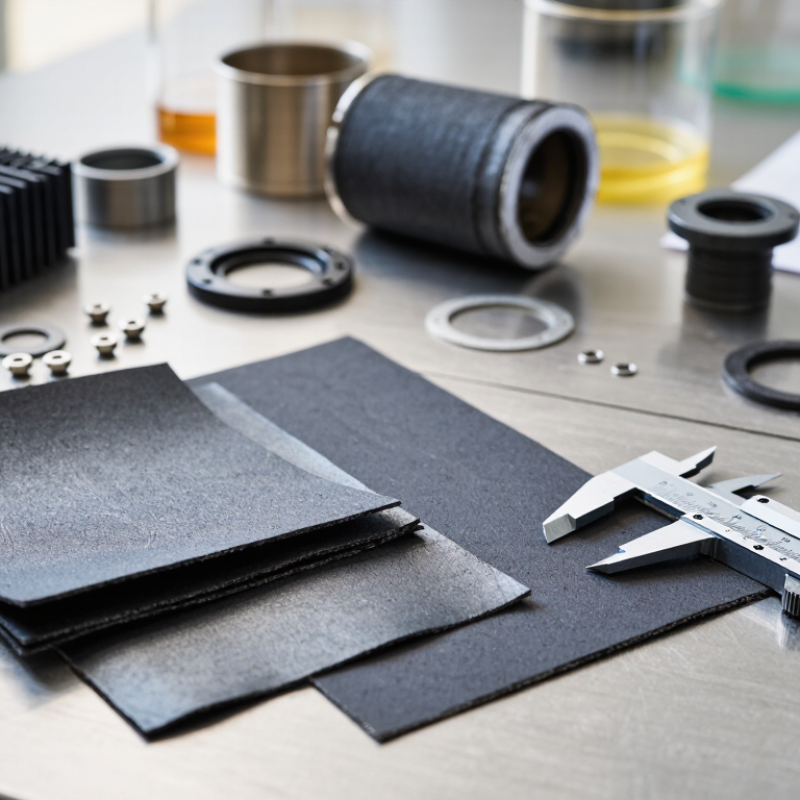
Classify the Grade: Flexible Graphite or Pyrolytic Sheet
Choosing a graphite sheet starts with its structure, not just its advertised conductivity. Flexible graphite is made from expanded graphite and pressed into a compressible sheet. It suits seals, flange joints, and uneven surfaces, where a 0.5-millimeter sheet can conform under clamping pressure. Pyrolytic graphite is a dense, engineered film. Its heat moves strongly along the plane but poorly through its thickness. Published engineering property compilations report in-plane conductivity around 1,000–1,950 W/m·K for some pyrolytic grades; flexible graphite varies widely with density and direction. Check the actual grade data. “Graphite” alone is not enough.
For a gasket around a pipe, flexibility and recovery may matter more than peak heat spreading. For a compact electronics assembly, pyrolytic sheet can move heat sideways from a hot component, but it will not replace a through-thickness thermal interface. Direction matters. The U.S. Geological Survey’s Mineral Commodity Summaries 2025 estimates 2024 world natural graphite mine production at about 1.6 million metric tons; that figure describes raw-material supply, not finished-sheet performance. Ask for conductivity by direction, thickness, density, and test method. I have seen selection discussions focus too much on one headline number. That is easy to do, and worth questioning.
Compare In-Plane Conductivity: Flexible Grades Often Reach 140–400 W/(m·K)
When choosing a graphite sheet, compare its in-plane thermal conductivity with the heat-spreading demands of your design. Flexible grades often reach 140–400 W/(m·K), but the figure depends on grade, thickness, and test method. Direction matters. In-plane conductivity describes heat moving across the sheet, not through its thickness.
A higher rating can help spread heat from a small hotspot, such as a warm component beneath a thin enclosure. Yet one catalog number may not predict performance in your assembly. Adhesive layers, contact pressure, bends, and surface gaps can all affect heat flow. Check whether the published value was measured using a method comparable to your application, and confirm the sheet’s temperature range and thickness. Small details count. If possible, test a sample in the intended stack-up; this step takes time, but it can reveal issues that a data sheet misses.
Tips: Compare like with like: use the same units, direction, and test conditions. Ask for measured data when the stated conductivity lacks context. Measure twice. A flexible sheet may be easier to install, though tight bends can make placement less consistent.
Check Density and Thickness: Flexible Sheets Commonly Span 0.7–1.2 g/cm³
Density and thickness shape how a flexible graphite sheet performs. Many flexible grades fall around 0.7–1.2 g/cm³, but confirm the supplier’s measured range and test method. A denser sheet may feel firmer and resist compression, while a lighter grade may conform more easily to uneven surfaces. These are tendencies, not guarantees; binders, construction, and processing can change the result.
Tips: Measure the available gap with calipers. Check thickness under the stated measurement pressure, since soft sheets can compress. Leave room for assembly pressure. Small gaps matter.
Choose thickness to suit the joint, not just the nominal specification. For a narrow seal, an overly thick sheet may squeeze out or load nearby parts. For an uneven flange, a slightly more compliant sheet may help fill surface irregularities. Compare samples under the actual clamping conditions whenever possible. It is easy to assume two sheets with the same density will behave alike; they may not. Check the technical data sheet, then verify fit and compression in a small trial before ordering larger quantities.
Set the Temperature Limit: Oxidation Accelerates Above ~400°C in Air
How to Choose the Right Graphite Sheet for Your Needs?
Set the Temperature Limit: Oxidation Accelerates Above ~400°C in Air
Temperature ratings need context. In air, graphite oxidation accelerates above roughly 400°C, but this is not a universal safe-use cutoff. The actual rate depends on the sheet’s grade, exposure time, airflow, and surface area. A thin sheet near a hot, ventilated edge may oxidize faster than a thicker sheet in a sheltered assembly. Small details matter.
Tips: Check the manufacturer’s temperature rating specifically for air, not just inert gas or vacuum. Compare the expected operating temperature with the rating, and allow a margin for brief heat spikes. Look for details on exposure duration and oxidation resistance. If these are missing, ask for clarification.
It is easy to focus on peak temperature and overlook how long the sheet stays hot. That can be a costly assumption. For a seal near a furnace opening, note the temperature at the sheet itself, not only the furnace’s set point. Where conditions vary, a small trial under representative airflow can reveal problems before installation. Graphite may still suit the application, but above about 400°C in air, material selection and protection deserve closer review.
Verify Purity and Sealing: Match Ash Content and Leakage Data to the Application
How to Choose the Right Graphite Sheet for Your Needs?
Verify Purity and Sealing: Match Ash Content and Leakage Data to the Application
Ash content can indicate how much non-graphite material remains in a sheet, but lower is not automatically better for every job. Check the supplier’s stated test method and compare results across materials measured consistently. For clean service or high temperatures, tighter purity requirements may matter. For general sealing, construction, thickness, and compression behavior also affect performance. Small details matter.
Tips: Ask for leakage data at a pressure, temperature, and test medium close to your actual conditions. Confirm whether the result applies to the sheet alone or a complete gasket assembly. A number without test conditions is hard to use.
Leakage performance depends on more than graphite purity. Flange finish, bolt load, gasket dimensions, and installation can change the outcome. A sheet that seals well in a smooth laboratory fixture may behave differently on worn equipment. That is an easy point to overlook. Before choosing, compare ash-content data with relevant leakage tests, then check compatibility with the process fluid and operating cycle. If the application is critical, request documented test conditions and verify the material in a representative setup. One small trial may reveal more than a broad claim.
How to Choose the Right Graphite Sheet for Your Needs? - Verify Purity and Sealing: Match Ash Content and Leakage Data to the Application
Use the ash figures below as procurement screening targets, not universal grade limits. Actual suitability depends on the sheet construction, service conditions, and the manufacturer's test data.
| Application | Suggested Ash-Content Screening Target (wt%) | Leakage Data to Request | Selection Check |
General industrial flanges
Non-critical service with moderate sealing demands | Typically screen for ≤ 2.0%; confirm the product specification | Ask for a sealability or leakage result with the test method, medium, pressure, temperature, and gasket stress stated. | Check that the test setup reflects the flange design and expected service. |
Process equipment and tighter cleanliness requirements
Where lower inorganic residue is preferred | A target of ≤ 1.0% may be used for initial screening | Request leakage data for the relevant gas or liquid and the intended pressure and clamping conditions. | Verify ash test method and whether the result is a typical value or a guaranteed maximum. |
High-purity or contamination-sensitive service
Where low ash content is a key purchasing criterion | Consider a target of ≤ 0.5%, subject to application requirements | Require application-relevant leakage results and documentation of the test conditions; do not infer sealing performance from purity alone. | Confirm the required purity, traceability, and any restrictions on fillers, reinforcements, or surface treatments. |
Gas service or other leak-sensitive joints
Where leakage control is especially important | Set the ash limit based on cleanliness needs; it is not a substitute for leak testing. | Request a quantified leakage rate with units, test gas, pressure differential, temperature, gasket dimensions, and applied stress. | Compare results only when test methods and conditions are comparable; define an acceptance limit for the application. |
Note: Ash content describes non-carbon residue and does not by itself establish sealing performance. Leakage results are condition-dependent; request the test method and full test conditions, and verify the selected sheet against the actual joint design and service requirements.





