


How to Choose the Right Extrusion Shapes for Your Project?

Choosing the right Extrusion Shapes starts with the part’s job, not its appearance. A profile supporting a narrow shelf has different demands from a channel carrying wiring or a frame exposed to repeated handling. Load, span, fit, finish, and production volume all influence the cross-section. Small details matter. A 2 mm wall may reduce material use, but it can also flex more than expected. A tight corner can complicate tooling or trap finish buildup. These effects deserve attention before a drawing is finalized.

For illustration, extrusion specialist Maya Chen offers this guide’s working principle: “Choose the simplest shape that meets the load, fit, and finish requirements.” This is an original illustrative quotation, not a verified statement from a sourced expert. It captures a useful design habit: keep the profile practical, and test assumptions early. Measurements from a real assembly, such as a fastener clearance or mating-part gap, can reveal problems that a screen view misses. Material choice, alloy, temper, and fabrication steps matter too. So does the supplier’s press capability. There is no universally best profile. That sounds neat. In practice, trade-offs can be messy, and early estimates may change after prototyping. The sections ahead explain how to compare requirements, assess manufacturability, and refine Extrusion Shapes with evidence rather than guesswork. A careful review can save revisions, though it cannot remove every surprise.
How to Choose the Right Extrusion Shapes for Your Project?

Identify the Project’s Functional and Environmental Requirements

Choosing an extrusion shape starts with the loads it must carry and the space it must fit. Note the span, mounting points, fasteners, and any impact or vibration. A deeper profile can improve stiffness, but it may add weight or complicate assembly. Check whether the section leaves room for cables, seals, drainage, or adjoining parts. Small details matter.

Then map the operating environment. Record temperature swings, moisture, salt spray, cleaning chemicals, and ultraviolet exposure. The 2023 Global Status Report for Buildings and Construction from UNEP and GlobalABC attributes about 34% of global energy demand to buildings and construction. For building components, that makes thermal performance worth checking alongside strength. Corrosion deserves equal attention: a 2002 FHWA/NACE study estimated its direct annual cost in the United States at $276 billion. This is a historical estimate, not a current project forecast, but it illustrates the cost of overlooking exposure. A coating cannot fix every poor material or drainage choice.

Tips: Write a short requirements list before comparing shapes. Ask a supplier or engineer to verify load calculations, tolerances, and material compatibility. Test the weak point. That sounds obvious, but it is easy to overlook a trapped-water pocket or a fastener that blocks assembly. Check a sample in the actual installation conditions when possible.


Compare Common Extrusion Shapes and Their Typical Uses

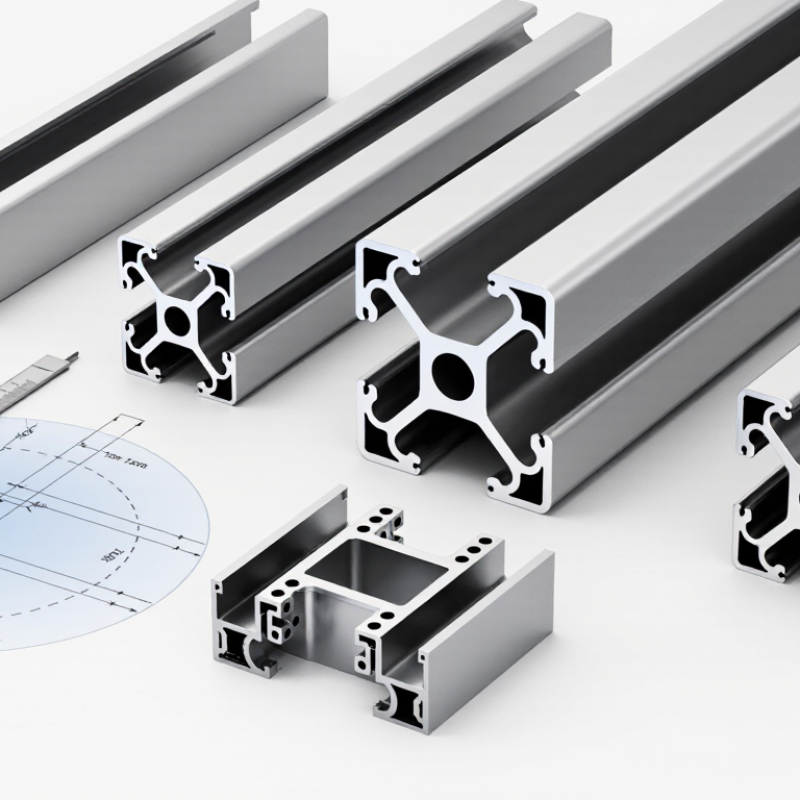
Solid bars suit compact brackets, machined pins, and parts needing material through the center. Angles and channels support shelves, frames, and edge stiffeners with less material than a solid section. Tubes work well for rails and lightweight supports; hollow profiles can also route cables or conceal fasteners. T-slot profiles make adjustable frames easier to assemble, though their grooves may collect dust.

Shape choice affects more than weight. A wide flange can resist bending in one direction, while a thin wall may dent under a point load. The U.S. Geological Survey’s Mineral Commodity Summaries 2024 estimated global primary aluminum production at 70 million metric tons in 2023. That figure shows the material’s industrial scale, but it cannot tell you which profile fits a particular load. Check span, connection details, finish, and available extrusion sizes. A tidy CAD section can still fail at a poorly designed corner.

Not always obvious.

Tips: Sketch the load path before choosing a shape. Compare the actual wall thickness and corner radii in supplier drawings. For a small prototype, test the joint as well as the profile; fasteners can loosen even when the extrusion feels rigid. Keep it simple.

Assess Material, Dimensions, and Manufacturing Constraints

Choosing an extrusion shape starts with the job it must do. Will it carry a load, guide a moving part, or hide wiring? Match the alloy to strength, corrosion exposure, weight, and finishing needs. Then sketch the real cross-section, including screw channels, hollow spaces, and mounting faces. Small details matter. A deep, thin wall may look efficient in CAD but can complicate metal flow and cooling. Ask an extrusion supplier to review wall thickness and transitions before freezing the drawing.

Dimensions need equal care. Define critical measurements, tolerances, straightness, and cut length separately; making every feature unusually precise can raise cost without improving function. Check whether the profile fits available press capacity, die limits, and finishing equipment. ASTM B221 covers aluminum-alloy extruded bars, rods, wire, profiles, and tubes, so it is a useful reference when specifying material and product form. Still, a standard does not guarantee that a complex section is easy to produce.

Material choices also affect the project’s footprint. The Aluminum Association’s report Aluminum: The Element of Sustainability estimates that recycling aluminum uses about 95% less energy than producing primary aluminum. That figure is not a promise for every supply chain. Ask what recycled content is available, and confirm that it suits the required alloy and finish. Prototype the section. A first sample may reveal a weak corner or awkward fastener access that drawings missed.

How to Choose the Right Extrusion Shapes for Your Project? — Assess Material, Dimensions, and Manufacturing Constraints

Material Typical Density Common Profile Applications Practical Wall-Thickness Starting Point Dimension and Shape Considerations Manufacturing Constraints Good Fit When...
Aluminum 6063 About 2.70 g/cm³ Architectural frames, channels, heat sinks, decorative trim About 1.0–2.0 mm for many profiles; confirm for the specific section Well suited to intricate cross-sections and relatively thin walls. Keep wall thicknesses as uniform as practical and avoid abrupt transitions. Very thin walls, deep narrow channels, and long unsupported features can make flow and dimensional control more difficult. Alloy, temper, profile size, and finish affect achievable tolerances. Low weight, good corrosion resistance, and a clean surface finish are priorities.
Aluminum 6061 About 2.70 g/cm³ Structural rails, machine components, brackets, load-bearing sections About 1.5–3.0 mm as an early design range Often selected for strength-oriented profiles. Simple, balanced sections are generally easier to produce than highly asymmetric shapes. Compared with 6063, complex thin-walled shapes can be more challenging. Strength depends on alloy temper and heat treatment; verify properties for the selected condition. Mechanical strength is more important than achieving the most intricate profile or decorative finish.
Carbon steel About 7.85 g/cm³ Structural tubing, frames, rails, supports, industrial sections About 2–5 mm for many general-purpose sections Useful for robust sections and a broad range of structural shapes. Consider the weight of the finished profile when setting dimensions. Requires corrosion protection where exposed to moisture. Profile complexity, section size, steel grade, and process route influence tolerances and surface condition. High strength, stiffness, and cost-effective structural performance are key requirements.
Stainless steel (for example, 304) About 8.0 g/cm³ Hygienic equipment sections, architectural trim, corrosion-resistant frames About 1.5–3.0 mm as a preliminary range Specify the alloy and required surface finish early. Minimize sharp transitions and account for the relatively high material density. Extrusion availability and profile complexity depend on the grade and supplier capability. Corrosion resistance varies with environment, finish, and exposure conditions. Corrosion resistance, cleanability, or appearance in demanding environments justifies the additional material and processing cost.
Copper About 8.96 g/cm³ Electrical conductors, busbar-like sections, thermal components About 1–2 mm for some profiles; confirm feasibility with the producer Plan around the required electrical or thermal function, cross-sectional area, and finished dimensions. Copper is substantially heavier than aluminum. Material condition and section geometry affect formability and dimensional control. Consider oxidation, surface protection, and joining requirements in the end use. High electrical or thermal conductivity is essential and the added weight is acceptable.
Rigid PVC About 1.3–1.45 g/cm³ Window and door profiles, cable channels, trim, protective covers About 1.5–4.0 mm for many profiles, depending on size and design Complex hollow sections can be practical with suitable tooling. Design for consistent cooling and avoid abrupt changes in wall thickness. Heat sensitivity, cooling, shrinkage, and formulation affect the final dimensions. Confirm operating temperature, UV exposure, and fire-performance requirements. Electrical insulation, weatherable building profiles, or cost-effective hollow shapes are needed.

Design note: Values shown are approximate material densities and preliminary wall-thickness ranges, not guaranteed process limits. Feasible dimensions and tolerances depend on the exact alloy or formulation, profile size and complexity, tooling, temper, and manufacturing equipment. Confirm the design with the extrusion producer before release.

Match the Profile to Assembly and Finishing Requirements

Choose an extrusion shape around the way parts will meet, not just the outline on a drawing. A channel may hold a panel neatly, while a T-slot can accept adjustable brackets and fasteners. For a screw joint, check that tools can reach the screw head and that the wall has enough material for the intended load. Snap-fit features need room to flex without interfering with nearby components. Small details matter. A profile that looks compact may be awkward to assemble once cables, panels, or gloves enter the picture.

Finishing can change the fit. Anodizing and powder coating add material to surfaces, so allow for the specified coating process where parts slide together or fit into narrow slots. Keep tight mating faces consistent, and ask the finisher which surfaces can be masked. Rounded corners and clear drainage paths can also help coating cover the part more evenly. A common oversight is designing a pocket that traps cleaning fluid or coating residue. Dry-fit it. Review a cut sample with the actual fasteners and finish before committing to production; the first drawing may still need revision.

How to Choose the Right Extrusion Shapes for Your Project?

Match the profile to assembly and finishing requirements.

Compare common profile types against practical project needs. Scores are illustrative guide ratings from 1 (lower fit) to 5 (higher fit), not measured test results. Check the specific geometry, alloy, and finish with your supplier before selecting a profile.

Validate the Shape Through Prototyping and Performance Testing

A drawing can show the intended profile, but it cannot reveal every production issue. Prototyping lets you check whether the shape can be extruded consistently and assembled as planned. Use a sample with the intended alloy and temper when possible. A plastic mock-up may confirm overall fit, but it cannot predict metal deflection or heat transfer. Small details matter. Check wall thickness, corner radii, and narrow channels against the supplier’s process limits. Then fit the sample into its actual mating parts, including fasteners, seals, and nearby panels.

Performance testing should reflect real use, not just a neat bench setup. Apply the expected load at the point where the profile will be supported. Measure deflection, inspect for cracks, and test thermal behavior if the part will face changing temperatures. Record the setup and results so later samples can be compared fairly. One early prototype may pass because the fixture is unusually rigid; that is a useful warning, not proof. Repeat tests with production-like tolerances, and include the finish or machining steps that could affect fit. If a flange bends or a slot traps debris, revise the shape and test again. Iteration takes time, and the first revision may not be better.

Powder Coat Booths

For those larger-sized parts, or smaller quantity runs, we have 2 independent powder coat booths and ovens. The quality, durability and affordability of today’s powder coating finishes make this the process of choice for world-class companies.

Powder coating advantages over other forms of coating are many. Materials used in the Powder coating process can be metals and non-metals that come in a multitude of thicknesses, textures, colors, etc. Another of Powder coating’s biggest advantages over conventional coatings is its ability to create finishes in many different textures. Powder Coating Booths allow us the ability to apply these advantages to large products.

Wet Paint Line

Tri-State Fabricators runs a full-service conveyor line for painting. Wet painting can provide protection or decoration to many different part styles. From start to finish, every project is easier to undergo random and point-based inspection by our skilled painting team.

Advantages to our Wet Paint Line are these lines start with product prep and ends with a thorough inspection of a high quality finished product. Our ability to complete large and small projects with a superior finish and doing so in a timely and economical fashion. This passes along the savings in production to our customers. When powder coating ins not an option, our Wet Paint Line gets the job done right the first time.

Wet Paint Booths

When the parts get big and heavy we roll-out our custom paint racks and oversize booth. By utilizing our partnerships with all the major paint brands, we can match virtually any color with wet paint.

The advantages of having access to a Wet Paint Booth are many. Large projects of many different shapes can be loaded into the booth. The Wet Paint Booth offers an environment that is much more controlled than a typical parts painting operation.

Not only are they used because of their controlled environment, but they’re are also advantageous when it comes to applying paint to parts that are needed in industries that require specialty coatings such as medical, aerospace, etc.

Military CARC

Our military forces have some very high standards when it comes to the finish of their vehicles and equipment. From the first pre-treatment step to final coat, it takes a great deal of knowledge and experience to protect the men and women of our armed forces. They deserve only the best, and Tri-State Fabricators provides it.

All of our processes are closely monitored by our staff and management teams. Both of which are highly trained in the processes of metal fabrication and finishing. Tri-State Fabricators’ goal is to always fully satisfy each and every customer, including the military. We will always put a 110% into what we do.

Glass-Bead Blasting

Abrasive media blasting is an excellent way to remove old paint, rust, and increase the paint/powder adhesion. Glass beads produce a much smoother and brighter finish than angular abrasives; leaving the part clean yet without any dimensional change. Chemically inert and environmentally friendly, we can recycle our beads approximately 30 times; making them a more preferred method of metal cleaning or surface finishing.

Advantages to Glass Bead Blasting are many. Glass bead blast media is used when a project is needing rough surfaces need to become smooth for applications of coatings such as paint. It is typically used to clean paint and rust from a product surface without deforming the surface it is being used on. Overall, compared to many other blasting media, Glass Bead Blasting is a very economical choice and those savings are always passed on to our customers.

Part Washing

Tri-State Fabricators utilize a zinc phosphate wash to clean and etch the material to ensure the best paint adhesion possible. The unique design of our 3-stage wash system does the work like a 5-stage. From Cleaning and rinsing to conversion coating and post-treatment, Our Part Washing process is a complete service and works throughout the fabrication service and the finishing service.

Along with the previously mentioned benefits, Curing is a vital chemical reaction that leaves the product finish hard and relatively safe from mild abrasion and aggressive corrosion. This process can be done in more than one way; ambient air-dry or in curing ovens at temps that exceed 240°.

Burn-Off Oven

From fixing paint mistakes (someone else’s of course) to simply cleaning our paint line hooks, our burn-off oven is put to good use. After a quick burn-off, a little clean up, and a fresh coat of paint, your parts will look better than new.

Why does our Burn-Off Oven work so well? Because super heating the air around parts turns the materials into ashes. From paint and powder coatings to rubber and machining oils, high temps do the job without degrading the integrity of the part.

Masking

Masking is a vital part of producing high quality products. We have die-cut masking patterns to protect machined surfaces as well as a wide range of plugs and caps to protect threaded holes and bolts. We provide permanent and temporary masking.

Masking allows the selected sections of a product to be protected from a fabrication or finishing service. This can be with both chemicals when etching and tapes, paints when only finishing just a section of the product. Masking is great in aiding the customization process of a project.

Screen Printing

Screen printing is a photographic process that transfers artwork onto a porous nylon screen which allows colored ink to flow through the screen and be deposited on an aluminum or plastic component. We can generally have just about any design created onto a screen for your parts.

Some of the advantages of Screen Printing are, brand recognition for your business displaying on your products, assembly instructions, product warnings/hazards, etc. Tri-State Fabricators produces Screen Printing of the highest quality so you know it’s durable.

Metal Finishing

Metal Finishing is the art of treating the exterior portion of product, often metal but can also be made of other materials, so that the surface is clean and free of any debris. Then the process of applying coats or either paint of powder coat takes place. This coating process improves the quality of the product in both appearance and resistance to wear and corrosion.

Tri-State Fabricators, Inc., understands that a project typically isn’t complete until a high-quality finish has been added to your product. This is why our painting and powder coating teams continuously inspect the products throughout the Metal Finishing process.
