


Choosing an Embedded Industrial Computer is not just a processor comparison. It is a decision about how reliably a system will work beside a vibrating conveyor, inside a hot cabinet, or across years of daily operation. In Embedded System Design, computer scientist Peter Marwedel describes embedded systems as “information processing systems embedded into enclosing products.” That idea matters here: the computer must fit the machine, its environment, and its actual workload.
Start with the conditions it must survive. Note the cabinet temperature, dust exposure, vibration, available space, and power limits. Then check the interfaces your equipment really uses, such as serial ports, Ethernet, USB, or fieldbus connections. A fast processor cannot compensate for a missing connector. Nor does a rugged-looking case prove reliable thermal performance. Ask for operating-temperature specifications, lifecycle information, and clear details about testing. Small omissions matter.
This guide compares the practical choices: processor performance, memory, storage, expansion, cooling, and long-term support. It also explains how to match these features to control, machine vision, or data-collection tasks. Keep the workload concrete. A system reading sensor values has different needs from one processing several camera feeds. There is no perfect checklist; even careful estimates can miss future software demands. That deserves a second look. The best choice is usually the one that meets today’s requirements with enough headroom, documented support, and no unnecessary complexity.
Start with the work the computer must perform, not a processor’s headline specifications. A vision system may need steady image processing, while a gateway may handle many small data streams. Test the actual software with realistic inputs. Watch CPU use during peak activity, not only during a quiet startup. Leave room for future tasks. A small margin can prevent a minor software update from becoming a hardware problem.
RAM needs depend on the operating system, applications, and temporary data held in memory. Measure usage while all expected services are running. Include space for buffers and brief workload spikes. Too little memory can cause slowdowns or unexpected restarts. More memory is not automatically better, either; it should match a practical growth plan. Field conditions can be messy.
Storage planning involves capacity, write activity, and data retention. Estimate how much space logs, updates, and local records will use over time. Check whether the drive can handle frequent writes and the equipment’s operating temperature. Keep free capacity for maintenance and normal file-system operation. Benchmarks help, but they can flatter a setup. Test a representative workload for long enough to reveal heat-related slowdowns and storage pressure. Then review the results honestly; estimates are useful, but they are still estimates.

Map every device the computer must connect to, including sensors, scanners, displays, and service tools. Then record its interface, data rate, connector, and operating conditions. A 1 GbE port may be enough for ordinary monitoring, but multiple cameras or sustained data transfers can change that calculation. Check network traffic under realistic workloads, not just peak figures on a specification sheet. Also consider whether the installation needs a second port for a separate machine network.
USB requirements are easy to underestimate. List each peripheral and note whether it needs USB 2.0, USB 3.x, steady power, or frequent disconnection. A touchscreen and a storage device can compete for ports; a hub adds another point of failure. For serial equipment, specify RS-232 or RS-485, port count, connector type, and any required isolation or termination. Small details matter.
PCIe deserves a physical check as well as an electrical one. Confirm lane requirements, card dimensions, connector clearance, and cooling inside the enclosure. A card that fits on paper may obstruct airflow or nearby wiring. Test the complete setup with all interfaces active, including startup and reconnect behavior. I would revisit the port map after that test; early assumptions are often too neat.
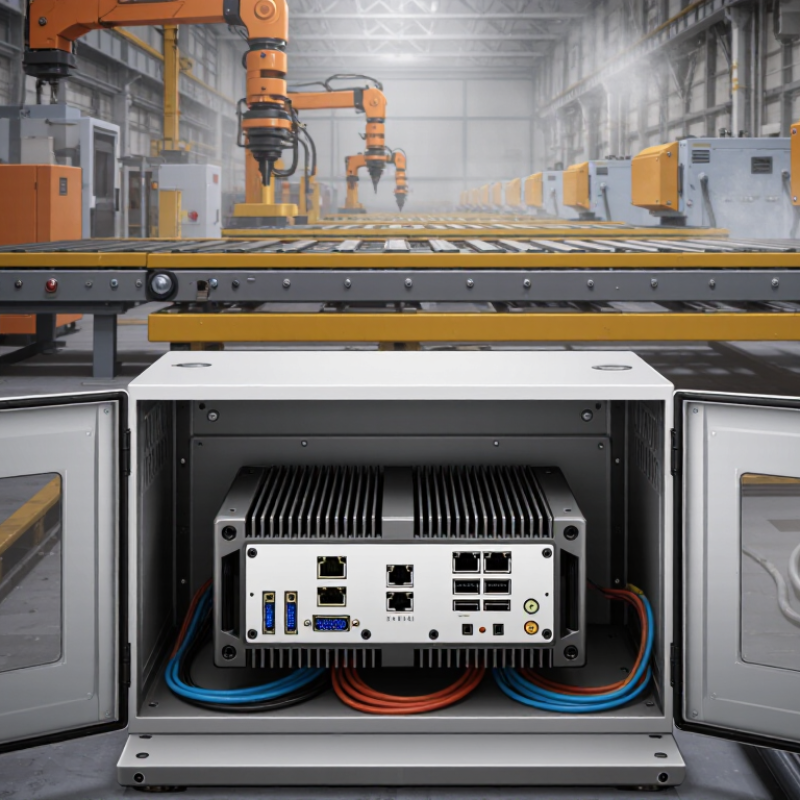
Illustrative interface targets for a compact industrial system: two 1 GbE ports for network connections, four USB ports for peripherals, two serial ports for legacy equipment, and one PCIe slot for expansion. Actual requirements depend on the devices and applications being connected.
When choosing an embedded industrial computer, treat IP67 as a test rating, not a promise against every wet environment. Under IEC 60529, the “6” indicates dust-tight protection, while “7” covers temporary immersion in water up to 1 metre for 30 minutes. That limit is specific. It does not describe deeper water, repeated submersion, or high-pressure washdown. A cabinet beside a coolant line may face a different risk from a device mounted outdoors in rain.
Check the test conditions against the installation. A loose cable gland, damaged seal, or poorly seated connector can become the weak point, even when the computer enclosure carries an IP67 rating. IEC 60529 is the authoritative reference for these enclosure classifications; the rating alone does not certify the complete system. Ask for the test documentation and confirm which ports and covers were fitted during testing. Then consider temperature changes, vibration, cleaning chemicals, and maintenance access. Small details matter. In practice, engineers sometimes focus on the enclosure and overlook the cable entry. I would check that twice. A one-metre immersion test offers useful evidence, but real installations are messy, and the rating cannot replace a site-specific assessment.
When choosing an embedded industrial computer, check its ESD evidence, not just the enclosure. IEC 61000-4-2 Level 4 requires 8 kV contact discharge. Its 2008 test waveform specifies a peak current of about 30 A, rising in roughly 0.8 nanoseconds. That is a sharp pulse. It can upset exposed ports, reset a processor, or corrupt a sensor reading.
Ask for the actual test report. It should identify the tested configuration, discharge points, polarity, and operating state. The IEC standard also defines 15 kV air discharge for Level 4, but that does not replace the 8 kV contact test. During evaluation, watch the console and connected equipment for resets, lost data, or communication faults. A green status light is not enough. Small details matter.
A pass applies to the tested setup, not every installation. Cable length, grounding, and nearby metal can change the discharge path. One uncomfortable detail: a test report may not reflect your cabinet. Compare its mounting and cabling with your own, and retest when the installation differs substantially.
I would also ask whether the computer recovered automatically after exposure. Recovery behavior can matter as much as survival.
When choosing an embedded industrial computer, match its input range to the power actually available at the installation site. A nominal 24 V supply may dip during motor startup or rise under light load. Check the computer’s specified operating limits, then compare them with measurements taken during real operating conditions. Leave practical margin; a unit that barely meets the limits may reset when the environment gets noisy.
Continuous operation needs more than a “24/7” label. Confirm that the rating applies to your expected workload, ambient temperature, and enclosure. Heat builds up inside sealed cabinets, especially near drives and power supplies. Review thermal derating details and storage or component-life estimates where available. Small detail, big consequence. I still think this is easy to overlook: a fanless design can reduce maintenance, but it does not remove the need to manage heat.
Service life also depends on support after installation. Ask how long compatible replacements, firmware updates, and repair services are expected to remain available. Check the warranty terms and typical response process before deployment, not during a production outage. Keep the answers in writing. A computer may run reliably for years, yet a short replacement window can make it difficult to maintain the system. The right choice is the one whose power limits, continuous-duty conditions, and support horizon fit the site’s actual needs.


For those larger-sized parts, or smaller quantity runs, we have 2 independent powder coat booths and ovens. The quality, durability and affordability of today’s powder coating finishes make this the process of choice for world-class companies.
Powder coating advantages over other forms of coating are many. Materials used in the Powder coating process can be metals and non-metals that come in a multitude of thicknesses, textures, colors, etc. Another of Powder coating’s biggest advantages over conventional coatings is its ability to create finishes in many different textures. Powder Coating Booths allow us the ability to apply these advantages to large products.
Tri-State Fabricators runs a full-service conveyor line for painting. Wet painting can provide protection or decoration to many different part styles. From start to finish, every project is easier to undergo random and point-based inspection by our skilled painting team.
Advantages to our Wet Paint Line are these lines start with product prep and ends with a thorough inspection of a high quality finished product. Our ability to complete large and small projects with a superior finish and doing so in a timely and economical fashion. This passes along the savings in production to our customers. When powder coating ins not an option, our Wet Paint Line gets the job done right the first time.
When the parts get big and heavy we roll-out our custom paint racks and oversize booth. By utilizing our partnerships with all the major paint brands, we can match virtually any color with wet paint.
The advantages of having access to a Wet Paint Booth are many. Large projects of many different shapes can be loaded into the booth. The Wet Paint Booth offers an environment that is much more controlled than a typical parts painting operation.
Not only are they used because of their controlled environment, but they’re are also advantageous when it comes to applying paint to parts that are needed in industries that require specialty coatings such as medical, aerospace, etc.
Our military forces have some very high standards when it comes to the finish of their vehicles and equipment. From the first pre-treatment step to final coat, it takes a great deal of knowledge and experience to protect the men and women of our armed forces. They deserve only the best, and Tri-State Fabricators provides it.
All of our processes are closely monitored by our staff and management teams. Both of which are highly trained in the processes of metal fabrication and finishing. Tri-State Fabricators’ goal is to always fully satisfy each and every customer, including the military. We will always put a 110% into what we do.
Abrasive media blasting is an excellent way to remove old paint, rust, and increase the paint/powder adhesion. Glass beads produce a much smoother and brighter finish than angular abrasives; leaving the part clean yet without any dimensional change. Chemically inert and environmentally friendly, we can recycle our beads approximately 30 times; making them a more preferred method of metal cleaning or surface finishing.
Advantages to Glass Bead Blasting are many. Glass bead blast media is used when a project is needing rough surfaces need to become smooth for applications of coatings such as paint. It is typically used to clean paint and rust from a product surface without deforming the surface it is being used on. Overall, compared to many other blasting media, Glass Bead Blasting is a very economical choice and those savings are always passed on to our customers.
Tri-State Fabricators utilize a zinc phosphate wash to clean and etch the material to ensure the best paint adhesion possible. The unique design of our 3-stage wash system does the work like a 5-stage. From Cleaning and rinsing to conversion coating and post-treatment, Our Part Washing process is a complete service and works throughout the fabrication service and the finishing service.
Along with the previously mentioned benefits, Curing is a vital chemical reaction that leaves the product finish hard and relatively safe from mild abrasion and aggressive corrosion. This process can be done in more than one way; ambient air-dry or in curing ovens at temps that exceed 240°.
From fixing paint mistakes (someone else’s of course) to simply cleaning our paint line hooks, our burn-off oven is put to good use. After a quick burn-off, a little clean up, and a fresh coat of paint, your parts will look better than new.
Why does our Burn-Off Oven work so well? Because super heating the air around parts turns the materials into ashes. From paint and powder coatings to rubber and machining oils, high temps do the job without degrading the integrity of the part.
Masking is a vital part of producing high quality products. We have die-cut masking patterns to protect machined surfaces as well as a wide range of plugs and caps to protect threaded holes and bolts. We provide permanent and temporary masking.
Masking allows the selected sections of a product to be protected from a fabrication or finishing service. This can be with both chemicals when etching and tapes, paints when only finishing just a section of the product. Masking is great in aiding the customization process of a project.
Screen printing is a photographic process that transfers artwork onto a porous nylon screen which allows colored ink to flow through the screen and be deposited on an aluminum or plastic component. We can generally have just about any design created onto a screen for your parts.
Some of the advantages of Screen Printing are, brand recognition for your business displaying on your products, assembly instructions, product warnings/hazards, etc. Tri-State Fabricators produces Screen Printing of the highest quality so you know it’s durable.
Metal Finishing is the art of treating the exterior portion of product, often metal but can also be made of other materials, so that the surface is clean and free of any debris. Then the process of applying coats or either paint of powder coat takes place. This coating process improves the quality of the product in both appearance and resistance to wear and corrosion.
Tri-State Fabricators, Inc., understands that a project typically isn’t complete until a high-quality finish has been added to your product. This is why our painting and powder coating teams continuously inspect the products throughout the Metal Finishing process.

