


Choosing an Electrostatic Collector is not a matter of picking the highest efficiency number. The right unit must match the contaminant, airflow, operating temperature, and maintenance conditions. A fine-particle collector in a metalworking shop faces a different load from one handling cooking fumes or indoor dust. That distinction matters.
The U.S. Environmental Protection Agency’s Electrostatic Precipitator fact sheet (EPA-452/F-03-028, 2003) reports typical collection efficiencies of 99–99.9% for industrial electrostatic precipitators. This is useful context, not a guarantee for every collector or installation. Actual performance depends on particle properties, gas flow, electrode condition, and system design. A neat catalog number can mislead. That sounds decisive. It isn’t.
Before comparing models, identify what is being collected and measure the airflow and particle load where the unit will operate. Check the manufacturer’s stated test conditions, pressure drop, power demand, cleaning method, and replacement-part availability. Ask how efficiency was measured, and request documentation for the specific operating range—not merely a best-case figure. For example, a unit that handles a steady, modest load may struggle when filters or collection plates accumulate residue. Maintenance access matters, too; a collector that is difficult to clean may not deliver its rated performance over time. EPA guidance offers a solid technical starting point, but site measurements and qualified engineering review should guide final selection. There is no universal winner. A careful choice starts with the actual air stream, then tests whether the equipment can manage it consistently.
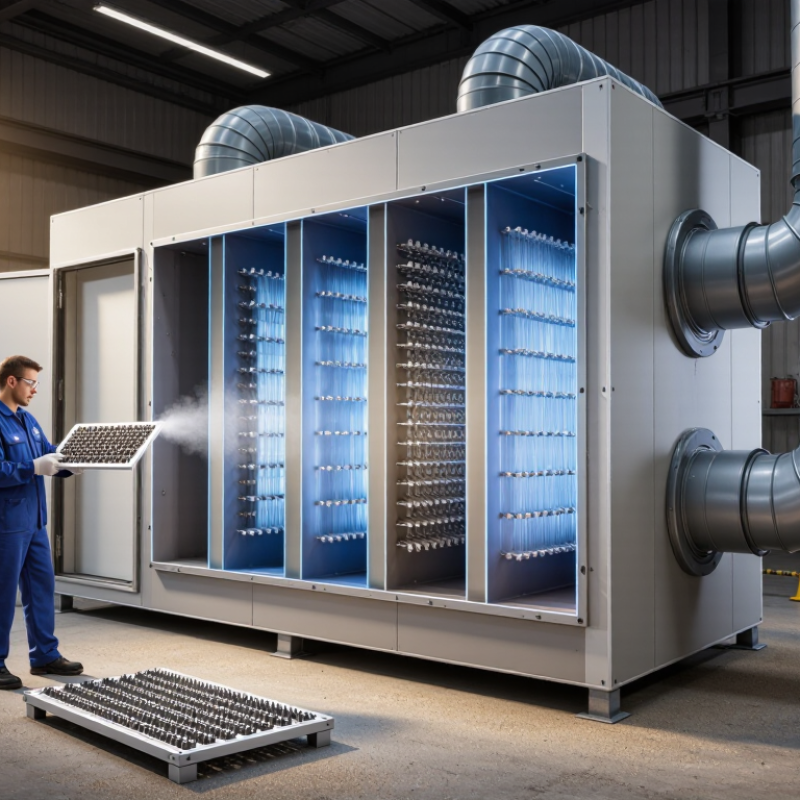
How to Choose the Right Electrostatic Collector
Understanding How Electrostatic Collectors Work
An electrostatic collector does not simply trap dust in a mesh. It gives airborne particles an electrical charge, then draws them toward oppositely charged plates. Picture fine dust moving through the unit and settling on metal surfaces. The plates need regular cleaning; a visibly dusty collector may capture particles less effectively. Performance also depends on airflow, particle size, and how well the unit is maintained.
The U.S. Environmental Protection Agency’s Electrostatic Precipitators fact sheet (EPA-452/F-03-028) reports that industrial systems can achieve collection efficiencies above 99 percent under suitable conditions. That figure describes industrial equipment, not every room-sized air cleaner. It is a useful reference, but not a promise for a home. Some electronic air cleaners can also generate ozone, so check independent performance information and the manufacturer’s maintenance instructions before choosing one. The science is elegant. Real rooms are messier.
Tips: Check clean-plate instructions, airflow ratings, and ozone information. Match the collector to your room and likely particle load. A unit that is difficult to maintain may not perform as expected.

Choosing an electrostatic collector starts with identifying what is actually in the air. “Dust” may mean coarse wood fibers, fine mineral powder, oily mist, or smoke-like particles, and each behaves differently. Keep a representative sample from normal operation, not just a clean startup. Note particle size, concentration, moisture, temperature, and whether particles carry oil or sticky residues. Small details matter.
Particle size affects how easily the collector can charge and capture particles. Very fine particles may need careful performance testing, while sticky aerosols can build up on collection plates and complicate cleaning. Electrical resistivity also matters: particles that resist charge transfer may be harder to collect consistently. Ask for measurements across changing production conditions, since one sample rarely tells the whole story. It can be tempting to rely on a supplier’s typical efficiency figure, but that figure may not match your mix of pollutants.
Record airflow and capture goals alongside the particle data. A collector sized for one exhaust rate may perform poorly when fans, shifts, or processes change. Check whether the stream contains corrosive gases or combustible dust, and have qualified professionals assess relevant equipment and safety requirements. I have seen “mostly dry dust” descriptions hide intermittent damp, oily material. That uncertainty deserves another sample, not a guess.
| Particle or Pollutant | Typical Particle Size | Common Sources | Electrostatic Collector Considerations | Important Limitations |
|---|---|---|---|---|
| Oil and coolant mist | Droplets commonly range from submicron sizes to several micrometres; the distribution depends on the process. | Metalworking machines, machining operations, and cooking processes | Assess the mist loading, droplet-size distribution, airflow, and whether collected liquid can drain from the collector. | Very fine droplets may be harder to collect. Sticky deposits and inadequate drainage can reduce performance or increase maintenance. |
| Welding fume | Primary particles are often submicron; airborne fume may also form larger agglomerates. | Arc welding, cutting, and thermal metalworking | Check airflow at the source, fume composition, operating temperature, and the collector’s ability to handle changing process loads. | Some fume constituents may be hazardous. A collector does not replace source capture, exposure controls, or required emissions testing. |
| Combustion smoke and fine aerosol | Often concentrated in the fine-particle range, including particles below 2.5 micrometres. | Combustion equipment, industrial process exhaust, and smoke-generating operations | Confirm that the equipment is designed for the gas temperature, flow rate, particle properties, and expected concentration. | Electrostatic collection captures particles, not gases such as carbon monoxide or most gaseous organic compounds. |
| Fly ash and other mineral particles | Broad size distribution, from fine particles below 2.5 micrometres to larger particles. | Boilers, kilns, furnaces, and mineral-processing operations | Particle electrical resistivity, gas temperature, moisture, and dust loading are important design inputs. | Very high resistivity can contribute to back corona; very low resistivity can promote particle re-entrainment. Site-specific testing may be needed. |
| Coarse dust and process particles | Often larger than 10 micrometres, though the actual range varies by process. | Material handling, grinding, and bulk processing | Consider a pre-separator or other upstream dust control where coarse loading is high, and verify that the collector can handle the expected mass flow. | Large or heavy particles may settle or be captured by other equipment more economically; performance depends on the full system design. |
| Gaseous pollutants and vapours | Not particles; present as gas molecules or vapour. | Solvent use, chemical processes, and combustion emissions | Identify these pollutants separately when defining the treatment train; gas-phase treatment may require adsorption, absorption, or another suitable process. | An electrostatic collector is not, by itself, a control device for gaseous pollutants. |
Selection tip: Confirm the particle-size distribution, concentration, gas temperature and humidity, airflow, particle resistivity, and pollutant chemistry before specifying a collector. Capture efficiency depends on the application and system design; verify performance under the intended operating conditions.
Matching Collector Types to Operating Conditions
Choosing an electrostatic collector starts with the gas stream, not a catalog. Measure temperature, moisture, particle size, and dust resistivity across normal and upset conditions. A dry ESP suits free-flowing particles that remain solid and can be collected in hoppers. It avoids wash-water handling.
For sticky aerosols, acid mist, or particles formed after cooling, a wet ESP may be more appropriate. It washes collected material from the plates, but adds water treatment and drainage needs. The U.S. EPA’s 2003 Electrostatic Precipitator fact sheet reports typical collection efficiencies of 99–99.9%. Treat that range as a reference, not a guarantee; actual performance depends on particle resistivity, gas flow, and field design.
High-resistivity dust can resist charging, while very conductive dust may lose charge too quickly. Both conditions can reduce capture. Ask for site-specific tests or validated performance data at the actual gas temperature and load. One uncomfortable detail: operating conditions drift, and a collector selected for average flow may underperform during peaks. The table looks tidy; the plant rarely is.
How to Choose the Right Electrostatic Collector
Comparing Capacity, Efficiency, and Maintenance Needs
Choose capacity from your real airflow, not a catalog’s headline rating. The U.S. EPA’s Dry Electrostatic Precipitator fact sheet (EPA-452/F-03-028, 2003) reports collection efficiencies of 99% or higher for well-designed systems. Actual results depend on particle size, dust resistivity, gas temperature, and operating conditions. Not always. Check airflow peaks and inlet dust loading, too; a unit sized for average conditions may struggle during production surges.
Efficiency is only one part of the comparison. The EPA fact sheet gives a typical ESP pressure drop of about 0.2–0.5 inches of water, but this does not predict every system’s energy use. High-voltage equipment and collector design matter. A quoted 99% can flatter a clean test. Ask for the outlet concentration, test conditions, and particle-size range, especially when handling fine process dust.
Maintenance can quietly reshape operating costs. Dry ESPs use periodic rapping to remove dust from collection plates, while hoppers, insulators, electrodes, and power controls need inspection. Ask how often servicing is expected and whether technicians can reach key components without a long shutdown. A clogged hopper or fouled insulator can undermine performance. Compare labor, downtime, and replacement parts alongside purchase price.
Safety, space, and compliance should shape the selection before airflow capacity does. Electrostatic collectors use high-voltage components, so check access panels, grounding, emergency shutoffs, and maintenance isolation. OSHA’s Control of Hazardous Energy standard, 29 CFR 1910.147, outlines lockout requirements for covered servicing work. Leave enough room to open panels and remove collection plates without moving nearby equipment. A unit that fits on paper may still block a walkway.
Match the collector to the particles and operating conditions. The U.S. EPA’s Air Pollution Control Technology Fact Sheet: Dry Electrostatic Precipitator (EPA-452/F-03-028, 2003) reports collection efficiencies above 99% in suitable applications. That figure is not a guarantee for every process; particle properties, airflow, and maintenance affect results. Confirm the design conditions with a qualified engineer. Also check the site’s electrical supply, ventilation, fire-safety provisions, and locally applicable codes. Compliance details vary by facility and jurisdiction, so document the relevant approvals before installation.
Tips: Measure the full service envelope, not just the machine footprint. Photograph nearby doors, ducts, and cable routes. Ask who will isolate power during cleaning, and record the answer. One overlooked clearance can make routine work awkward.


For those larger-sized parts, or smaller quantity runs, we have 2 independent powder coat booths and ovens. The quality, durability and affordability of today’s powder coating finishes make this the process of choice for world-class companies.
Powder coating advantages over other forms of coating are many. Materials used in the Powder coating process can be metals and non-metals that come in a multitude of thicknesses, textures, colors, etc. Another of Powder coating’s biggest advantages over conventional coatings is its ability to create finishes in many different textures. Powder Coating Booths allow us the ability to apply these advantages to large products.
Tri-State Fabricators runs a full-service conveyor line for painting. Wet painting can provide protection or decoration to many different part styles. From start to finish, every project is easier to undergo random and point-based inspection by our skilled painting team.
Advantages to our Wet Paint Line are these lines start with product prep and ends with a thorough inspection of a high quality finished product. Our ability to complete large and small projects with a superior finish and doing so in a timely and economical fashion. This passes along the savings in production to our customers. When powder coating ins not an option, our Wet Paint Line gets the job done right the first time.
When the parts get big and heavy we roll-out our custom paint racks and oversize booth. By utilizing our partnerships with all the major paint brands, we can match virtually any color with wet paint.
The advantages of having access to a Wet Paint Booth are many. Large projects of many different shapes can be loaded into the booth. The Wet Paint Booth offers an environment that is much more controlled than a typical parts painting operation.
Not only are they used because of their controlled environment, but they’re are also advantageous when it comes to applying paint to parts that are needed in industries that require specialty coatings such as medical, aerospace, etc.
Our military forces have some very high standards when it comes to the finish of their vehicles and equipment. From the first pre-treatment step to final coat, it takes a great deal of knowledge and experience to protect the men and women of our armed forces. They deserve only the best, and Tri-State Fabricators provides it.
All of our processes are closely monitored by our staff and management teams. Both of which are highly trained in the processes of metal fabrication and finishing. Tri-State Fabricators’ goal is to always fully satisfy each and every customer, including the military. We will always put a 110% into what we do.
Abrasive media blasting is an excellent way to remove old paint, rust, and increase the paint/powder adhesion. Glass beads produce a much smoother and brighter finish than angular abrasives; leaving the part clean yet without any dimensional change. Chemically inert and environmentally friendly, we can recycle our beads approximately 30 times; making them a more preferred method of metal cleaning or surface finishing.
Advantages to Glass Bead Blasting are many. Glass bead blast media is used when a project is needing rough surfaces need to become smooth for applications of coatings such as paint. It is typically used to clean paint and rust from a product surface without deforming the surface it is being used on. Overall, compared to many other blasting media, Glass Bead Blasting is a very economical choice and those savings are always passed on to our customers.
Tri-State Fabricators utilize a zinc phosphate wash to clean and etch the material to ensure the best paint adhesion possible. The unique design of our 3-stage wash system does the work like a 5-stage. From Cleaning and rinsing to conversion coating and post-treatment, Our Part Washing process is a complete service and works throughout the fabrication service and the finishing service.
Along with the previously mentioned benefits, Curing is a vital chemical reaction that leaves the product finish hard and relatively safe from mild abrasion and aggressive corrosion. This process can be done in more than one way; ambient air-dry or in curing ovens at temps that exceed 240°.
From fixing paint mistakes (someone else’s of course) to simply cleaning our paint line hooks, our burn-off oven is put to good use. After a quick burn-off, a little clean up, and a fresh coat of paint, your parts will look better than new.
Why does our Burn-Off Oven work so well? Because super heating the air around parts turns the materials into ashes. From paint and powder coatings to rubber and machining oils, high temps do the job without degrading the integrity of the part.
Masking is a vital part of producing high quality products. We have die-cut masking patterns to protect machined surfaces as well as a wide range of plugs and caps to protect threaded holes and bolts. We provide permanent and temporary masking.
Masking allows the selected sections of a product to be protected from a fabrication or finishing service. This can be with both chemicals when etching and tapes, paints when only finishing just a section of the product. Masking is great in aiding the customization process of a project.
Screen printing is a photographic process that transfers artwork onto a porous nylon screen which allows colored ink to flow through the screen and be deposited on an aluminum or plastic component. We can generally have just about any design created onto a screen for your parts.
Some of the advantages of Screen Printing are, brand recognition for your business displaying on your products, assembly instructions, product warnings/hazards, etc. Tri-State Fabricators produces Screen Printing of the highest quality so you know it’s durable.
Metal Finishing is the art of treating the exterior portion of product, often metal but can also be made of other materials, so that the surface is clean and free of any debris. Then the process of applying coats or either paint of powder coat takes place. This coating process improves the quality of the product in both appearance and resistance to wear and corrosion.
Tri-State Fabricators, Inc., understands that a project typically isn’t complete until a high-quality finish has been added to your product. This is why our painting and powder coating teams continuously inspect the products throughout the Metal Finishing process.

