How to Choose the Right Conductivity Meter for Your Needs
Clear water can still contain substantial dissolved ions. A Conductivity Meter helps reveal that hidden variation, but the reading is not a complete water-quality assessment. It does not identify individual substances. That distinction matters when comparing drinking-water sources, checking process water, or monitoring an aquarium.
The USGS National Field Manual’s specific-conductance guidance describes field measurement practices, while USGS Water Data for the Nation provides station records that include specific-conductance observations. ASTM D1125 also sets out test methods for electrical conductivity and resistivity in water. Together, these references show why consistent technique matters: temperature, calibration, and sample handling can shift a reading. A probe lifted from a warm rinse cup may not represent a cool sample in a beaker.
Choosing a meter starts with the expected range and required accuracy. Then consider temperature compensation, calibration options, probe design, and whether measurements happen at a bench or beside a tank. A basic handheld model may suit occasional checks; a benchtop instrument may better support repeated laboratory work. There is no universally right meter. Even careful buyers can misjudge their needs, especially when sample conditions vary. Check the specifications against your actual samples, and confirm the method with a suitable reference standard. A stable reading is useful. It is not the whole story.
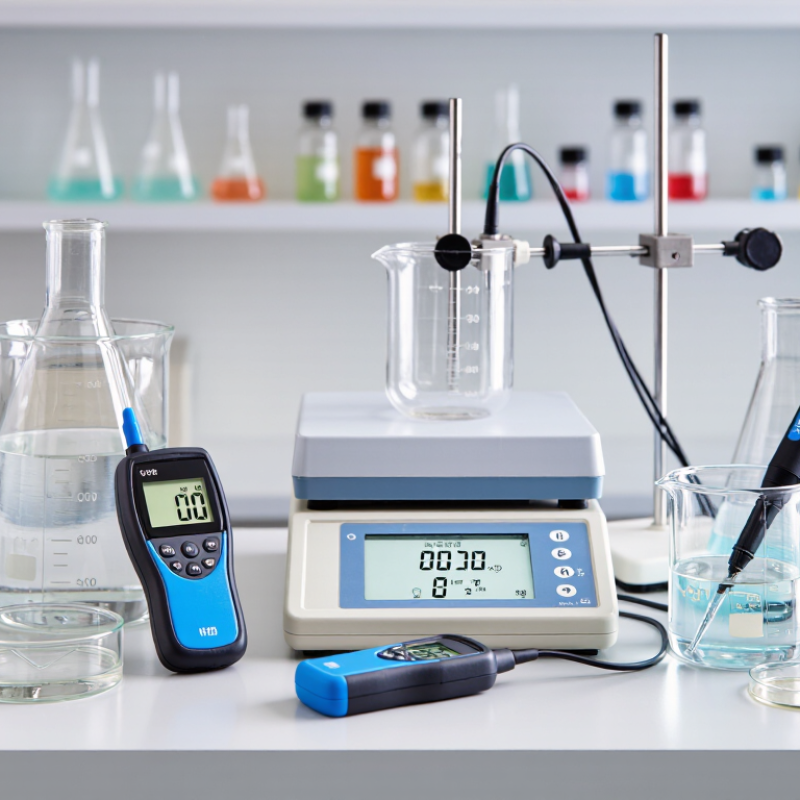
How Conductivity Meters Measure Ionic Content in μS/cm and mS/cm
A conductivity meter estimates how readily dissolved ions carry an electrical current. Its probe applies an alternating signal between electrodes and measures the response. The result is commonly shown in μS/cm or mS/cm; 1 mS/cm equals 1,000 μS/cm. Conductivity reflects the combined effect of ions, not their identities or exact concentrations. Units matter.
Range choice should match the sample. The USGS Water Science School gives seawater conductivity as about 50,000 μS/cm, or 50 mS/cm, while many freshwater samples read far lower. A meter with a suitable range gives a useful reading without overloading its display. Temperature also changes conductivity, so check whether the instrument compensates readings to 25°C, as described in the USGS National Field Manual. Calibration with a standard near the expected sample range improves confidence. Still, a clean-looking reading can hide a dirty probe.
Tips: Rinse the probe between samples, remove trapped bubbles, and let the value settle before recording it. Check calibration regularly. For low-conductivity water, even a small amount of residue can distort the result.
How to Choose the Right Conductivity Meter for Your Needs
Conductivity meters measure how readily ions carry electrical current through a solution. Readings are commonly reported in μS/cm or mS/cm; 1 mS/cm equals 1,000 μS/cm.
How to use this chart: Choose a meter whose range and resolution suit your sample. Very low-conductivity water requires a meter that can resolve fractions of a μS/cm, while seawater is better measured with a meter that covers tens of mS/cm. Values shown are approximate reference examples at or near 25°C; actual readings vary with temperature, dissolved substances, and sample conditions. Temperature compensation helps make measurements comparable.
Set a Range from 0.055 μS/cm Ultrapure Water to 50,000 μS/cm Seawater
Choosing a conductivity meter starts with the sample, not the display. The span from 0.055 μS/cm ultrapure water to 50,000 μS/cm seawater covers very different measurement conditions. At the low end, a fingerprint, an open beaker, or trace rinse water can shift the reading. Use a clean, closed flow cell when practical, and rinse the probe and vessel consistently. Small details matter. Ultrapure water absorbs carbon dioxide from the air, so its conductivity can rise while it sits. A meter needs suitable resolution and low-noise performance to make those small readings useful.
At the high end, check that the meter can handle salty samples without over-ranging, and that the probe’s cell constant suits the measurement. Seawater readings shift with temperature. Use a stated compensation method or measure at a controlled temperature. Ask for accuracy and resolution specifications at both ends, then verify performance with suitable conductivity standards. A broad range is convenient, but it does not guarantee equal confidence across the whole span. A probe suited to concentrated salt may be less dependable near ultrapure levels. That trade-off is easy to miss when comparing specifications.
Match the Cell Constant to Your Range: K = 0.1, 1.0, or 10 cm⁻¹
The cell constant, K, links a conductivity probe’s geometry to its measurement. A K of 0.1 cm⁻¹ usually suits low-conductivity samples, such as purified water, where the probe needs to detect small changes. Its electrodes typically provide a larger effective area or shorter spacing. Keep the cell clean: a thin film of residue can distort readings in very pure water.
K = 1.0 cm⁻¹ is a versatile choice for many routine samples, including tap water and common process solutions. For more conductive liquids, such as concentrated salt solutions, K = 10 cm⁻¹ often helps keep the signal within the meter’s useful range. Match the probe to the sample, not just the meter. Fit matters.
These are practical guides, not fixed limits. The usable range depends on the instrument, probe design, temperature compensation, and calibration standards. Check the manufacturer’s stated range and confirm that your calibration solution falls within it. A probe that works well for a water sample may respond poorly in a concentrated solution. And switching probes mid-test can complicate comparisons. Not always. If your samples vary widely, choosing one cell constant may mean accepting weaker performance at one end; that trade-off deserves a test with your actual samples.
Compare Accuracy and Calibration Using a 1,413 μS/cm Standard
Choose a conductivity meter whose stated accuracy and measuring range fit your samples. A 1,413 μS/cm standard is useful for checking performance near that conductivity level. If your samples sit far above or below it, one calibration point may not show how well the meter performs across your full working range. That match matters.
Check the standard’s temperature reference and the meter’s temperature compensation settings. Conductivity changes with temperature, so a warm standard and a cool sample can produce misleading comparisons. Rinse the probe with clean water, then rinse it with a small amount of standard. Pour a fresh portion into a clean cup. Keep the probe away from the cup’s sides and bottom. Wait for a stable reading.
Record the reading before and after calibration, along with the standard’s temperature and expiry details. Compare the result with the standard’s stated value and the meter’s accuracy specification; resolution alone does not prove accuracy. If the reading drifts, check for bubbles, a dirty cell, or contaminated solution before adjusting anything. It is easy to overlook the cup. A quick repeat with fresh standard can reveal whether the problem lies with the meter or the setup, though it cannot replace a proper check across the meter’s full range.
Check 25°C Temperature Compensation and Probe Suitability for Your Sample
A conductivity meter’s 25°C temperature compensation makes readings easier to compare, but it does not make every sample behave alike. The meter estimates what conductivity would be at 25°C using a temperature coefficient. Many common aqueous solutions use a coefficient near 2% per °C, but the right value depends on the sample. A wrong setting can create a tidy, misleading number. Check whether compensation is automatic or adjustable, and confirm the reference temperature is 25°C. Details matter.
Probe suitability matters just as much. Match the cell constant and measurement range to the expected conductivity: a probe designed for low-conductivity water may not suit a concentrated salt solution. Consider the sample vessel, too. A narrow tube needs a small probe; a viscous or dirty sample may coat the sensor and slow its response. For tiny samples, check the minimum immersion depth before buying.
Calibration standards should be close to the range you expect to measure, and the probe should be rinsed between samples. Temperature compensation cannot correct contamination, poor contact, or a dirty cell. It is easy to trust the displayed value too quickly. For unusual samples, compare readings at a stable temperature and consult the meter’s method guidance. A little doubt is useful.





