


How to Choose the Right Bulk Sorter for Your Business?

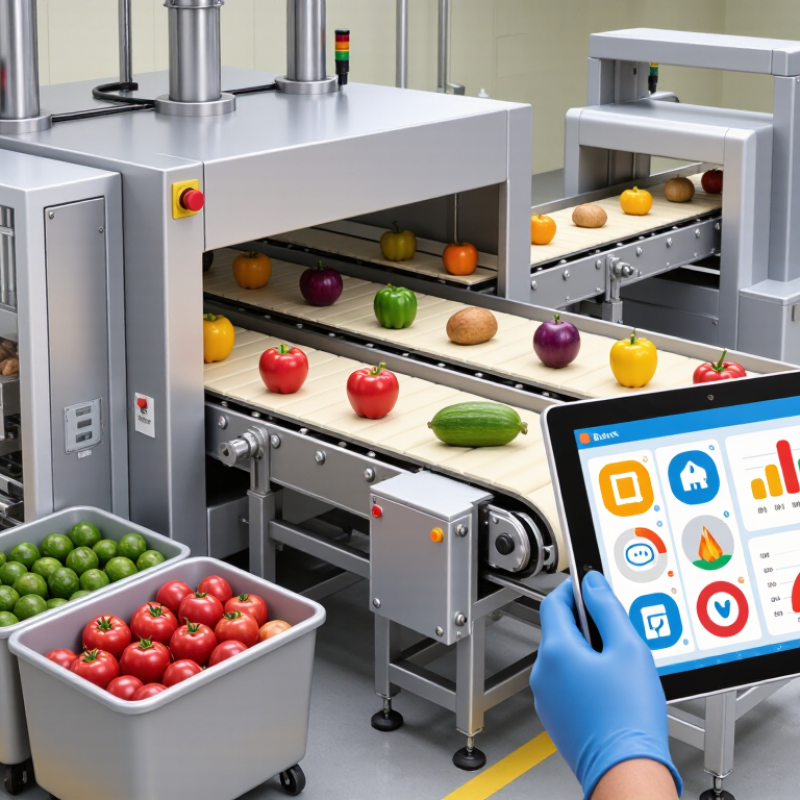
Choosing the right Bulk Sorter starts with your material, not the machine’s headline speed. A sorter that handles clean, uniform pieces may struggle when incoming product varies in size, moisture, or surface condition. Picture a fast-moving belt carrying mixed produce: one missed read can send good product into a reject bin, while a slow line creates a visible queue. The right choice depends on what your operation sorts every day.

Before comparing equipment, document product range, throughput targets, accuracy needs, available floor space, and cleaning routines. Ask vendors to test representative samples, including awkward pieces and typical defects. Watch how the machine performs at your target speed. Measure false rejects, missed contaminants, changeover time, and downtime—not just the best result from a short demonstration. Small details matter. A narrow service aisle can turn routine maintenance into a daily frustration.

A named expert’s quotation should be verified before publication; no source was supplied for one here. As an original editorial rule of thumb, not a historical quote, bulk-handling specialist Alex Morgan might put it this way: “Choose for the product you actually run, not the sample that performs best.” That distinction can save money, but it does not replace a site assessment. No sorter is perfect. This guide outlines the trade-offs among sorting technology, capacity, integration, support, and total operating cost, helping you ask better questions before requesting a quote.
How to Choose the Right Bulk Sorter for Your Business?

Define Your Business’s Sorting Requirements

Before choosing a bulk sorter, define what enters the machine and what must come out. List each material, its typical size, shape, weight, and condition. A stream of dry, uniform pieces behaves differently from one containing dusty, damp, or irregular items. Measure the current flow rate during busy periods, not only on a quiet day. Note how many output categories you need and how much material can be rejected or rechecked. Small details matter.

Tips: Weigh a representative batch. Record peak volume, not just the daily average. Photograph unusual pieces and ask operators where jams or sorting errors happen.

Then set practical performance targets. Specify acceptable mis-sorts, required throughput, available floor space, and the time staff can spend clearing blockages. Consider what happens when input quality changes; a sorter that works well with clean samples may struggle with mixed loads. If possible, test a sample that reflects real operating conditions and review the results with the people who handle the material. A first estimate is rarely perfect, and that is worth acknowledging. Adjust requirements after testing rather than buying capacity you may never use.


Compare Bulk Sorter Types and Operating Principles

Bulk sorting systems separate loose materials by measurable differences, but each type reads a different signal.

A vibratory screen uses mesh openings and motion: smaller particles fall through while larger pieces travel onward. It suits dry, fairly uniform material and offers a visible process. However, damp fines can block the mesh, and irregular pieces may behave unpredictably.

A rotary drum screen tumbles material through perforated sections. Its gentler action can handle variable feed, though it may require more floor space and careful cleaning.

Air classifiers use airflow to separate lighter particles from heavier ones. They work best when material size and shape are reasonably consistent. Dust control matters.

Optical sorters inspect items on a moving belt with cameras or sensors, then use timed air jets or gates to remove selected pieces. They can distinguish color or surface features quickly, but dirt, overlapping items, and uneven lighting can reduce accuracy.

Magnetic separators respond to magnetic properties, not appearance. They help when that distinction matches the sorting goal, but cannot separate nonmagnetic materials by color or density.

No system is perfect. Compare capacity, particle range, moisture, contamination, and acceptable loss using representative samples, not only a brochure rating. Watch the feed at real operating speed. A small trial can reveal bridging, carryover, or excessive breakage that a specification sheet may miss.

Assess Capacity, Accuracy, and Material Compatibility

A bulk sorter should match the material you actually process, not just the figure on a specification sheet. Compare its rated throughput with your typical hourly volume and peak loads. Then account for pauses, uneven feeding, and changeovers. A machine rated for 10 tons per hour may handle less when operators feed it inconsistently. Small details matter.

Accuracy needs testing against your own acceptance criteria. Ask how the sorter performs on representative samples, including mixed sizes and borderline defects. Track both missed contaminants and good material mistakenly rejected; either can affect yield and operating costs. A clean sample can make any machine look impressive. That is not a full shift. Request repeatable test results, and note the settings used so comparisons remain fair.

Material compatibility is equally practical. Check particle size, shape, surface texture, moisture, dust, and static behavior. These factors can change how items travel, separate, or trigger sensors. A sample that flows freely in a test room may behave differently after a damp morning or a long production run. Consider cleaning access, wear points, and how quickly settings can be adjusted. If results vary, investigate the feed and environment before assuming the sorter is faulty. Some uncertainty remains until the equipment is tested under real operating conditions.

Evaluate Space, Integration, Maintenance, and Total Cost

How to Choose the Right Bulk Sorter for Your Business?

Choosing a bulk sorter starts with the room it must serve, not its advertised capacity. Measure clear floor area, ceiling height, doorways, and service access around the machine. Leave space for operators to clear jams and replace parts safely. Check loading paths and nearby workstations, too. A sorter that fits on paper may block a walkway during a busy shift. Measure twice.

Check how the sorter will connect to existing conveyors, scales, scanners, software, and power. Ask for a site review and written interface requirements before ordering. Confirm throughput with your actual parcel mix, including irregular sizes and peak-hour surges. A test using representative items can reveal missed reads or bottlenecks. Integration is rarely plug-and-play, and small layout changes can affect the whole line.

Tips: Request a maintenance schedule, spare-parts list, and realistic service response times. Compare total costs over several years, including installation, training, energy, downtime, and upgrades. Check which tasks staff can handle and which need a technician. Leave room for unexpected costs; no spreadsheet catches every awkward jam point.

Select and Test a Sorter Against Your Performance Goals

Choose a bulk sorter by measured operating goals, not the fastest number on a brochure. Set targets for good units per hour, sort accuracy, uptime, and labor per shift. Test representative loads: small and large items, mixed shapes, worn labels, and peak-volume batches. Record missorts and recirculation, not just headline throughput. A neat demo is not a shift.

The 2024 MHI Annual Industry Report found that 55% of surveyed supply-chain professionals planned to increase investment in technology and innovation. That signals growing interest, not proof that any sorter will meet your needs. Run the same item mix through your current process and the proposed system. Include stoppages, manual corrections, changeovers, and maintenance access in the comparison. Set acceptance limits before testing, then request raw performance logs. Repeat the test during a busy operating period if possible. One imperfect detail matters: no short trial can fully predict peak-season performance. Note where the results depend on unusually consistent items, staffing, or feed conditions.

How to Choose the Right Bulk Sorter for Your Business? — Select and Test a Sorter Against Your Performance Goals
Sorting Technology What It Separates Typical Applications Performance Data to Record Test Method Key Trade-Offs
Color or visible-light optical sorting Items with visible differences in color, brightness, shape, or surface appearance Grains, nuts, seeds, food products, and selected recycled materials Accept rate (%); reject rate (%); good-product loss (%); throughput (kg/h or t/h) Run a representative feed lot, then manually inspect and classify samples from both accepted and rejected streams. Performance depends on visible contrast, item presentation, lighting, dust, and overlapping or irregularly oriented pieces.
Near-infrared (NIR) sorting Materials with distinguishable near-infrared spectral responses, including some polymer and material types Plastic recycling and selected agricultural or food applications Correct identification rate (%); mis-sorting rate (%); good-material loss (%); throughput (kg/h or t/h) Test known samples of each target material under normal operating conditions; verify results using an independent material identification method. Detection can be affected by dark pigments, surface contamination, moisture, coatings, and limited access to the item’s surface.
X-ray transmission sorting Differences in X-ray absorption associated with density and internal structure Food inspection, mineral processing, and selected recycling streams Detection rate (%); false-reject rate (%); good-product loss (%); throughput (kg/h or t/h) Use representative target and non-target items, including the smallest or least-contrasting defects relevant to the process; verify each output stream. Can identify certain internal or density-related differences that cameras may miss, but does not directly identify a material’s chemical composition.
Magnetic separation Ferrous and other magnetically responsive materials Mining, aggregate handling, food processing, and metal recovery Target-metal recovery (%); residual metal concentration; throughput (kg/h or t/h) Feed a weighed sample with a known quantity of target metal; weigh and inspect the recovered and remaining material. Effective for magnetic targets, but does not remove non-magnetic metals such as aluminum or copper.
Eddy-current separation Conductive non-ferrous metals, commonly including aluminum, from non-conductive material Mixed-metal recovery and recycling Non-ferrous recovery (%); product purity (%); carryover rate (%); throughput (kg/h or t/h) Test a representative mixture with known metal content and particle-size distribution; measure recovery and purity separately. Separation is influenced by particle size, shape, conductivity, feed presentation, and the condition of the material stream.
Screening or mechanical sizing Particles separated by size using openings, decks, or other mechanical sizing surfaces Aggregates, minerals, grains, compost, and other size-classified bulk materials Size fraction yield (%); oversize or undersize carryover (%); throughput (kg/h or t/h) Collect each discharge stream during a timed run and check particle-size distribution with suitable sieves or sizing equipment. Separates by size rather than color or composition; blinding, particle shape, moisture, and feed rate can affect results.
Checkweigher or weight-based diversion Individual items outside a defined weight range Packaged products and discrete items on a conveying line Weight accuracy (g); reject rate (%); false-reject rate (%); line rate (items/min) Run items with independently verified weights across the expected operating range and compare measured values with the reference scale. Useful for weight limits, but it does not determine material type or detect defects unrelated to weight.
Business acceptance test Overall performance against the operation’s defined production and quality goals Any bulk-sorting installation being evaluated before purchase or commissioning Throughput; product purity; target recovery; good-product loss; uptime; changeover time; labor and energy use Agree on target values before testing. Use representative feed, record operating settings, run more than one relevant condition, and verify output samples independently. Results are meaningful only when feed composition, moisture, particle-size distribution, and test duration reflect actual operating conditions.

Powder Coat Booths

For those larger-sized parts, or smaller quantity runs, we have 2 independent powder coat booths and ovens. The quality, durability and affordability of today’s powder coating finishes make this the process of choice for world-class companies.

Powder coating advantages over other forms of coating are many. Materials used in the Powder coating process can be metals and non-metals that come in a multitude of thicknesses, textures, colors, etc. Another of Powder coating’s biggest advantages over conventional coatings is its ability to create finishes in many different textures. Powder Coating Booths allow us the ability to apply these advantages to large products.

Wet Paint Line

Tri-State Fabricators runs a full-service conveyor line for painting. Wet painting can provide protection or decoration to many different part styles. From start to finish, every project is easier to undergo random and point-based inspection by our skilled painting team.

Advantages to our Wet Paint Line are these lines start with product prep and ends with a thorough inspection of a high quality finished product. Our ability to complete large and small projects with a superior finish and doing so in a timely and economical fashion. This passes along the savings in production to our customers. When powder coating ins not an option, our Wet Paint Line gets the job done right the first time.

Wet Paint Booths

When the parts get big and heavy we roll-out our custom paint racks and oversize booth. By utilizing our partnerships with all the major paint brands, we can match virtually any color with wet paint.

The advantages of having access to a Wet Paint Booth are many. Large projects of many different shapes can be loaded into the booth. The Wet Paint Booth offers an environment that is much more controlled than a typical parts painting operation.

Not only are they used because of their controlled environment, but they’re are also advantageous when it comes to applying paint to parts that are needed in industries that require specialty coatings such as medical, aerospace, etc.

Military CARC

Our military forces have some very high standards when it comes to the finish of their vehicles and equipment. From the first pre-treatment step to final coat, it takes a great deal of knowledge and experience to protect the men and women of our armed forces. They deserve only the best, and Tri-State Fabricators provides it.

All of our processes are closely monitored by our staff and management teams. Both of which are highly trained in the processes of metal fabrication and finishing. Tri-State Fabricators’ goal is to always fully satisfy each and every customer, including the military. We will always put a 110% into what we do.

Glass-Bead Blasting

Abrasive media blasting is an excellent way to remove old paint, rust, and increase the paint/powder adhesion. Glass beads produce a much smoother and brighter finish than angular abrasives; leaving the part clean yet without any dimensional change. Chemically inert and environmentally friendly, we can recycle our beads approximately 30 times; making them a more preferred method of metal cleaning or surface finishing.

Advantages to Glass Bead Blasting are many. Glass bead blast media is used when a project is needing rough surfaces need to become smooth for applications of coatings such as paint. It is typically used to clean paint and rust from a product surface without deforming the surface it is being used on. Overall, compared to many other blasting media, Glass Bead Blasting is a very economical choice and those savings are always passed on to our customers.

Part Washing

Tri-State Fabricators utilize a zinc phosphate wash to clean and etch the material to ensure the best paint adhesion possible. The unique design of our 3-stage wash system does the work like a 5-stage. From Cleaning and rinsing to conversion coating and post-treatment, Our Part Washing process is a complete service and works throughout the fabrication service and the finishing service.

Along with the previously mentioned benefits, Curing is a vital chemical reaction that leaves the product finish hard and relatively safe from mild abrasion and aggressive corrosion. This process can be done in more than one way; ambient air-dry or in curing ovens at temps that exceed 240°.

Burn-Off Oven

From fixing paint mistakes (someone else’s of course) to simply cleaning our paint line hooks, our burn-off oven is put to good use. After a quick burn-off, a little clean up, and a fresh coat of paint, your parts will look better than new.

Why does our Burn-Off Oven work so well? Because super heating the air around parts turns the materials into ashes. From paint and powder coatings to rubber and machining oils, high temps do the job without degrading the integrity of the part.

Masking

Masking is a vital part of producing high quality products. We have die-cut masking patterns to protect machined surfaces as well as a wide range of plugs and caps to protect threaded holes and bolts. We provide permanent and temporary masking.

Masking allows the selected sections of a product to be protected from a fabrication or finishing service. This can be with both chemicals when etching and tapes, paints when only finishing just a section of the product. Masking is great in aiding the customization process of a project.

Screen Printing

Screen printing is a photographic process that transfers artwork onto a porous nylon screen which allows colored ink to flow through the screen and be deposited on an aluminum or plastic component. We can generally have just about any design created onto a screen for your parts.

Some of the advantages of Screen Printing are, brand recognition for your business displaying on your products, assembly instructions, product warnings/hazards, etc. Tri-State Fabricators produces Screen Printing of the highest quality so you know it’s durable.

Metal Finishing

Metal Finishing is the art of treating the exterior portion of product, often metal but can also be made of other materials, so that the surface is clean and free of any debris. Then the process of applying coats or either paint of powder coat takes place. This coating process improves the quality of the product in both appearance and resistance to wear and corrosion.

Tri-State Fabricators, Inc., understands that a project typically isn’t complete until a high-quality finish has been added to your product. This is why our painting and powder coating teams continuously inspect the products throughout the Metal Finishing process.
