


Choosing the right Water Tank Filter can protect your household water, appliances, and daily comfort. A clear tank may still contain dust, rust, algae, or sediment. These particles often enter through uncovered openings, damaged pipes, or poor maintenance. I have found that many buyers focus only on price. That decision can become expensive later.
A reliable filter should match your tank size, water source, and expected flow rate. Check the filter’s micron rating before comparing brands. A finer rating may improve particle removal, but it can also reduce water pressure. Consider the filter material, replacement schedule, connection size, and cleaning process. These details matter when someone needs water during a busy morning. Certification and manufacturer instructions also deserve careful attention. However, certification alone does not guarantee perfect performance in every home.
Small choices matter.
These seven practical tips will help you compare filters with greater confidence. They cover filtration needs, capacity, durability, installation, maintenance, and long-term value. The best option is not always the most powerful model. It may be the one that remains easy to inspect and affordable to maintain. I should add one limitation: household water conditions differ widely, so general advice cannot replace a local water test. A filter that works well for rainwater may perform poorly with heavily sedimented bore water. Measure your needs honestly, check the specifications carefully, and leave room for reconsideration after real use.
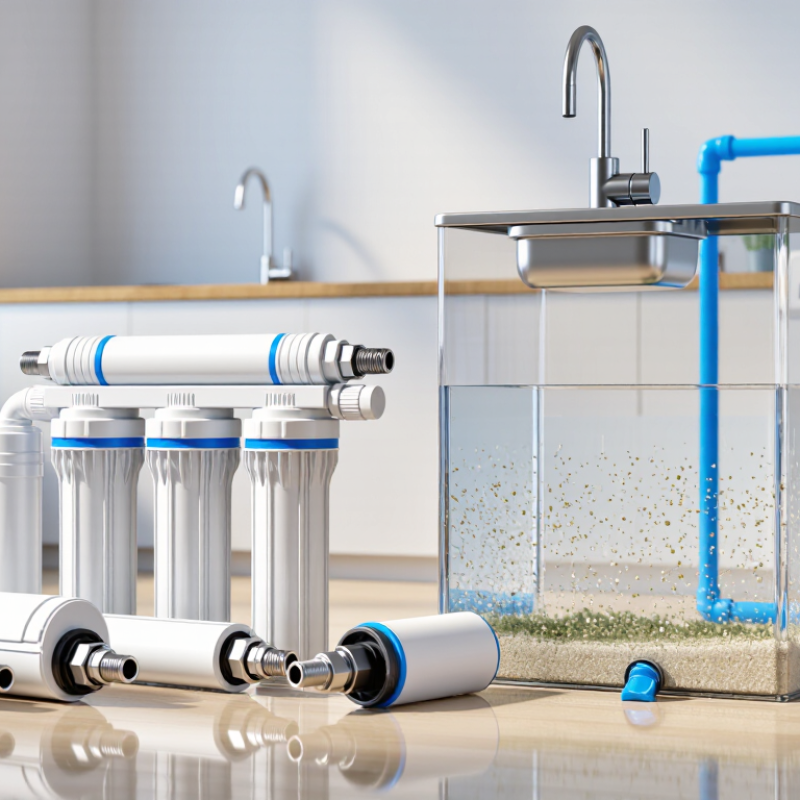
Choosing a water tank filter should begin with a measurable water quality goal. The World Health Organization recommends keeping drinking water turbidity below 5 NTU. Lower turbidity can also improve disinfection performance, because suspended particles may shelter microorganisms. A clear glass is not enough. Water can look clean while carrying fine sediment.
Measure turbidity at the tank inlet and outlet when possible. Record readings after heavy rain, tank cleaning, and long storage periods. This simple comparison reveals whether the filter is actually working.
Choose a filter rated for the expected flow, sediment load, and tank volume. A filter that removes particles well may restrict water pressure too much. That trade-off is easy to overlook.
Check the filter housing, seals, and replacement schedule. Dirty cartridges can become a hidden source of poor water quality. In field maintenance, many failures come from delayed replacement rather than weak filtration. Keep service records with dates and turbidity readings. Small details matter.
Do not trust one test.
Portable meters need calibration, and sampling technique can change results. I have seen operators sample from a clean tap while ignoring sediment at the tank bottom. That creates false confidence.
Testing should include the water people actually use. If readings remain above 5 NTU, inspect the tank cover, inlet, and internal sediment before simply installing a finer filter. A more restrictive filter is not always the better choice.

Choosing the best water tank filter starts with peak demand, not the tank’s total volume. A 5,000-liter tank may still suffer pressure loss when several outlets open together. The USGS report Estimated Use of Water in the United States in 2015 recorded about 82 gallons of public-supply water per person daily. That figure describes average use, not sudden demand. A household may fill a washing machine, open a shower, and run a hose within minutes.
Measure the highest expected flow in liters per minute, then compare it with the filter’s rated capacity. Keep the tank outlet, pipe diameter, and filter connection in the same calculation. A cartridge rated for 40 L/min may perform poorly if the pump delivers 55 L/min. Too much flow can shorten contact time and increase pressure drop. It may also push debris through the filter.
WHO drinking-water guidance supports risk-based treatment decisions, rather than relying on appearance alone. Check turbidity, sediment load, and intended use before selecting a filter grade. I usually allow a practical reserve of 15–25%, but this is not a universal rule. Actual demand can be messier. A clogged pre-filter may reduce flow long before the scheduled replacement date. Test the system during the busiest period, record inlet and outlet pressure, and adjust the capacity when the first estimate proves wrong.
Choosing a tank filter starts with understanding the water, not the product label. Check for sand, rust flakes, cloudy water, and organic debris. A 5–10 µm sediment prefilter is often a practical first barrier. It can reduce visible particles before they reach finer treatment stages. This protects smaller pores from rapid blockage.
Finer stages may target smaller particles, odors, or specific dissolved substances. They should come after sediment removal, not before it. I have seen users install a very fine filter first, then complain about weak flow within days. That experience is common, but not always predictable. Water quality, tank age, and daily demand change the result.
Measure the tank outlet and available pressure. A filter that looks efficient may restrict flow too much. Check the rated flow under realistic pressure, rather than relying on a maximum figure. Replace sediment elements when flow drops, water turns cloudy, or the service interval ends. Do not wait for complete blockage.
A transparent housing can make inspection easier. Yet appearance alone proves little. Keep records of installation dates and pressure changes. Testing the water periodically is wiser than guessing. Some households may need a 5 µm prefilter, while others perform better with 10 µm filtration followed by finer treatment. The “best” setup may need adjustment after real use.
7 Tips for Choosing the Best Water Tank Filter?
A filter’s certification claim deserves more attention than its advertising. NSF/ANSI 42 covers taste, odor, and chlorine reduction. NSF/ANSI 53 addresses specific health-related contaminants. NSF/ANSI 55 applies to ultraviolet microbiological treatment, while NSF/ANSI 58 covers reverse osmosis systems. These standards are not interchangeable. A 42-certified filter cannot automatically claim lead or PFAS reduction.
Tip 1: Verify the exact model in the certifier’s public directory. Check the tested contaminant, reduction percentage, flow rate, and replacement cartridge. The U.S. Environmental Protection Agency’s 2024 PFAS rule set limits of 4 nanograms per liter for PFOA and PFOS. Yet certification under NSF/ANSI 53 or 58 does not automatically prove PFAS removal. Look for a specific performance claim. Small wording matters.
Tip 2: Match the standard to the tank’s real risk. For stored water with unpleasant taste, NSF/ANSI 42 may be suitable. For microbial concerns, check NSF/ANSI 55 and its ultraviolet classification. Class A systems target contaminated water, while Class B systems generally treat already disinfected water. The World Health Organization and UNICEF reported that 2.2 billion people lacked safely managed drinking water in 2022. That figure shows why maintenance cannot be ignored. My own weak point is trusting labels too quickly; certificates can expire, and installation conditions can change performance.
7 Tips for Choosing the Best Water Tank Filter
Choose a filter by tested flow, not the largest advertised capacity. Rated capacity shows how much water the unit can treat before replacement. It does not guarantee performance under heavy sediment loads. The U.S. EPA UV Disinfection Guidance Manual states that UV performance depends on dose, flow, lamp output, and water quality. Check all four. Select pre-filtration that protects the UV chamber from cloudiness and particles. Keep turbidity low. A clear sleeve matters.
Plan service around the rated capacity and a validated 40 mJ/cm² UV dose. NSF/ANSI 55 Class A requirements use 40 mJ/cm² as a critical treatment benchmark under validated conditions. Confirm that the stated flow still reaches this dose at lamp end-of-life. Mark the replacement date on the tank. Inspect the quartz sleeve for scale, especially where hard water leaves a pale ring. Replace sediment cartridges earlier when pressure drops sharply. Do not wait for a bad smell.
A flow alarm helps. So does a simple log. In field maintenance, operators sometimes trust the hour meter too much. That is risky. Water conditions change after storms, construction, or tank cleaning. The World Health Organization’s drinking-water guidance supports multiple protective barriers, rather than relying on one device. Recheck flow after every cartridge change. A small oversight can reduce the delivered UV dose. Personally, I would rather service slightly early than defend a missed limit later.
Plan Maintenance Around Rated Capacity and a 40 mJ/cm² UV Dose
The chart shows the exposure time needed to deliver a 40 mJ/cm² UV dose at different UV irradiance levels. The relationship is calculated as dose = irradiance × exposure time. Tank capacity should be checked separately, while filter maintenance should be scheduled using rated throughput, pressure drop, flow rate, and the manufacturer's service limits.


For those larger-sized parts, or smaller quantity runs, we have 2 independent powder coat booths and ovens. The quality, durability and affordability of today’s powder coating finishes make this the process of choice for world-class companies.
Powder coating advantages over other forms of coating are many. Materials used in the Powder coating process can be metals and non-metals that come in a multitude of thicknesses, textures, colors, etc. Another of Powder coating’s biggest advantages over conventional coatings is its ability to create finishes in many different textures. Powder Coating Booths allow us the ability to apply these advantages to large products.
Tri-State Fabricators runs a full-service conveyor line for painting. Wet painting can provide protection or decoration to many different part styles. From start to finish, every project is easier to undergo random and point-based inspection by our skilled painting team.
Advantages to our Wet Paint Line are these lines start with product prep and ends with a thorough inspection of a high quality finished product. Our ability to complete large and small projects with a superior finish and doing so in a timely and economical fashion. This passes along the savings in production to our customers. When powder coating ins not an option, our Wet Paint Line gets the job done right the first time.
When the parts get big and heavy we roll-out our custom paint racks and oversize booth. By utilizing our partnerships with all the major paint brands, we can match virtually any color with wet paint.
The advantages of having access to a Wet Paint Booth are many. Large projects of many different shapes can be loaded into the booth. The Wet Paint Booth offers an environment that is much more controlled than a typical parts painting operation.
Not only are they used because of their controlled environment, but they’re are also advantageous when it comes to applying paint to parts that are needed in industries that require specialty coatings such as medical, aerospace, etc.
Our military forces have some very high standards when it comes to the finish of their vehicles and equipment. From the first pre-treatment step to final coat, it takes a great deal of knowledge and experience to protect the men and women of our armed forces. They deserve only the best, and Tri-State Fabricators provides it.
All of our processes are closely monitored by our staff and management teams. Both of which are highly trained in the processes of metal fabrication and finishing. Tri-State Fabricators’ goal is to always fully satisfy each and every customer, including the military. We will always put a 110% into what we do.
Abrasive media blasting is an excellent way to remove old paint, rust, and increase the paint/powder adhesion. Glass beads produce a much smoother and brighter finish than angular abrasives; leaving the part clean yet without any dimensional change. Chemically inert and environmentally friendly, we can recycle our beads approximately 30 times; making them a more preferred method of metal cleaning or surface finishing.
Advantages to Glass Bead Blasting are many. Glass bead blast media is used when a project is needing rough surfaces need to become smooth for applications of coatings such as paint. It is typically used to clean paint and rust from a product surface without deforming the surface it is being used on. Overall, compared to many other blasting media, Glass Bead Blasting is a very economical choice and those savings are always passed on to our customers.
Tri-State Fabricators utilize a zinc phosphate wash to clean and etch the material to ensure the best paint adhesion possible. The unique design of our 3-stage wash system does the work like a 5-stage. From Cleaning and rinsing to conversion coating and post-treatment, Our Part Washing process is a complete service and works throughout the fabrication service and the finishing service.
Along with the previously mentioned benefits, Curing is a vital chemical reaction that leaves the product finish hard and relatively safe from mild abrasion and aggressive corrosion. This process can be done in more than one way; ambient air-dry or in curing ovens at temps that exceed 240°.
From fixing paint mistakes (someone else’s of course) to simply cleaning our paint line hooks, our burn-off oven is put to good use. After a quick burn-off, a little clean up, and a fresh coat of paint, your parts will look better than new.
Why does our Burn-Off Oven work so well? Because super heating the air around parts turns the materials into ashes. From paint and powder coatings to rubber and machining oils, high temps do the job without degrading the integrity of the part.
Masking is a vital part of producing high quality products. We have die-cut masking patterns to protect machined surfaces as well as a wide range of plugs and caps to protect threaded holes and bolts. We provide permanent and temporary masking.
Masking allows the selected sections of a product to be protected from a fabrication or finishing service. This can be with both chemicals when etching and tapes, paints when only finishing just a section of the product. Masking is great in aiding the customization process of a project.
Screen printing is a photographic process that transfers artwork onto a porous nylon screen which allows colored ink to flow through the screen and be deposited on an aluminum or plastic component. We can generally have just about any design created onto a screen for your parts.
Some of the advantages of Screen Printing are, brand recognition for your business displaying on your products, assembly instructions, product warnings/hazards, etc. Tri-State Fabricators produces Screen Printing of the highest quality so you know it’s durable.
Metal Finishing is the art of treating the exterior portion of product, often metal but can also be made of other materials, so that the surface is clean and free of any debris. Then the process of applying coats or either paint of powder coat takes place. This coating process improves the quality of the product in both appearance and resistance to wear and corrosion.
Tri-State Fabricators, Inc., understands that a project typically isn’t complete until a high-quality finish has been added to your product. This is why our painting and powder coating teams continuously inspect the products throughout the Metal Finishing process.

