


Choosing the right Uv Drying Solutions starts with the material, not the lamp. A glossy coating on a plastic label may need a different setup from ink on a paper carton. The best system must deliver a reliable cure at the required production speed, without overheating the substrate or wasting energy. More power alone is not a solution.
UV-curing expert Dr. Robert F. Bohn’s published work informs a process-focused approach. A useful paraphrase of that principle is: “Match the lamp, formulation, and production line before chasing maximum power.” This is a paraphrase, not a verbatim quotation. It captures an important point: wavelength, irradiance, exposure time, ink chemistry, and line speed work together. A mismatch can leave a surface tacky, weaken adhesion, or create inconsistent results across a wide web.
Small details matter. Check the substrate’s heat tolerance, measure output at the working distance, and test the actual ink or coating under production conditions. Ask suppliers for measurable performance data and clear maintenance requirements. Then confirm the cure on real samples, not just a demonstration panel.
There is no universal best system. And that is easy to overlook. A compact LED unit may suit a heat-sensitive product, while another application may require a different source or configuration. Treat early trials as evidence, not proof. Record the settings, inspect the finished surface, and revisit the choice when materials or line speeds change.
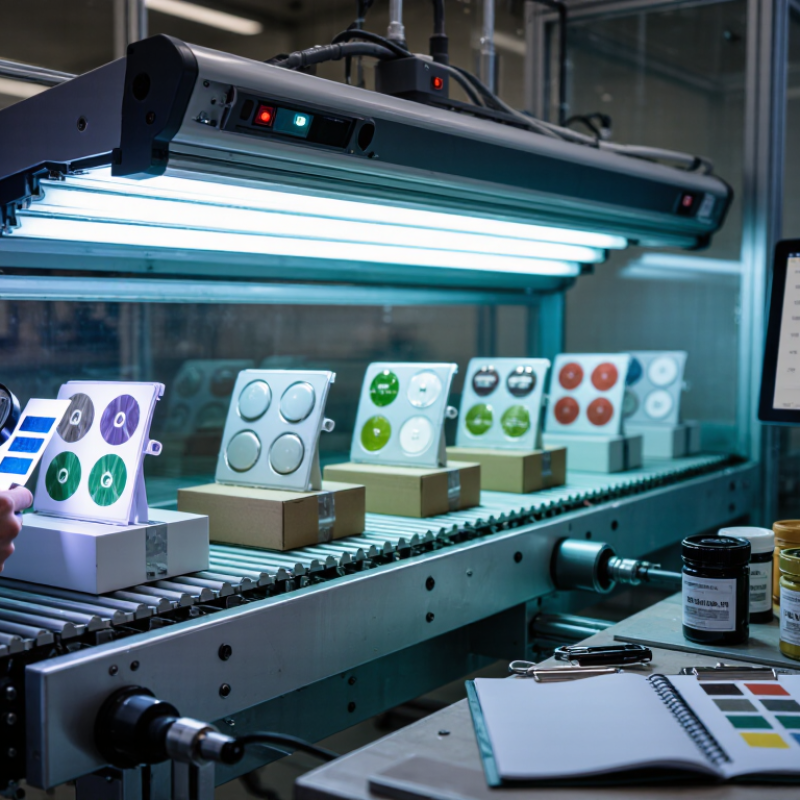
Choosing a UV dryer starts with the actual substrate, not a machine specification sheet. A clear varnish on glass behaves differently from an opaque ink on flexible film. Check whether the material absorbs or reflects the lamp’s output, and test adhesion after curing. Thin plastics can warp under heat; paper may curl when coating coverage is uneven. Small details matter.
The coating determines the wavelength and energy needed for a reliable cure. Ask its supplier for recommended wavelength, irradiance, and dose, then verify them on your production line. MarketsandMarkets’ 2023 UV Curing System Market report estimated the market at USD 3.3 billion in 2023 and projected USD 5.1 billion by 2028. That growth suggests broad adoption, but it does not prove a system suits your job. Line speed, web width, lamp distance, and shaded areas all affect results. I still consider a glossy test panel weak evidence; check adhesion and curing through the full production run.
Match the system to real operating conditions: daily hours, changeovers, cooling needs, and available maintenance time. Record test results for each substrate and coating combination. A slower line may cure well while a faster one leaves tacky edges. That is easy to miss. Start with small trials, inspect the finished surface, and adjust only one process setting at a time.

Choosing a UV system starts with the lamp’s spectrum, not its advertised power. Mercury-vapor lamps emit across a broad band, which can suit coatings containing several photoinitiators. Metal-halide lamps shift that output toward longer wavelengths, helping light reach some pigmented layers. UV LEDs emit narrow bands. RadTech’s UV LED Curing Primer identifies common peaks at 365, 385, 395, and 405 nanometers. Match the peak to the photoinitiator’s absorption range; a mismatch can leave a tacky surface or weak adhesion. Not always obvious.
The curing chemistry matters just as much. Free-radical acrylates cure quickly, but oxygen at the surface can inhibit the reaction, especially on thin films. Cationic epoxy systems are less sensitive to oxygen and may continue curing after exposure, though moisture can interfere. LEDs generally deliver less infrared heat to the workpiece than conventional arc lamps, but the substrate can still warm during repeated passes. Check irradiance and dose at the part, not only at the lamp window. A handheld radiometer helps, but readings depend on wavelength and measurement setup. That detail is easy to miss. Test the actual ink, coating, line speed, and substrate before choosing a curing technology; small trials often reveal uneven edges or shadowed areas that a datasheet cannot.
Compare representative emission wavelengths for common UV sources used in curing and related applications.
How to read this chart: The bars show representative wavelengths, not lamp power, efficiency, or cure speed. Medium-pressure mercury lamps emit multiple wavelengths across a broad spectrum; UV LEDs are available at several discrete peaks, commonly from about 365 to 405 nm. Match the source to the photoinitiator and material, and note that low-pressure mercury at 254 nm is primarily used for disinfection rather than general UV coating cure.
Choosing UV drying equipment starts with the ink, coating, or adhesive chemistry, not the lamp’s headline wattage. Check the material’s response range: a formulation may cure well at 365 nm but respond poorly at 395 nm. Dark pigments and thick films can also limit light penetration. Measure at the surface.
Judge output by both irradiance and delivered dose. Irradiance describes the power reaching the work; dose accumulates during exposure. On a conveyor, higher speed means less exposure time, so more output may be needed to maintain the required dose. But more power is not always better. Heat-sensitive films may warp, while a cured surface can hide a tacky layer underneath. Test with the actual material.
Set conveyor speed after checking lamp distance, reflector condition, and light uniformity across the belt. A reading at one point can miss weak edges. Run a small trial at production speed, then check adhesion, tack, and gloss at the center and edges. Record the wavelength, measured output, and belt speed. One assumption worth questioning: a setup that worked last month may not work today. Dust on a lamp window or sensor can quietly change exposure, so recheck readings after maintenance or when results shift.
Assess Equipment Fit, Safety, and Operating Costs
Choose equipment around the actual material and production line, not a headline wattage. Test the intended ink, coating, or adhesive on the real substrate. Check curing depth, conveyor speed, working width, and available clearance. A test coupon tells more than a brochure. It can also reveal heat damage or uneven curing before installation.
Safety features deserve a close inspection. Look for effective shielding and interlocks that stop UV output when access panels open. Use eye and skin protection specified for the equipment, and consider ventilation when materials release vapors during curing. Do not judge exposure by visible brightness. UV light may be difficult to see. Keep maintenance procedures clear, too; hurried lamp cleaning can create avoidable exposure or downtime.
Purchase price is only part of the cost. Compare energy use, cooling needs, lamp or LED replacement, ventilation, servicing, and production interruptions. Estimate cost per acceptable finished piece across a typical shift. A faster unit may still be costly if it needs frequent maintenance or rejects delicate parts. I would leave room for doubt: one successful sample does not prove stable performance across a full run. Recheck cure quality as speed, material, and equipment age change.
A lamp’s rated output cannot tell you whether a coating will cure on your production line. Test with the actual substrate, coating thickness, and conveyor speed. A thin film on clear glass behaves differently from a heavier layer on a heat-sensitive plastic. Small differences matter.
Measure UV dose with a radiometer suited to the lamp’s wavelength, and record the lamp-to-surface distance. Then check the cured sample for tack, rub resistance, adhesion, and cure through the full film depth. Run several passes at normal line speed, not just one slow test. Not always. A surface can feel dry while material underneath remains undercured.
Keep notes on temperature, lamp age, and sample position; edges may receive less exposure than the center. I would not treat one successful pass as proof, even when the finish looks clean. That shortcut is tempting under schedule pressure. Test under realistic operating conditions, and include the least favorable setup you expect to use. A test coupon is useful, but it cannot reproduce every variation in a full production run. If results shift between samples, investigate the process before selecting equipment.


For those larger-sized parts, or smaller quantity runs, we have 2 independent powder coat booths and ovens. The quality, durability and affordability of today’s powder coating finishes make this the process of choice for world-class companies.
Powder coating advantages over other forms of coating are many. Materials used in the Powder coating process can be metals and non-metals that come in a multitude of thicknesses, textures, colors, etc. Another of Powder coating’s biggest advantages over conventional coatings is its ability to create finishes in many different textures. Powder Coating Booths allow us the ability to apply these advantages to large products.
Tri-State Fabricators runs a full-service conveyor line for painting. Wet painting can provide protection or decoration to many different part styles. From start to finish, every project is easier to undergo random and point-based inspection by our skilled painting team.
Advantages to our Wet Paint Line are these lines start with product prep and ends with a thorough inspection of a high quality finished product. Our ability to complete large and small projects with a superior finish and doing so in a timely and economical fashion. This passes along the savings in production to our customers. When powder coating ins not an option, our Wet Paint Line gets the job done right the first time.
When the parts get big and heavy we roll-out our custom paint racks and oversize booth. By utilizing our partnerships with all the major paint brands, we can match virtually any color with wet paint.
The advantages of having access to a Wet Paint Booth are many. Large projects of many different shapes can be loaded into the booth. The Wet Paint Booth offers an environment that is much more controlled than a typical parts painting operation.
Not only are they used because of their controlled environment, but they’re are also advantageous when it comes to applying paint to parts that are needed in industries that require specialty coatings such as medical, aerospace, etc.
Our military forces have some very high standards when it comes to the finish of their vehicles and equipment. From the first pre-treatment step to final coat, it takes a great deal of knowledge and experience to protect the men and women of our armed forces. They deserve only the best, and Tri-State Fabricators provides it.
All of our processes are closely monitored by our staff and management teams. Both of which are highly trained in the processes of metal fabrication and finishing. Tri-State Fabricators’ goal is to always fully satisfy each and every customer, including the military. We will always put a 110% into what we do.
Abrasive media blasting is an excellent way to remove old paint, rust, and increase the paint/powder adhesion. Glass beads produce a much smoother and brighter finish than angular abrasives; leaving the part clean yet without any dimensional change. Chemically inert and environmentally friendly, we can recycle our beads approximately 30 times; making them a more preferred method of metal cleaning or surface finishing.
Advantages to Glass Bead Blasting are many. Glass bead blast media is used when a project is needing rough surfaces need to become smooth for applications of coatings such as paint. It is typically used to clean paint and rust from a product surface without deforming the surface it is being used on. Overall, compared to many other blasting media, Glass Bead Blasting is a very economical choice and those savings are always passed on to our customers.
Tri-State Fabricators utilize a zinc phosphate wash to clean and etch the material to ensure the best paint adhesion possible. The unique design of our 3-stage wash system does the work like a 5-stage. From Cleaning and rinsing to conversion coating and post-treatment, Our Part Washing process is a complete service and works throughout the fabrication service and the finishing service.
Along with the previously mentioned benefits, Curing is a vital chemical reaction that leaves the product finish hard and relatively safe from mild abrasion and aggressive corrosion. This process can be done in more than one way; ambient air-dry or in curing ovens at temps that exceed 240°.
From fixing paint mistakes (someone else’s of course) to simply cleaning our paint line hooks, our burn-off oven is put to good use. After a quick burn-off, a little clean up, and a fresh coat of paint, your parts will look better than new.
Why does our Burn-Off Oven work so well? Because super heating the air around parts turns the materials into ashes. From paint and powder coatings to rubber and machining oils, high temps do the job without degrading the integrity of the part.
Masking is a vital part of producing high quality products. We have die-cut masking patterns to protect machined surfaces as well as a wide range of plugs and caps to protect threaded holes and bolts. We provide permanent and temporary masking.
Masking allows the selected sections of a product to be protected from a fabrication or finishing service. This can be with both chemicals when etching and tapes, paints when only finishing just a section of the product. Masking is great in aiding the customization process of a project.
Screen printing is a photographic process that transfers artwork onto a porous nylon screen which allows colored ink to flow through the screen and be deposited on an aluminum or plastic component. We can generally have just about any design created onto a screen for your parts.
Some of the advantages of Screen Printing are, brand recognition for your business displaying on your products, assembly instructions, product warnings/hazards, etc. Tri-State Fabricators produces Screen Printing of the highest quality so you know it’s durable.
Metal Finishing is the art of treating the exterior portion of product, often metal but can also be made of other materials, so that the surface is clean and free of any debris. Then the process of applying coats or either paint of powder coat takes place. This coating process improves the quality of the product in both appearance and resistance to wear and corrosion.
Tri-State Fabricators, Inc., understands that a project typically isn’t complete until a high-quality finish has been added to your product. This is why our painting and powder coating teams continuously inspect the products throughout the Metal Finishing process.

