


Choosing the best Udon Noodle Machine in 2026 starts with the product, not the brochure. Fresh udon needs consistent dough thickness, smooth sheeting, and clean cutting. A machine that runs quickly may still produce uneven strands or waste dough. Small details count.
Industry figures offer context, but they need careful interpretation. The World Instant Noodles Association reported global demand of about 120.2 billion servings in 2023. That figure concerns instant noodles, not fresh udon, so it signals broad noodle demand rather than udon-machine sales. Grand View Research valued the global food processing equipment market at approximately US$52.4 billion in 2023. This wider category includes many types of machinery, not just noodle makers. The numbers are useful, but they cannot choose a machine for your kitchen or factory.
Start with daily output, available floor space, and the dough batches you actually make. Then compare roller adjustment, cutter options, cleaning access, electrical requirements, and spare-part availability. Ask suppliers for sample results using your flour and hydration level. Request written details on warranty coverage and service response times. Not just speed. A lower-cost model may fit a small shop, while a larger operation may need automated feeding and dependable production records. I would not treat published capacity as guaranteed output; real results depend on dough, operator skill, and cleaning breaks. Choose evidence over impressive claims.
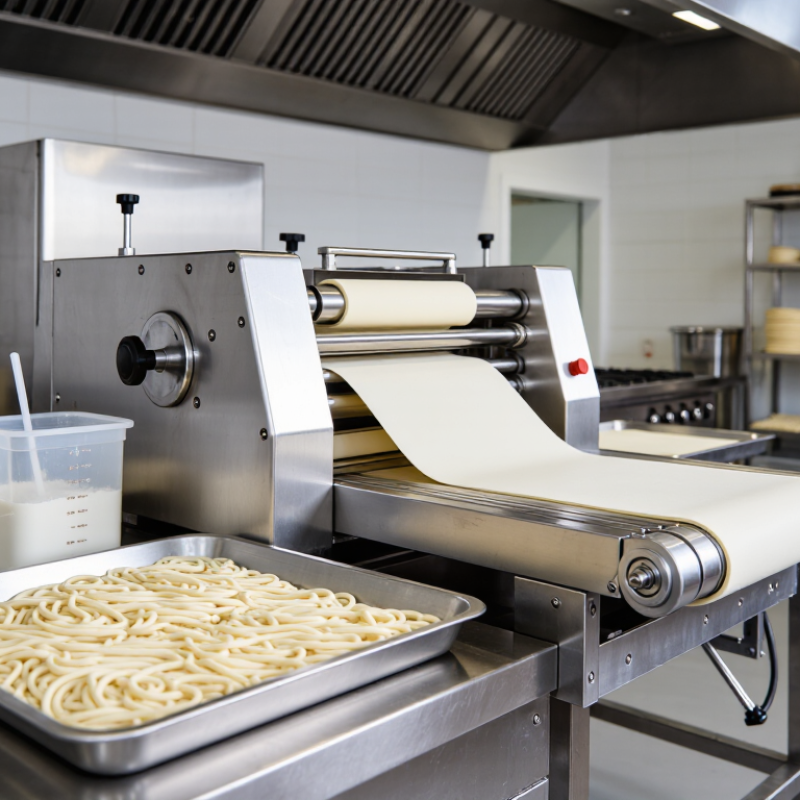
An udon machine typically mixes wheat flour, water, and salt, then develops dough through kneading or repeated compression. The dough rests, passes between rollers, and is cut into even strands. Some compact machines combine these steps; larger lines separate mixing, sheeting, cutting, and conveying. Extrusion models also exist, but pressure and die shape can produce a different bite. The FAO Statistical Yearbook 2023 reports 808.4 million tonnes of wheat produced worldwide in 2022. That figure does not measure noodle quality. It does remind buyers that flour strength and moisture can vary by supply and season.
Different jobs. Manual or tabletop rollers suit test batches and small kitchens, though output depends on operator rhythm. Semi-automatic units power the rollers and cutter, reducing repetitive work while staff still feed dough and check consistency. Integrated lines automate more stages and need space, stable power, and cleaning access. Compare dough width, thickness settings, cutting sizes, hourly capacity, and food-contact materials. Run a trial with your own flour and hydration; catalog capacity can mislead. A little unevenness is normal. Check whether dough releases cleanly from the rollers after a short production run.

Compare common machine types by their typical level of automation. The 1–3 scale is ordinal, not a measured performance rating; actual functions depend on the machine configuration.
How to choose: Manual machines suit small batches and hands-on production. Powered sheeter-and-cutter machines reduce repetitive rolling and cutting. Automated lines integrate more production steps and are generally intended for higher-volume operations. Check the exact functions, capacity, and cleaning requirements of each configuration before buying.
How to Choose the Best Udon Noodle Machine in 2026?
Match production capacity to your real service pattern, not just the busiest hour on paper. Estimate bowls per shift, then check the machine’s rated output and how long it takes to prepare dough, roll sheets, and cut noodles. A high-capacity model may sit idle during quiet periods. That still costs space and cleaning time.
Noodle quality depends on more than speed. Ask whether the machine can produce your preferred thickness and width, and test it with the flour and dough recipe you plan to use. Look for even strands, clean cuts, and a texture that holds up after cooking. Check the dough carefully. Small changes in hydration can affect the result, so a quick demonstration may not tell the whole story.
Kitchen space can narrow your options fast. Measure the counter, nearby work area, and route through doorways before ordering. Leave room for loading dough, collecting cut noodles, and cleaning around the rollers. A compact machine may fit neatly but slow down staff if its tray is awkward to reach. It is easy to focus on output figures and overlook daily handling; that trade-off deserves a second look.
| Machine Type | Indicative Production Capacity | Noodle Quality and Consistency | Approximate Equipment Footprint | Typical Kitchen Requirements | Best Suited For | Key Trade-Off |
|---|---|---|---|---|---|---|
| Manual pasta roller and cutter | Small batches; output depends heavily on operator speed and dough preparation. | Good hands-on control over sheet thickness and noodle width. Results can vary between operators and batches. | About 0.2–0.5 m² for the machine; allow additional bench space for dough handling. | Stable workbench, room for manual feeding, cutting, and flouring. | Home kitchens, very small restaurants, or occasional fresh-noodle production. | Low space and equipment needs, but labor-intensive and difficult to scale. |
| Compact tabletop electric sheeter and cutter | Low to moderate volume; check the manufacturer’s rated dough throughput and recommended duty cycle. | More repeatable sheet thickness and cutting than manual equipment when dough hydration and feeding are consistent. | About 0.3–0.7 m², excluding clearance for loading dough and collecting noodles. | Strong, level counter; suitable electrical supply; space for mixing and resting dough nearby. | Cafés, small kitchens, and restaurants making fresh udon in limited batches. | Compact and relatively easy to place, but batch handling may limit service-volume output. |
| Floor-standing sheeter and cutter | Moderate to high volume; capacity depends on roller width, motor rating, feeding rate, and operating schedule. | Can produce more uniform sheets and cuts across larger batches; dough preparation remains essential to texture. | About 0.6–1.2 m² for the machine, plus access and product-handling space. | Dedicated floor area, safe operator access, appropriate power supply, and room for dough carts or trays. | Busy restaurants, commissary kitchens, and small-scale food production. | Higher throughput potential, but requires more floor space and a larger initial investment. |
| Integrated mixing, sheeting, and cutting line | High-volume production; use the line’s rated capacity for the specific dough recipe and product format. | Can improve repeatability across larger runs when mixing, resting, sheeting, and cutting are controlled as a process. | Typically several square metres; the full line may need substantially more room than the machines alone. | Planned workflow, ingredient storage, cleaning access, operator clearance, and suitable electrical and ventilation provisions. | Central kitchens and dedicated production facilities with regular, substantial demand. | High output potential, but greater space, installation, cleaning, and maintenance demands. |
Planning note: Capacity and footprint are not standardized across machine designs. Treat the space figures as preliminary layout estimates, and confirm rated throughput, dimensions, electrical requirements, cleaning access, and duty cycle with the equipment supplier before purchasing. Noodle texture also depends on flour, hydration, mixing, resting, and cooking—not the machine alone.
Choosing the best udon noodle machine in 2026 means matching its features to your dough and daily output. Adjustable roller gaps help produce consistent thickness, while a sturdy cutter should create clean strands without tearing hydrated dough. Check whether the machine handles your batch size without forcing continuous operation. USDA Economic Research Service data show food away from home made up 58.5% of U.S. food spending in 2023, underscoring the importance of dependable commercial kitchen equipment. Still, advertised capacity can mislead; ask how it was measured and test a realistic batch if possible.
Materials and cleaning deserve equal attention. The FDA Food Code 2022, section 4-202.11, calls for food-contact surfaces to be smooth, durable, nonabsorbent, and easily cleanable. Stainless steel is a practical choice for exposed surfaces, but inspect seams, roller ends, and cutter housings, where dough can lodge. Small details matter. Removable parts can speed cleaning, provided they are easy to reassemble and do not create alignment problems. Check the manual for water restrictions; a motor housing should not be treated like a washable tray. One caveat: the easiest machine to wipe down may still have hard-to-reach joints. Look closely before buying.
When comparing udon noodle machines in 2026, look beyond the purchase price. Include delivery, installation, staff training, and any mixer or cutting attachments. A lower-priced machine may need more manual work or produce noodles less consistently. Ask how quickly settings can be changed between noodle thicknesses. Small costs add up.
Estimate operating costs using your expected weekly production. Add flour, water, electricity, labor, and the cost of dough or noodles lost during setup. Compare machines by cost per 100 kilograms of saleable noodles, not just hourly output. A machine that runs quickly may still waste more dough. Track actual consumption during a trial if possible; estimates can be off.
Maintenance affects both the budget and production schedule. Check the price and replacement interval for blades, belts, and other wear parts. Ask how often cleaning is needed and how long routine service usually takes. Also assign a cost to downtime, even if it is only a cautious estimate. The calculation will never be perfect. That is fine. Use the same assumptions for every machine, then update them after several weeks of real production.
Choosing an udon noodle machine starts with dough and shift patterns, not advertised maximum speed. Record kilograms per hour, batch size, hydration, noodle width, and available operating hours. Leave time for cleaning and changeovers. The World Instant Noodles Association reported 120.21 billion servings of instant noodles consumed worldwide in 2023. This is not an udon market measure, but it shows the scale of noodle demand. Do not use it to calculate your capacity. Your order history is better evidence.
Match machine features to the product. A sheeter needs stable roller gaps; a cutter must hold noodle width without tearing hydrated dough. Check motor duty rating, adjustment range, food-contact documentation, spare-part access, and washdown time. Ask for a test with your flour and target hydration. Measure yield, thickness variation, and rejects. A tidy brochure is not proof. In compact kitchens, floor space and operator reach may matter more than peak output. Central kitchens may need continuous feeding and quick recovery after stops. There is no perfect specification. Treat calculated capacity as provisional until a full-shift trial reveals pauses, sticking, and operator fatigue.


For those larger-sized parts, or smaller quantity runs, we have 2 independent powder coat booths and ovens. The quality, durability and affordability of today’s powder coating finishes make this the process of choice for world-class companies.
Powder coating advantages over other forms of coating are many. Materials used in the Powder coating process can be metals and non-metals that come in a multitude of thicknesses, textures, colors, etc. Another of Powder coating’s biggest advantages over conventional coatings is its ability to create finishes in many different textures. Powder Coating Booths allow us the ability to apply these advantages to large products.
Tri-State Fabricators runs a full-service conveyor line for painting. Wet painting can provide protection or decoration to many different part styles. From start to finish, every project is easier to undergo random and point-based inspection by our skilled painting team.
Advantages to our Wet Paint Line are these lines start with product prep and ends with a thorough inspection of a high quality finished product. Our ability to complete large and small projects with a superior finish and doing so in a timely and economical fashion. This passes along the savings in production to our customers. When powder coating ins not an option, our Wet Paint Line gets the job done right the first time.
When the parts get big and heavy we roll-out our custom paint racks and oversize booth. By utilizing our partnerships with all the major paint brands, we can match virtually any color with wet paint.
The advantages of having access to a Wet Paint Booth are many. Large projects of many different shapes can be loaded into the booth. The Wet Paint Booth offers an environment that is much more controlled than a typical parts painting operation.
Not only are they used because of their controlled environment, but they’re are also advantageous when it comes to applying paint to parts that are needed in industries that require specialty coatings such as medical, aerospace, etc.
Our military forces have some very high standards when it comes to the finish of their vehicles and equipment. From the first pre-treatment step to final coat, it takes a great deal of knowledge and experience to protect the men and women of our armed forces. They deserve only the best, and Tri-State Fabricators provides it.
All of our processes are closely monitored by our staff and management teams. Both of which are highly trained in the processes of metal fabrication and finishing. Tri-State Fabricators’ goal is to always fully satisfy each and every customer, including the military. We will always put a 110% into what we do.
Abrasive media blasting is an excellent way to remove old paint, rust, and increase the paint/powder adhesion. Glass beads produce a much smoother and brighter finish than angular abrasives; leaving the part clean yet without any dimensional change. Chemically inert and environmentally friendly, we can recycle our beads approximately 30 times; making them a more preferred method of metal cleaning or surface finishing.
Advantages to Glass Bead Blasting are many. Glass bead blast media is used when a project is needing rough surfaces need to become smooth for applications of coatings such as paint. It is typically used to clean paint and rust from a product surface without deforming the surface it is being used on. Overall, compared to many other blasting media, Glass Bead Blasting is a very economical choice and those savings are always passed on to our customers.
Tri-State Fabricators utilize a zinc phosphate wash to clean and etch the material to ensure the best paint adhesion possible. The unique design of our 3-stage wash system does the work like a 5-stage. From Cleaning and rinsing to conversion coating and post-treatment, Our Part Washing process is a complete service and works throughout the fabrication service and the finishing service.
Along with the previously mentioned benefits, Curing is a vital chemical reaction that leaves the product finish hard and relatively safe from mild abrasion and aggressive corrosion. This process can be done in more than one way; ambient air-dry or in curing ovens at temps that exceed 240°.
From fixing paint mistakes (someone else’s of course) to simply cleaning our paint line hooks, our burn-off oven is put to good use. After a quick burn-off, a little clean up, and a fresh coat of paint, your parts will look better than new.
Why does our Burn-Off Oven work so well? Because super heating the air around parts turns the materials into ashes. From paint and powder coatings to rubber and machining oils, high temps do the job without degrading the integrity of the part.
Masking is a vital part of producing high quality products. We have die-cut masking patterns to protect machined surfaces as well as a wide range of plugs and caps to protect threaded holes and bolts. We provide permanent and temporary masking.
Masking allows the selected sections of a product to be protected from a fabrication or finishing service. This can be with both chemicals when etching and tapes, paints when only finishing just a section of the product. Masking is great in aiding the customization process of a project.
Screen printing is a photographic process that transfers artwork onto a porous nylon screen which allows colored ink to flow through the screen and be deposited on an aluminum or plastic component. We can generally have just about any design created onto a screen for your parts.
Some of the advantages of Screen Printing are, brand recognition for your business displaying on your products, assembly instructions, product warnings/hazards, etc. Tri-State Fabricators produces Screen Printing of the highest quality so you know it’s durable.
Metal Finishing is the art of treating the exterior portion of product, often metal but can also be made of other materials, so that the surface is clean and free of any debris. Then the process of applying coats or either paint of powder coat takes place. This coating process improves the quality of the product in both appearance and resistance to wear and corrosion.
Tri-State Fabricators, Inc., understands that a project typically isn’t complete until a high-quality finish has been added to your product. This is why our painting and powder coating teams continuously inspect the products throughout the Metal Finishing process.

