


Choosing the Best Steel Frame Carport starts with the conditions around your vehicle, not a catalogue photo. Measure the parking area, including door clearance and room to walk around the car. Then consider local wind, snow, rain, and sun exposure. A frame that looks sturdy may still be poorly suited to its site.
For this guide, fictional steel-structure consultant Elena Ward offers this illustrative reminder: “Match the frame and roof to the site before comparing finishes or price.” This is an original example, not a sourced quotation. The principle is practical: compare steel quality, frame dimensions, roof design, protective coating, and anchoring requirements. Ask suppliers for clear specifications, warranty details, and installation guidance. Check that the proposed design fits your site conditions, and seek qualified advice when loads or foundations are uncertain.
Details matter. A low roof can make vehicle access awkward. A thin coating may show wear where rainwater collects or branches scrape. And a bargain frame is not always a bargain after delivery, assembly, or repairs. Look closely.
The right Steel Frame Carport balances strength, usable space, maintenance, and cost. No single model suits every driveway. This guide explains what to compare, which questions to ask, and where a little extra scrutiny can prevent a costly mismatch. Even careful buyers can overlook small details, so verify measurements and specifications before deciding.
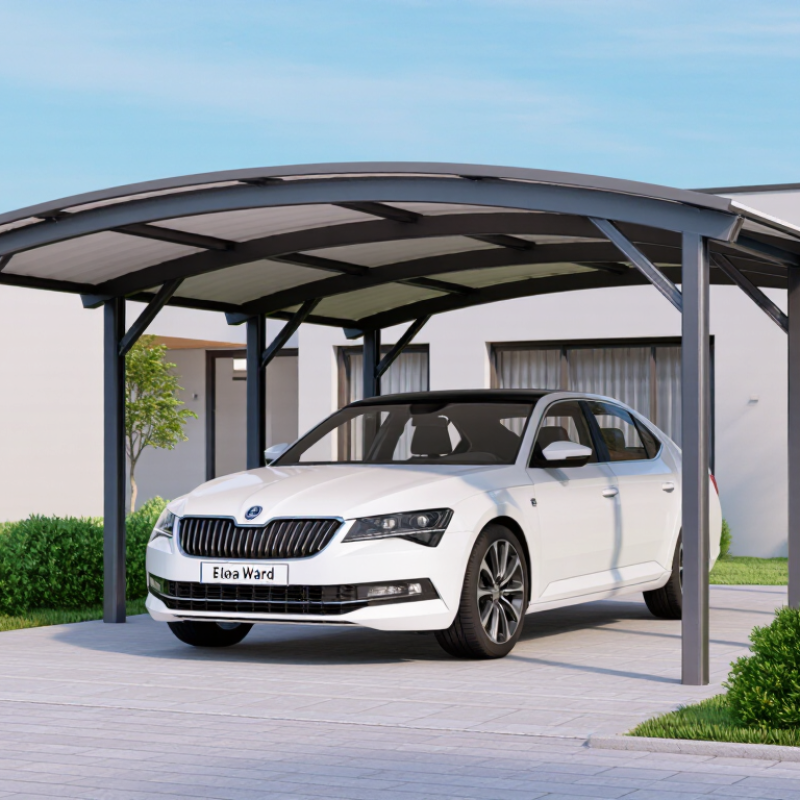
Before comparing steel frame carports, decide what the structure must protect. A car used daily needs easy access and enough clearance for doors, mirrors, and roof racks. For a boat or work vehicle, measure the full length and height, including antennas or mounted equipment. Leave room to walk around it. A few extra inches can prevent daily frustration.
Then study the site in person. Check the ground after rain: does water collect near the proposed posts? Note slopes, overhead branches, gates, and the path vehicles take into the space. Measure the available footprint, not just the vehicle. Soil conditions and drainage affect how the frame should be anchored, so ask a qualified installer to assess uncertain ground. Small details matter.
Local weather should shape your choices. Consider typical wind, snow, and rainfall, and confirm that the proposed frame and anchoring suit those conditions. Check applicable local requirements before ordering. A broad roof may offer useful shade, but it can also catch more wind. That trade-off is easy to overlook. Even careful plans can miss something; revisit your measurements and site notes before committing to a layout.
Use this planning guide to match the carport’s intended use with practical space, access, and site considerations. Dimensions are typical planning ranges, not structural specifications.
| Purpose | Typical Planning Footprint | Clearance to Consider | Useful Layout Features | Site Requirements to Check |
|---|---|---|---|---|
| One passenger vehicle | About 12 ft × 20 ft (3.7 m × 6.1 m) | Allow room to open doors and walk around the vehicle; increase the width for larger vehicles or frequent access. | Open sides provide easy entry. A roof overhang can offer additional weather protection where permitted. | Measure the vehicle, driveway approach, property boundaries, overhead obstructions, and drainage path. |
| Two passenger vehicles | About 20 ft × 20 ft (6.1 m × 6.1 m); wider layouts may improve access. | Check door-opening space between vehicles and room to enter or leave without blocking the other vehicle. | A wider single bay or two-bay layout can suit different driveway shapes and parking habits. | Confirm driveway width, turning space, setbacks, underground utilities, and whether posts would obstruct vehicle doors. |
| Pickup truck, van, or SUV | Often about 12–14 ft wide × 22–26 ft long (3.7–4.3 m × 6.7–7.9 m), depending on vehicle size. | Measure vehicle height with roof racks or accessories, then allow additional overhead clearance for safe entry. | Longer bays and taller entry clearance can make parking and loading easier. | Check the vehicle’s actual height and length, approach slope, overhead branches, and local height restrictions. |
| Boat or recreational vehicle | Determine the footprint from the complete stored setup, including trailer, hitch, and accessories. | Allow clearance for the tallest point, trailer movement, and the turning path needed to back into the bay. | Consider a deeper bay, a clear approach, and an opening that accommodates the full stored height and width. | Assess access-road width, turning radius, ground firmness, drainage, and any restrictions on vehicle or trailer storage. |
| Vehicle plus storage or work area | Plan space beyond the vehicle footprint; a wider or deeper bay may be needed for shelving or a workbench. | Keep walking routes clear and allow room for doors, stored equipment, and safe movement around the vehicle. | Optional side panels or enclosed storage can improve protection, subject to ventilation and local requirements. | Check the intended use, fire and access rules, lighting needs, surface drainage, and whether the site can support added loads. |
| Seasonal or general outdoor shelter | Size the covered area around the largest item to be sheltered and the desired usable space around it. | Allow practical clearance for moving equipment in and out and for maintenance access. | An open-sided design offers flexibility; partial walls may reduce exposure to prevailing weather. | Identify prevailing wind direction, sun exposure, nearby trees, runoff routes, and applicable permit requirements. |
Before selecting a frame: Verify local planning and building requirements, property setbacks, utility locations, and site drainage. Wind, snow, seismic, and soil conditions vary by location; have the structure’s dimensions, anchoring, foundation, and structural capacity checked against local codes by a qualified professional.

Start with the tube, not the paint. ASTM A500/A500M lists minimum yield strengths of 50 ksi for Grade C round tubing and 46 ksi for shaped tubing. Those figures help compare material, but thicker steel is not automatically the better choice. Ask for the grade, wall thickness, and mill certificate. Small detail. It matters.
Frame design determines how those parts handle wind and snow. Closely spaced roof purlins support panels between the main arches or rafters; wider spacing can leave panels flexing under gusts. Check how the frame anchors to concrete, too. A strong roof frame can still move if its base connections are undersized. Compare the manufacturer’s design loads with local site conditions, not just the advertised span.
Coating choice affects maintenance. ASTM A123/A123M sets minimum hot-dip galvanizing thicknesses by steel category and material thickness; for many structural-shape categories over 6.4 mm thick, the minimum average is 100 micrometres. Request the specified coating thickness and inspection records. Paint or powder coating can add color and a barrier, but damaged edges and drilled holes deserve attention. I might be overfocused on finish; a hidden, uncoated cut can matter more than a glossy surface.
A steel frame carport should fit more than the vehicle’s footprint. Measure the car’s length and width, then allow space to open doors and walk around it. Add room for roof racks, a mower, or stored bins if they will share the space. Measure twice. A tight fit can turn ordinary parking into daily frustration. Check the site for slopes, low branches, and drainage paths before settling on dimensions.
Roof style affects maintenance and weather performance. A regular roof has a simple profile, while a boxed-eave design adds a finished look. Vertical roof panels help rain and debris move downward, which can be useful beneath trees. Still, panel direction alone does not determine strength. That distinction is easy to overlook. Compare the roof’s stated snow and wind capacities, not just its appearance.
Load capacity must match local exposure and the carport’s intended use. Snow depth, gusts, and open-sided layouts can change the forces on the frame. Ask for documented ratings and confirm what foundation and anchoring those ratings assume. A concrete pad may not suit every site, and anchoring details matter. If conditions are severe or unclear, get qualified local advice before installation; guessing here is a poor trade.
A steel frame carport can look sturdy in a showroom and still shift on a poorly prepared site. Check how each post will be anchored before comparing prices. Anchors must match the surface, whether it is a concrete slab, footings, or compacted ground. A small mismatch matters. Ask for the required anchor type and installation details, then confirm that the ground can support them. Loose soil or a sloped driveway may need extra planning.
Weather resistance is more than a galvanized finish. Look for information about coating and corrosion protection, especially if the structure will face frequent rain or salty air. Check the frame’s stated wind and snow-load ratings against conditions at your property. These figures depend on design and installation, so avoid assuming one model suits every region. Clear leaves and standing water after storms; small maintenance tasks can reveal loose fasteners early.
Local building codes may set rules for permits, setbacks, height, and structural loads. Contact your local building department before ordering, and ask whether site plans or inspections are required. Requirements can vary between neighboring areas. I would double-check this step, even if a seller says a carport is “standard.” That word is vague. Keep the written specifications and permit guidance together, so the installer and inspector can review the same details.
How to Choose the Best Steel Frame Carport?
Evaluate Installation, Warranty, and Long-Term Maintenance
A steel frame carport is only as dependable as its installation. Ask for a written plan showing post locations, anchor types, roof direction, and drainage. The installer should check the ground for slope or soft spots before setting the frame. A tidy estimate can still hide an important detail. That matters.
Clarify who prepares the site, removes packaging, and checks the finished structure. On a windy or snowy property, ask how the design accounts for local conditions. Do not rely on a casual promise; request the relevant specifications in writing. Small gaps count. Poorly placed anchors or blocked runoff may become costly problems later.
Read the warranty for coverage periods and exclusions, especially for the steel finish, corrosion, and workmanship. Confirm whether routine care is required to keep coverage valid. Maintenance is usually simple, but it is easy to postpone. After storms, inspect fasteners, look for chipped coating, and clear leaves from roof edges. Twice a year, check for standing water, loose trim, and rust near cut edges or ground-level posts. Keep a note of repairs and dated photos; they can help explain when a problem began. No frame is truly maintenance-free, and that’s worth remembering before comparing prices.


For those larger-sized parts, or smaller quantity runs, we have 2 independent powder coat booths and ovens. The quality, durability and affordability of today’s powder coating finishes make this the process of choice for world-class companies.
Powder coating advantages over other forms of coating are many. Materials used in the Powder coating process can be metals and non-metals that come in a multitude of thicknesses, textures, colors, etc. Another of Powder coating’s biggest advantages over conventional coatings is its ability to create finishes in many different textures. Powder Coating Booths allow us the ability to apply these advantages to large products.
Tri-State Fabricators runs a full-service conveyor line for painting. Wet painting can provide protection or decoration to many different part styles. From start to finish, every project is easier to undergo random and point-based inspection by our skilled painting team.
Advantages to our Wet Paint Line are these lines start with product prep and ends with a thorough inspection of a high quality finished product. Our ability to complete large and small projects with a superior finish and doing so in a timely and economical fashion. This passes along the savings in production to our customers. When powder coating ins not an option, our Wet Paint Line gets the job done right the first time.
When the parts get big and heavy we roll-out our custom paint racks and oversize booth. By utilizing our partnerships with all the major paint brands, we can match virtually any color with wet paint.
The advantages of having access to a Wet Paint Booth are many. Large projects of many different shapes can be loaded into the booth. The Wet Paint Booth offers an environment that is much more controlled than a typical parts painting operation.
Not only are they used because of their controlled environment, but they’re are also advantageous when it comes to applying paint to parts that are needed in industries that require specialty coatings such as medical, aerospace, etc.
Our military forces have some very high standards when it comes to the finish of their vehicles and equipment. From the first pre-treatment step to final coat, it takes a great deal of knowledge and experience to protect the men and women of our armed forces. They deserve only the best, and Tri-State Fabricators provides it.
All of our processes are closely monitored by our staff and management teams. Both of which are highly trained in the processes of metal fabrication and finishing. Tri-State Fabricators’ goal is to always fully satisfy each and every customer, including the military. We will always put a 110% into what we do.
Abrasive media blasting is an excellent way to remove old paint, rust, and increase the paint/powder adhesion. Glass beads produce a much smoother and brighter finish than angular abrasives; leaving the part clean yet without any dimensional change. Chemically inert and environmentally friendly, we can recycle our beads approximately 30 times; making them a more preferred method of metal cleaning or surface finishing.
Advantages to Glass Bead Blasting are many. Glass bead blast media is used when a project is needing rough surfaces need to become smooth for applications of coatings such as paint. It is typically used to clean paint and rust from a product surface without deforming the surface it is being used on. Overall, compared to many other blasting media, Glass Bead Blasting is a very economical choice and those savings are always passed on to our customers.
Tri-State Fabricators utilize a zinc phosphate wash to clean and etch the material to ensure the best paint adhesion possible. The unique design of our 3-stage wash system does the work like a 5-stage. From Cleaning and rinsing to conversion coating and post-treatment, Our Part Washing process is a complete service and works throughout the fabrication service and the finishing service.
Along with the previously mentioned benefits, Curing is a vital chemical reaction that leaves the product finish hard and relatively safe from mild abrasion and aggressive corrosion. This process can be done in more than one way; ambient air-dry or in curing ovens at temps that exceed 240°.
From fixing paint mistakes (someone else’s of course) to simply cleaning our paint line hooks, our burn-off oven is put to good use. After a quick burn-off, a little clean up, and a fresh coat of paint, your parts will look better than new.
Why does our Burn-Off Oven work so well? Because super heating the air around parts turns the materials into ashes. From paint and powder coatings to rubber and machining oils, high temps do the job without degrading the integrity of the part.
Masking is a vital part of producing high quality products. We have die-cut masking patterns to protect machined surfaces as well as a wide range of plugs and caps to protect threaded holes and bolts. We provide permanent and temporary masking.
Masking allows the selected sections of a product to be protected from a fabrication or finishing service. This can be with both chemicals when etching and tapes, paints when only finishing just a section of the product. Masking is great in aiding the customization process of a project.
Screen printing is a photographic process that transfers artwork onto a porous nylon screen which allows colored ink to flow through the screen and be deposited on an aluminum or plastic component. We can generally have just about any design created onto a screen for your parts.
Some of the advantages of Screen Printing are, brand recognition for your business displaying on your products, assembly instructions, product warnings/hazards, etc. Tri-State Fabricators produces Screen Printing of the highest quality so you know it’s durable.
Metal Finishing is the art of treating the exterior portion of product, often metal but can also be made of other materials, so that the surface is clean and free of any debris. Then the process of applying coats or either paint of powder coat takes place. This coating process improves the quality of the product in both appearance and resistance to wear and corrosion.
Tri-State Fabricators, Inc., understands that a project typically isn’t complete until a high-quality finish has been added to your product. This is why our painting and powder coating teams continuously inspect the products throughout the Metal Finishing process.

