


Choosing a Solar Water Pump is not simply a matter of matching a panel to a well. The right system must lift the required volume of water, at the needed pressure, through the site’s actual pumping head. A pump that looks powerful on paper may disappoint when clouds pass, pipes are undersized, or the water table drops. Small details matter. So does the daily schedule.
The economics have improved, but system-level costs still need careful checking. IRENA’s Renewable Power Generation Costs in 2023 reported that utility-scale solar photovoltaic electricity cost 56% less than fossil-fuel alternatives on average. That figure describes power generation, not a complete water-pumping installation. It should not be treated as a guaranteed saving for a farm or household. IRENA Director-General Francesco La Camera has described renewables as “the cheapest source of new power.” For pump buyers, that broader trend is encouraging, but it does not replace site-specific calculations.
This guide explains how to compare pump types, flow rates, total dynamic head, panels, controllers, storage, and maintenance needs. It also considers water quality, seasonal sunlight, and the practical distance from the pump to the tank. These are measurable factors, yet estimates can still miss real conditions. A cloudy week or a changing water level can alter performance. Before choosing, gather reliable well data and daily water demand. Then compare complete system specifications, not just the pump’s advertised capacity.
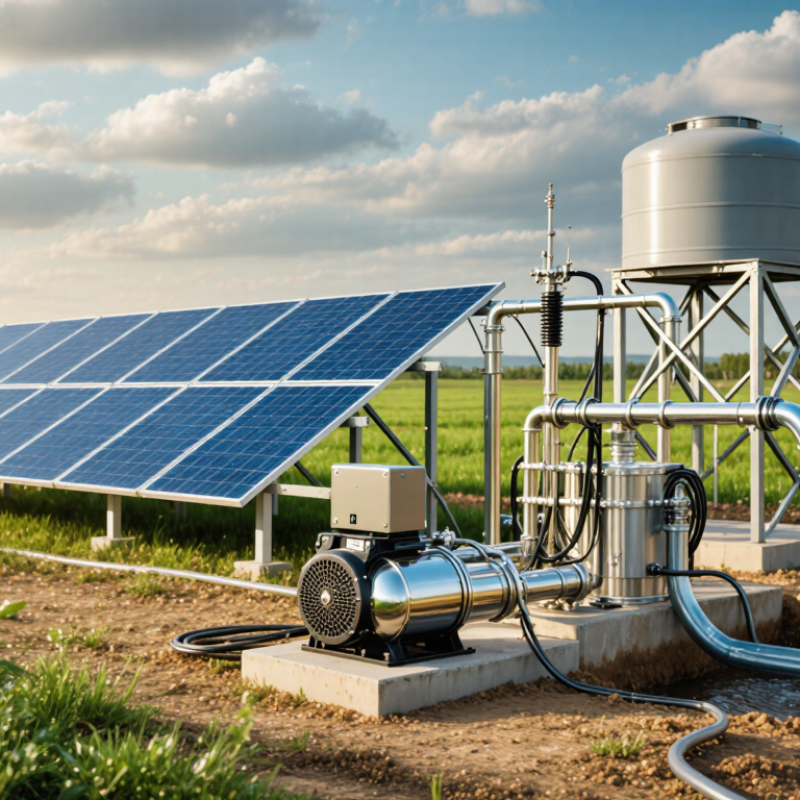
Before choosing a solar water pump, measure how much water you need each day and when demand peaks. A household, livestock trough, and irrigated field require very different flow rates. FAO AQUASTAT estimates that agriculture accounts for about 70% of global freshwater withdrawals, so irrigation demand deserves careful calculation. For crops, FAO Irrigation and Drainage Paper 56 estimates crop water use using reference evapotranspiration multiplied by a crop coefficient. It is a better starting point than guessing from acreage alone.
Next, check the site. Measure the vertical lift from the water source to the tank or field, then account for pipe length, bends, and friction. These affect total dynamic head and pump output. Review seasonal sunlight, not just annual averages: the World Bank and ESMAP’s Global Solar Atlas provides location-based solar resource and photovoltaic potential data. A shaded well or cloudy-season water shortage can change the system size considerably. Estimates can still miss real conditions. A partly blocked intake, for example, may reduce flow.
Tips: Record water use for several days, measure well depth and water-level changes, and note the sunniest and cloudiest months. Keep a little margin for dry spells, but avoid oversizing without a reason. Small site details matter.

Example irrigation estimates use an application rate of 5 mm per day; since 1 mm of water over 1 m² equals 1 litre, the estimates are 5 litres per square metre per day. Actual demand varies with crop, weather, soil, and irrigation efficiency. When selecting a pump, compare its daily output at the site’s total dynamic head—including lift, water-level drawdown, elevation, and pipe losses—and check that the water source and available sunlight can meet the requirement.
Solar water pumps suit farms, livestock plots, gardens, and remote homes, but the best type depends on water depth and daily demand. FAO AQUASTAT estimates that agriculture accounts for about 70% of global freshwater withdrawals, making efficient water delivery important. A pump should match the site’s measured water level, required flow, and seasonal sunlight—not just the panel rating.
Surface pumps work well for shallow wells, ponds, and tanks where water sits near the pump. Submersible pumps are better for deep boreholes because they push water upward from below the surface. For smaller systems, a DC pump can reduce conversion equipment; an AC pump with an inverter may suit higher-flow installations. IRENA’s report Solar Pumping for Irrigation: Improving livelihoods and sustainability (2016) highlights the value of matching solar pumping systems to local conditions. One detail is often missed: cloudy-season output may be far lower than summer output.
Tips: Ask an installer to calculate total dynamic head and daily water needs. Compare water storage with battery storage; a tank can often meet irrigation schedules more simply. Check the borehole’s recovery rate, too. It matters.
Sizing a solar water pump starts with daily water demand and total dynamic head, not panel wattage. Total dynamic head includes the vertical lift, delivery pressure, and pipe friction. For example, moving 10 cubic meters per day through a 30-meter head requires about 1.64 kWh of hydraulic energy at 50% overall efficiency. That estimate uses the standard hydraulic-energy relationship; actual pump and motor efficiency should come from verified performance curves. Add realistic pipe losses, and the number changes.
To estimate array size, divide daily electrical energy by peak-sun hours and system efficiency. At four peak-sun hours and 75% usable system efficiency, 1.64 kWh requires roughly 550 watts of panels. NREL’s PVWatts documentation uses a 14% default system-loss assumption for its modeled systems, but that figure is not a guarantee for an off-grid pump. Wiring, heat, controller losses, shading, and seasonal sunlight can reduce output. A tidy spreadsheet can still be wrong if it uses the sunniest month.
Tip: Check the driest-season solar data and the pump’s flow at your actual head. Store water in a tank when practical; it can reduce the need for batteries. Confirm daily demand with a measured flow test, then add a modest safety margin. The margin is judgment, not magic.
A solar water pump is a system, not just a motor. Match its rated flow to daily water demand and its total head to the lift from the well, plus pipe losses. A pump that looks powerful on paper may deliver little water at a deep lift. Check the panels, controller, wiring, and protection against dry running. Small details matter. A shaded panel can reduce output sharply, even on a bright day.
Durability depends on the site. Dust, heat, mineral-rich water, and repeated starts all affect service life. Ask what materials touch the water, whether seals and filters are replaceable, and how the controller handles voltage changes. Inspect the installation points, too: loose cable connections often cause trouble before the pump itself fails. I would not judge quality by casing thickness alone. It is a useful clue, but not proof.
Compare the full cost, including panels, mounting, pipework, storage, installation, and likely maintenance. Batteries can add expense and replacement needs; a water tank may provide simpler storage where space allows. Request expected output for your actual lift and local sunlight, not an ideal test setup. Quotes can still miss a detail. Budget a little for repairs, and check whether common parts are available nearby.
Before choosing a solar water pump, check the site, not just the product sheet. Record daily water demand, well depth, seasonal water levels, pipe length, and elevation to the tank. These details determine the pump’s required flow and total lift. Ask the installer to document the proposed configuration and test water output during commissioning. Small details matter. A shaded panel or undersized pipe can reduce performance, even when the pump itself is correctly selected.
Plan for routine care. Keep panels clear of dust, inspect cables and electrical connections, clean intake screens, and watch for changes in flow. NREL researchers Jordan and Kurtz reviewed nearly 2,000 reported photovoltaic degradation rates and found a median decline of about 0.5% per year. That figure is a planning reference, not a promise for a dusty or shaded site. Paper estimates are not field measurements. I would still allow room for uncertainty.
Before signing, ask exactly what each warranty covers: panels, pump, controller, installation, and labor may have different terms. Check exclusions for dry running, sediment, lightning, or poor maintenance, and confirm who handles claims and replacement shipping. IRENA’s guidance on solar pumping emphasizes matching system design to local water needs and conditions. Keep commissioning records, photographs, and service dates; they make later troubleshooting less of a guessing game. A little paperwork now can prevent a long wait for water.
| Selection Factor | What to Check | Practical Guidance | Installation, Maintenance, or Warranty Consideration |
|---|---|---|---|
| Daily water demand | Estimate the water needed per day for household use, livestock, irrigation, or storage. | Size the pump for the required daily volume and the available pumping hours. For irrigation, account for crop needs, season, and local climate. | Ask the installer to document the expected daily output and the assumptions used, including sunlight and operating hours. |
| Water source and pump type | Identify whether water comes from a borehole, well, pond, tank, or other source. | Submersible pumps are commonly used in boreholes and deep wells. Surface pumps are installed above the water and are generally suited to shallow sources with limited suction lift. | Confirm that the pump is designed for the source, water quality, and installation environment. Keep electrical components protected from water and weather. |
| Total dynamic head (TDH) | Include the vertical lift, the water-level drop while pumping, and losses through pipes, fittings, and filters. | Compare the required TDH with the pump’s performance curve—not just its maximum head. A pump’s flow usually decreases as the required head increases. | Have the installer record the measured water levels, elevation, pipe route, and estimated friction losses for future troubleshooting. |
| Flow rate and output | Check the flow rate at the actual operating head and the expected daily water volume. | Match the pump curve to the system requirement. A high maximum flow figure alone does not establish that the pump will deliver enough water at the required lift. | Where practical, measure and record commissioning flow. Consider a storage tank so water can be collected during sunny hours and used later. |
| Solar array and controller | Check array power, voltage, controller compatibility, wiring, and protection requirements. | Use the pump maker’s system-sizing guidance and account for local solar conditions, shading, temperature, and seasonal variation. Avoid mixing incompatible components. | Confirm correct cable sizing, grounding, overcurrent protection, and any dry-run or low-water protection recommended for the system. |
| Site access and installation | Review borehole dimensions, mounting arrangements, pipework, lifting access, and distance from the solar array. | Check that the pump fits the source and can be installed and retrieved safely. Protect exposed pipes from damage, freezing where relevant, and excessive heat. | Request an installation plan, commissioning record, wiring diagram, and clear instructions for isolating the system before service. |
| Routine maintenance | Find out which parts need inspection or cleaning and how frequently they should be checked. | Keep panels free of heavy dust, leaves, and shading. Inspect visible cables, pipework, filters, and connections; maintenance needs depend on the pump, water quality, and site conditions. | Ask whether local technicians can access replacement parts and whether servicing requires specialized tools or equipment to lift the pump. |
| Water quality and protection | Check for sand, sediment, corrosive water, or other conditions that may affect pump materials and wear. | Choose materials and filtration appropriate to the water. Use a suitable intake position and protection against running dry where recommended. | Clarify which water conditions are covered by the product documentation and which may require additional filtration or more frequent inspection. |
| Warranty and service support | Read the written warranty for the pump, controller, and other system components separately. | Warranty periods and coverage vary by product and seller. Check start date, covered parts, labor, exclusions, claim process, and whether installation conditions affect coverage. | Keep proof of purchase, serial details, installation records, and maintenance notes. Confirm where service is available and who pays for transport or removal. |
| Total ownership cost | Compare purchase, installation, storage, maintenance, and likely replacement costs. | Consider the complete system rather than the pump alone, including panels, controller, mounting, pipework, tank, and any backup supply. | Ask for an itemized quotation and a list of consumable or replaceable components before purchasing. |


For those larger-sized parts, or smaller quantity runs, we have 2 independent powder coat booths and ovens. The quality, durability and affordability of today’s powder coating finishes make this the process of choice for world-class companies.
Powder coating advantages over other forms of coating are many. Materials used in the Powder coating process can be metals and non-metals that come in a multitude of thicknesses, textures, colors, etc. Another of Powder coating’s biggest advantages over conventional coatings is its ability to create finishes in many different textures. Powder Coating Booths allow us the ability to apply these advantages to large products.
Tri-State Fabricators runs a full-service conveyor line for painting. Wet painting can provide protection or decoration to many different part styles. From start to finish, every project is easier to undergo random and point-based inspection by our skilled painting team.
Advantages to our Wet Paint Line are these lines start with product prep and ends with a thorough inspection of a high quality finished product. Our ability to complete large and small projects with a superior finish and doing so in a timely and economical fashion. This passes along the savings in production to our customers. When powder coating ins not an option, our Wet Paint Line gets the job done right the first time.
When the parts get big and heavy we roll-out our custom paint racks and oversize booth. By utilizing our partnerships with all the major paint brands, we can match virtually any color with wet paint.
The advantages of having access to a Wet Paint Booth are many. Large projects of many different shapes can be loaded into the booth. The Wet Paint Booth offers an environment that is much more controlled than a typical parts painting operation.
Not only are they used because of their controlled environment, but they’re are also advantageous when it comes to applying paint to parts that are needed in industries that require specialty coatings such as medical, aerospace, etc.
Our military forces have some very high standards when it comes to the finish of their vehicles and equipment. From the first pre-treatment step to final coat, it takes a great deal of knowledge and experience to protect the men and women of our armed forces. They deserve only the best, and Tri-State Fabricators provides it.
All of our processes are closely monitored by our staff and management teams. Both of which are highly trained in the processes of metal fabrication and finishing. Tri-State Fabricators’ goal is to always fully satisfy each and every customer, including the military. We will always put a 110% into what we do.
Abrasive media blasting is an excellent way to remove old paint, rust, and increase the paint/powder adhesion. Glass beads produce a much smoother and brighter finish than angular abrasives; leaving the part clean yet without any dimensional change. Chemically inert and environmentally friendly, we can recycle our beads approximately 30 times; making them a more preferred method of metal cleaning or surface finishing.
Advantages to Glass Bead Blasting are many. Glass bead blast media is used when a project is needing rough surfaces need to become smooth for applications of coatings such as paint. It is typically used to clean paint and rust from a product surface without deforming the surface it is being used on. Overall, compared to many other blasting media, Glass Bead Blasting is a very economical choice and those savings are always passed on to our customers.
Tri-State Fabricators utilize a zinc phosphate wash to clean and etch the material to ensure the best paint adhesion possible. The unique design of our 3-stage wash system does the work like a 5-stage. From Cleaning and rinsing to conversion coating and post-treatment, Our Part Washing process is a complete service and works throughout the fabrication service and the finishing service.
Along with the previously mentioned benefits, Curing is a vital chemical reaction that leaves the product finish hard and relatively safe from mild abrasion and aggressive corrosion. This process can be done in more than one way; ambient air-dry or in curing ovens at temps that exceed 240°.
From fixing paint mistakes (someone else’s of course) to simply cleaning our paint line hooks, our burn-off oven is put to good use. After a quick burn-off, a little clean up, and a fresh coat of paint, your parts will look better than new.
Why does our Burn-Off Oven work so well? Because super heating the air around parts turns the materials into ashes. From paint and powder coatings to rubber and machining oils, high temps do the job without degrading the integrity of the part.
Masking is a vital part of producing high quality products. We have die-cut masking patterns to protect machined surfaces as well as a wide range of plugs and caps to protect threaded holes and bolts. We provide permanent and temporary masking.
Masking allows the selected sections of a product to be protected from a fabrication or finishing service. This can be with both chemicals when etching and tapes, paints when only finishing just a section of the product. Masking is great in aiding the customization process of a project.
Screen printing is a photographic process that transfers artwork onto a porous nylon screen which allows colored ink to flow through the screen and be deposited on an aluminum or plastic component. We can generally have just about any design created onto a screen for your parts.
Some of the advantages of Screen Printing are, brand recognition for your business displaying on your products, assembly instructions, product warnings/hazards, etc. Tri-State Fabricators produces Screen Printing of the highest quality so you know it’s durable.
Metal Finishing is the art of treating the exterior portion of product, often metal but can also be made of other materials, so that the surface is clean and free of any debris. Then the process of applying coats or either paint of powder coat takes place. This coating process improves the quality of the product in both appearance and resistance to wear and corrosion.
Tri-State Fabricators, Inc., understands that a project typically isn’t complete until a high-quality finish has been added to your product. This is why our painting and powder coating teams continuously inspect the products throughout the Metal Finishing process.

