How to Choose the Best POY Spinning Line?
Choosing the best POY Spinning Line is a practical decision, not a catalog exercise. It affects yarn consistency, energy use, maintenance time, and future production flexibility. A line may look efficient on paper, yet perform poorly with your polymer grade, spinneret design, or local operating conditions.
Dr. Seshadri Ramkumar, a textile technology expert, offers a useful principle: “The right technology must serve the process, not complicate it.” This idea matters when comparing suppliers. Examine the extruder’s output stability, spinning beam temperature control, godet alignment, winding precision, and online monitoring functions. Ask for verified production data, not only attractive brochures. A serious manufacturer should explain denier range, filament count, maximum speed, power consumption, and expected uptime.
Walk through the line physically, if possible. Notice cable routing, access around the quench system, and the space required for filter changes. Request samples produced from similar raw materials. Check their tenacity, elongation, dye uniformity, and package build. Small variations can become large complaints downstream.
Do not chase speed alone.
A faster POY Spinning Line may increase waste if tension control is unstable. It may also demand more skilled operators than your factory has available. This is where selection becomes uncomfortable. There is no universal “best” line. The strongest choice balances output, product quality, service response, spare-part availability, training, and lifecycle cost. Even experienced buyers can underestimate installation delays and commissioning support. Careful comparison reduces that risk.
Define Production Goals and POY Product Requirements
Choosing a POY spinning line starts with a clear production target, not a machine catalogue. Define annual output, operating hours, planned maintenance, and acceptable waste. A line designed for 30 tonnes per day may be inefficient for a smaller facility. Your product plan should also specify denier, filament count, luster, strength, elongation, and winding package size.
Polymer quality strongly affects the equipment decision. Record polymer viscosity, moisture sensitivity, melting behavior, and filtration needs before requesting quotations. These details influence extruder capacity, spinning beam design, quench airflow, and winding stability. If you produce several POY specifications, check changeover time and recipe control. In practical trials, stable tension matters as much as maximum speed. A fast line is not useful when broken filaments increase every afternoon.
Tips
Ask suppliers for test data using polymer close to your actual material. Request hourly output records, yarn evenness results, and energy estimates. Inspect the control system’s alarms and trend screens; operators need clear information during a small process drift. Leave capacity for future products, but avoid paying for unused features. A spreadsheet may look convincing. Factory conditions are less tidy. Confirm installation space, cooling-water quality, spare-part access, and operator training before signing technical specifications. A short pilot run can reveal winding problems that drawings will never show.
Compare the Main Components of Available Spinning Lines
How to Choose the Best POY Spinning Line?
Compare the Main Components of Available Spinning Lines
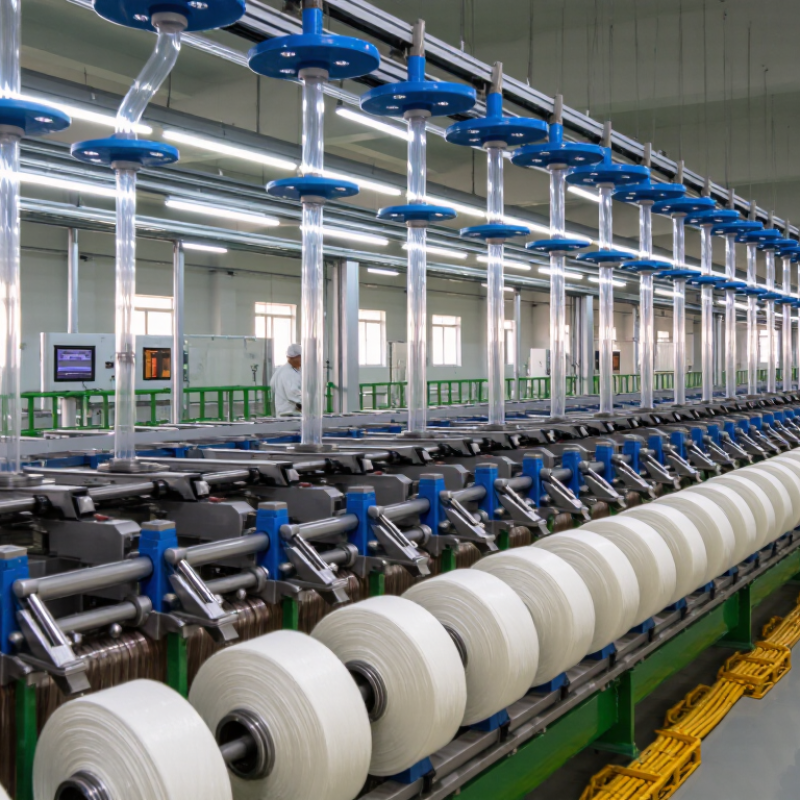
Polyester remains central to filament production. Textile Exchange’s Materials Market Report 2024 estimates 124 million tonnes of global fiber output in 2023, with polyester accounting for 57%. This scale makes equipment selection a production decision, not a simple purchase. Compare the polymer feeder, extruder, spinning beam, cooling cabinet, godets, and winding units as one system. A stable extruder should control melt temperature closely. Small thermal changes can create denier variation across positions.
The spinning beam determines pressure balance and polymer residence time. Check the number of positions, spinneret arrangement, and heating zones. Quench airflow needs uniform distribution around every filament bundle. Uneven cooling may produce unstable interlacing and weaker yarn.
Godet design affects draw control, surface friction, and operating speed. A high-speed winder is useful only when tension remains consistent. Otherwise, more speed can create more waste. It sounds obvious, but factories still compare maximum speed first.
Energy and maintenance deserve equal attention. The International Energy Agency’s Energy Efficiency 2023 analysis identifies motor-driven systems as major industrial electricity users, so inspect drive efficiency, pump loading, and standby consumption. Ask for measured kWh per kilogram, not estimated figures. Also compare filter access, sensor replacement time, spare-part availability, and control-system diagnostics. I would not trust a perfect brochure. Trial yarn, inspection records, and operator experience often reveal weaknesses that specifications hide.
Assess Automation, Maintenance, and Technical Support
Choosing the best POY spinning line requires more than comparing output figures. Automation, maintenance access, and technical support often determine daily profitability. A useful line should record tension, temperature, speed, and alarm history without hiding important details.
During a production review, inspect the control interface and watch a simulated fault. Can operators identify the problem within minutes? Automatic doffing saves labor. However, poor alarm design can create confusion. Manual override remains essential when sensors fail or settings need adjustment. Operators should also receive practical training, not only a short presentation.
Maintenance details deserve close attention. Check whether filters, heaters, rollers, and lubrication points are easy to reach. Ask how long common sensor replacements take. A compact layout may save factory space but make servicing slower. That trade-off is easy to miss. Request a preventive maintenance schedule, spare-parts list, and realistic downtime estimates.
Technical support should include commissioning assistance, remote diagnostics, clear manuals, and defined response times. Confirm who handles software updates and process deviations after installation. Reliable support also means keeping parameter backups and documenting every change. In my experience, unresolved minor alarms can become expensive quality problems. No evaluation is perfect. Leave room for operator feedback after the first months of production.
How to Choose the Best POY Spinning Line? - Assess Automation, Maintenance, and Technical Support
| Line Configuration | Typical Throughput Range
(kg/h) | Automation Level | Estimated Routine Maintenance
(hours per 1,000 operating hours) | Typical Start-Up Waste
(% of Start-Up Material) | Remote Diagnostic Capability | Recommended Technical Support Coverage | Scalability | Evaluation Score
(out of 10) |
Entry-Level POY Line
Small Production Capacity | 300–600 | Basic to Semi-Automatic | 55–75 | 3.0–5.0% | Limited | Business-hours support with on-site commissioning | Moderate | 6.4 / 10 |
Standard POY Line
Medium Production Capacity | 600–1,000 | Automatic Process Control | 40–60 | 2.0–3.5% | Basic remote monitoring | Extended-hours support and scheduled service visits | Good | 7.6 / 10 |
High-Speed POY Line
Large Production Capacity | 1,000–1,600 | Advanced Automatic Control | 30–45 | 1.5–2.5% | Real-time diagnostics and alarm history | 24/7 remote response with regional field service | Very Good | 8.7 / 10 |
Energy-Optimized POY Line
High Efficiency Design | 800–1,400 | Advanced Automatic Control | 28–42 | 1.5–2.5% | Production analytics and predictive alerts | 24/7 technical hotline and preventive maintenance planning | Very Good | 8.9 / 10 |
Flexible Multi-Product POY Line
Multiple Polymer and Denier Options | 500–1,300 | Recipe-Based Automatic Control | 35–55 | 2.0–3.5% | Remote diagnostics and recipe backup | Application engineering, training, and on-site support | Excellent | 8.5 / 10 |
| Selection Guidance: Prioritize automation when consistent denier, lower start-up waste, and reduced operator intervention are important. Compare maintenance hours, spare-parts availability, technician response time, training scope, and remote diagnostic functions. Throughput and maintenance figures are typical planning ranges for modern POY production lines; actual results depend on polymer type, denier range, spinning speed, operating schedule, utilities, preventive-maintenance practices, and plant conditions. |
Calculate Total Ownership Cost Before Making a Decision
Choosing a POY spinning line requires more than comparing purchase prices. Calculate total ownership cost over at least ten years. Include equipment, installation, building modifications, utilities, labor, spare parts, financing, waste, and resale value. A low-priced line may become expensive when it consumes more electricity or requires frequent component replacement.
Start with measurable operating data. Record kilowatt-hours per kilogram, production speed, annual operating hours, and expected efficiency. For example, a 2,000-kilogram daily line creates a major cost difference from small energy variations. The U.S. Department of Energy reports that compressed-air systems often lose 20–30% of their output through leaks. Therefore, include air leakage inspections, pressure requirements, and compressor maintenance in the calculation. Small leaks become large annual expenses.
Demand also matters. Textile Exchange’s Materials Market Report 2024 states that global fiber production reached 124 million tonnes in 2023. Polyester remained the dominant fiber category, increasing pressure for stable, efficient production. Ask for verified energy records, maintenance histories, and output data from comparable installations. Do not rely only on supplier estimates. My first cost spreadsheet once ignored floor reinforcement and chilled-water capacity. That mistake changed the investment result. Leave room for uncertainty, because electricity prices, labor availability, and product specifications can shift. A realistic model should show best-case, normal, and difficult operating scenarios.





