


Choosing a Mbbr System For Wastewater Treatment starts with the wastewater, not the equipment brochure. A moving bed biofilm reactor uses small carriers that provide surfaces for microorganisms to grow. Air or mechanical mixing keeps those carriers moving through the treatment tank. The process can suit municipal and industrial applications, but performance depends on more than media type. Small details matter.
Begin by documenting average and peak flow, influent strength, temperature, and the required effluent quality. These figures help determine tank volume, media quantity, aeration needs, and screening requirements. Ask suppliers to explain their design assumptions, including expected loading and media fill fraction. A high advertised surface area alone does not prove a system will meet your needs. No single number settles it.
Compare the proposed system with site conditions. Check available footprint, existing tanks, power supply, downstream treatment, and access for maintenance. Review how the design handles peak loads, retains carriers with screens, and supplies enough oxygen without excessive energy use. Request operating data from comparable installations, not just ideal design estimates. Where uncertainty remains, independent engineering review or pilot testing can reduce risk. That can feel slow, but replacing an undersized blower or unsuitable screen is worse. Trade-offs remain. A careful selection balances treatment goals, reliability, operating costs, and the skills of the people who will run the plant.
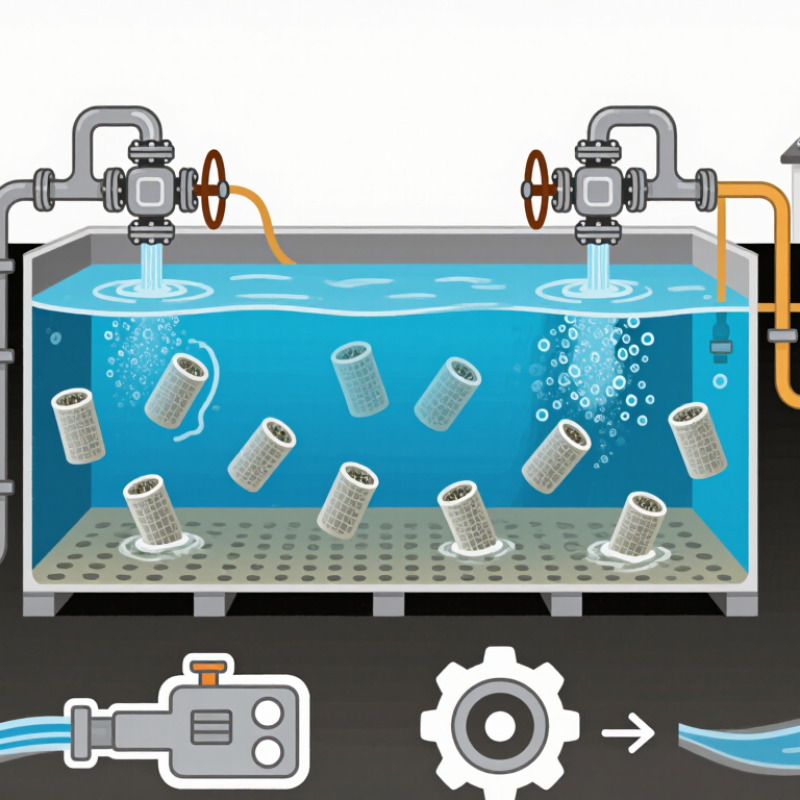
An MBBR system treats wastewater by growing microorganisms on small plastic carriers suspended inside a tank. Incoming water usually passes through screening first, where rags and larger debris are removed. Air diffusers or mixers keep the carriers moving and supply oxygen. A thin biofilm forms on their surfaces. These microorganisms consume biodegradable pollutants and, when conditions allow, convert ammonia into nitrate. The carriers stay in the tank while treated water flows onward. Simple in principle. Not effortless in practice.
Choosing a system means matching tank volume, carrier fill, and aeration to actual wastewater flow and pollutant levels. A food-processing facility, for example, may see sharp organic-load changes between shifts. A municipal plant may need steady ammonia removal through colder months. Both require site-specific design. Too little oxygen can limit treatment; too much airflow wastes energy and may disrupt the process. Downstream settling or filtration may still be needed to remove suspended solids. Check influent data, temperature swings, existing tank dimensions, and discharge targets before selecting equipment. A single lab sample can be misleading. Repeated testing gives a more useful picture, though operating conditions will still change.

Before selecting an MBBR system, define the treatment result it must achieve. Identify required reductions in organic load, suspended solids, or ammonia, and set measurable effluent targets. A small food-processing plant may face sharp washdown peaks, while municipal flows often vary by hour. That matters. Design around measured average and peak flows, not a single convenient sample.
Collect influent data across operating conditions, including temperature, pH, and pollutant concentrations. Check seasonal changes and any planned production increases. MBBR carriers provide surface area for biofilm growth, but their performance depends on suitable loading, aeration, and screening. Existing basins may be reusable, yet their depth, shape, and mixing pattern can limit practical capacity. Check power supply, access for maintenance, and space for screens and blowers. Operators matter.
Walk the site with the people who run the plant. Ask where solids collect, how often screens need attention, and whether backup equipment is available. A spreadsheet can make uncertain data look exact; it is worth noting gaps rather than hiding them. Confirm key assumptions with additional sampling or a treatability assessment before sizing equipment. That step may feel slow, but it can prevent a system from being sized for conditions the site rarely sees.
Compare representative domestic wastewater influent ranges with example secondary-treatment planning values when setting initial MBBR goals. Actual influent concentrations and permitted effluent limits vary by location and facility; confirm them with site sampling and applicable regulations. Ammonia targets are site- and permit-specific.
A reliable MBBR design starts with measured wastewater flows and loads, not the tank volume alone. Record average and peak flow, daily BOD or COD, ammonia, temperature, and solids. A small equalization tank can soften sharp flow swings, but it cannot fix an undersized biological process. Size the reactor against expected loading and required effluent limits, then check hydraulic retention time at peak flow.
Process design also depends on carrier media and oxygen transfer. The media’s protected surface area supports biofilm growth, but filling the tank too heavily can restrict movement and mixing. Confirm the proposed fill fraction with the supplier’s design data, and verify that screens retain carriers without clogging. Aeration must keep carriers moving while meeting oxygen demand; watch for dead zones near corners and under diffuser grids. Leave room for maintenance access. A design that works on paper may still need adjustment after startup, especially when influent quality changes seasonally.
Tips: Ask for the assumptions behind every capacity figure. Compare peak-day loading, not just annual averages. If data are uncertain, sample over time or run a pilot test. It may feel slower, but guessing can be costly.
Choosing an MBBR system means matching carrier media, aeration, and tank geometry to the actual wastewater. The US EPA’s Moving Bed Biofilm Reactor fact sheet reports carrier fill ratios commonly around 40–70% of reactor volume. More media is not automatically better: carriers need room to move, and screens must retain them without trapping debris. Check protected surface area, carrier density, and resistance to abrasion against the supplier’s test data. Then confirm performance with site-specific wastewater, not a catalogue example.
Aeration must supply oxygen and keep carriers circulating. Watch the water surface: dead zones, quiet corners, or carriers piling against a screen can signal poor distribution. Design checks should account for peak oxygen demand, diffuser fouling, and the energy cost of continuous mixing. EPA’s Nutrient Control Design Manual notes that nitrification slows as temperatures fall, so cold-weather oxygen and treatment margins deserve attention. Small changes matter.
Layout affects access as much as biology. Compare single-stage and staged tanks, screen locations, bypass provisions, and space for diffuser maintenance. A compact arrangement may fit a tight site but complicate cleaning; that trade-off is easy to underestimate. Ask engineers to show carrier movement and airflow under minimum and peak loads. A simple pilot or mixing test can reveal problems before concrete is poured. I would still treat generic sizing ranges as a starting point, not a promise.
How to Choose the Best MBBR System for Wastewater Treatment
Evaluate Operating Needs, Costs, and Compliance
Choose an MBBR system around the wastewater your plant actually receives, not just its average flow. Review peak flows, BOD, COD, ammonia, temperature, and suspended solids. A morning sample may miss a washdown surge or a weekend lull. Use operating records across seasons when possible. These details affect tank volume, media fill, and aeration needs.
Compare more than the purchase price. Blower electricity, screen cleaning, media retention, sludge handling, and operator time all shape long-term cost. Ask suppliers for energy estimates tied to your actual load, and check what assumptions they used. A spreadsheet can make costs look precise when influent quality is not. That matters.
For compliance, compare expected effluent quality with your discharge permit and required monitoring limits. Confirm the design can handle peak loading, and plan accessible sampling points. Request performance data from comparable wastewater conditions, not just ideal test results. I’d be cautious about promises of guaranteed compliance; real plants vary, sometimes in ways the design model misses. Commissioning data and routine lab tests help reveal those gaps early.
| Evaluation Factor | Municipal Secondary-Treatment Upgrade | Industrial Wastewater with Variable or High Organic Loads | Nitrification or Permit-Driven Upgrade |
|---|---|---|---|
| Best suited to | Increasing biological capacity at an existing plant, especially where adding conventional aeration-basin volume is difficult. | Wastewater with changing flow or biodegradable organic loads, provided toxic or inhibitory compounds are identified and managed. | Improving ammonia removal or adding biological treatment capacity where discharge limits require more consistent performance. |
| Key design inputs | Average and peak flow, influent BOD5/COD, temperature, existing tank dimensions, and downstream clarification capacity. | Flow and load profiles, COD fractionation, pH, temperature, salinity, toxicity, and the effect of production cycles or cleaning discharges. | Influent ammonia, required effluent ammonia, minimum wastewater temperature, alkalinity, dissolved oxygen, and available contact time. |
| Media fill and retention | Media fill is commonly selected within roughly 30–60% of reactor volume, subject to media geometry, mixing, screen design, and supplier limits. | Fill fraction is established by the required treatment capacity and hydraulic mixing checks; higher fill is not automatically better. | Reactor sizing must provide sufficient protected biofilm area and contact time at the coldest expected operating conditions. |
| Aeration and mixing | Provide oxygen for carbon removal and enough mixing to keep carriers moving throughout the reactor; verify blower and diffuser capacity. | Design for peak oxygen demand and load swings. Equalization, staged treatment, or load control may be needed for stable operation. | Maintain oxygen and alkalinity for nitrification. Nitrification commonly requires more oxygen and is more temperature-sensitive than carbon removal. |
| Solids separation | Confirm that the existing clarifier or downstream separation process can handle the additional suspended solids and sloughed biofilm. | Allow for variable solids production and consider pretreatment where oil, grit, or high suspended solids could disrupt operation. | Include reliable downstream solids capture; an MBBR reactor alone does not remove suspended solids from the final effluent. |
| Capital cost considerations | Often attractive for a retrofit when existing tanks can be reused; costs include carriers, retention screens, aeration upgrades, and installation. | Cost depends on equalization, pretreatment, corrosion-resistant materials, redundancy, and the range of influent conditions to be covered. | May require additional reactor volume, aeration capacity, alkalinity management, and polishing or filtration to meet the discharge permit. |
| Operating cost drivers | Blower electricity, diffuser maintenance, screen cleaning, carrier loss prevention, and routine effluent monitoring. | Energy use, pH or nutrient adjustment, pretreatment, process monitoring, and management of variable production loads. | Aeration energy, alkalinity addition where needed, temperature-related capacity, and more frequent ammonia monitoring. |
| Compliance checks | Compare expected performance with the site permit for BOD5, TSS, ammonia, and any applicable nutrient limits. | Check permit limits and local pretreatment requirements for parameters such as pH, COD/BOD, TSS, oil and grease, and specific regulated pollutants. | Use permit-specific ammonia and nitrogen limits, sampling requirements, seasonal conditions, and any required effluent polishing as design criteria. |
| Main risks to evaluate | Insufficient clarifier capacity, inadequate aeration, poor carrier movement, or hydraulic short-circuiting. | Shock loads, toxic compounds, pH excursions, temperature changes, and inadequate equalization or pretreatment. | Low temperatures, insufficient alkalinity or oxygen, inadequate biofilm contact time, and relying on biological treatment without solids polishing. |
| Useful selection documents | Recent flow and laboratory data, tank drawings, blower and clarifier capacity checks, and a process performance guarantee tied to defined influent conditions. | Representative sampling across production cycles, treatability testing where uncertainty is high, chemical inventory, and a load-variation assessment. | Seasonal ammonia and temperature data, alkalinity measurements, permit conditions, process calculations, and a commissioning and monitoring plan. |
Planning note: Media fill ranges are preliminary screening guidance, not universal design limits. Final sizing and expected effluent quality depend on wastewater characteristics, temperature, media properties, reactor hydraulics, aeration, downstream solids separation, and site-specific permit requirements. Obtain project-specific process calculations and cost estimates before equipment selection.


For those larger-sized parts, or smaller quantity runs, we have 2 independent powder coat booths and ovens. The quality, durability and affordability of today’s powder coating finishes make this the process of choice for world-class companies.
Powder coating advantages over other forms of coating are many. Materials used in the Powder coating process can be metals and non-metals that come in a multitude of thicknesses, textures, colors, etc. Another of Powder coating’s biggest advantages over conventional coatings is its ability to create finishes in many different textures. Powder Coating Booths allow us the ability to apply these advantages to large products.
Tri-State Fabricators runs a full-service conveyor line for painting. Wet painting can provide protection or decoration to many different part styles. From start to finish, every project is easier to undergo random and point-based inspection by our skilled painting team.
Advantages to our Wet Paint Line are these lines start with product prep and ends with a thorough inspection of a high quality finished product. Our ability to complete large and small projects with a superior finish and doing so in a timely and economical fashion. This passes along the savings in production to our customers. When powder coating ins not an option, our Wet Paint Line gets the job done right the first time.
When the parts get big and heavy we roll-out our custom paint racks and oversize booth. By utilizing our partnerships with all the major paint brands, we can match virtually any color with wet paint.
The advantages of having access to a Wet Paint Booth are many. Large projects of many different shapes can be loaded into the booth. The Wet Paint Booth offers an environment that is much more controlled than a typical parts painting operation.
Not only are they used because of their controlled environment, but they’re are also advantageous when it comes to applying paint to parts that are needed in industries that require specialty coatings such as medical, aerospace, etc.
Our military forces have some very high standards when it comes to the finish of their vehicles and equipment. From the first pre-treatment step to final coat, it takes a great deal of knowledge and experience to protect the men and women of our armed forces. They deserve only the best, and Tri-State Fabricators provides it.
All of our processes are closely monitored by our staff and management teams. Both of which are highly trained in the processes of metal fabrication and finishing. Tri-State Fabricators’ goal is to always fully satisfy each and every customer, including the military. We will always put a 110% into what we do.
Abrasive media blasting is an excellent way to remove old paint, rust, and increase the paint/powder adhesion. Glass beads produce a much smoother and brighter finish than angular abrasives; leaving the part clean yet without any dimensional change. Chemically inert and environmentally friendly, we can recycle our beads approximately 30 times; making them a more preferred method of metal cleaning or surface finishing.
Advantages to Glass Bead Blasting are many. Glass bead blast media is used when a project is needing rough surfaces need to become smooth for applications of coatings such as paint. It is typically used to clean paint and rust from a product surface without deforming the surface it is being used on. Overall, compared to many other blasting media, Glass Bead Blasting is a very economical choice and those savings are always passed on to our customers.
Tri-State Fabricators utilize a zinc phosphate wash to clean and etch the material to ensure the best paint adhesion possible. The unique design of our 3-stage wash system does the work like a 5-stage. From Cleaning and rinsing to conversion coating and post-treatment, Our Part Washing process is a complete service and works throughout the fabrication service and the finishing service.
Along with the previously mentioned benefits, Curing is a vital chemical reaction that leaves the product finish hard and relatively safe from mild abrasion and aggressive corrosion. This process can be done in more than one way; ambient air-dry or in curing ovens at temps that exceed 240°.
From fixing paint mistakes (someone else’s of course) to simply cleaning our paint line hooks, our burn-off oven is put to good use. After a quick burn-off, a little clean up, and a fresh coat of paint, your parts will look better than new.
Why does our Burn-Off Oven work so well? Because super heating the air around parts turns the materials into ashes. From paint and powder coatings to rubber and machining oils, high temps do the job without degrading the integrity of the part.
Masking is a vital part of producing high quality products. We have die-cut masking patterns to protect machined surfaces as well as a wide range of plugs and caps to protect threaded holes and bolts. We provide permanent and temporary masking.
Masking allows the selected sections of a product to be protected from a fabrication or finishing service. This can be with both chemicals when etching and tapes, paints when only finishing just a section of the product. Masking is great in aiding the customization process of a project.
Screen printing is a photographic process that transfers artwork onto a porous nylon screen which allows colored ink to flow through the screen and be deposited on an aluminum or plastic component. We can generally have just about any design created onto a screen for your parts.
Some of the advantages of Screen Printing are, brand recognition for your business displaying on your products, assembly instructions, product warnings/hazards, etc. Tri-State Fabricators produces Screen Printing of the highest quality so you know it’s durable.
Metal Finishing is the art of treating the exterior portion of product, often metal but can also be made of other materials, so that the surface is clean and free of any debris. Then the process of applying coats or either paint of powder coat takes place. This coating process improves the quality of the product in both appearance and resistance to wear and corrosion.
Tri-State Fabricators, Inc., understands that a project typically isn’t complete until a high-quality finish has been added to your product. This is why our painting and powder coating teams continuously inspect the products throughout the Metal Finishing process.

