


How to Choose the Best Material Handling Robots?

Choosing Material Handling Robots is less about buying the newest machine and more about matching a robot to the work on your floor. Joseph F. Engelberger, a robotics pioneer, is widely credited with saying, “I can’t define a robot, but I know one when I see one.” For warehouse teams, the practical question is more specific: can the system move your actual loads, through your actual space, at the pace your operation needs?

Start with the task. A pallet-moving AMR, a fixed industrial arm, and an autonomous forklift solve different problems. Record load weight, dimensions, pickup height, travel distance, aisle width, and daily peaks. Watch the route during a busy shift. A clear floor plan can still hide a blocked fire door or a slippery corner. Small details matter.

Then compare safety features, navigation, integration, service support, and total cost over time. Ask vendors to demonstrate your own containers and workflows, not only a polished test setup. Check how the robot behaves when a pallet is crooked or a route is temporarily blocked. It may pause. That matters. A pilot can expose downtime, training needs, and awkward handoffs before a larger rollout. Be honest about the data, too; cycle-time estimates are often less tidy than expected. The best choice is not always the fastest robot. It is the one your people can use reliably, maintain, and adapt as demand changes.
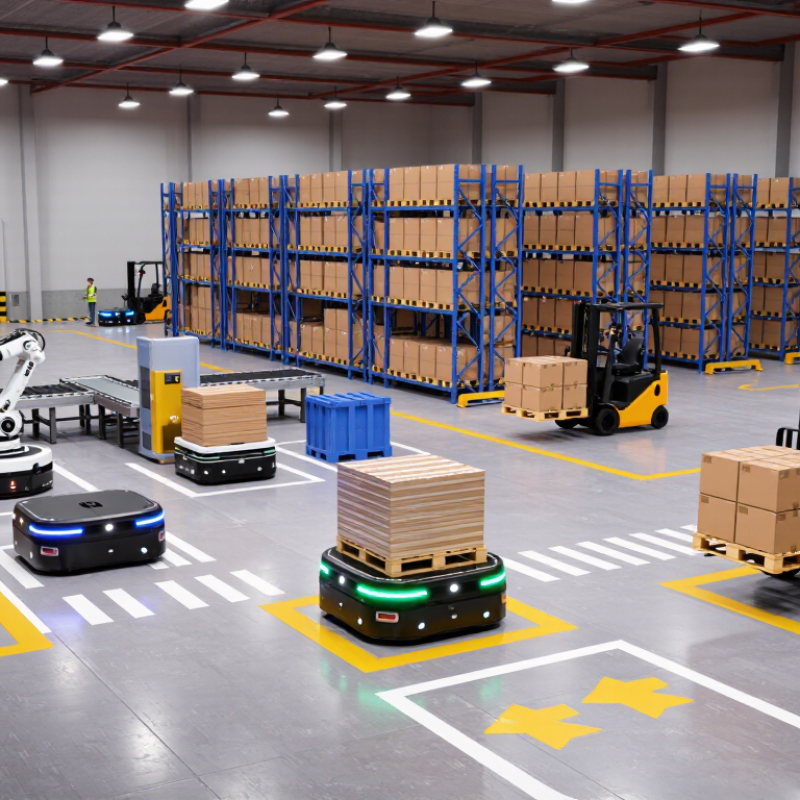
How to Choose the Best Material Handling Robots?

Define Your Material Handling Needs and Operating Requirements

How to Choose the Best Material Handling Robots?

Define Your Material Handling Needs and Operating Requirements

Start by mapping each movement the robot must handle: where loads begin, where they go, and how often trips occur. Record load dimensions, weight, packaging, and the heaviest realistic case—not just the average carton. A pallet that shifts slightly on a rough floor can change the handling requirements. Small details matter.

Measure aisle widths, turning spaces, floor transitions, and docking points on site. Note pedestrian crossings, doorways, and shared work areas during busy shifts. Then estimate required moves per hour, peak periods, and acceptable downtime. If orders vary by season, use real operating data where possible. Guesswork can make a neat plan look more certain than it is.

Check how the robot will connect with conveyors, lifts, storage systems, and existing work procedures. Confirm where charging can happen without blocking traffic, and who will clear a stalled load. Measure it twice. Requirements often change once teams see a route in motion, so trial runs should include awkward loads and congested periods. A requirement that seems minor on paper may become a daily bottleneck. Be willing to revise the plan.


Compare Robot Types for the Tasks You Need to Automate

Material handling is not one job. A mobile robot can move a tote across a changing work area, while an automated guided vehicle follows a more fixed route. For pallet loads, an autonomous forklift may reduce repeated driving; a robotic arm suits repeatable picking, packing, or machine tending. Check payload, travel distance, aisle width, floor condition, and handoff points before comparing models. A robot that handles the load but cannot turn at the rack is the wrong fit.

The International Federation of Robotics reported 4,281,585 industrial robots operating worldwide in 2023, with 541,302 installed that year (World Robotics 2024). These figures show broad automation adoption, but they do not tell you which robot type fits a specific warehouse. Run a small pilot using real shift patterns and representative loads. Measure cycle time, blocked routes, mispicks, and recovery time after a stoppage. One awkward handoff can undo a tidy simulation. It happens.

Tips: Match the robot to the task, not the trend. Mark routes with tape, test peak-hour traffic, and ask operators where loads snag. Compare safety features, integration needs, maintenance access, and total cost over the expected service life. Leave room for human judgment; the first layout rarely stays perfect.

How to Choose the Best Material Handling Robots? — Compare Robot Types for the Tasks You Need to Automate

Robot type Best suited tasks How it moves or works Payload suitability Key advantages Main considerations
Autonomous mobile robot (AMR) Moving totes, components, carts, or other loads between workstations, storage, and packing areas. Navigates using onboard sensors and mapping; can typically plan or adjust routes around obstacles. Varies by model and platform; available solutions range from small-item carriers to heavy-load units. Flexible routes; useful in changing layouts; can reduce repetitive transport work. Needs suitable routes, traffic management, charging arrangements, and integration with doors, lifts, or workflow systems where applicable.
Automated guided vehicle (AGV) Repeatable transport along established routes, such as moving pallets or production materials between fixed points. Follows defined guidance or navigation infrastructure; route changes may require system updates or facility changes. Available in configurations for light loads through heavy pallet and industrial loads. Well suited to stable, repetitive transport flows and predictable routes. Less adaptable than many AMR systems when routes or workflows change; assess aisle access and interaction with people and vehicles.
Articulated industrial robot Machine tending, case packing, palletizing, depalletizing, and handling parts across a work cell. A multi-joint arm moves an end-of-arm tool through a programmed work envelope. Broad range, from small-part handling to heavy industrial loads; capacity depends on arm reach and configuration. Flexible reach and motion; can perform repeated handling tasks at high production rates when properly engineered. Requires application-specific tooling, programming, risk assessment, and appropriate safeguarding or safety-rated design.
Collaborative robot (cobot) Light- to medium-duty pick-and-place, kitting, packaging, and machine tending where workers share a workspace under a validated safety setup. A compact robotic arm designed with features that can support collaborative applications; the complete work cell must still be risk-assessed. Generally selected for lighter loads than many large industrial arms; verify payload, reach, and tool weight for the application. Often compact and comparatively straightforward to redeploy between suitable tasks. Collaborative capability does not automatically make every application safe without guarding; speed and payload may be limited by the task and safety requirements.
Cartesian or gantry robot Palletizing, case handling, loading and unloading, and movement over a large, rectangular work area. Moves along linear axes, commonly in a straight-line X-Y-Z arrangement, often above or around the work area. Can be configured for a wide range of loads, depending on the structure, axes, and end effector. Provides predictable straight-line motion and can cover broad areas with a fixed installation. Requires space for the frame and travel; less suited than an articulated arm to tasks needing complex approaches around obstacles.
Robotic forklift or pallet-handling vehicle Transporting, staging, or storing palletized loads between docks, production areas, and warehouse locations. A mobile vehicle with fork or load-handling equipment navigates facility routes and performs pallet pickup or placement. Designed for palletized loads; check rated capacity, load dimensions, lift height, and load-center requirements. Automates pallet movements without requiring a separate robot arm for each transfer point. Needs compatible pallets, sufficient aisle and turning space, clear pickup locations, and safe coordination with people and other vehicles.
Robotic picking system with vision Picking and sorting individual items from bins, totes, or conveyors for order fulfillment or production feeding. Combines a robot, camera or other sensing, and software to identify item locations and guide the pick. Usually selected for the item size and weight range in the application; irregular or fragile items may need specialized gripping. Can handle varied item positions when the vision and grasping system is matched to the inventory. Performance depends on item presentation, lighting, packaging, graspability, and the quality of vision-system training and integration.

Selection note: Payload, reach, travel speed, throughput, and safety requirements vary by model and application. Confirm the rated specifications and evaluate the robot with representative loads, routes, and work conditions before deployment.

Check Facility Layout, Payload, and System Compatibility

A material-handling robot must fit the building, not just the task list. Map aisle widths, turning points, floor joints, ramps, door clearances, and busy pedestrian crossings. A robot that clears a drawing may still struggle beside a pallet overhang. The International Federation of Robotics reported about 541,000 industrial robot installations worldwide in 2023 in its World Robotics 2024 report. That figure signals broad adoption, but it does not tell you whether a robot suits your floor. Measure the route.

Payload checks need more than the product’s stated weight. Include the pallet, container, gripper, and any load shift during acceleration or braking. Check the load’s center of gravity, too. A tall, uneven stack may be harder to move safely than a heavier, compact one. MHI’s 2024 Annual Industry Report found that 55% of respondents planned to increase investment in supply-chain innovation and technology. Investment is growing; careful site checks still matter.

System compatibility can make or break a deployment. Confirm how the robot exchanges task, location, and fault data with warehouse software, conveyors, lifts, and charging equipment. Ask who owns interface testing, and test real exception cases, such as a blocked aisle or a missing pallet. Small details matter. I would not assume that a successful route simulation proves the whole system is ready; actual traffic and shift changes can expose gaps. Keep time for a pilot, and revise the plan when operators find friction.

Compare the robot’s payload range with your heaviest load, then check aisle width, turning space, floor conditions, and pickup/drop-off points. Confirm the robot can integrate with your warehouse systems and safety equipment. Payload ranges are indicative; specifications vary by model.

Evaluate Safety, Reliability, Integration, and Total Cost

A material handling robot should make a specific task safer, not simply move faster. Map the route, payload, pinch points, and people sharing the aisle. Then test emergency stops, protective sensors, and recovery procedures under realistic conditions. A safety demonstration is useful; a documented risk assessment is better. Reliability needs equal scrutiny. Ask for expected uptime, maintenance intervals, spare-part lead times, and service response targets. Request operating data from similar shifts, not only ideal factory trials. Small faults matter. A stalled lift can block a whole aisle.

Integration can make or break a project. Confirm that the robot can exchange orders and status updates with existing warehouse systems, and test what happens during network loss. The International Federation of Robotics reported 553,052 industrial robot installations worldwide in 2022, a 10% annual increase (World Robotics 2023). Adoption is growing, but scale alone does not prove suitability. Compare total cost: equipment, installation, software, training, energy, maintenance, and downtime. MHI’s 2024 Annual Industry Report found 55% of surveyed supply chain professionals planned to increase technology investment that year. Use that as context, not a reason to rush. A spreadsheet may understate awkward handoffs or uneven floors. Pilot the robot on a busy shift, record exceptions, and revise the assumptions.

Test Candidates and Select the Best-Fit Robot Solution

A robot that looks capable in a showroom may struggle with your actual aisles, loads, or shift patterns. Test candidates in the work area they will serve. Use representative pallets, bins, and load weights, including awkward shapes your team handles every day. Watch how each robot turns at aisle ends and crosses floor joints. Small bumps can expose problems a smooth demo never reveals.

Keep the test realistic. Run repeated trips during a busy shift, then record cycle times, missed handoffs, operator interventions, and charging needs. Check whether the robot stops reliably when people enter its route. Ask maintenance staff to review access to batteries, sensors, and common service points. Count the support hours, too. A fast unit can become costly if it needs frequent attention.

Compare results against your actual priorities, not a single headline speed. One test plan may still miss a seasonal rush or an unusual load. That is worth admitting. Include operators in the review; they may spot awkward staging or unclear alerts before managers do. Confirm that the solution can connect with existing dispatch and inventory systems, and define who handles updates and troubleshooting. Choose the candidate that performs consistently under ordinary working conditions, not only during its best run.

Powder Coat Booths

For those larger-sized parts, or smaller quantity runs, we have 2 independent powder coat booths and ovens. The quality, durability and affordability of today’s powder coating finishes make this the process of choice for world-class companies.

Powder coating advantages over other forms of coating are many. Materials used in the Powder coating process can be metals and non-metals that come in a multitude of thicknesses, textures, colors, etc. Another of Powder coating’s biggest advantages over conventional coatings is its ability to create finishes in many different textures. Powder Coating Booths allow us the ability to apply these advantages to large products.

Wet Paint Line

Tri-State Fabricators runs a full-service conveyor line for painting. Wet painting can provide protection or decoration to many different part styles. From start to finish, every project is easier to undergo random and point-based inspection by our skilled painting team.

Advantages to our Wet Paint Line are these lines start with product prep and ends with a thorough inspection of a high quality finished product. Our ability to complete large and small projects with a superior finish and doing so in a timely and economical fashion. This passes along the savings in production to our customers. When powder coating ins not an option, our Wet Paint Line gets the job done right the first time.

Wet Paint Booths

When the parts get big and heavy we roll-out our custom paint racks and oversize booth. By utilizing our partnerships with all the major paint brands, we can match virtually any color with wet paint.

The advantages of having access to a Wet Paint Booth are many. Large projects of many different shapes can be loaded into the booth. The Wet Paint Booth offers an environment that is much more controlled than a typical parts painting operation.

Not only are they used because of their controlled environment, but they’re are also advantageous when it comes to applying paint to parts that are needed in industries that require specialty coatings such as medical, aerospace, etc.

Military CARC

Our military forces have some very high standards when it comes to the finish of their vehicles and equipment. From the first pre-treatment step to final coat, it takes a great deal of knowledge and experience to protect the men and women of our armed forces. They deserve only the best, and Tri-State Fabricators provides it.

All of our processes are closely monitored by our staff and management teams. Both of which are highly trained in the processes of metal fabrication and finishing. Tri-State Fabricators’ goal is to always fully satisfy each and every customer, including the military. We will always put a 110% into what we do.

Glass-Bead Blasting

Abrasive media blasting is an excellent way to remove old paint, rust, and increase the paint/powder adhesion. Glass beads produce a much smoother and brighter finish than angular abrasives; leaving the part clean yet without any dimensional change. Chemically inert and environmentally friendly, we can recycle our beads approximately 30 times; making them a more preferred method of metal cleaning or surface finishing.

Advantages to Glass Bead Blasting are many. Glass bead blast media is used when a project is needing rough surfaces need to become smooth for applications of coatings such as paint. It is typically used to clean paint and rust from a product surface without deforming the surface it is being used on. Overall, compared to many other blasting media, Glass Bead Blasting is a very economical choice and those savings are always passed on to our customers.

Part Washing

Tri-State Fabricators utilize a zinc phosphate wash to clean and etch the material to ensure the best paint adhesion possible. The unique design of our 3-stage wash system does the work like a 5-stage. From Cleaning and rinsing to conversion coating and post-treatment, Our Part Washing process is a complete service and works throughout the fabrication service and the finishing service.

Along with the previously mentioned benefits, Curing is a vital chemical reaction that leaves the product finish hard and relatively safe from mild abrasion and aggressive corrosion. This process can be done in more than one way; ambient air-dry or in curing ovens at temps that exceed 240°.

Burn-Off Oven

From fixing paint mistakes (someone else’s of course) to simply cleaning our paint line hooks, our burn-off oven is put to good use. After a quick burn-off, a little clean up, and a fresh coat of paint, your parts will look better than new.

Why does our Burn-Off Oven work so well? Because super heating the air around parts turns the materials into ashes. From paint and powder coatings to rubber and machining oils, high temps do the job without degrading the integrity of the part.

Masking

Masking is a vital part of producing high quality products. We have die-cut masking patterns to protect machined surfaces as well as a wide range of plugs and caps to protect threaded holes and bolts. We provide permanent and temporary masking.

Masking allows the selected sections of a product to be protected from a fabrication or finishing service. This can be with both chemicals when etching and tapes, paints when only finishing just a section of the product. Masking is great in aiding the customization process of a project.

Screen Printing

Screen printing is a photographic process that transfers artwork onto a porous nylon screen which allows colored ink to flow through the screen and be deposited on an aluminum or plastic component. We can generally have just about any design created onto a screen for your parts.

Some of the advantages of Screen Printing are, brand recognition for your business displaying on your products, assembly instructions, product warnings/hazards, etc. Tri-State Fabricators produces Screen Printing of the highest quality so you know it’s durable.

Metal Finishing

Metal Finishing is the art of treating the exterior portion of product, often metal but can also be made of other materials, so that the surface is clean and free of any debris. Then the process of applying coats or either paint of powder coat takes place. This coating process improves the quality of the product in both appearance and resistance to wear and corrosion.

Tri-State Fabricators, Inc., understands that a project typically isn’t complete until a high-quality finish has been added to your product. This is why our painting and powder coating teams continuously inspect the products throughout the Metal Finishing process.
