Choosing a Manual Ceramic Coffee Grinder is less about finding a universally “best” model and more about matching its design to your coffee routine. The National Coffee Association’s 2024 National Coffee Data Trends report found that 67% of U.S. adults had coffee in the previous day. That figure describes coffee drinking, not grinder preferences or performance. Still, it highlights why a dependable way to prepare fresh grounds matters to many households.
Small details make a real difference. Consider the burr alignment, grind adjustment range, handle comfort, and capacity before focusing on ceramic burrs alone. Ceramic can resist corrosion, but material by itself does not guarantee even particle size or a better cup. The Specialty Coffee Association’s brewing resources emphasize controlling variables such as dose and extraction; a grinder helps shape the grounds, but it cannot fix every brewing problem. A useful buying decision starts with what you brew: fine grounds for espresso, or coarser particles for a French press.
There are trade-offs. Hand grinding takes time, and some adjustment systems are harder to repeat than others. A compact grinder may fit neatly beside a kettle, yet hold too little coffee for multiple cups. Check how clearly it changes settings and whether its parts can be cleaned or replaced. Reviews can help, but treat unsupported claims about “perfect consistency” with care. Not every cup will be perfect. The aim is a grinder that feels comfortable, produces a suitable range of grounds, and earns its place in your daily routine.
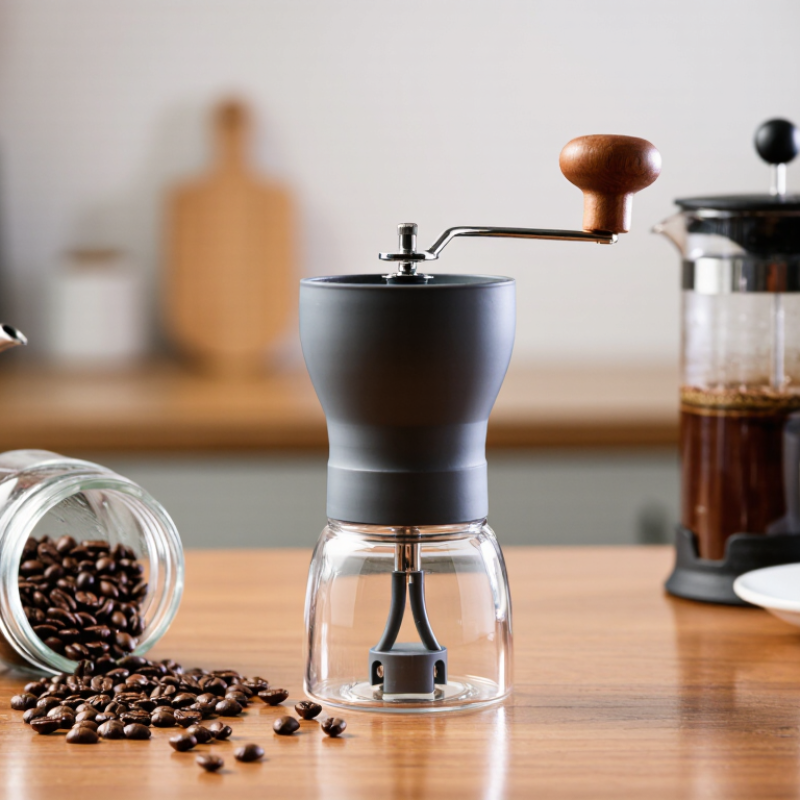
Before choosing a manual ceramic coffee grinder, decide how you usually brew. A pour-over needs a fairly even, medium grind; a French press works better with coarser particles. Espresso requires a much finer setting and careful adjustment. If you switch between methods, check that the grinder offers a useful range for both. A wide range sounds appealing, but it matters only if the settings are consistent.
Think about your daily routine, too. Grinding one cup by hand is manageable; preparing several cups can take longer than expected. Ceramic burrs resist rust and may stay sharp through regular use, but they do not guarantee perfectly uniform grounds. Check whether the adjustment mechanism feels clear and repeatable. Small setting changes should make a noticeable difference without leaving you guessing. Honestly, grind labels can be imperfect; testing a few settings with your own beans is more reliable.
Tips: Start with a medium setting for pour-over or a coarse one for French press. Brew, taste, and adjust one step at a time. If coffee tastes bitter, try a coarser grind; if it tastes weak or sour, try finer. Keep notes. Your preferred range may shift with the beans.
A ceramic burr’s material matters, but its geometry and alignment matter just as much. Look for evenly formed ridges, clean edges, and burrs that sit squarely without visible wobble. Turn the handle slowly with no beans; scraping or uneven resistance may suggest an alignment issue, though it is not a complete diagnosis. Check the fit. A chipped tooth or rough finish can contribute to uneven particle sizes. Ceramic can resist wear, but it is more brittle than steel, so avoid dropping the grinder.
Test consistency using the same beans, dose, and setting across several small batches. Spread each sample on white paper: a consistent grind should not have many powdery fines beside conspicuously large fragments. For a more useful comparison, brew each sample the same way and note drawdown time and taste; one cup alone proves little. That part is messy. Hand speed, bean age, and adjustment also affect results, so do not blame the burr immediately. A grinder that feels smooth may still produce a broad mix of particle sizes.
A manual ceramic coffee grinder should offer settings that match your brewing routine, not just an impressive number of clicks. Coarser settings suit many French press brews, while pour-over often needs a medium grind. Espresso requires a fine, even grind, and some hand grinders cannot adjust precisely enough for it. Check whether the adjustment ring moves in clear steps or turns continuously. Clicks are easier to repeat; stepless adjustment allows finer control but can be fiddly.
Tips: Before brewing, note the setting beside your chosen method. Turn the ring gently, then check that it locks or stays put. Small details matter. A few test cups can reveal whether one click makes a noticeable change in flow or taste.
Look for adjustment markings you can read and a mechanism that feels stable, even with coffee grounds nearby. Ceramic burrs can work well, but burr material alone does not guarantee consistent particle size. There is a trade-off: more settings may offer flexibility, yet tiny adjustments are not useful if they are hard to reproduce. It is also easy to blame the grinder when water temperature or pouring changes the result. Keep those variables steady, and compare one adjustment at a time. Not always perfect, but more informative.
Compare Grind Settings and Adjustment Mechanisms
These approximate particle-size bands show why useful adjustment range matters: espresso generally needs a finer grind than pour-over or French press. Stepped mechanisms move between set positions; stepless mechanisms allow continuous adjustment. Actual particle sizes and ideal settings vary with the grinder, coffee, and brewing method.
Check the grinder’s stated capacity against the coffee you make each time. A small chamber may suit one mug, but it can mean repeated loading for two people. Capacity figures can be confusing, so compare grams rather than cup counts. Cup sizes vary. If possible, measure your usual dose at home and check whether the grounds container holds it without spilling. A narrow counter or packed travel bag also changes what feels practical.
Portability is more than low weight. Look for a handle that folds or detaches securely, a lid that stays in place, and parts that are easy to clean. Ceramic burrs resist corrosion, but they can chip if dropped; a padded pouch may help. For ease of use, test the grip and crank movement if you can. A slippery body or stiff handle gets annoying before the beans are ground. Settings should be clear enough to adjust for different brewing methods, though tiny markings can still be hard to read. There’s a trade-off: a compact grinder may take longer to turn. I’d rather notice that before a rushed morning than after one.
Cleaning is not a minor detail when a grinder is used every morning. The National Coffee Association’s 2024 National Coffee Data Trends report found that 67% of U.S. adults had coffee the previous day. Frequent use makes trapped grounds and oily residue worth considering. Look for a hopper and burr assembly that can be reached with a small brush. Ceramic burrs should stay dry; rinsing them may leave moisture in tight spaces. Check the maker’s cleaning instructions before buying.
Durability depends on more than the burr material. Turn the handle and notice whether the shaft wobbles or the adjustment dial slips. A stable axle and replaceable parts can matter more over time than a polished wooden knob. Ceramic burrs resist corrosion, but they can chip if dropped or struck. It is easy to focus on the burrs and overlook the handle joint. That part takes daily strain.
Compare price with repairability and expected use, not just the first number on the tag. A low-cost grinder may be sensible for occasional brewing, while a sturdier model may suit several cups each day. Divide the price by a realistic number of years, then check whether replacement parts are available. This estimate is imperfect; use and care vary widely. Still, it makes comparisons more grounded than choosing by appearance alone.



For those larger-sized parts, or smaller quantity runs, we have 2 independent powder coat booths and ovens. The quality, durability and affordability of today’s powder coating finishes make this the process of choice for world-class companies.
Powder coating advantages over other forms of coating are many. Materials used in the Powder coating process can be metals and non-metals that come in a multitude of thicknesses, textures, colors, etc. Another of Powder coating’s biggest advantages over conventional coatings is its ability to create finishes in many different textures. Powder Coating Booths allow us the ability to apply these advantages to large products.
Tri-State Fabricators runs a full-service conveyor line for painting. Wet painting can provide protection or decoration to many different part styles. From start to finish, every project is easier to undergo random and point-based inspection by our skilled painting team.
Advantages to our Wet Paint Line are these lines start with product prep and ends with a thorough inspection of a high quality finished product. Our ability to complete large and small projects with a superior finish and doing so in a timely and economical fashion. This passes along the savings in production to our customers. When powder coating ins not an option, our Wet Paint Line gets the job done right the first time.
When the parts get big and heavy we roll-out our custom paint racks and oversize booth. By utilizing our partnerships with all the major paint brands, we can match virtually any color with wet paint.
The advantages of having access to a Wet Paint Booth are many. Large projects of many different shapes can be loaded into the booth. The Wet Paint Booth offers an environment that is much more controlled than a typical parts painting operation.
Not only are they used because of their controlled environment, but they’re are also advantageous when it comes to applying paint to parts that are needed in industries that require specialty coatings such as medical, aerospace, etc.
Our military forces have some very high standards when it comes to the finish of their vehicles and equipment. From the first pre-treatment step to final coat, it takes a great deal of knowledge and experience to protect the men and women of our armed forces. They deserve only the best, and Tri-State Fabricators provides it.
All of our processes are closely monitored by our staff and management teams. Both of which are highly trained in the processes of metal fabrication and finishing. Tri-State Fabricators’ goal is to always fully satisfy each and every customer, including the military. We will always put a 110% into what we do.
Abrasive media blasting is an excellent way to remove old paint, rust, and increase the paint/powder adhesion. Glass beads produce a much smoother and brighter finish than angular abrasives; leaving the part clean yet without any dimensional change. Chemically inert and environmentally friendly, we can recycle our beads approximately 30 times; making them a more preferred method of metal cleaning or surface finishing.
Advantages to Glass Bead Blasting are many. Glass bead blast media is used when a project is needing rough surfaces need to become smooth for applications of coatings such as paint. It is typically used to clean paint and rust from a product surface without deforming the surface it is being used on. Overall, compared to many other blasting media, Glass Bead Blasting is a very economical choice and those savings are always passed on to our customers.
Tri-State Fabricators utilize a zinc phosphate wash to clean and etch the material to ensure the best paint adhesion possible. The unique design of our 3-stage wash system does the work like a 5-stage. From Cleaning and rinsing to conversion coating and post-treatment, Our Part Washing process is a complete service and works throughout the fabrication service and the finishing service.
Along with the previously mentioned benefits, Curing is a vital chemical reaction that leaves the product finish hard and relatively safe from mild abrasion and aggressive corrosion. This process can be done in more than one way; ambient air-dry or in curing ovens at temps that exceed 240°.
From fixing paint mistakes (someone else’s of course) to simply cleaning our paint line hooks, our burn-off oven is put to good use. After a quick burn-off, a little clean up, and a fresh coat of paint, your parts will look better than new.
Why does our Burn-Off Oven work so well? Because super heating the air around parts turns the materials into ashes. From paint and powder coatings to rubber and machining oils, high temps do the job without degrading the integrity of the part.
Masking is a vital part of producing high quality products. We have die-cut masking patterns to protect machined surfaces as well as a wide range of plugs and caps to protect threaded holes and bolts. We provide permanent and temporary masking.
Masking allows the selected sections of a product to be protected from a fabrication or finishing service. This can be with both chemicals when etching and tapes, paints when only finishing just a section of the product. Masking is great in aiding the customization process of a project.
Screen printing is a photographic process that transfers artwork onto a porous nylon screen which allows colored ink to flow through the screen and be deposited on an aluminum or plastic component. We can generally have just about any design created onto a screen for your parts.
Some of the advantages of Screen Printing are, brand recognition for your business displaying on your products, assembly instructions, product warnings/hazards, etc. Tri-State Fabricators produces Screen Printing of the highest quality so you know it’s durable.
Metal Finishing is the art of treating the exterior portion of product, often metal but can also be made of other materials, so that the surface is clean and free of any debris. Then the process of applying coats or either paint of powder coat takes place. This coating process improves the quality of the product in both appearance and resistance to wear and corrosion.
Tri-State Fabricators, Inc., understands that a project typically isn’t complete until a high-quality finish has been added to your product. This is why our painting and powder coating teams continuously inspect the products throughout the Metal Finishing process.


