


How to Choose the Best Hose Crane for Your Needs?

Choosing the right Hose Crane begins with the work it must do, not the largest figure in a catalog. Consider the hose’s weight when full, its length, bend radius, and the distance it must reach. A crane that looks adequate on paper may feel awkward beside a tank, pump, or loading bay. Small details matter.

A practical buying principle is: “Match the crane to the hose, the reach, and the real work cycle.” This is an original editorial line, not a verified quotation from a named industry expert. For a published article, replace it with a sourced quote from a qualified Hose Crane specialist. That distinction matters. Reliable advice should be traceable.

Check mounting space, available power, control type, operating environment, and maintenance access. Ask how the crane behaves when the hose is wet, dragging, or carrying product. These conditions change handling. Also review the manufacturer’s load data and installation guidance with a qualified professional. Do not rely on a headline capacity alone.

This guide explains how to compare crane types, reach, capacity, controls, and support. It also points out trade-offs that product pages often leave vague. A lower purchase price can mean more effort during daily handling. Sometimes the simplest setup is best. Sometimes it is not. The right choice should fit the site, protect the hose, and make routine work more controlled.
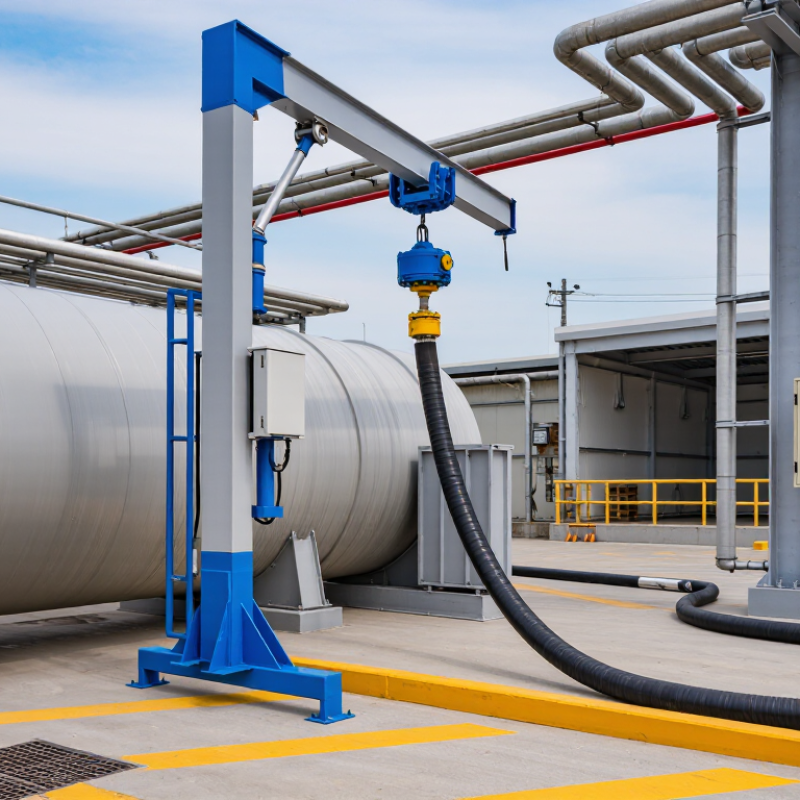
How to Choose the Best Hose Crane for Your Needs?

Identify the Hose-Handling Tasks and Loads You Need to Support

Before choosing a hose crane, map the work it must actually do. Note the hose’s type, length, filled weight, and connection points. A hose carrying liquid can weigh far more than it does when empty. Record how often it moves, how far it travels, and whether operators need to guide it around equipment or over a tank. Measure the available space, too. A crane that reaches the load but blocks a walkway creates a different problem.

Tips: Weigh the hose in its heaviest expected condition. Include fittings and any liquid inside. Check the working radius from the crane’s mounting point to the farthest handling position. Leave room for movement, not just a perfect, straight lift.

Then compare those details with the crane’s rated capacity and reach. Check the load rating at the intended extension; capacity can change as the arm reaches farther. Consider the hose’s bend radius and how it will be supported, since a tight bend may damage the hose or interrupt flow. Think about the operator’s position and visibility during handling. These checks help, though they cannot replace the manufacturer’s load chart or a qualified site assessment. I’ve seen planning focus too much on maximum capacity and too little on awkward hose routing. That part is easy to overlook.


Compare Crane Types, Mounting Options, and Available Space

A hose crane should match the hose route, not just its rated load. A wall-mounted jib keeps floor space open, but needs a sound wall or column and enough swing clearance. A floor-mounted jib offers more placement freedom, though its base and anchor bolts occupy valuable space. Overhead or gantry systems suit long travel paths, but need headroom and a clear runway. Measure the hose’s full reach, bend radius, reel width, and the operator’s working zone before choosing.

Space matters. OSHA 29 CFR 1910.179(b)(6) specifies at least 3 inches of overhead and 2 inches of lateral clearance for overhead and gantry cranes. Treat these figures as a reference for those crane types, not a universal hose-crane design rule. Verify the applicable requirements with a qualified designer. OSHA 29 CFR 1910.179(k)(2) also limits overhead-crane test loads to 125% of rated load unless the manufacturer recommends otherwise. Don’t use that figure to size a crane; confirm its rating and test plan with the supplier.

Tips: Mark the crane’s swing arc on the floor with tape. Then check doors, pipes, lights, and parked equipment. A layout can look spacious on paper and still snag a hose in daily use. Leave room for maintenance, too. That detail is easy to miss.

How to Choose the Best Hose Crane for Your Needs? — Compare Crane Types, Mounting Options, and Available Space
Crane Type Common Mounting Option Space Requirements Reach and Movement Key Advantages Best Suited For
Wall-mounted jib crane Attached to a structurally suitable wall or building column Leaves the floor area beneath the crane largely open; requires a suitable supporting structure and unobstructed swing area Typically swings around a fixed vertical pivot; working radius depends on the jib design Uses less floor space and can serve a defined workstation or hose-handling point Facilities with strong supporting walls or columns and limited floor space
Floor-mounted jib crane Fixed to a designed foundation or structural floor mounting Needs a clear area for the base and boom rotation; does not rely on a building wall for support Provides local coverage around its installation point; rotation and reach vary by design Can be positioned near a work area when wall mounting is not practical Open work areas, loading points, and locations without a suitable wall or column
Pedestal-mounted crane Installed on a pedestal secured to a deck, foundation, or other engineered support Requires a dedicated mounting footprint and enough clearance for the boom and suspended hose to move May provide a broad working envelope, depending on its boom and rotation design Offers a dedicated crane position and can be configured for specific site or vessel layouts Marine, dockside, or industrial installations where a freestanding support is appropriate
Articulating or knuckle-boom crane Often pedestal-, deck-, or vehicle-mounted, subject to the installation design Can fold into a relatively compact stowed position; still needs clearance throughout its operating range Articulated boom sections can reach around obstacles and change the working angle Offers flexible positioning in confined or obstructed work areas Sites where a straight boom cannot easily reach the hose connection or handling point
Telescopic-boom crane Commonly mounted on a pedestal, deck, or suitable mobile carrier Requires space for operation and a clear route for the boom to extend; stowed dimensions depend on the model Reach can be adjusted by extending or retracting boom sections Allows the operator to vary reach without repositioning the crane base Applications with changing reach requirements and a suitable operating clearance
Fixed or straight-boom hose crane May be wall-, floor-, or pedestal-mounted, depending on the site structure Needs a clear sweep area; typically has fewer folding or extension movements than articulated designs Moves along a simpler, defined path; reach is set by the crane configuration Simple layout can make it suitable for repetitive handling at a consistent location Hose transfer between regularly positioned connection points
Selection checks: Confirm the hose assembly’s total suspended weight, including fluid when applicable, fittings, and lifting attachments. Check the crane’s rated capacity at the required working radius using its load chart, and verify foundation or supporting-structure suitability, operating and stowed clearances, hose bend limits, and applicable local safety requirements. Capacity, reach, rotation, and mounting requirements vary by crane design and installation.

Match Lifting Capacity, Reach, and Motion to Your Worksite

How to Choose the Best Hose Crane for Your Needs?

A hose crane should match the load, working radius, and movement your site actually requires. Start with the heaviest realistic lift, including the hose, couplings, and any retained fluid. Do not size only for a dry hose. Check the crane’s rated capacity at the intended reach, since lifting ability often falls as the boom extends. Leave room for safe positioning around trucks, tanks, and walkways. A crane that reaches the far edge of a work area may not lift the load there.

Consider how the hose must move. A compact site may need controlled slewing and careful boom positioning, while a larger work zone may benefit from greater reach. Look at overhead obstacles, ground conditions, and where operators can stand with a clear view. A common planning mistake is choosing extra reach before checking capacity at full extension. That choice can be costly, and it deserves a second look. Confirm the load chart and operating limits with qualified personnel before use.

Tips: Measure the farthest pickup point. Record the hose and accessory weights. Check the rated capacity at that exact radius, then allow space for setup and movement.

Assess Safety Features, Controls, and Environmental Ratings

Safety features, controls, and environmental ratings should shape your hose crane choice. A 2011–2017 analysis of U.S. Bureau of Labor Statistics records counted 297 crane-related worker deaths. The figure covers cranes broadly, not hose cranes alone, but it underlines the value of reliable safeguards. Check for overload protection, emergency stops, limit switches, clear load charts, and controls that remain usable while wearing gloves. Test whether the operator can see the load and stop movement quickly.

Match the crane’s environmental protection to its actual location. IEC 60529 IP ratings describe protection against dust and water, but they do not measure resistance to salt corrosion. For marine or washdown settings, ask about corrosion-resistant materials, sealed electrical components, and a documented maintenance schedule. A higher IP rating is not a substitute for corrosion protection. That distinction is easy to miss. Confirm that control stations and cable entries suit the expected exposure, including spray, temperature changes, and grit.

Tips: Before purchase, run a practical check with the hose attached. Test the emergency stop, controls, and movement limits, then review inspection records. Record any awkward reach or blind spot; small problems can persist when the crane is in daily use.

How to Choose the Best Hose Crane: Understanding Water Ingress Ratings

How to read this chart: The bars show the water-protection code numbers defined by IEC 60529, not a linear measure of protection. IPX4 covers splashing water, IPX5 water jets, IPX6 powerful water jets, and IPX7 temporary immersion under specified test conditions. IPX7 does not automatically mean protection against IPX5 or IPX6 jet tests.

When selecting a hose crane: Match the equipment’s certified ingress rating to the site’s actual exposure. Separately verify the crane’s rated load and safety devices, and check that its controls suit the operator and installation.

Compare Maintenance Needs, Total Cost, and Supplier Support

A hose crane’s purchase price reveals little about its long-term value. Compare inspection access, corrosion protection, spare-part availability, and the time needed to replace seals or hydraulic hoses. Ask suppliers for a maintenance schedule tied to duty cycles and operating conditions, not just calendar dates. Small leaks matter. A slow repair can leave a loading bay unusable.

Total cost includes installation, inspections, energy, downtime, and replacement parts. The U.S. Department of Energy’s Operations & Maintenance Best Practices Guide reports that effective operations and maintenance programs can save 5–20% on energy bills. That figure is not a hose-crane guarantee, but it shows why operating practices deserve attention. Request a cost breakdown across the crane’s expected service life, and check which assumptions drive it. They may be optimistic.

Supplier support is practical, not decorative. Confirm response times, technician coverage, documentation, and whether critical components are stocked locally. Ask for a sample service record and a clear escalation contact. If a supplier cannot explain how a technician would diagnose a hose leak or limit downtime, pause. I would also compare two service plans using the same operating hours; otherwise, the cheaper offer may only look cheaper. No spreadsheet captures every delay. That is worth admitting.

Article Source:

Powder Coat Booths

For those larger-sized parts, or smaller quantity runs, we have 2 independent powder coat booths and ovens. The quality, durability and affordability of today’s powder coating finishes make this the process of choice for world-class companies.

Powder coating advantages over other forms of coating are many. Materials used in the Powder coating process can be metals and non-metals that come in a multitude of thicknesses, textures, colors, etc. Another of Powder coating’s biggest advantages over conventional coatings is its ability to create finishes in many different textures. Powder Coating Booths allow us the ability to apply these advantages to large products.

Wet Paint Line

Tri-State Fabricators runs a full-service conveyor line for painting. Wet painting can provide protection or decoration to many different part styles. From start to finish, every project is easier to undergo random and point-based inspection by our skilled painting team.

Advantages to our Wet Paint Line are these lines start with product prep and ends with a thorough inspection of a high quality finished product. Our ability to complete large and small projects with a superior finish and doing so in a timely and economical fashion. This passes along the savings in production to our customers. When powder coating ins not an option, our Wet Paint Line gets the job done right the first time.

Wet Paint Booths

When the parts get big and heavy we roll-out our custom paint racks and oversize booth. By utilizing our partnerships with all the major paint brands, we can match virtually any color with wet paint.

The advantages of having access to a Wet Paint Booth are many. Large projects of many different shapes can be loaded into the booth. The Wet Paint Booth offers an environment that is much more controlled than a typical parts painting operation.

Not only are they used because of their controlled environment, but they’re are also advantageous when it comes to applying paint to parts that are needed in industries that require specialty coatings such as medical, aerospace, etc.

Military CARC

Our military forces have some very high standards when it comes to the finish of their vehicles and equipment. From the first pre-treatment step to final coat, it takes a great deal of knowledge and experience to protect the men and women of our armed forces. They deserve only the best, and Tri-State Fabricators provides it.

All of our processes are closely monitored by our staff and management teams. Both of which are highly trained in the processes of metal fabrication and finishing. Tri-State Fabricators’ goal is to always fully satisfy each and every customer, including the military. We will always put a 110% into what we do.

Glass-Bead Blasting

Abrasive media blasting is an excellent way to remove old paint, rust, and increase the paint/powder adhesion. Glass beads produce a much smoother and brighter finish than angular abrasives; leaving the part clean yet without any dimensional change. Chemically inert and environmentally friendly, we can recycle our beads approximately 30 times; making them a more preferred method of metal cleaning or surface finishing.

Advantages to Glass Bead Blasting are many. Glass bead blast media is used when a project is needing rough surfaces need to become smooth for applications of coatings such as paint. It is typically used to clean paint and rust from a product surface without deforming the surface it is being used on. Overall, compared to many other blasting media, Glass Bead Blasting is a very economical choice and those savings are always passed on to our customers.

Part Washing

Tri-State Fabricators utilize a zinc phosphate wash to clean and etch the material to ensure the best paint adhesion possible. The unique design of our 3-stage wash system does the work like a 5-stage. From Cleaning and rinsing to conversion coating and post-treatment, Our Part Washing process is a complete service and works throughout the fabrication service and the finishing service.

Along with the previously mentioned benefits, Curing is a vital chemical reaction that leaves the product finish hard and relatively safe from mild abrasion and aggressive corrosion. This process can be done in more than one way; ambient air-dry or in curing ovens at temps that exceed 240°.

Burn-Off Oven

From fixing paint mistakes (someone else’s of course) to simply cleaning our paint line hooks, our burn-off oven is put to good use. After a quick burn-off, a little clean up, and a fresh coat of paint, your parts will look better than new.

Why does our Burn-Off Oven work so well? Because super heating the air around parts turns the materials into ashes. From paint and powder coatings to rubber and machining oils, high temps do the job without degrading the integrity of the part.

Masking

Masking is a vital part of producing high quality products. We have die-cut masking patterns to protect machined surfaces as well as a wide range of plugs and caps to protect threaded holes and bolts. We provide permanent and temporary masking.

Masking allows the selected sections of a product to be protected from a fabrication or finishing service. This can be with both chemicals when etching and tapes, paints when only finishing just a section of the product. Masking is great in aiding the customization process of a project.

Screen Printing

Screen printing is a photographic process that transfers artwork onto a porous nylon screen which allows colored ink to flow through the screen and be deposited on an aluminum or plastic component. We can generally have just about any design created onto a screen for your parts.

Some of the advantages of Screen Printing are, brand recognition for your business displaying on your products, assembly instructions, product warnings/hazards, etc. Tri-State Fabricators produces Screen Printing of the highest quality so you know it’s durable.

Metal Finishing

Metal Finishing is the art of treating the exterior portion of product, often metal but can also be made of other materials, so that the surface is clean and free of any debris. Then the process of applying coats or either paint of powder coat takes place. This coating process improves the quality of the product in both appearance and resistance to wear and corrosion.

Tri-State Fabricators, Inc., understands that a project typically isn’t complete until a high-quality finish has been added to your product. This is why our painting and powder coating teams continuously inspect the products throughout the Metal Finishing process.
