Choosing the right Hdpe Liner in 2026 begins with understanding the job it must perform. A liner for a farm pond faces different demands from one used in a landfill, reservoir, or mining operation. Site conditions matter. Soil movement, slope, sunlight, liquid chemistry, and installation access can all affect performance. A product that looks suitable on paper may not fit the actual site. That sounds simple. It rarely is.
This guide explains how to compare liner thickness, resin quality, panel dimensions, seam strength, and installation requirements. It also considers practical details, such as whether the rolls can reach the site and how seams will be tested. Ask suppliers for technical data sheets, quality-control records, and clear information about manufacturing standards. Then check that the proposed specifications match the project’s design and operating conditions. Price matters, but a lower initial cost may bring difficult installation or earlier maintenance. There is no universal “best” liner. Even experienced teams can overlook a site-specific constraint, so independent review is worthwhile. The aim is to make the trade-offs visible before purchasing, not to promise a perfect outcome.
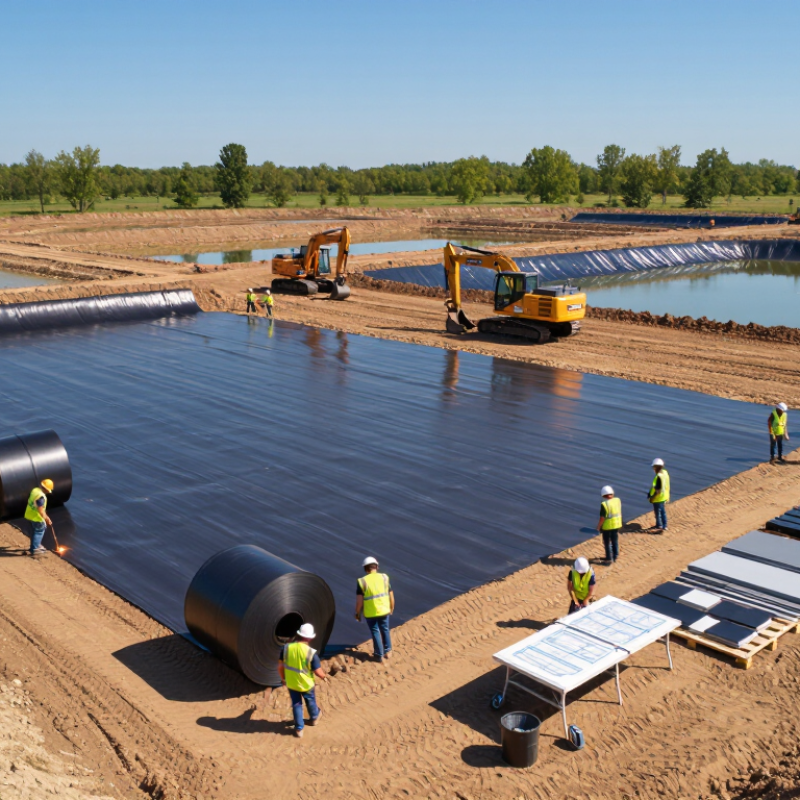
Before comparing HDPE liner thicknesses, define what the barrier must contain and for how long. List the liquid’s chemistry, expected temperature range, sunlight exposure, and contact duration. Record hydraulic head, slope, subgrade condition, and construction traffic. A sharp stone under a loaded track may matter more than a catalog value. Small details matter.
The Geosynthetic Institute’s GRI-GM13 specification gives practical screening benchmarks for HDPE geomembranes. It specifies 2.0–3.0% carbon black and a minimum standard oxidation induction time (OIT) of 100 minutes. These values help assess formulation and antioxidant reserve, but they do not predict service life on their own. Request current, lot-specific test results rather than relying only on a generic product sheet.
Match resin and thickness to measured chemical exposure, temperature, stress, and installation method. Treat seams and penetrations as design details, not afterthoughts. For aggressive liquids, request compatibility testing and review the findings with a geosynthetics engineer. Revisit assumptions after a site walk: plans may miss a wet pocket, uneven grade, or late change to equipment access. That can affect the specification.
Indicative HDPE liner mass per square metre at three commonly specified thicknesses
How to use this: Greater thickness adds material mass, but thickness alone does not determine suitability. Select a liner based on the contained substance, temperature, installation conditions, subgrade, and expected mechanical stresses. Estimates use an assumed density of 0.95 g/cm³; actual product values vary.
Choosing an HDPE liner starts with the site, not the catalog. Thickness influences puncture resistance, flexibility, handling, and cost. A thinner sheet may work on a smooth, carefully prepared pond base. Rough ground, sharp aggregate, or frequent equipment access may call for a thicker liner or protective geotextile. There is no universal best thickness. Match the specification to the soil, stored material, slope, and installation plan. Small details matter.
Resin quality affects how a liner performs over time. Ask for traceable production records and test data relevant to the intended use. Review properties such as tensile strength, stress-crack resistance, and oxidation-induction time. Carbon black dispersion and consistent sheet quality also matter, especially where sunlight exposure is expected. Do not judge quality by thickness alone. A thick sheet made with inconsistent material is not automatically the safer choice.
Performance depends on installation as much as the sheet itself. Poorly prepared ground can create stress points, while weak seams can become leak paths. Check that the crew’s welding procedures and seam testing suit the project conditions. Temperature, wind, and moisture can affect field work. Even a sound specification cannot prevent every installation mistake. In practice, comparisons are not perfectly neat; site conditions can change, and that should prompt a careful review rather than a guess.
Choosing an HDPE liner in 2026 starts with the ground beneath it, not the catalog photo. Smooth liners suit many applications with prepared, stable subgrades. Textured surfaces can increase interface friction on slopes or beneath cover soil. But texture cannot compensate for a weak base. A few sharp stones can still cause trouble. For sloped areas, review shear data for the actual soil, geotextile, and liner combination; texture alone cannot predict stability. Check samples in daylight.
Panel design matters just as much. Large panels can reduce total seam length, yet wind, limited access, and irregular corners may make them difficult to place. Smaller panels can fit around sumps and narrow benches, but create more seams to weld and inspect. Walk the site with the installer before confirming the layout. Mark anchor trenches, drains, penetrations, and equipment routes on the drawings. Field measurements are often less tidy than plans suggest. Allow space for trial seams, repairs, and temperature-related movement. That detail is easy to miss. Specify resin quality, thickness, and testing alongside texture and panel size, so the liner matches both site conditions and installation capabilities.
A good HDPE liner starts with the project conditions, not thickness alone. Identify the stored material, expected temperatures, subgrade conditions, and likely exposure to sunlight. Then compare the liner specification with recognized test methods, such as GRI-GM13 and relevant ASTM procedures. Confirm which edition and requirements apply to your project. A standard is useful only when its tests match real service conditions. Small details matter.
Review more than tensile strength. Ask for documented results on stress-crack resistance, puncture, tear, and carbon black content. Check that the specified thickness suits the site’s risks, including sharp stones or frequent access. I would not treat a thicker sheet as automatically safer; poor support beneath it can still cause damage. No checklist removes every risk.
Installation can determine whether a sound liner performs well. The prepared surface should be smooth, compacted, and free of roots, debris, and standing water. Qualified crews should use suitable fusion-welding procedures and record seam locations and test results. Weather matters: wind, dust, and cold can complicate welding. After placement, inspect seams and repair verified defects before covering the liner. For long-term durability, assess chemical compatibility, UV exposure, drainage, and expected movement from temperature changes. Keep inspection records, and revisit assumptions when site conditions change.
Evaluate Suppliers, Warranties, and Total Lifecycle Cost
Compare suppliers on more than price per square metre. Request resin and production-batch records, independent test results, installation references, and a clear quality-control plan. Check that proposed material properties meet the project specification and relevant GRI-GM13 requirements. A warranty matters, but read its exclusions: installation damage, chemical exposure, and maintenance duties may affect coverage. Ask who handles claims and what evidence is required. Get the answer in writing.
Lifecycle cost includes more than the liner. Add transport, subgrade preparation, welding inspections, repairs, and likely replacement costs. The Geosynthetic Institute’s GRI White Paper No. 6 models HDPE geomembrane service life at about 446 years at 20°C, versus about 90 years at 40°C. These are model estimates, not guarantees; actual performance depends on exposure, material, and installation. Small details matter. A hot, exposed site can change the calculation.
Tips: Compare at least three itemized bids. Ask for seam-test records and a sample warranty claim process. Then check whether the lowest bid still looks low after freight, testing, and maintenance are included. It may not. Also, project cost estimates are imperfect: service conditions and future repair access are easy to underestimate.



For those larger-sized parts, or smaller quantity runs, we have 2 independent powder coat booths and ovens. The quality, durability and affordability of today’s powder coating finishes make this the process of choice for world-class companies.
Powder coating advantages over other forms of coating are many. Materials used in the Powder coating process can be metals and non-metals that come in a multitude of thicknesses, textures, colors, etc. Another of Powder coating’s biggest advantages over conventional coatings is its ability to create finishes in many different textures. Powder Coating Booths allow us the ability to apply these advantages to large products.
Tri-State Fabricators runs a full-service conveyor line for painting. Wet painting can provide protection or decoration to many different part styles. From start to finish, every project is easier to undergo random and point-based inspection by our skilled painting team.
Advantages to our Wet Paint Line are these lines start with product prep and ends with a thorough inspection of a high quality finished product. Our ability to complete large and small projects with a superior finish and doing so in a timely and economical fashion. This passes along the savings in production to our customers. When powder coating ins not an option, our Wet Paint Line gets the job done right the first time.
When the parts get big and heavy we roll-out our custom paint racks and oversize booth. By utilizing our partnerships with all the major paint brands, we can match virtually any color with wet paint.
The advantages of having access to a Wet Paint Booth are many. Large projects of many different shapes can be loaded into the booth. The Wet Paint Booth offers an environment that is much more controlled than a typical parts painting operation.
Not only are they used because of their controlled environment, but they’re are also advantageous when it comes to applying paint to parts that are needed in industries that require specialty coatings such as medical, aerospace, etc.
Our military forces have some very high standards when it comes to the finish of their vehicles and equipment. From the first pre-treatment step to final coat, it takes a great deal of knowledge and experience to protect the men and women of our armed forces. They deserve only the best, and Tri-State Fabricators provides it.
All of our processes are closely monitored by our staff and management teams. Both of which are highly trained in the processes of metal fabrication and finishing. Tri-State Fabricators’ goal is to always fully satisfy each and every customer, including the military. We will always put a 110% into what we do.
Abrasive media blasting is an excellent way to remove old paint, rust, and increase the paint/powder adhesion. Glass beads produce a much smoother and brighter finish than angular abrasives; leaving the part clean yet without any dimensional change. Chemically inert and environmentally friendly, we can recycle our beads approximately 30 times; making them a more preferred method of metal cleaning or surface finishing.
Advantages to Glass Bead Blasting are many. Glass bead blast media is used when a project is needing rough surfaces need to become smooth for applications of coatings such as paint. It is typically used to clean paint and rust from a product surface without deforming the surface it is being used on. Overall, compared to many other blasting media, Glass Bead Blasting is a very economical choice and those savings are always passed on to our customers.
Tri-State Fabricators utilize a zinc phosphate wash to clean and etch the material to ensure the best paint adhesion possible. The unique design of our 3-stage wash system does the work like a 5-stage. From Cleaning and rinsing to conversion coating and post-treatment, Our Part Washing process is a complete service and works throughout the fabrication service and the finishing service.
Along with the previously mentioned benefits, Curing is a vital chemical reaction that leaves the product finish hard and relatively safe from mild abrasion and aggressive corrosion. This process can be done in more than one way; ambient air-dry or in curing ovens at temps that exceed 240°.
From fixing paint mistakes (someone else’s of course) to simply cleaning our paint line hooks, our burn-off oven is put to good use. After a quick burn-off, a little clean up, and a fresh coat of paint, your parts will look better than new.
Why does our Burn-Off Oven work so well? Because super heating the air around parts turns the materials into ashes. From paint and powder coatings to rubber and machining oils, high temps do the job without degrading the integrity of the part.
Masking is a vital part of producing high quality products. We have die-cut masking patterns to protect machined surfaces as well as a wide range of plugs and caps to protect threaded holes and bolts. We provide permanent and temporary masking.
Masking allows the selected sections of a product to be protected from a fabrication or finishing service. This can be with both chemicals when etching and tapes, paints when only finishing just a section of the product. Masking is great in aiding the customization process of a project.
Screen printing is a photographic process that transfers artwork onto a porous nylon screen which allows colored ink to flow through the screen and be deposited on an aluminum or plastic component. We can generally have just about any design created onto a screen for your parts.
Some of the advantages of Screen Printing are, brand recognition for your business displaying on your products, assembly instructions, product warnings/hazards, etc. Tri-State Fabricators produces Screen Printing of the highest quality so you know it’s durable.
Metal Finishing is the art of treating the exterior portion of product, often metal but can also be made of other materials, so that the surface is clean and free of any debris. Then the process of applying coats or either paint of powder coat takes place. This coating process improves the quality of the product in both appearance and resistance to wear and corrosion.
Tri-State Fabricators, Inc., understands that a project typically isn’t complete until a high-quality finish has been added to your product. This is why our painting and powder coating teams continuously inspect the products throughout the Metal Finishing process.


