What Is the Best China SMT Reflow Machine?
Choosing the best China Smt Reflow Machine depends on more than peak temperature or purchase price. The right system must deliver a stable thermal profile across the actual board, components, solder paste, and production rate. IPC’s J-STD-001 and IPC-7530 offer useful industry references for soldering requirements and reflow-process profiling. They help buyers ask sharper questions about measurement methods, process windows, and repeatability. A supplier’s brochure is not a substitute for a profile run on your own product.
Compare oven zones, conveyor width, nitrogen capability, temperature uniformity, energy use, maintenance access, and local service. Ask for profile data at production speed, not only a demonstration with an easy test board. Check whether the supplier explains how thermocouples were attached and where they were placed. Small details matter. A loose thermocouple or an unusually light board can make a promising profile look better than production reality. Industry market reports can describe equipment demand, but they cannot prove that one machine suits your factory.
One caution: no expert quotation or named industry report was supplied with this request, so attributing a quote or precise market statistic would risk inventing evidence. A sound engineering principle is simple: “Choose the oven that repeatedly meets your verified process window—not the one with the most impressive brochure.” Treat this as editorial guidance, not a quotation from a named expert. The best China Smt Reflow Machine is the one your team can validate, operate, and support over time.
What Is an SMT Reflow Machine and How Does It Work?
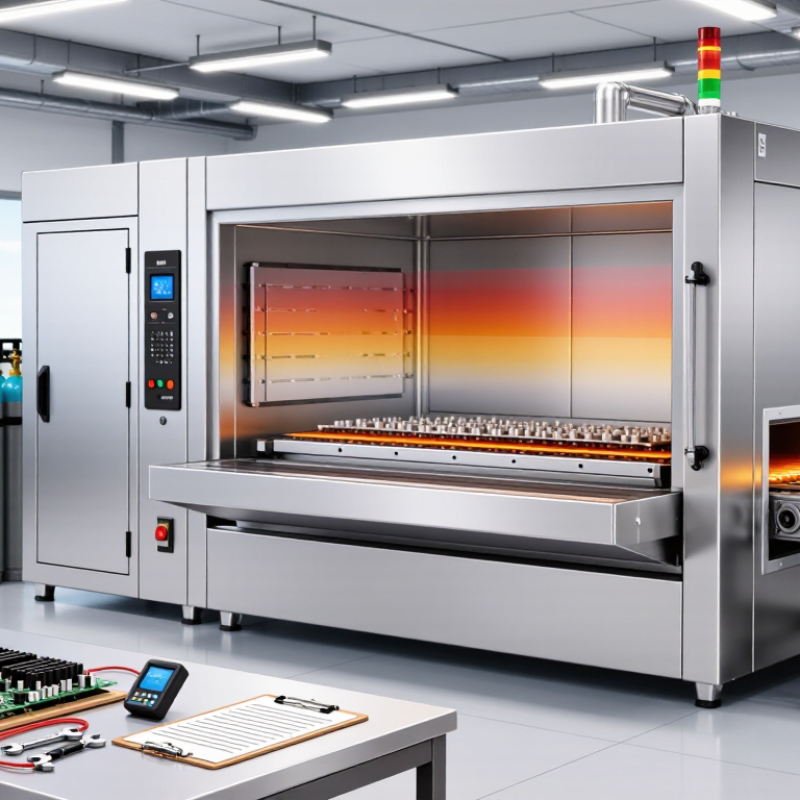
An SMT reflow machine solders surface-mount components by heating printed circuit boards in a controlled sequence. A conveyor carries each board through temperature zones, while fans circulate heated air. Solder paste first softens, then melts around component leads and copper pads. Cooling lets the joints solidify. The result is a board with many connections formed in one pass. Quite precise.
The temperature profile matters more than a single peak setting. IPC J-STD-006 identifies SAC305 solder alloy’s melting range as approximately 217–220°C; the board must heat enough to form reliable joints without overheating sensitive parts. IPC-7530A recommends profiling the actual assembly, because board mass, component size, and oven loading affect heating. In practice, technicians attach thermocouples to test boards and review the recorded temperature curve. A heavy connector may warm slowly, while a small chip heats quickly. That difference is easy to miss. Reflow is repeatable, but not automatic: paste volume, conveyor speed, and airflow all influence results, and a profile that works for one board may fail on another. The standard gives useful guidance, not a universal recipe.
What Is the Best China SMT Reflow Machine? - What Is an SMT Reflow Machine and How Does It Work?
| Topic | Typical Data or Operation | What to Consider |
| What the machine does | Heats a PCB and its solder paste through a controlled temperature profile to melt the solder and form electrical and mechanical joints. | Used after solder paste printing and component placement in surface-mount assembly. |
| Typical heating zones | About 6–12 independently controlled heating zones is common for production equipment; compact systems may have fewer. | More zones allow finer profile control, but the required number depends on board size, throughput, and process complexity. |
| Preheat and soak | The board warms gradually; a soak section may help reduce temperature differences and activate the solder-paste flux. | Set the profile according to the solder-paste supplier’s recommendations and the components’ temperature limits. |
| Reflow and peak temperature | The solder passes its melting point in the reflow zone. Lead-free SAC alloys commonly have a liquidus temperature near 217°C; actual peak settings are profile-dependent. | Confirm peak temperature and time above liquidus using a profiling instrument on a representative PCB assembly. |
| Cooling | Controlled cooling solidifies the joints after reflow; cooling sections and rates vary by machine and process. | Choose cooling capacity that suits the board, throughput, and solder-joint requirements without exceeding component limits. |
| Conveyor and board size | Conveyor width and speed are model-specific; production machines commonly use adjustable rail widths and variable-speed transport. | Check maximum PCB width, edge clearance, board support, conveyor direction, and compatibility with the rest of the line. |
| Convection and nitrogen | Most production systems use hot-air convection. Nitrogen-capable systems can provide an inert atmosphere when the process requires it. | Assess heat transfer, atmosphere control, operating cost, and whether nitrogen is justified for the products being assembled. |
| Controls and monitoring | Zone temperature, conveyor speed, alarms, and stored profiles are typically managed through a control interface. | Look for repeatable settings, data access, over-temperature protection, and clear fault reporting. |
| Choosing the best fit | Match the machine’s usable width, heating capacity, conveyor speed, and profile control to the actual production workload. | Compare installation needs, energy use, maintenance access, local technical support, training, and spare-parts availability. |
Note: Values and configurations are indicative, not universal specifications. Always validate the reflow profile against the solder-paste data sheet, PCB assembly, and component limits.
Which Features Matter Most in a Reflow Machine?
When comparing China SMT reflow machines, focus on process control, not just the number of heating zones. A stable temperature profile helps solder joints form consistently across different board sizes. Ask whether the machine can record profiles and show actual temperatures during a run. Check sensor placement, profile repeatability, and how easily operators can adjust settings. A clear touchscreen is useful, but accurate data matters more.
Conveyor stability also deserves attention. Inspect rail adjustment, board support, and transfer smoothness with your heaviest and narrowest assemblies. Small details count. Confirm the usable temperature range and whether the machine handles your expected board mix without frequent profile changes. Review exhaust management, energy use, and access for routine cleaning. A perfect-looking spec sheet can still mislead. Request a sample run using a representative board, then inspect solder quality and compare the logged profile with your target. Ask about spare-part availability, maintenance instructions, and operator training. These checks may take time, but they reveal practical limits that a brochure cannot.
How Do Chinese Reflow Machines Compare Across Key Criteria?
A Chinese SMT reflow machine should be judged by process evidence, not its control-panel graphics. Compare temperature uniformity across the full belt width, stable conveyor speed, zone control, and repeatability between recipes.
Ask for a thermal profile using your actual board, solder paste, and component load. IPC-7530A provides guidance on profiling mass-soldering processes; it is not a substitute for testing your own assembly.
Small boards may run smoothly, while a dense, heavy board exposes uneven heating.
Energy use and support matter too.
The IEA’s Energy Efficiency 2023 report estimates that industry used about 37% of global final energy in 2022, making efficiency a practical operating concern. Request measured power consumption at your production rate, not just an unloaded figure.
Check exhaust handling, nitrogen control if required, spare-part lead times, and whether local technicians can diagnose faults. Compare actual logs.
A low purchase price can lose its appeal when profile drift causes rework or production stops. I would not rank machines by country alone; configuration and commissioning vary, and a polished demonstration may not reflect a full shift.
Ask for a trial run with representative boards and inspect the temperature records afterward.
How Should You Choose the Best China SMT Reflow Machine?
What Is the Best China SMT Reflow Machine?
How Should You Choose the Best China SMT Reflow Machine?
Start with the boards you actually build, not the largest machine on a supplier’s list. Record board width, component density, throughput, and the solder paste’s recommended temperature profile. Then ask for a thermal-profile test using a representative loaded board. A profile from an empty conveyor tells you little about production conditions.
Check whether the oven can maintain stable temperatures across its width and repeat the profile across multiple runs. Review heating-zone layout, conveyor speed range, exhaust design, and cooling capacity. Ask how temperature sensors are calibrated and how often maintenance is expected. Small details matter. A few degrees of variation can affect joints, especially on boards with mixed component sizes.
Consider service access and operator training alongside purchase price. Request clear documentation, spare-parts lead times, and a demonstration of alarm handling and recipe changes. If possible, bring your own board and compare measured results with the stated specifications. Do not rely on brochure numbers alone. A wider process window may sound reassuring, but verify it against your actual assemblies; this step can be inconvenient, and it is easy to skip. A suitable machine should fit your product mix, floor space, staffing, and planned output—not just today’s target.
Which Industries Use SMT Reflow Machines?
SMT reflow machines are used wherever surface-mounted components must be soldered onto printed circuit boards. Consumer electronics is a major user, from routers and laptops to compact home appliances. A small board may pass through the oven quickly, while a dense power board needs a carefully controlled heating profile. Details matter.
Automotive suppliers use reflow for control modules, sensors, and dashboard electronics. These assemblies can face vibration and wide temperature changes, so stable solder joints are important. Medical-device manufacturers also rely on reflow for monitoring equipment and diagnostic systems. Their boards may be small, but inspection records and repeatable process settings matter greatly. Telecommunications and data-center equipment makers process boards for network switches, optical modules, and power supplies, often balancing throughput with mixed component sizes.
Industrial automation is another common application, including motor drives, programmable controllers, and factory sensors. Some aerospace electronics also use SMT assembly, though requirements vary by product. A suitable reflow machine is not defined by industry alone. Engineers compare board size, component density, solder alloy, production volume, temperature uniformity, and profile logging. Speed isn’t everything. A fast machine may still be a poor fit for a low-volume line or heat-sensitive assembly. Trial runs with actual boards can reveal issues that a brochure cannot. Changeovers still take time, even on well-equipped lines.





